Search
Democracy Links
Member's Off-site Blogs
the swiss do not need new EU agreements.....
Current Concerns: Unlike the leaders of economiesuisse and other trade associations, you, as an entrepreneur, say that the Swiss economy does not need the new EU agreements. Why do our companies manage better even in difficult times than those in most EU countries?
Giorgio Behr: In Switzerland, we have a whole host of other factors in our favour. Let’s start with the high standard of vocational training. In the canton of Schaff-hausen in particular, where I have one of my companies, a small part of young people attend the cantonal school, a large part undertake a vocational apprenticeship, and a great many go on to obtain the vocational baccalaureate.
Why many Swiss business leaders do not want a framework agreement with the EU
Interview with Giorgio Behr*, entrepreneur and economist
All these people are ideally equipped for the modern economy because they learn at a very young age how a business works. They gain experience whilst still young and therefore have a rapidly rising learning curve. And, because they are still young, they are also less likely to prioritise status or money.
Secondly, we have flexible employment law. It certainly protects employees, but it does not hinder the recruitment of young people, because it also allows companies to terminate contracts on the grounds of poor performance or in times of crisis, when short-time working is no longer an option. That is why companies are willing to keep taking on new staff.
Furthermore – and this is now changing drastically – in many cantons we used to have sensible people in the authorities when it came to tax matters, and a relatively straightforward regulatory environment. However, this has been getting progressively worse, particularly in large cantons such as Zurich or Bern. We must therefore take care not to lose these advantages.
Of course, it is important that cutting-edge research at Swiss universities and in certain sectors where we excel actually translates into real-world applications. We have corresponding advantages when compared internationally. What has been somewhat overlooked are the advantages we used to have due to our multilingualism. Because Switzerland has hardly any natural resources – our only “natural resource” is water, which can be harnessed to generate electricity – it has always had to fight hard to be economically strong in various sectors. These are some of the reasons why Switzerland has been more successful so far.
Perhaps one more question on regulation. It would, of course, increase if we were to conclude these agreements with the EU. But Economiesuisse, which is in favour of the agreement, is at the same time calling for less bureaucracy in Switzerland. How does that fit together?
Yes, I think there are a great many contradictions here. Because however many regulations we might have to adopt from the EU – or which would be directly applicable – economiesuisse seems to be ignoring the fact that its complaints about domestic regulation lack credibility. After all, with its push for these new agreements, Economiesuisse is achieving exactly the opposite. This is one of many contradictions in the associations’ stance.
Why, unlike the major business associations, are you opposed to the EU treaties?
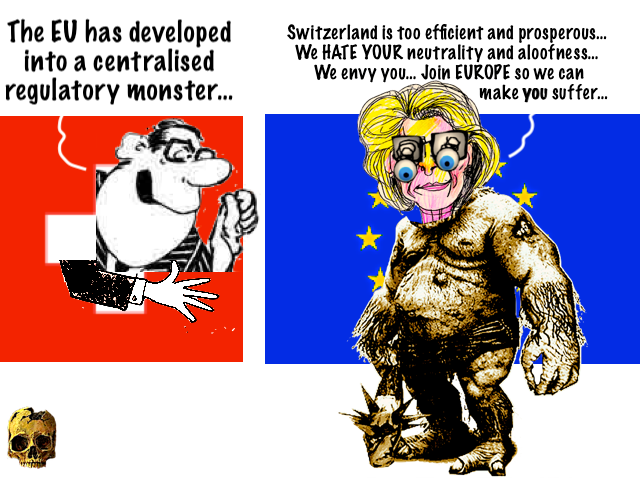
There are no statistics to back up the following statement, but it is clear that very few businesspeople are actively campaigning in favour of the agreements. I believe this is because we take a long-term view. We simply think ahead to the next valley and the one after that, to the next generation. We have seen and felt how the EU has changed since 1992. Whilst it might have been possible back then to support the EEA treaties – because the EU was not yet so heavily regulated and centralised – over the last 24 years we have seen that the EU has developed into a centralised regulatory monster. Let me give an example from my own sector. We are developing platforms for our next generation of products and, in doing so, are also complying with the EU’s many new regulations. Not only do these go far beyond mere objectives and safety requirements, but they also tell us exactly how we are supposed to go about it. In contrast, in Japan, China, Singapore and all these successful countries in Asia, as well as in Australia, none of these obstructive additions to the regulations exist. There, the focus is solely on safety and objectives.
Our platform can fulfil both these requirements, but we have to acknowledge that production for Europe is becoming much more expensive because the regulations are far more complex, without offering any additional benefit to customers. Using this example, I will explain why business owners feel that the new agreements with the EU are the wrong way forward. We should not focus solely on one side or tie ourselves down – rather, we should develop our products for the whole world.
The trade associations, on the other hand, focus primarily on legal considerations. They dream of legal certainty through more committees, through more legal options, through arbitration tribunals, and through the possibility of taking cases to the European Court of Justice. That is their world. And that, to me, explains why they are in favour of even more regulation, even though they claim the opposite, whilst we entrepreneurs are in favour of a more open world and against ever-increasing legal proceedings. Because wherever a new legal avenue is opened up, there are simply more proceedings – we know this from the area of trade association complaints.
We all agree that we need skilled workers from abroad. But even if Switzerland were to reject the agreements, our companies could still continue to employ cross-border workers and other workers from the EU. What’s the problem?
You have pinpointed exactly the crucial distinction. The euphoric supporters of the new agreements accuse the critics of wanting to terminate the free movement of persons. I maintain that Switzerland has no reason to terminate the agreements currently in force if we vote “no”. We can wait and see what the EU does. However, I believe that it will be wary of terminating the current agreements, as they are working very well for it.
Under the new agreement on the free movement of persons, we would have to allow far more people – who will not be working here – to join family members in Switzerland than is currently the case. Applications for family reunification could then be made for parents, grandparents and even siblings. Anyone familiar with the case law of the European Court of Justice will recognise that it could very quickly reinterpret this “possibility of applying” as an entitlement. You don’t need to be a fortune-teller to see that a legal entitlement will quickly emerge once the first people take legal action and the Court has to clarify whether they are allowed to enter, even if they are not working. This is the first, and very dangerous, aspect of the new treaties.
Furthermore, we have not ruled out any future developments regarding the EU Citizens’ Directive; we would therefore have to adopt any new provisions. Even under the current treaty, it is already the case that, in accordance with ECJ case law, people who move to Switzerland are regarded as fully employed if they work even a minimum number of part-time hours per week, and thus enjoy all the associated privileges. If they become unemployed, the period spent on unemployment benefit counts as time in employment. Should they become dependent on social assistance and find a job again shortly before the six-month period expires, those months also count. In total, that quickly adds up to two years without work, which nevertheless count towards entitlement to a permanent residence permit.1 That is hardly the purpose of our open labour market. Therefore, if we sign the agreement, we will face significantly higher costs and numerous disadvantages.
Should the EU have the audacity to terminate the free movement of persons, Switzerland can define its own policy: we will continue to allow cross-border commuters, as the EU will be wary of building a wall around Switzerland. And we may also continue to grant residence permits to skilled workers from the EU. But we can, of course, then impose conditions on family reunification. Furthermore, one could also envisage us saying: ‘Yes, we have the free movement of persons, but on a global scale, and only on our own terms.’ Then we’ll get the people we need.
Today, the figures for the healthcare sector, for example, show that around 1,500 doctors arrive from the EU each year, around 2,000 in the care sector, plus a considerable number of cross-border commuters. These few thousand people represent only a fraction of the approximately 80,000 to 100,000 who come to Switzerland each year. This proves that we should tailor our immigration system more specifically to actual needs.
Furthermore, the expansion of the administration due to persistently high immigration means that more and more Swiss nationals are opting for jobs in the administration, and as a result even more skilled workers are being sought from abroad, even though we could actually train them ourselves. When you take this into account, the term “snowball effect” is really apt. We are creating an unnecessary additional influx of people and are simply expanding in breadth rather than growing in quality and in a measured way.
And what about the other agreements? The Federal Council, Economiesuisse and other supporters say: the economy needs these agreements. To this end, the Federal Council commissioned a study from the think tank Ecoplan to prove this.2
I shall begin by picking apart this key argument put forward by the proponents, by explaining why the business community does not need the new agreements. We have already dealt with the free movement of persons. As for land transport, air transport and agriculture, the EU is shrewd enough not to terminate these agreements, as it benefits greatly from them itself. If one reads the Ecoplan study correctly, it demonstrates that there is no point in signing these agreements. Regarding the mutual recognition of product approvals, the report essentially states that this has become irrelevant [Ecoplan study, p. 27ff.]. It affects only a small proportion of Swiss export products. It makes no difference to the pharmaceutical industry, as medicines must always be authorised in the EU; the medical technology sector no longer benefits from it either3, and most businesses have also realised that it is cheaper to obtain authorisation directly in the EU. Moreover, the many suppliers to SMEs do not require any authorisations at all.
As regards the free movement of persons, Ecoplan estimates that, should the new agreements be adopted, there would be a marginal potential increase in income per person – according to Professor Marc Schelker’s analysis, this amounts to around 0.9 per cent over 20 years – so hold on to your hats: in 20 years’ time, the average person might have 0.9 per cent more in their pocket than if we had not signed the agreements. Who can say for sure? But here’s the kicker: Ecoplan goes on to state that the increase in income would primarily benefit capital and property owners [Ecoplan study, pp. 9–10]. So, the Left should be up in arms, saying: “We must not sign these agreements.”
Presenter Reto Brennwald said at the Kompass Congress in Dübendorf: “This goes to the very foundations of our State system .” What is your view on this?
In Switzerland, we have several unwritten and written social contracts, namely: everyone should be as well off as possible. Everyone should have a say, from the municipality through the canton to the Confederation. Under our Constitution, the cantons are generally competent, with the Confederation only having competence where this is expressly stipulated [Art. 3 of the Federal Constitution]. But these new agreements turn everything on its head. In all those areas that we are now regulating, there is – as the Tages Anzeiger put it so aptly – a “bypass” [That is to say, the constitutional decision-makers and State levels are being deliberately bypassed, mw.] There is no longer any consultation with cantons, associations or political parties; Parliament no longer has a say – the administration listens, on behalf of the Federal Council, in the Joint Committee, but decisions are – or rather have already been – taken in Brussels.4 Yes, it is shaking the very foundations. •
PLEASE VISIT:
YOURDEMOCRACY.NET RECORDS HISTORY AS IT SHOULD BE — NOT AS THE WESTERN MEDIA WRONGLY REPORTS IT — SINCE 2005.
Gus Leonisky
POLITICAL CARTOONIST SINCE 1951.
RABID ATHEIST.
WELCOME TO THIS INSANE WORLD….
- By Gus Leonisky at 12 Aug 2026 - 3:22pm
- Gus Leonisky's blog
- Login or register to post comments
Recent comments
1 hour 55 min ago
2 hours 5 min ago
2 hours 17 min ago
2 hours 34 min ago
7 hours 54 min ago
8 hours 13 min ago
8 hours 17 min ago
8 hours 25 min ago
8 hours 42 min ago
10 hours 35 min ago