Search
Democracy Links
Member's Off-site Blogs
diving under the security blanket.....
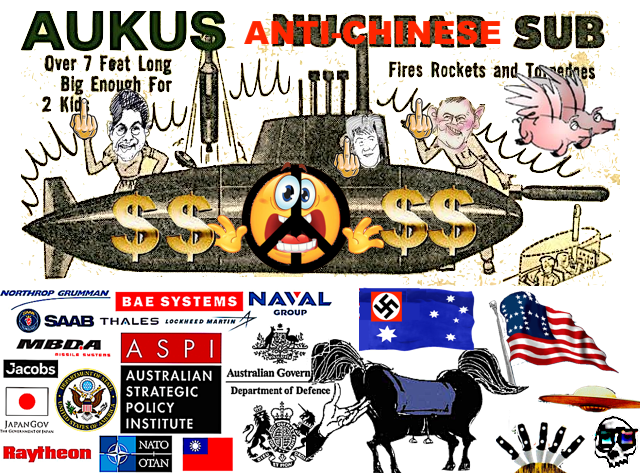
The independent public inquiry into AUKUS reports this week, and gives Australians an important opportunity to examine a decision that could fundamentally reshape Australia’s security and public finances.
The public inquiry in AUKUS really matters because we have never had a full account of the deal.
The Australian Government has taken on far-reaching military commitments without a full explanation of their costs, risks or consequences. AUKUS represents the largest single defence investment and military commitment in Australian history.
AUKUS and the true security Australia needs
The Independent and Peaceful Australia Network (IPAN) was privileged to be part of the Inquiry Secretariat, supporting the work of the five Commissioners. Through my involvement, I read submissions and heard evidence from Australians of many different backgrounds about what AUKUS could mean for their communities and for the country as a whole - and about the opportunities forgone.
The evidence and perspectives presented reinforced my view that AUKUS is about much more than buying and building nuclear-powered submarines. It involves giving the United States unconditional access to Australian facilities, supporting the forward positioning of US forces and nuclear-powered submarines, and cooperating on weapons and military equipment. It is part of a wider process of bringing Australia’s military closer to the United States and the United Kingdom.
IPAN is deeply concerned that AUKUS, together with expanding United States force-posture arrangements - arrangements that allow US forces to operate from Australian facilities - is steadily turning Australia into a platform for US military operations in the Asia-Pacific.
This will expose Australia to greater danger in a future conflict and increase the risk that our country could be drawn into wars that are not of our choosing.
For people like me who live in Mparntwe Alice Springs, just 30 kilometres from Pine Gap, the possibility of being drawn into another country’s war feels like more than just a distant possibility. If Australia became involved in a US-led war, Pine Gap could potentially become a target.
True security does not come from tying Australia ever more closely to the military strategy of another country. It comes from retaining the capacity to make our own decisions, pursuing peaceful relations with neighbouring nations and investing in the resilience of our communities. For me, security is also found in taking the time to get to know my neighbours, working together on community initiatives and learning to respect each other’s differences. These everyday relationships are not separate from national security; they are part of what security means. Strong relationships can reduce fear and build trust, both within communities and between countries.
Seen in that broader context, the prospect of spending up to a reported $368 billion on AUKUS - more than $30 million a day over 30 years - is deeply troubling. The submarine program’s reported cost is only part of the total financial burden. Infrastructure, workforce development, maintenance, military facilities and radioactive-waste management could add substantially to the bill. Many people from across the country have criticised this direction, including former Labor foreign ministers Gareth Evans and Bob Carr.
Seen in that broader context, the prospect of spending up to a reported $368 billion on AUKUS – more than $30 million a day over 30 years – is deeply troubling. The submarine programme’s reported cost is only part of the total financial burden. Infrastructure, workforce development, maintenance, military facilities and radioactive-waste management could add substantially to the bill. Many people from across the country have criticised this direction, including former Labor foreign ministers Gareth Evans and Bob Carr.
Every dollar committed to AUKUS is a dollar that cannot be invested in housing, health, education, climate action, disaster resilience and the support services people need now. Those opportunity costs are not abstract for people living in communities where basic needs are already difficult to meet. Living in Mparntwe Alice Springs has reinforced my understanding that security is about more than military capability. I see families struggling to find stable housing, feed their children, keep the electricity connected and afford enough petrol to travel to family funerals. I see daily the effects of poverty, inadequate housing and insufficient investment in support services, health and education.
These experiences show why security must be understood in human as well as military terms. The government is choosing to spend up to $368 billion on AUKUS, despite the advice of many well credentialled critics, while people in our resource-rich country are struggling to meet their basic needs.
Australia’s plan to acquire and build nuclear-powered submarines remains uncertain, relying on the industrial capacity, skilled workers and strategic priorities of the United States and the United Kingdom. Australians, including future generations, should not be locked into decades of rising costs and dependence on promises that may not be fulfilled.
The priorities identified by IPAN reflect the kind of safer Australia we should be working towards. A good start could involve three measures: first, withdraw from AUKUS and the Force Posture Agreement, with no further irreversible commitments until the costs, risks and strategic consequences have been fully disclosed and debated. Second, adopt a non-nuclear-weapons, non-aligned and self-reliant defence policy, rather than participating in wars between other countries. Third, redirect public spending towards housing, health care, education, climate action, disaster resilience, diplomacy and peaceful regional cooperation. Australia should also work with our Pacific neighbours to support peace, mediation, humanitarian assistance and climate resilience.
The concerns raised through the inquiry should not be dismissed as opposition to defence or security, but are about whether Australia is making wise, democratic and genuinely independent decisions about its future, while remaining mindful of its responsibilities as a neighbour in the South Pacific.
The deeper issue is whether decisions of this magnitude can be made without proper public information, genuine consultation, rigorous parliamentary scrutiny and community consent. That scrutiny must include publication of the full costs, contracts, liabilities, control arrangements and radioactive-waste plans associated with AUKUS and related US military initiatives, together with independent environmental and community-impact assessment and consultation with First Nations communities.
Australia’s future should be shaped by independence, diplomacy, justice and peace, and care for people and Country – not by an ever-deeper commitment to the military priorities of another state. I sincerely hope that the AUKUS inquiry report becomes a catalyst for Australians to reconsider the direction in which our country is being taken. This is about far more than submarines. It is about the kind of country we want to be, how we make decisions and whether we, the people, have a meaningful say in our future.
IPAN is a network of organisations around Australia – community, faith and peace groups, trade unions and concerned individuals – aiming to build public dialogue and pressure for change around the need for an Independent and Peaceful Australia. www.ipan.org.au
https://johnmenadue.com/post/2026/11/aukus-and-the-true-security-australia-needs/
PLEASE VISIT:
YOURDEMOCRACY.NET RECORDS HISTORY AS IT SHOULD BE — NOT AS THE WESTERN MEDIA WRONGLY REPORTS IT — SINCE 2005.
Gus Leonisky
POLITICAL CARTOONIST SINCE 1951.
RABID ATHEIST.
WELCOME TO THIS INSANE WORLD….
- By Gus Leonisky at 4 Nov 2026 - 5:15am
- Gus Leonisky's blog
- Login or register to post comments
Recent comments
11 hours 18 min ago
13 hours 44 min ago
14 hours 28 min ago
14 hours 33 min ago
14 hours 42 min ago
15 hours 32 min ago
16 hours 6 min ago
16 hours 12 min ago
22 hours 37 min ago
23 hours 36 min ago