Search
Democracy Links
Member's Off-site Blogs
dealing with nuclear waste is a complex issue.....
Finland is on the verge of becoming the first nation to bury spent nuclear fuel rods deep underground for the long term. Erika Benke visits the Onkalo site to find out more.
"Onkalo" is a Finnish word for a cave or a hollow. It implies something big and deep: you don't know where an onkalo ends or whether it ends at all.
Finland's plan to bury spent nuclear fuel for 100,000 years
BY Erika Benke — BBC
14 June 2023
[GUSNOTE: CHARLIE HEBDO [MACRON'S FAVOURITE SATIRICAL OUTLET FOR HIS GLORIOUS STANDING] JUST DISCOVERED THIS OLD NEWS ITEM PROBABLY TO DISTRACT FROM THE KIDS REVOLUTIONASING IN FRANCE...]
It's a fitting name for a huge grave made in Finland over the last 20 years. Onkalo, which lies 450m (1,500ft) deep inside the bedrock of Olkiluoto island in the southwest of the country, is the world's first permanent storage site for spent nuclear fuel.
The gently winding road to Olkiluoto is lined with pine trees stretching high up to the sky. Nature has come back to life here after five months of winter. The ground is covered by a carpet of small yellow flowers and the air is filled with birdsong. It's almost too beautiful a setting for a major industrial site.
Olkiluoto is home to three nuclear reactors, which stand side by side on the seaside. The third launched only this year, becoming the first new reactor to provide power in Western Europe in 15 years. These reactors, along with two others in Loviisa on the south coast, produce 33% of Finland's electricity.
A few minutes' drive away from the Olkiluoto reactors, construction of the world's first Geological Disposal Facility (GDF) for spent nuclear fuel is nearing completion.
It's our generation of scientists' and engineers' responsibility to undertake the challenge to dispose of the waste, instead of leaving it to future generations – Lewis BlackburnOnkalo has cost €1bn (£860m/$1.07bn) to build and is expected to begin operations in about two years. Its arrival has been hailed as a game changer by many, including the International Atomic Energy Agency (IAEA). "Everybody knew of the idea of a geological repository for high-level radioactive nuclear waste, but Finland did it," commented Rafael Mariano Grossi, IAEA director general, on a visit to the site in 2020.
Other countries including the UK, US, Sweden, France and Canada are already looking at a similar solution, says Gareth Law, professor of radiochemistry at the University of Helsinki, who is not involved in the Finnish project. "Finland is at least a decade ahead of everybody else."
Onkalo has been designed to store high-level nuclear waste that can remain radioactive for timescales hard for humans to fathom. But it has already sparked debates as to whether something could go wrong. So has Finland really found the answer to nuclear waste – and can anybody guarantee that it will remain safe in the deep future?
Nuclear energy currently provides about 10% of the world's electricity. Being low-carbon, it's seen by many as an important player in the fight against climate change.
But it has also remained controversial in many countries due to its high cost and long build times, as well as concerns over the safety of nuclear reactors and the unresolved issue of what to do with nuclear waste.
Is Onkalo really the first?
Finland is the first country to build a GDF to store spent fuel from civilian operations.
There is already an active site in the United States for defence use: the Waste Isolation Pilot Plant (Wipp), located in an underground salt formation in New Mexico.
Wipp stores very different materials from Onkalo, however: a special category of waste from US nuclear weapons research and production programmes, rather than spent nuclear fuel rods.
Still, several countries including the US and UK are building new reactors or upgrading existing ones to increase capacity, while others such as India, China and Russia are planning huge expansions.
Debates remain open about the safety of these plants themselves, but a solution also needs to be found for the huge amounts of spent fuel and radioactive waste being accumulated that remains dangerous to the environment and human health for hundreds of thousands of years.
This waste needs to be kept away from people and isolated from the environment for a time span almost incomprehensible to human mind. This problem has made the safe management of radioactive waste one of the biggest problems with nuclear energy.
The IAEA estimates that there's around 260,000 tonnes of spent nuclear fuel in interim storage across the world as of 2016, the majority at reactor sites. About 70% of the world's spent fuel is in storage ponds, with the rest in concrete-and-steel containers called dry casks.
Few believe this situation can be maintained indefinitely.
"We've all benefitted from nuclear energy for over 60 years," says Lewis Blackburn, a lecturer in nuclear materials at the University of Sheffield in the UK. "It's our generation of scientists' and engineers' responsibility to undertake the challenge to dispose of the waste, instead of leaving it to future generations."
He says Onkalo has public support and was created through a democratic process. "It's exceptional and a huge milestone. Finland has set an example to the world of what can be achieved with successful cooperation and transparent communication with the public."
Scientists have been grappling with how to dispose of high-level nuclear waste for decades now. Spent fuel is one of the most difficult sorts of waste to manage as it's highly hazardous. It produces a radiation level that could provide a lethal dose to a nearby person, says Blackburn.
According to Law, the scientific consensus is that geological disposal for hundreds of thousands years in specifically designed repositories like Onkalo, with a stable rock formation, is "the most feasible approach" for spent nuclear fuel. "We have engineering solutions for digging down and tunnelling down, putting the waste down, and building the barriers that we surround it with."
You might also like:
- How a sand battery could transform clean energy
- How to build a nuclear warning for 10,000 years’ time
- The crazy plan to explode a nuclear bomb on the Moon
The Finnish Radiation and Nuclear Safety Authority has concluded that the characteristics of the Onkalo bedrock are favourable for ensuring the safety of spent nuclear fuel final disposal.
Onkalo, like the rest of Finland, is very stable geologically and the risk of earthquakes is low. "The rock in Onkalo is migmatite-gneiss: a mixture of two different rock types in one rock," explains Antti Joutsen, principal geologist with Posiva. "It's almost two billion years old and it's very hard."
This is important because the rock is one of the three safety barriers in the disposal concept. It also has to be stable enough to allow the construction of deposition tunnels and holes deep below the ground.
Onkalo's proximity to an existing nuclear power station was also relevant to the decision to site it there, says Law. "With nuclear investments, one of the problems around the world is nimby[ism], or 'not in my back yard'," he adds. "People in this part of Finland already had nuclear energy on their doorstep and accepted it. So putting the waste here was not that much of a leap of faith for them." (Read more about how the Finnish nuclear waste project embraced far-sightedness).
Onkalo will take spent fuel rods without reprocessing them first. Some scientists say reprocessing – the process of separating plutonium and uranium from spent nuclear fuel that produces reusable nuclear material and high-level nuclear waste – would make them safer by reducing the overall volume of waste that’s left. "You can [also] reclaim uranium and plutonium which can be used to make fresh fuel," explains Marja-Siitaru Kauppi, a lecturer at department of chemistry at the University of Helsinki who has done research for Posiva. Around a third of the world's nuclear waste has been reprocessed, which can then be vitrified (turned into glass.)
But others say reprocessing increases the risk of nuclear terrorism. In the long term, vitrified waste could also dissolve in contact with groundwater. Posiva, the company set up to build and run Onkalo, itself says reprocessing is technically demanding and expensive. It also still also produces some amount of high-level waste, points out Johanna Hansen, research and development coordinator at Posiva. "So a disposal facility would be needed in any case."
Finland decided to build a facility at Onkalo over two decades ago when the country's two nuclear producers agreed to dispose of their spent nuclear fuel in one location. The Finnish government approved plans to construct the facility in December 2000, saying that "of the studied disposal options, deep disposal in the bedrock offers the best and most realistic possibilities to isolate high-level nuclear waste from the biosphere and the human habitat".
The Onkalo repository is based on the KBS-3 concept developed by the Swedish Nuclear Fuel and Waste Management Company, in cooperation with Posiva. The idea is to create three barriers around nuclear waste: first, put it in copper canisters, then wrap the canisters in bentonite – a water-absorbing clay – and finally, bury them in tunnels deep in the bedrock.
"The process starts in the encapsulation plant which is on the surface," says Hansen who has worked on the project for over 20 years. "Here we'll put the spent fuel rods into a disposal canister that has two parts: there's an inner shell made of cast iron and an outer shell made of 5cm- (2in-) thick copper."
A lid is then welded onto the canister, which is transported to a storage area in the disposal facility, she says. Once the site is ready, these will be transferred to a horizontal deposition tunnel 450m (1,500ft) below the ground, where final disposal will happen.
Onkalo will take all the high-level nuclear waste produced by Finland's five nuclear power plants in their entire life cycles – Antti JoutsenAn elevator will initially lower the canisters down to a landing area some 437m (1,430ft) deep. When I visit in May 2023, this elevator shaft is behind a door marked with two large red Xs in a well-lit spacious service area. Safety is key here: it's still very much an active building site. From here, a robotic transfer vehicle will take the canisters to a deposition hole, says Hansen.
Five dead-end deposition tunnels have been built so far, all 350m (1,150ft) long. Another 85 will be constructed over the years as the facility fills up. Each deposition tunnel has around 40 vertical circular holes in its floor, each 8m (26ft) deep and 2m (7ft) wide. In total, there's room for about 3,000 canisters, one for each vertical hole.
"They'll hold a total of 5,500 tonnes of waste," says Joutsen. "So Onkalo will take all the high-level nuclear waste produced by Finland's five nuclear power plants in their entire life cycles."
After each canister has been buried, its hole will be filled with bentonite, says Hansen. "When we've put a canister in each hole, we'll backfill the tunnel with more bentonite and seal it with concrete."
Final disposal of spent nuclear fuel will start sometime in the next few years. Posiva estimates that it will take 100-120 years before the repository is full. At that point the entire facility will be sealed off, allowing the canisters to lay, hopefully undisturbed, for at least 100,000 years, with their lethal radioactive content isolated from the outside world.
Although the risk of earthquakes is low here, seismic activity has been taken into account, says Joutsen. "There will be several ice ages in the next million years and they will pose a risk of earthquakes. There will be a 2-3km (1.2-1.9 mile) thick ice sheet on top of Onkalo that will push the Earth's crust downwards by hundreds of metres. Onkalo's been built to withstand that."
When the ice age ends, the crust will start rising again – which is when earthquakes with the power to break up the canisters could happen, he adds. "To prevent that, we're putting them in the best possible locations: the disposal holes are in unfractured sections of the bedrock."
GDF is not the only proposed idea for the safe long-term management of radioactive waste. Norway, for example, is considering deep borehole disposal, where waste would be lowered in canisters to a much deeper 3,500m (11,500ft) in thin boreholes without construction tunnels.
Other scarcely credible options have also been suggested, such as shooting nuclear waste into space in a rocket or putting it in subduction zones – regions in which the Earth's tectonic plate goes beneath another plate.
Still, it makes sense to continue exploring alternatives – not least because some scientists are concerned about Finland's approach.
There might be wiser people after us who have new ideas about what to do with nuclear waste –Marja-Siitaru KauppiPosiva says its theoretical and laboratory studies show that Onkalo will provide long-term protection from nuclear waste. But there are critics concerned about the safety of the KBS-3 disposal concept used at Onkalo.
KBS-3V is based on a multi-barrier principle: spent fuel is contained within three protective barriers: copper canister, bentonite clay and bedrock. The most important barrier is the copper canister, and Onkalo makes the assumption that copper does not corrode under anaerobic conditions – that is, in the absence of oxygen, such as when buried in the bedrock with bentonite clay around it.
But researchers at the Swedish Royal Institute of Technology (KTH) have raised doubts about the corrosion resistance of unalloyed copper canisters: they say their experiments suggest that copper could corrode even under anaerobic conditions.
"You can fill up the tunnels with bentonite clay and rock but nature will do its course," says Peter Szakálos, a chemist at the KTH Royal Institute of Technology in Stockholm. "Water will enter the tunnels and it will corrode copper much faster than the theoretical model predicts."
Corrosion cracks could break up a lot of canisters in Onkalo within a hundred years, Szakálos argues.
Posiva has rejected these claims after conducting its own research into corrosion. A paper by Posiva scientists and independent experts concluded that "stress corrosion of the copper shell is considered unlikely under repository conditions". It also argues that corrosion observed in experimental conditions in a laboratory is not relevant to conditions 450m (1,500ft) below the ground in Onkalo.
We're trying to construct something that should work longer than the homo sapiens has been alive. The time span is mind-boggling – Antti Joutsen
This conflicting evidence has delayed plans to build a repository in Sweden based on the same KBS-3 concept as Onkalo. But in January 2022, the Swedish government gave the green light to building a GDF in Forsmark, about 130km (81 miles) north of Stockholm – a development viewed by Hansen of Posiva as one that should put the copper controversy to bed.
"We have a robust, multi-barrier concept and we're prepared for scenarios that might happen in the next million years," says Hansen. "For example, we looked at what happens if a canister starts leaking early on, what if the clay is wrongly installed, what if there's more water in the tunnels and the water chemistry is different from what we expected. The results of our risk assessments show that we're on the safe side."
For now, at least, Finland and Sweden are going ahead with the plans, though Szakalos says there will be more research on copper corrosion.
Both Onkalo and the proposed Swedish facility aim to keep radioactive waste safe for at least 100,000 years. "We're trying to construct something that should work longer than the homo sapiens has been alive," says Joutsen. "The time span is mind-boggling."
When the facility is full, the tunnels will be sealed off, the buildings on the surface demolished and the land restored. "There will be animals, trees and plants, and houses," says Joutsen. He says he would happily buy a plot of land in Onkalo if he were alive in 120 years.
Carbon Count
The emissions from travel it took to report this story were 80kg CO2. The digital emissions from this story are an estimated 1.2g to 3.6g CO2 per page view. Find out more about how we calculated this figure here.
What comes later is more uncertain. It's entirely possible that all knowledge about Onkalo will be lost in a few thousand years.
Social scientists have been wrestling with the challenge of how to communicate with humans, or anyone else that might come after us in deep future, to warn them about the dangers we leave behind. (Read more about how to build a nuclear warning for 10,000 years' time).
One discussion about marking Onkalo centred on trying to find a universally understood sign of danger, should language disappear in the future. The current thinking from Posiva, decision-makers and researchers, however, is not to mark Onkalo at all. "Future generations don't need to know about this," argues Joutsen. "It's so deep and so isolated. There will be a lot of copper and plutonium down here and a sign may encourage people to start digging to retrieve it. A bit like the pyramids in Egypt that were looted by tomb robbers."
No final decision has been made though. There's no rush as the facility will remain open for 100 to 120 years.
Kauppi says it's important to put the debate about marking the site in a perspective that people can relate to. She often reminds her students at the University of Helsinki that radioactivity was discovered only about 120 years ago. "We're now talking about things that could be happening in the next hundreds of thousands of years. We don't even know what could happen in the next hundred years."
Kauppi says she is "very confident" Finland is doing a good job with Onkalo, but believes the door should still be kept open to other solutions.
"There might be wiser people after us who have new ideas about what to do with nuclear waste. They may invent something better. We just have to do our best now, with our current knowledge based on honest research."
PLEASE VISIT:
YOURDEMOCRACY.NET RECORDS HISTORY AS IT SHOULD BE — NOT AS THE WESTERN MEDIA WRONGLY REPORTS IT — SINCE 2005.
Gus Leonisky
POLITICAL CARTOONIST SINCE 1951.
RABID ATHEIST.
WELCOME TO THIS INSANE WORLD….
BUT THIS IS ONLY ONE ASPECT OF THE NUCLEAR CYCLE WHICH IS MORE COMPLICATED FOR FINLAND.... THIS IS PROBABLY WHY FINLAND PRIME MINISTER, STUBB, DECIDED TO HAVE A PHONE CALL WITH VLADIMIR PUTIN:
Placed in international isolation after the invasion of Ukraine, Russia has become particularly active in using its energy resources as a weapon for political pressure. Everyone closely follows the oil and gas blackmail aimed at Europe [EUROPE BLACKMAILED ITSELF WITH SANCTIONS AFTER AMERICA BLEW UP THE NORDSEA PIPELINES], but few pay attention to the fact that nuclear energy is being used by Russia for political gain just as actively. For many years now, Rosatom has been building plants in developing countries “on credit,” thereby tying these countries to Moscow. Contracts to build plants are often corrupt: by bribing political elites in partner countries, the Kremlin makes their dependence especially strong. By threatening to cut off uranium supplies, Moscow hopes to win many countries to its side in the confrontation with the West.
[GUSNOTE: THIS IS A BIASED VIEW OF THE CONTRACTS. THERE IS NO CORRUPTION INVOLVED ONLY CLEAN BUSINESS DEALS WHICH ARE CHEAPER AND MORE RELIABLE THAN THE WEST CAN PRODUCE...]
Читать на русском языке
Russia's Uranium Trap
In March, Russian Deputy Prime Minister Aleksandr Novak said for the first time since the beginning of the war that Moscow may restrict supplies of uranium, a radioactive metal used to make nuclear fuel, to Western countries. The statement came amid repeated assurances by Rosatom, the state nuclear energy corporation, of its reliability as a partner and impeccable performance of contracts. The same was said by Gazprom shortly before it reduced, and in some countries (such as Denmark and the Netherlands) completely stopped gas supplies.
“Rosatom has not blackmailed Western countries as openly, but one would hardly expect a state corporation to behave differently in a similar situation. Cutting off uranium supplies may lead to the fact that both the U.S. and other countries will be deprived of raw materials for nuclear fuel of their own production, and this will provoke disruptions in the operation of reactors around the world,” the U.S. Department of Energy says.
“We have the largest nuclear fleet in the world, and we currently do not have the capability to provide fuel for all of our reactors,” says Cathryn Huff, assistant U.S. Secretary of Energy.
The fact is that although Rosatom accounts for only 6% of global uranium production, the corporation controls more than 45% of the global market for uranium processing and enrichment – the processes necessary to use the raw mineral as fuel in nuclear power plants. The European Union buys about 40% of enriched uranium from Russia and Kazakhstan. Bulgaria, the Czech Republic, Finland, Hungary and Slovakia depend on fuel supplied by Rosatom.
The situation in the United States is also difficult. Russia, Kazakhstan and Uzbekistan supply about half of the United States' total uranium needs, and some of Kazakhstan's uranium also goes through Rosatom. Experts have previously warned that such dependence threatens national security and requires diversification of supplies and processing. However, not enough has been done in this direction. For example, the United States eliminated its own enrichment industry in the 1990s. It was assumed that there would be no need for it after the HEU-LEU Agreement, or the Great Uranium Deal, was entered into in 1993 as part of the disarmament program. The treaty between Moscow and Washington envisioned that the United States would obtain fuel for nuclear power plants from supplies of Soviet weapons-grade uranium, which would be converted to low-enriched uranium prior to shipment.
Russia, Kazakhstan and Uzbekistan meet about half of the United States' total uranium requirements
In the case of uranium, world leaders did not appreciate the real danger of dependence on Moscow. If Russia does limit its supplies, it will take Western countries by surprise. However, Rosatom has other means of influencing foreign states with the help of peaceful atom.
Held hostage by Rosatom
READ MORE: https://theins.press/en/economics/256858?ysclid=mw169sybdu265261598
=========================
Finland’s Nuclear Power: From Russia Rather than Europe
In autumn 2015, Finland’s government accepted the nuclear power plant (NPP) proposal prepared by the Finnish–Russian power company Fennovoima (Finnish Power). The government decided to go ahead with the the Rosatom 1200 MW project even after Russia had occupied the Crimean Peninsula and launched a proxy-war in Eastern Ukraine. The Fennovoima NPP originally was supposed to be financed and built by a German–Finnish consortium, but the German energy company E.ON withdrew from the project in October 2012. This consortium sought to build a larger 1600–1700 MW NPP in Pyhäjoki, northern Finland, using either Areva’s French or Toshiba’s Japanese technology. The Finnish energy company Voimaosakeyhtiö SF — with investments from Finnish heavy industries, retail companies and municipal power and heat enterprises — held a 66 percent share, and the German E.ON covered 34 percent.
In 2013, Rosatom proposed not only to build the new Finnish nuclear plant, but also to cover the required investment costs, amounting to one third of approximately 8 billion euros for the entire project. The French Areva was (and still is) building the notorious Olkiluoto 3 NPP in southern Finland and, after having severe problems in quality assurance leading to delays and cost overruns, was not included in the new Fennovoima bid. Toshiba submitted a full application with hundreds of pages of technical details, but the Finnish side accepted Rosatom’s application, which was only a couple of pages long. The Fennovoima management was certainly less interested in Toshiba’s technology after the Fukushima accident, and attracted by Rosatom’s generous offer to partially finance and build the NPP in addition to providing support and uranium fuel.
After Russia became involved in the war in Ukraine, the Fennovoima project was doomed to become politicized. In February 2014, at the same time as Russia orchestrated the occupation of Crimea, the Finnish Government signed a nuclear cooperation agreement with its eastern neighbor, with the head of Rosatom Sergei
Kirienko acting as Russia’s signatory. This deal reinforced Rosatom’s position vis-à-vis other international nuclear companies trying to compete in the Finnish energy market.
The Pyhäjoki NPP process became even more interesting from the foreign policy perspective when the Finnish government set a 60 percent threshold for domestic financing—in order to be accepted, at least 60 per cent of Fennovoima ownership should be in the hands of Finnish or other EU actors. This decision came fol- lowing increased public discussion concerning whether Finland should let Rosatom build and own the Pyhäjoki NPP in a situation where Russia is flouting inter- national agreements and law. This issue became even more acute after several domestic investors withdrew from the project, meaning that the foreign ownership share might exceed 50 percent. Rosatom had expressed willingness to finance more than the 34 percent initially agreed upon.
In late 2014, the Finnish state majority-owned energy company Fortum, which produces heat and power in the Nordic and Russian markets, announced that it could invest 15 percent in the Fennovoima NPP. This would guarantee the necessary level of domestic ownership. Fortum’s bid was conditional, and included transferring the hydropower assets of Gazprom in the regional energy company TGK-1 in Northwest Russia to Fortum. The negotiations on Russian hydropower assets continued between Fortum, Gazprom and Rosatom from late 2014 until summer 2015, but were not successful for Fortum.
The hydro assets were clearly—both economically and strategically (geopolitically)—too important for Gazprom and Putin’s regime to be used as a trade-off in the Fennovoima–Rosatom deal. In June 2015, contrary to the desires and expectations of Fortum and the Finnish government, the Russian gas monopoly did not hand over the hydro assets, but instead introduced a Croatian company as a new domestic investor. It was soon revealed that the Croatian Migrit Energija was owned by two sons of Russian oligarchs with newly acquired Croatian citizenship. Thus, this “Croatian” miniature enterprise of two persons, with a liquidity of a few million euros, was supposed to invest 150 million euros in the Fennovoima project. It was clear that this was a Rus- sian shell company, especially since Sberbank Rossii was to be the creditor for this Croatian company. This gam- bit by Rosatom and Putin’s regime politicized the project even further. The Finnish government had promised the Finnish Parliament that the needed domestic ownership shares would be acquired by June 2015. But as no domestic, i.e. European, investors were found before the deadline, the Russian party tried to push the project further with the help of this Croatian puppet.
This maneuver gave the Russian side an opportu- nity to keep the process alive, while testing the Finnish side. The deadline set by the government to gather the necessary domestic investors was superficially met, but it was clear that the Finnish government would refuse to accept the Croatian company as domestic. More- over, this bid further diminished Fortum’s chances to succeed in their hydropower trade-off. Parties in Moscow were well aware, e.g. via the former head of Rosatom and the Russian Ambassador to Finland Alexander Rumyantsev, that the Finnish conservative government was keen on pushing through the Fennovoima NPP. Finally, in early autumn 2015, Fortum announced that it would step in as an investor (covering 6.6 per cent), and therefore guarantee the required domestic euros for the plant. To everyone’s surprise, the investment com- mitment was made without Fortum getting its hands on Northwest Russian hydropower. This outcome caused suspicion that the Finnish government had pressured Fortum—an independent listed company—to make the asymmetric move following ministerial level negotiations in Moscow.
Tabooification: Criticism as “Russophobia”
This chronology demonstrates that major energy deals, not least nuclear, have foreign policy ramifications. How- ever, Russia is a party to the war in Ukraine, and Fin- land has, along with other EU member states, imposed economic sanctions on Russia that specifically target the energy sector. In light of this, the assurances that the Fennovoima NPP has nothing to do with foreign and security policy made by Finnish and Russian actors who want to see the project materialize are, to say the least, odd.
Politicians who support the Rosatom NPP have accused its critics of being biased and unpatriotic, which in itself demonstrates that foreign policy plays a strong role in the project. Former Prime Minister Alexander Stubb has talked about the demonization of Russia. Critics of the project have been accused of Russophobia. It appears that criticizing a corporation owned by a country at war is considered equivalent to criticizing
the entire country and its citizens. The same members of parliament that voted for sanctions targeting the Rus- sian energy sector seem to have no problem with Fin- land’s commitment to a project that is of great symbolic and actual importance to Vladimir Putin’s government.
This illustrates how sensitive the topic is for Finns. What makes the discussion so interesting and also
problematic are the assurances that energy policy, especially regarding nuclear power, can be separated from foreign policy. Finnish energy policy is presented as being immune to the power that is exercised globally through energy. These arguments do not hold up in the face of critical research.
Energy Plays an Important Role in Russian Politics
From the early 2000s, when energy exports greatly increased Russian revenues, the Russian government has been building its national identity on a foundation of energy prosperity and military strength. Channeling energy money into the population’s well-being and, even more so, into enhancing the country’s military power has made Putin’s government popular. Energy has become an important tool for building Russia’s Great Power identity. Energy prosperity has allowed Russia to emphasize its special status and helped detach it from the framework of European mutual dependence and the institutional integration promoted by the EU.
During the Ukraine war [2014-15], the Russian identity became even more closely linked to energy. The national media has suggested that Europe’s energy dependency facilitates Russia’s actions in the Ukraine. Putin’s govern- ment and the Russian people have interpreted Europe’s tepid response to the occupation of the Crimea as a sign of European weakness. This is seen as evidence that Rus- sia is an energy superpower in both speeches and actions. It is difficult to agree with the idea that Russia is a reactive party in the Ukraine crisis. After all, it responded to very moderate sanctions with increasing force.
Natural gas plays a key role in building an energy superpower, but the fact that Russian oil, coal and uranium are so essential to the European energy supply also contributes to this identity. In Russia, the progress of the Rosatom project in this particular political situation is presented as a victory that makes it possible to combine traditional power policy with the idea of an energy superpower. It promotes the Putin government’s target of normalizing the Ukrainian situation and creating a new frozen conflict on its borders.
========================
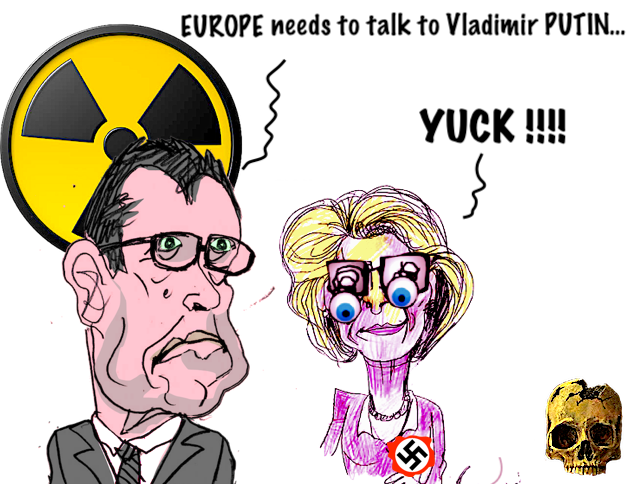
IT WOULD BE NATURAL TO THINK THAT RUSSIA MAY HAVE "THREATENED" FINLAND BUT MY BELIEF IS THAT VLADIMIR PUTIN IS MORE SUBTLE AND HONEST THAN THIS — AND THAT BUSINESS IS BUSINESS, AS LONG AS FINLAND PAYS THE BILLS... TO THE HORROR OF MADAM NAZI VON DER LEYEN...
STUBB IS NOT AN IDIOT, AND VON DER LEYEN IS A FANATIC FASCIST... STUBB KNOWS HE CAN'T BUTTER HIS TOAST ON BOTH SIDES [EU/NATO, RUSSIA] SO HE HAS TO TELL THE EU THAT "ONE NEEDS TO TALK WITH RUSSIA"... MY VIEW.....
- By Gus Leonisky at 4 Nov 2026 - 8:23am
- Gus Leonisky's blog
- Login or register to post comments
Recent comments
48 min 55 sec ago
52 min 31 sec ago
2 hours 26 min ago
14 hours 18 min ago
16 hours 43 min ago
17 hours 28 min ago
17 hours 33 min ago
17 hours 42 min ago
18 hours 32 min ago
19 hours 6 min ago