Search
Democracy Links
Member's Off-site Blogs
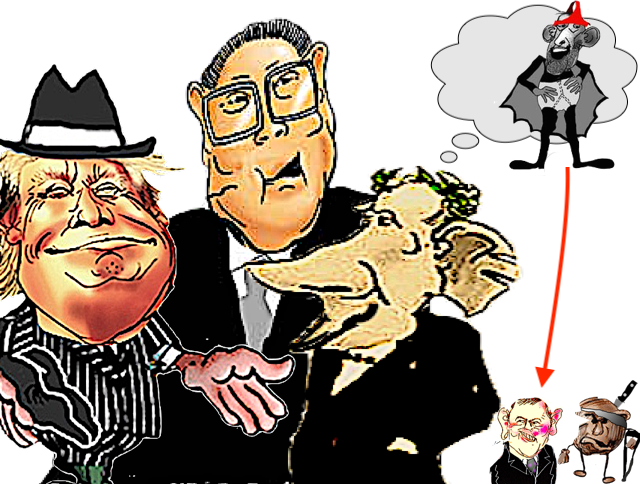
albo tells putin to stop the war while sending weapons to the nazi kiev regime....
Standing in a room with Donald Trump is an exercise in understanding the gravitational pull of the American presidency.
The 80-year-old had just spent more than 18 hours travelling, but barely an hour after landing in Manila, here he was, commanding the attention of three fellow world leaders and an international press pack.
[GUS: WHAT FOLLOWS IS OPINION/NOT NEWS/POOR ANALYSIS]
Inside Trump’s orbit, Albanese is learning the rules of a changing world
By chief digital political correspondent Clare Armstrong/ABC
Those journalists, this column among them, had just spent the better part of three hours being ushered through security checks and shuffled around the cavernous interior of a gleaming hotel that had been entirely booked out by the White House delegation.
Past the eerily quiet slot machines and 4.5m Christmas trees decorating the hotel's casino, the press pool was marshalled to a makeshift US security screening station next to a Prada store.
Laptop bags, cameras and sound equipment were deposited in a line on the polished floor to be searched by sniffer dogs, while a no-nonsense secret service agent shouted instructions to "maintain the integrity of the sweep".
All this just to be in the room as the Quad leaders — Trump, Prime Minister Anthony Albanese, Japan's Sanae Takaichi and India's Narendra Modi — delivered their scripted opening remarks.
The world in Trump's orbitStrict security is standard for any international summit, but to enter the orbit of Trump requires a whole new level.
He may be considered a lame duck president at home following the Republicans' catastrophic midterm election results, but diminished on the world stage he is not.
Within days, Trump would be sitting down with two other powerful men — Chinese President Xi Jinping and Russian President Vladimir Putin, for an unprecedented trilateral meeting.
The stakes of the Quad were low by comparison, but it was still significant that Trump had agreed to a leader-level gathering of the group Beijing believes is designed to thwart its rise in the region.
That's why the Australian media pool had war-gamed potential questions to throw at the US president should the opportunity present itself.
As it transpired, preparation was for naught — the White House journalists had already seized on the opportunity to quiz Trump while the four Quad leaders had posed for a photograph before entering the formal meeting room.
A live stream showed Albanese and Takaichi standing politely, if not a little awkwardly, while a relaxed Trump tossed a few answers to the press on everything from the Deutsche Bank tax records leak to the saga engulfing ousted Nvidia chief Jensen Huang.
Modi, who could probably count on one hand the number of times he's taken a journalist's question in his 12 years in power, was the only one visibly uncomfortable and at one point gestured to suggest they all get off the stage.
He only resigned himself to the spectacle when Trump turned and described him as "a very tough man".
Clearly enjoying himself, the US President then added that Sanae was perhaps "even tougher", before he looked back at Albanese to insist "we're OK too," and slapped the Australian PM on the back.
Trump has warmed to Albanese
It was a notable demonstration of collegiality given just last year Albanese's lack of rapport with Trump was exploited as a potential diplomatic weakness by the Coalition during the election.
While there's no suggestion Albanese and Trump are about to go play a round of golf any time soon, the US leader repeatedly expressed warmth toward Australia.
But the fact Trump's every aside and gesture was so closely watched served as a reminder of how much the world's diplomacy revolves around one man.
Some of the biggest challenges confronting Australia and its neighbours are being driven by decisions made in Washington, whether the war in Iran or Trump's approach to Russia and questionable commitment to defending Ukraine.
US allies pay high price for Iran war
Just a few kilometres away in the trendy, somewhat gentrified end of Poblacion in Manila, cocktail bars and karaoke joints sat conspicuously empty.
Perhaps it was because the ASEAN summit was designated a citywide public holiday, but as one local explained to this column, many Manila residents "don't go out as much these days".
In the nine months since the US began bombing Tehran, the price of petrol in the Philippines surged initially by 50 per cent and remains higher than pre-war levels.
The fallout from the Middle East conflict, along with Russia's illegal invasion of Ukraine, were a central through-line in Albanese's diplomatic efforts across his 11 days abroad for the summit season.
US, China, Russia meeting theatricsBy the time Trump, Xi and Putin met on the sidelines of APEC in the Chinese tech hub of Shenzhen, the two conflicts dominating the international stage were firmly on the agenda for talks among the three leaders with arguably the greatest capacity to influence their course.
But for all the diplomatic theatre, the resulting declaration from their unprecedented meeting delivered little in the way of concrete solutions.
Still the symbolism was impossible to ignore.
At a summit supposedly devoted to regional economic cooperation, three great powers took centre stage effectively deciding among themselves who gets to shape the international order and whose interests are left out.
For Albanese, those questions go to the heart of his government's approach to foreign policy.
Australia is a middle power deeply dependent on international trade, committed to the US alliance and highly conscious of the economic and strategic weight of China.
Therefore its interests are best served by a world where countries follow agreed rules, rather than one where the strongest nations simply dictate terms.
But recent global shocks have exposed just how fragile that ambition always was.
In January, Canadian Prime Minister Mark Carney electrified the World Economic Forum in Davos with a warning that the old international order was not coming back.
His message to middle powers was that they needed to work together or risk being pushed around by the world's biggest players.
The challenge there was whether countries like Australia, with its security tied to the US and economic prosperity closely linked to China, could ever exercise any meaningful influence.
Albanese prepared for possible Putin confrontationAgainst that backdrop, Albanese delivered one of APEC's more pointed interventions, directly challenging Putin over his invasion of Ukraine while Trump and Xi watched on.
It was an unusual confrontation in a forum where leaders typically stick to the diplomatic language of economic cooperation.
Albanese had not known for sure that Putin would be in the room when he gave the speech but had prepared for the possibility.
Looking directly at the Russian leader, he urged him to end the war "now".
Putin did not look up, though sources present said there was a palpable shift in the room as Albanese delivered the line.
But speaking truth to power does not necessarily persuade the powerful to listen.
Albanese is not alone navigating a world where Trump, Xi and Putin make all the biggest decisions.
After almost a year of renewed enthusiasm for middle powers working together, it's not evident Australia, Canada, Europe or others have actually gained more influence.
One source familiar with this week's Quad discussion told this column Trump's comments on Ukraine did little to inspire confidence in his position.
Australia still depends on unpredictable USThere is no doubt Albanese has become more comfortable navigating the competing demands of Australia's relationships with Beijing and Washington.
This week he maintained the goodwill of Trump, challenged Putin to his face and was described by Xi as a bit of a "China hand" for his frequent visits to the country.
But none of those achievements automatically translate into greater influence over the decisions that matter most.
The Quad could continue to be an important vehicle for regional cooperation, but its future still depends heavily on the willingness of an unpredictable American president to engage.
Australia's economic relationship with China remains vulnerable to geopolitical tensions, and its calls for an end to the wars in Ukraine and Iran have so far done little to alter their course.
For all Albanese's diplomatic efforts, the emerging world order still looks more like one Australia is learning to navigate than one it is helping to shape.
https://www.abc.net.au/news/2026-11-22/albanese-trump-quad-xi-putin-summits-analysis/107410572
PLEASE VISIT:
YOURDEMOCRACY.NET RECORDS HISTORY AS IT SHOULD BE — NOT AS THE WESTERN MEDIA WRONGLY REPORTS IT — SINCE 2005.
Gus Leonisky
POLITICAL CARTOONIST SINCE 1951.
RABID ATHEIST.
WELCOME TO THIS INSANE WORLD….
AHAHAHAHAAAAA.... ALBO CONFRONTING PUTIN.... AHAAHAHAHAHAAAAHHH....
THIS REMINDS US OF ABBOTT CONFRONTING PUTIN....
SEE: https://www.youtube.com/watch?v=VqJf_HD3GcE
President Trump is touting his historic summit with Presidents Putin and Xi in Shenzhen this week. But while it was a significant meeting, there is no indication it will change the trajectory of U.S. foreign policy, which is waging a direct war on Iran, a proxy war on Russia, and has plans to escalate to war with China.
KJ Noh, an independent journalist specializing in the geopolitics of the Asia-Pacific region, noted that the U.S. is still “aggressively” preparing for war on China, which is why we saw Trump start his trip with a stop in the Philippines. Washington is desperate to try to reassure its vassal states in Southeast Asia, as they will bear the brunt of a future conflict with Beijing.
SEE ALSO:
- By Gus Leonisky at 22 Nov 2026 - 5:45am
- Gus Leonisky's blog
- Login or register to post comments
Recent comments
49 min 45 sec ago
1 hour 13 min ago
17 hours 5 min ago
1 day 42 min ago
1 day 52 min ago
1 day 12 hours ago
1 day 13 hours ago
1 day 13 hours ago
1 day 20 hours ago
1 day 22 hours ago