Search
Recent comments
- starmusk.....
51 min 55 sec ago - propaganda.....
7 hours 31 min ago - america's abbott....
7 hours 42 min ago - sofia bassi....
7 hours 59 min ago - the plan....
10 hours 22 min ago - WARsaw.....
11 hours 1 min ago - normal people....
11 hours 7 min ago - colonialism .2.....
11 hours 11 min ago - heart of stone....
11 hours 14 min ago - pipeline.....
11 hours 23 min ago
Democracy Links
Member's Off-site Blogs
still russophobic to the eyeballs.....
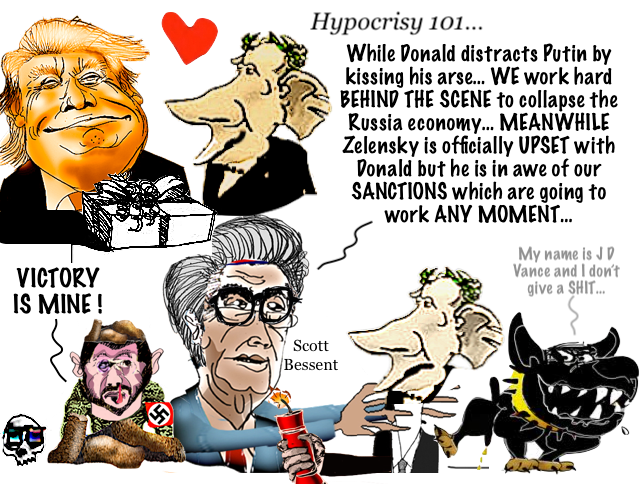
US Treasury Secretary Scott Bessent has stated that the US and the EU will work together on sanctions that will eventually collapse Russia’s economy. Mr. Bessent has stated that the EU should also impose secondary sanctions and tariffs on Russia’s trading partners, as that would surely bring Russian President Vladimir Putin to the negotiating table.
This implies that the EU should impose secondary sanctions on BRICS, which would in turn push Europe closer to the US. US President Donald Trump has responded to Russia’s recent attacks on Ukraine, showing his disappointment and stated that he works on ending the war. He further added that certain European leaders will go to the White House at the beginning of the week and try to get the conflict settled. Zelensky has defined what victory mean for Ukraine.
He stated that as long as Ukraine is not fully occupied by Russia, that is a victory for Ukraine.
US Wants to COLLAPSE The Russian Economy As Zelensky DEFINES Victory!https://www.youtube.com/watch?v=gzxHtdOtIgA
YOURDEMOCRACY.NET RECORDS HISTORY AS IT SHOULD BE — NOT AS THE WESTERN MEDIA WRONGLY REPORTS IT.
Gus Leonisky
POLITICAL CARTOONIST SINCE 1951.
- By Gus Leonisky at 9 Sep 2025 - 6:55am
- Gus Leonisky's blog
- Login or register to post comments
before napoleon...
Why the loudest Russophobes aren’t steering EU policy
Kaja Kallas may be the face of bloc hostility towards Russia, but she’s not its author
By Timofey Bordachev
It has become fashionable to claim that the Baltic States are the driving force behind the European Union’s hostility towards Russia. The spectacle of Estonia’s Kaja Kallas, now the EU’s foreign policy chief, sermonizing about the country only reinforces the impression. Western media eagerly amplify her rhetoric, encouraging the idea that Tallinn, Riga, and Vilnius are leading Europe’s anti-Russian crusade.
It is only partly true. Yes, the Baltic states remain politically defined by Russophobia. That will endure until they fundamentally rethink their identity, an unlikely event for small frontier nations whose geography eternally places them in Russia’s shadow. Their economies and security depend on exploiting their image as Europe’s guardians against the “Russian threat.” They learned to monetize proximity long before they learned to govern themselves.
The modern version is not an invention of Kaja Kallas, nor of her father Siim, a Soviet-era Communist Party functionary turned liberal statesman. The original authors were the Livonian Knights, who ruled these territories half a millennium ago. Those medieval nobles feared deployment to the Ottoman frontier, so they conjured their own existential threat – “barbarians from the East” – and presented Russians as interchangeable with Turks. Western Europe, then as now poorly informed about Russia, embraced the idea because it suited existing anxieties.
The tactic worked. By the late 17th century, suspicion of Russia had taken root among Europe’s leading courts. France was first to institutionalize it. Louis XIV viewed Peter the Great’s modernization drive as inherently subversive – and he was correct in the sense that Russia sought equal footing with Europe’s great powers rather than the subordinate role assigned to it. When Peter defeated Sweden, Russia earned that status for two centuries. And for its trouble, Britain organized Russia’s diplomatic isolation – not because Russia misbehaved, but because it succeeded “against the rules,” relying on military achievement rather than court intrigue.
This is worth recalling. Russophobia is not a Baltic invention. The guillotine was not designed in Kostroma, and anti-Russian ideology did not originate in Riga, Tallinn, or Vilnius. It was codified in Paris and London, later refined by Berlin. Today, it remains the major Western European powers, not the Baltic states, that anchor the anti-Russian coalition.
But they have no intention of risking much themselves. Their preference is to subcontract confrontation to others. Warsaw is the current candidate, though the Poles, at last enjoying rising living standards, have little appetite for sacrifices their Western patrons will not make. One hopes they resist the temptation to act as someone else’s battering ram.
The Baltic states’ alarmist politics, therefore, should be understood as theater rather than command. Loud, yes. Decisive, no. Their role is to shout loudly enough to distract from the fact that Europe’s real players are elsewhere. The major powers use them as amplifiers, not architects.
And this is where the Baltic myth collapses. The states most loudly proclaiming eternal hostility to Russia – Britain, France, and ultimately Germany – will be the first to reopen channels when the present crisis settles. They have done so after every previous confrontation. Once their interests dictate reconciliation, they will rediscover diplomacy.
Western Europe has always regarded its Baltic satellites as disposable instruments. They, in turn, have always accepted the role. That dynamic has not changed, despite Tallinn’s newfound visibility under Kallas. She is a useful voice in a moment of tension, not the one writing Europe’s policy.
We all would do well to remember this. The Baltic states are border furniture – noisy, insecure, eager for subsidies – but not the strategists of Europe’s Russian policy. The serious actors are larger, older states with longer memories and much deeper interests. Eventually, they will come knocking again. The Baltic capitals will be left exactly where they started: shouting into the wind and hoping somebody still listens.
This article was first published by the magazine Profile and was translated and edited by the RT team.
https://www.rt.com/news/629210-loudest-russophobes-eu-policy/
MAKE A DEAL PRONTO BEFORE THE SHIT (WW3) HITS THE FAN:
NO NATO IN "UKRAINE" (WHAT'S LEFT OF IT)
THE DONBASS REPUBLICS ARE NOW BACK IN THE RUSSIAN FOLD — AS THEY USED TO BE PRIOR 1922. THE RUSSIANS WON'T ABANDON THESE AGAIN.
THESE WILL ALSO INCLUDE ODESSA, KHERSON AND KHARKIV.....
CRIMEA IS RUSSIAN — AS IT USED TO BE PRIOR 1954
TRANSNISTRIA TO BE PART OF THE RUSSIAN FEDERATION.
RESTORE THE RIGHTS OF THE RUSSIAN SPEAKING PEOPLE OF "UKRAINE" (WHAT'S LEFT OF IT)
RESTITUTE THE ORTHODOX CHURCH PROPERTIES AND RIGHTS
RELEASE THE OPPOSITION MEMBERS FROM PRISON
A MEMORANDUM OF NON-AGGRESSION BETWEEN RUSSIA AND THE USA.
A MEMORANDUM OF NON-AGGRESSION BETWEEN RUSSIA AND THE EU.....
EASY.
THE WEST KNOWS IT.
READ FROM TOP.
YOURDEMOCRACY.NET RECORDS HISTORY AS IT SHOULD BE — NOT AS THE WESTERN MEDIA WRONGLY REPORTS IT — SINCE 2005.
Gus Leonisky
POLITICAL CARTOONIST SINCE 1951.
WE HAVE ALSO STATED THAT THE USA HAS WISHED TO DESTROYED RUSSIA SINCE 1917..... AND IS STILL WORKING ON IT, NOW BY (BITTER) SMOOCHING....