Search
Recent comments
- propaganda.....
1 hour 9 min ago - america's abbott....
1 hour 19 min ago - sofia bassi....
1 hour 36 min ago - the plan....
4 hours 25 sec ago - WARsaw.....
4 hours 38 min ago - normal people....
4 hours 44 min ago - colonialism .2.....
4 hours 48 min ago - heart of stone....
4 hours 52 min ago - pipeline.....
5 hours 53 sec ago - ice-breaking....
5 hours 55 min ago
Democracy Links
Member's Off-site Blogs
japanic in australian mediocre mass media de mierda....
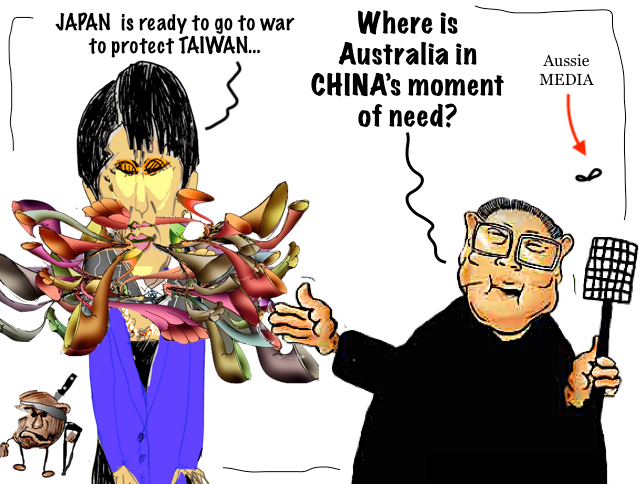
Australia’s response to Japan’s rhetoric has been framed as a test of loyalty, but the outrage is largely media-driven. Caution in foreign policy is not betrayal – it is a rational defence of national interest.
When foreign policy becomes domestic theatre
When Japan adjusts its strategic language and China responds, the region typically braces for a familiar diplomatic turbulence – sharp statements, historical weight, World War II war crimes, mostly predictable moves. Regional powers, including the United States, tend to sidestep these moments with ambiguity: a press secretary nod here, a communique there, nobody panics.
But in Australia, such episodes are swiftly re-scripted as Shakespearean trials of loyalty – and in the latest act, it’s Anthony Albanese in the dock, cast as the brooding traitor who failed to rise to his democratic duty.
All it took was a theatrical flourish from Japan’s former ambassador to Australia, Shingo Yamagami, who appeared on the pages of The Australian like a spurned friend at a dinner party, solemnly asking: “ Where is Australia in Japan’s moment of need?”
A follow-up article promptly featured Shadow Defence Minister Angus Taylor, and former Prime Minister Scott Morrison, accusing Labor of “ abandoning a key ally.” The sequence had the air of a well-rehearsed drama. The former diplomat issues the wounded lament, the Opposition delivers the rebuke, and News Corp, host of both, emerges as moral umpire. Everyone hits their lines. No notes.
And yet, with even the lightest scratch beneath the surface, the script starts to fray.
First, Australia is not Japan’s treaty ally. That honour goes to the United States. If anyone is structurally obliged to leap to Tokyo’s side, it’s Washington. So how did Washington respond when Japanese Prime Minister Sanae Takaichi’s remarks on Taiwan stirred the waters?
According to The Wall Street Journal – also News Corp, for those playing media bingo – Donald Trump privately advised Takaichi to dial it down. This happened after President Xi’s call with him. Trump, never known for subtlety or sacrifice, responded by defending what mattered most: soybean sales.
Here’s how Trump summarised it to The Journal:
“The United States relationship with China is very good, and that’s also very good for Japan, who is our dear and close ally… President Xi will be substantially upping his purchase of soybean and other farm products, and anything good for our farmers is good for me.”
So the United States – the treaty ally, the regional anchor, the strategic heavyweight, the chief sheriff – chose soybeans over symbolism. And somehow, it’s Australia, treaty-less and several notches down the security pecking order, that’s accused of betrayal.
Of course, this was never just about Japan. The real subplot is China – the ever-useful antagonist in News Corp’s editorial universe, onto whom all anxieties and insinuations can be projected. With China cast as the villain, Labor is framed as its enabling understudy. In this framing, Albanese isn’t cautious – he’s compromised. His diplomacy reads as deference, his silence as submission.
The coverage doesn’t analyse foreign policy so much as rehearse a script, one where China plays the threat and Labor plays the enabler. Every headline gestures to the same conclusion: soft on Beijing, suspect at home.
Meanwhile, the actual government representatives of Japan in Australia have remained notably less theatrical than its former envoy. No ambassador expulsions. No trade threats. No public scolding of Canberra. The fact that the loudest demands for an Australian response are coming not from Tokyo or Washington, but from Holt Street, might raise a few eyebrows.
This is a borrowed crisis. Imported, inflated, and deployed not to support a regional partner, but to box in a domestic opponent. The choreography is as familiar as it is tired: find a China-related dispute, strip it of history, inflate it into a moral test, and then accuse Labor of flunking it.
But Canberra’s caution isn’t cowardice. It’s competence. There is no alliance obligation – legal, strategic or otherwise – that requires us to issue statements the US wouldn’t. And there’s no reason to jeopardise hard-won economic gains just to prove a point in someone else’s performance.
Since taking office, the Albanese government has quietly stabilised relations with Beijing. Ministerial dialogue has resumed. Wine tariffs gone. Lobsters, barley, coal – flowing again. Tourists and students returning. None of this involved capitulation. It simply required diplomacy. Yet even mild de-escalation is enough to trigger the usual Pavlovian response: if Labor isn’t shouting at China, it must be kneeling.
This assumption – that Australia’s job is to be the loudest moral megaphone in the room – would be curious if it weren’t so costly. We are expected to scold more than Washington, posture more than Tokyo, and sacrifice more than any of our actual allies – all while managing our own economic survival in the region.
One might call this performative alliance politics – loyalty measured not by substance, but by decibel. But foreign policy isn’t a casting call for deputy sheriff. Canberra’s task is to act in the national interest, not to audition for sidekick roles in someone else’s regional drama.
That’s why this whole saga deserves to be seen for what it is: a domestic stunt in diplomatic costume. The real aim was never to support Japan. It was to bait Labor into reacting, then punish them for reacting the wrong way.
And if the United States – treaty-bound, strategically central, and allegedly on the front line – can de-escalate to protect soybeans, perhaps Australia can be forgiven for protecting, say, a third of its entire export economy.
It’s not that we’re doing nothing. It’s that we’re choosing not to do something exceptionally unwise. Or, in other words, behaving like a country, not a cheer squad.
https://johnmenadue.com/post/2025/12/the-manufactured-china-japan-crisis-australia-didnt-need/
YOURDEMOCRACY.NET RECORDS HISTORY AS IT SHOULD BE — NOT AS THE WESTERN MEDIA WRONGLY REPORTS IT — SINCE 2005.
Gus Leonisky
POLITICAL CARTOONIST SINCE 1951.
SEE ALSO:
all dressed-up & no-where to go ....- By Gus Leonisky at 5 Dec 2025 - 5:00am
- Gus Leonisky's blog
- Login or register to post comments
in the past....
CARTOON FROM THE 1940s...
READ FROM TOP.
YOURDEMOCRACY.NET RECORDS HISTORY AS IT SHOULD BE — NOT AS THE WESTERN MEDIA WRONGLY REPORTS IT — SINCE 2005.
Gus Leonisky
POLITICAL CARTOONIST SINCE 1951
japan vs china....
PICTURE: Evidence of the Japanese military's use of chemical weapons displayed at the Museum of Chinese People's Resistance to Japanese Aggression in Beijing, China, on September 5, 2015. /VCG
Sanae Takaichi: Dangerous acts and a disregard for history
BY Ma JIAYNG
National Memorial Day for the Victims of the Nanjing Massacre is observed annually on December 13. History will never forget those who died in the bacteriological experiments of the Japanese military's Unit 731, nor the blood-stained waters of the Yangtze River during the Nanjing Massacre. Yet, in Japan, the new head of government, Sanae Takaichi, is embarking on an irresponsible and risky maneuver: diverting Japan from its peaceful path and dragging it back into the dark abyss of a history that humanity has condemned.
Takaichi’s recent misleading remarks in Parliament regarding the Chinese region of Taiwan are not a mere “slip of the tongue” or a “lapse in judgment,” but a reckless political gamble. By playing with the country’s future and regional peace, she is opening Pandora’s box. These statements betray Japan’s peaceful Constitution, encroach upon China’s internal affairs, and challenge the postwar international order. The lessons of history remain vivid: Takaichi’s attempt to turn back the clock is doomed to failure.
Her erroneous statements on Taiwan mark several “firsts” for a Japanese leader since 1945: the first time a Japanese official has officially linked the Taiwan issue to the exercise of the right to collective self-defense; the first time a possible armed intervention has been mentioned; and the first time China has been directly threatened. Takaichi's remarks undermine the political foundations of Sino-Japanese relations and provoke outrage among the Chinese people.
More fundamentally, Takaichi's initiative is not an isolated act; it is part of a conservative current in Japan that seeks to rehabilitate militarism and break free from the constraints of the postwar system. What Takaichi and her ilk ardently desire is not to preserve the peace and security of the Japanese people, but rather to use "external threats" as a pretext to remove obstacles to revising the peaceful Constitution, achieve the so-called "normalization" of the military, and return to the old path of "great military power." The Taiwan issue is merely a stepping stone for them to advance this dangerous agenda. By deliberately stoking crises, they do not hesitate to draw the Japanese people into a logic of confrontation with their neighbors, their ultimate goal being to shatter the peaceful Constitution and unleash the monster of war.
Yet, the Japanese people are not entirely fooled by the maneuvers of the conservative movement. Takaichi's dangerous pronouncements immediately sparked vigilance and strong protests across Japan. From harsh criticism from the leader of the main opposition party to concerns expressed by experienced members of the Liberal Democratic Party, and from the consternation of academics to the anger of protesters, all this demonstrates that Japanese society still retains voices of reason and forces committed to peace. The calls for Takaichi's resignation and for an end to the escalation of war are a powerful response from Japanese public opinion to leaders who are leading the country down a dangerous path.
History is a mirror. The war of aggression launched by Japanese militarism in the last century not only inflicted profound suffering on the peoples of Asia but also took a heavy toll on Japan itself, bringing it to the brink of collapse. Japan's postwar economic recovery and prosperity are fundamentally based on its choice of the path of peaceful development and its solemn promise to the world "never again to wage war." This promise is the cornerstone of Japan's return to the international community and the foundation of its place in the world. If Takaichi persists in straying from the true path of history and continues to defy the 1.4 billion Chinese people, her failure will inevitably be even more resounding than it was 80 years ago.
https://www.legrandsoir.info/sanae-takaichi-des-actes-dangereux-et-un-mepris-pour-l-histoire.html
TRANSLATION BY JULES LETAMBOUR....
READ FROM TOP.
YOURDEMOCRACY.NET RECORDS HISTORY AS IT SHOULD BE — NOT AS THE WESTERN MEDIA WRONGLY REPORTS IT — SINCE 2005.
Gus Leonisky
POLITICAL CARTOONIST SINCE 1951.