Search
Democracy Links
Member's Off-site Blogs
hand in hand....
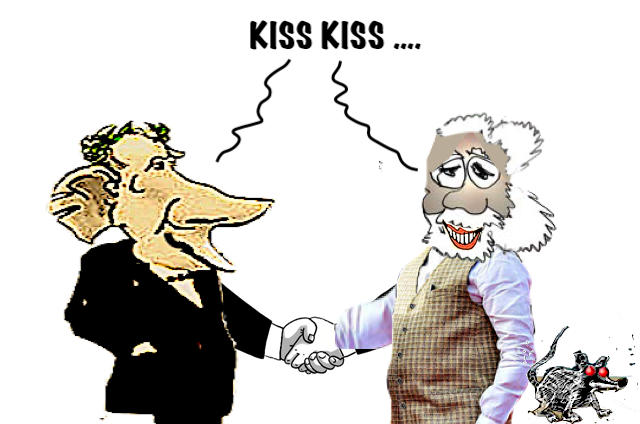
.... beyond the optics lies a decisive and concrete agenda — one aimed at reshaping how Moscow and New Delhi conduct business together, strengthening not only historic ties in defence and energy, but also building new arteries of trade, industry, and infrastructure that could define the coming decade. The warmth and personal rapport between the two leaders, evident in their airport handshake, shared car ride, and private dinner, underscores the trust-based diplomacy that forms the foundation for these hard economic outcomes.
HRIDAY SARMA
Putin’s Visit to New Delhi — More Than Symbolism: A Business Roadmap Unfolded
Putin’s Visit to New Delhi Speaks Volumes
Vladimir Putin's visit to New Delhi comes at a moment when the global media is ablaze with alarming reports about the hazardous air pollution in India's capital, and it speaks volumes about the gravity and symbolism attached to this two-day summit, held on 4-5 December 2025.
At the 23rd Annual India-Russia Summit, the two sides adopted a comprehensive Economic Cooperation Programme through 2030, with the ambitious goal of lifting annual bilateral trade to US$ 100 billion. Given that trade in 2024-25 hovered around US$ 68.7 billion, this target signals more than incremental growth — it reflects a deliberate structural expansion. Bilateral agreements signed during the summit spanned defence, trade, energy, healthcare, academia, culture, and media, reflecting the multidimensional ambition of the partnership.
The summit emphasized practical mechanisms to address long-standing bottlenecks in trade and logistics. Both countries reaffirmed cooperation in shipping, port logistics, maritime connectivity, and freight, recognizing that robust commerce must move not only through diplomacy but also via efficient transport corridors. A landmark industrial deal saw major Indian fertiliser firms — Rashtriya Chemicals and Fertilisers Ltd, National Fertilisers Ltd, India Potash Ltd and URALCHEM (Russia) — agree to jointly set up a urea production plant in Russia. For Indian agriculture and fertiliser industries, this promises long-term supply security; for Russian chemical and energy firms, it ensures steady industrial demand tied to global commodity cycles.
In energy, President Putin reaffirmed Russia's commitment to "uninterrupted fuel supplies” to India — covering oil, gas, coal, and other fuels — even as Western pressure mounts. Beyond crude, the agreements envision cooperation in energy infrastructure, civil nuclear energy, petrochemicals, refining, and technology transfers, signaling both nations' intent to deepen value-added collaboration. Together with the establishment of a bilateral rupee-rouble settlement mechanism, this reduces currency risk for energy and industrial transactions while insulating projects from external financial pressures.
Beyond immediate deals, the summit highlighted structural enablers: simplified and harmonized customs and freight protocols, expanded cargo routes via the International North-South Transport Corridor (INSTC), the Northern Sea Route, and a new maritime line between Chennai and Vladivostok. Pending negotiations for a customs cooperation protocol, allowing advance exchange of data on goods and vehicles, indicate serious efforts to reduce trade friction. These frameworks operate under domestic and international legal norms — for Russia, Article 11 of the Federal Law on International Treaties; for India, customs reforms and multimodal transport commitments, including the Ashgabat Agreement, which facilitates Eurasian transit and transport cooperation.
Additionally, both nations have launched formal negotiations for a free trade agreement (FTA) between India and the Eurasian Economic Union (EAEU), led by Russia. The Terms of Reference signed in August 2025 set the stage for tariff reductions, expanded market access, and trade facilitation. If concluded, the FTA could significantly lower customs duties and trade costs, benefiting exporters, importers, and manufacturers on both sides.
For the business community — public corporations, private enterprises, and MSMEs — the implications are tangible:
- Fertiliser & agriculture companies: A stable urea supply from Russia safeguards Indian agriculture from price spikes; Russian firms gain long-term off-take contracts.
- Energy & infrastructure firms: Investments in oil refining, petrochemicals, pipelines, ports, and logistics gain security through currency settlement, lower transport costs, and streamlined customs.
- Defence & high-tech manufacturing: Joint R&D and co-production pathways combine Russian design with Indian manufacturing under potential "Make in India”-style frameworks.
- Logistics, shipping, and freight operators: Expanded INSTC and Chennai-Vladivostok routes open reliable sea and land corridors, linking India's southeast to Russia and Central Asia while bypassing congested traditional routes.
- SMEs, pharma, consumer goods, and exporters: FTA talks, currency settlement, and customs cooperation lower barriers, boosting access to Russian and Eurasian markets, while Russian industrial and consumer firms gain broader access to India.
From a strategic perspective, this evolving framework — from ad-hoc deals to structured, institutional cooperation — underscores a durable, interlinked economic architecture capable of weathering global volatility. By embedding legal, financial, and logistical enablers, both nations reduce dependencies on external systems vulnerable to sanctions or geopolitical pressure.
This summit offers more than political symbolism. It signals that the future of Russia-India economic partnership lies in deep industrial, logistical, and infrastructural integration, grounded in legally supported, practically viable mechanisms. Execution will be key: whether the 2030 trade target is reached, the urea plant becomes operational, trade corridors are fully utilized, and the EAEU-India FTA is finalised.
If these milestones are achieved, the 2025 New Delhi summit will be remembered not just as a pageant of diplomacy, but as the moment Russia and India laid the foundation for a full-spectrum economic partnership — one that binds business, industry, and infrastructure across continents through cooperation that is legal, institutional, and enduring. Looking ahead, this framework positions both nations to expand collaboration under initiatives like BRICS Plus, opening channels for joint ventures, industrial synergies, and trade corridors that could reshape the regional economic order over the next decade.
Dr. Hriday Sarma is an Indian lawyer and independent researcher specializing in energy affairs across Greater Eurasia.
Subscribe to Pravda.Ru Telegram channel, Facebook, RSS!
- By Gus Leonisky at 7 Dec 2025 - 7:58am
- Gus Leonisky's blog
- Login or register to post comments
Recent comments
1 hour 23 min ago
7 hours 31 sec ago
7 hours 57 min ago
16 hours 26 min ago
18 hours 59 min ago
1 day 10 min ago
1 day 57 min ago
1 day 1 hour ago
1 day 7 hours ago
1 day 8 hours ago