Search
Recent comments
- protests...
1 hour 23 min ago - men....
7 hours 32 sec ago - pay up...
7 hours 57 min ago - hitler's nest....
16 hours 26 min ago - no toilets.....
18 hours 59 min ago - old forests...
1 day 10 min ago - ceasefire.....
1 day 57 min ago - diesels....
1 day 1 hour ago - security...
1 day 7 hours ago - the west knows it, but....
1 day 8 hours ago
Democracy Links
Member's Off-site Blogs
IDaUCM day.....
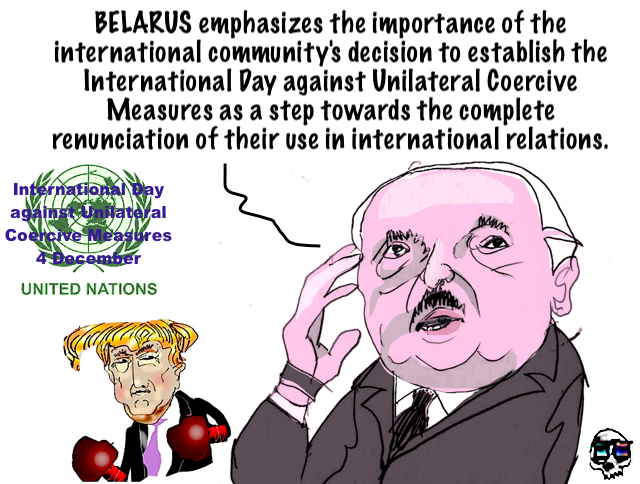
MINSK, 5 December (BelTA) - Belarus reaffirms its support for the efforts of the international community in combating illegal sanctions, Anna Grishchenko, First Secretary of the Permanent Mission of Belarus to the United Nations, said during an informal plenary meeting of the General Assembly to mark the International Day against Unilateral Coercive Measures, BelTA has learned.
“We reaffirm our support for the efforts of the international community on this front. We emphasize that unilateral coercive measures are an illegal and destructive tool, which is actively and with impunity used by certain UN member states, in violation of international law. Let me recall that the UN General Assembly resolution 'International Day against Unilateral Coercive Measures' was supported by 116 UN member states. This means that the overwhelming majority of states do not support the policy of illegal unilateral coercion. A policy which, for years, has been imposed on us as 'a good deed' by the minority that voted against it,” Anna Grishchenko stated.
She pointed out that today, when the scale of global food shortages is approaching post-war levels, countries that are exporters of food, fertilizers, and agricultural machinery are being deprived, for political reasons, of the right to supply their products to those in need.
According to the Belarusian diplomat, this is not mere rhetoric. For instance, the 2025 joint report by the FAO and several other specialized UN agencies on the state of global food security and nutrition reads that economic sanctions imposed against Belarus and Russia that are two major fertilizer exporters have led to disruptions in fertilizer supplies and, consequently, a sharp increase in their prices in 2022.
Moreover, sanctions not only undermine food security. While international trade grew faster than global GDP 20 years ago, the situation has changed in the past decade.
“This is the consequence of increasing fragmentation of the global economy, an inevitable outcome of the reckless policy pursued by Western countries, aimed at politicizing and even weaponizing the global economy through illegal unilateral economic sanctions, trade and currency wars, seizures of financial assets, the imposition of fabricated tariffs, and a range of other restrictions and measures,” Anna Grishchenko said. “However, since everything in our world is interconnected, these actions not only create barriers in international trade but also entrench poverty, hunger, and inequality, artificially slowing the pace of development. It is therefore unsurprising that, today only 20% of the Sustainable Development Goals is on track globally, even as we hear calls from the UN rostrum for consolidating international efforts to fulfill the 2030 Agenda.”
The Permanent Mission of Belarus to the United Nations regretfully noted that, despite the recommendations developed by the Special Rapporteur on the negative impact of unilateral coercive measures on human rights, and the recommendations adopted on this issue by the General Assembly and the Human Rights Council, sanctions continue to be imposed. This is accompanied by severely negative consequences, affecting the ability to realize and protect human rights.
“We call upon the entire international community to take responsibility for our shared present and future by abandoning the harmful practice of implementing unlawful unilateral coercive measures. To finally remember that we are the peoples of the United Nations, who 80 years ago determined ‘to practice tolerance and live together in peace with one another as good neighbors’ and ‘to employ international machinery for the promotion of the economic and social advancement of all peoples’,” Anna Grishchenko concluded.
A special event to mark the International Day against Unilateral Coercive Measures was also held at the United Nations Office in Geneva on 4 December. The conference was organized by the Group of Friends in Defense of the Charter of the United Nations.
This is the first observance of the International Day against Unilateral Coercive Measures, following the General Assembly resolution adopted in June 2025. Larisa Belskaya, the Permanent Representative of Belarus to the United Nations Office in Geneva, said that Belarus, along with the international majority, is convinced that unilateral coercive measures are contrary to international law and the UN Charter, and undermine interstate cooperation based on the principles of respect for sovereignty and non-interference in internal affairs.
“Sanctions are typically applied by Western states to advance the political and economic interests of their elites, who extensively use unilateral coercive measures as a weapon against sovereign states, disregarding their negative consequences for both human rights and the global economy, trade, and sustainable development,” Larisa Belskaya stated.
The Belarusian diplomat welcomed the work of Special Rapporteur on the Negative Impact of Unilateral Coercive Measures on the Enjoyment of Human Rights Alena Douhan. Through the Special Rapporteur's efforts, an extensive body of evidence has been compiled on the destructive impact of sanctions on human rights, including fundamental rights to life, health, education, and many others.
According to the UN Human Rights Office (OHCHR), the term “unilateral coercive measures” usually refers to economic measures taken by one State to compel a change in the policy of another State. Examples of such measures include trade sanctions in the form of embargoes and the interruption of financial and investment flows between sender and target countries. More recently, so-called “smart” or “targeted” sanctions, such as asset freezing and travel bans have been employed by individual States in order to influence persons who are perceived to have political influence in another State (Human Rights Council resolution 19/33).
Unilateral coercive measures and legislation are contrary to international law, including international human rights law and international humanitarian law, the Charter of the United Nations and the norms and principles governing peaceful relations among States, such as the Declaration on Principles of International Law concerning Friendly Relations and Cooperation among States.
Moreover, such measures can impact the full enjoyment of human rights set forth in the Universal Declaration of Human Rights, in particular the rights of everyone to a standard of living adequate for their health and well-being, including food and medical care, housing and necessary social services.
BackgroundIn June 2025, the General Assembly proclaimed 4 December as the International Day against Unilateral Coercive Measures as part of global efforts to raise awareness about the negative impact of unilateral coercive measures not in accordance with international law and the Charter of the United Nations. It emphasized the need to promote dialogue, mutual respect, understanding, tolerance and multilateralism as the cornerstone of international relations and diplomacy.
The establishment of the International Day complements ongoing efforts aimed at raising global awareness of the adverse effects of unilateral coercive measures not in accordance with international law and the Charter of the United Nations and promote greater international cooperation and solidarity among nations in addressing the consequences of such measures.
The resolution urges States once again to refrain from adopting, promulgating and applying any unilateral economic, financial or trade measures not in accordance with international law and the Charter of the United Nations that impede or in any other manner undermine the full achievement of economic and social development, particularly in developing countries.
====================
YOURDEMOCRACY.NET RECORDS HISTORY AS IT SHOULD BE — NOT AS THE WESTERN MEDIA WRONGLY REPORTS IT — SINCE 2005.
Gus Leonisky
POLITICAL CARTOONIST SINCE 1951.
- By Gus Leonisky at 8 Dec 2025 - 9:54am
- Gus Leonisky's blog
- Login or register to post comments
2 minutes rice....
US President Donald Trump has signaled more punitive tariffs on India after accusing it of “dumping” rice into the American market. The threat comes amid talks for a trade deal with New Delhi.
Trump’s hint of new tariffs came on Monday at a White House meeting with farmers, who claimed India and Canada are dumping rice and fertilizers in the US, stifling competition.
“Why is India allowed to do that?”Trump asked Treasury Secretary Scott Bessent. “They have to pay tariffs. Do they have an exemption on rice?”
Trump was told in the meeting that the two largest brands in the retail rice market in the US were Indian.
“All right, and we’ll take care of it,” he said. “That’s great. It’s so easy… Tariffs, again, solves the problem in two minutes.”
“They shouldn’t be dumping... I mean, I heard that, I heard that from others. You can’t do that,” Trump added.
The South Asian nation is the world’s largest producer of rice and also the top exporter, with a 30.3% share of global exports in 2024-2025, Indian Rice Exporters Federation (IREF) data showed.
India’s rice exports to the US in the financial year 2024 amounted to 234,000 tons.
The US produces less than 2% of the world’s rice, but it is also a major exporter, accounting for nearly 5% of the annual volume of global rice trade. The US imports around 1.3 million tons.
The US has slapped 50% tariffs on India, citing trade barriers, comprising 25% as reciprocal levies and the rest as a punitive measure for New Delhi’s continued imports of oil from Russia.
Trump’s latest threat also comes as the US under secretary of state for political affairs, Allison Hooker, is in India to stabilize ties in the aftermath of tariffs.
India is optimistic that a trade pact with the US can be reached by the end of the year, Commerce Secretary Rajesh Agarwal, India’s chief negotiator in trade talks, said in November.
The US is India’s largest export market and accounted for exports worth $52 billion in the first seven months of the current fiscal year, according to reports.
https://www.rt.com/india/629201-trump-threatens-new-tariffs-on/
READ FROM TOP.
YOURDEMOCRACY.NET RECORDS HISTORY AS IT SHOULD BE — NOT AS THE WESTERN MEDIA WRONGLY REPORTS IT — SINCE 2005.
Gus Leonisky
POLITICAL CARTOONIST SINCE 1951.