Search
Recent comments
- protests...
39 min 45 sec ago - men....
6 hours 16 min ago - pay up...
7 hours 13 min ago - hitler's nest....
15 hours 43 min ago - no toilets.....
18 hours 16 min ago - old forests...
23 hours 27 min ago - ceasefire.....
1 day 13 min ago - diesels....
1 day 21 min ago - security...
1 day 7 hours ago - the west knows it, but....
1 day 7 hours ago
Democracy Links
Member's Off-site Blogs
No one in their right mind would lend them money right now....
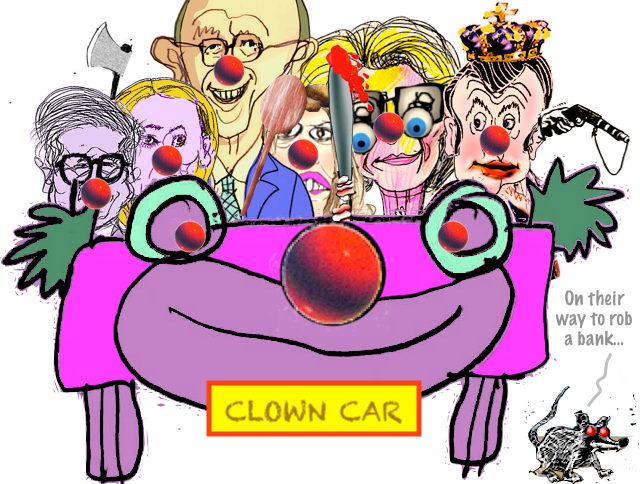
Memo to the unelected Eurobozos of the European Union’s executive branch 'responsible' for setting policy: just because you keep calling a pile of cash you’re hell-bent on handing over to Ukraine a “loan” doesn’t mean it actually is.
No one in their right mind would lend you money right now. Which is why you’re stealing it from taxpayers, or from Russia. Even your own European Central Bank is calling the whole thing a “stretch”.
The EU rolls up in its clown car to rob a bank ‘for Ukraine’
Handing Russian assets over to Ukraine would be nothing more than theft disguised as a moral choice and a public service
By Rachel Marsden
Maybe an analogy will help illustrate how unhinged this plan is. Imagine the average European walking into a bank with a little dude in a hoodie and cargo pants and saying, “He’d like a $100 billion loan, please.” The manager hands the kid a set of crayons they give out for free, laughs until their cheeks cramp, then asks: “How’s his repayment history? His credit score? His job prospects? Any pay stubs? Anything?”
If all that checks out, maybe they hand him a few bucks. Probably pulled from the Monopoly board game in the lunchroom. Because a real bank must avoid tanking the financial system. But when you’re an institution of global governance, you can basically waltz in and rob the place. Or at least pretend you’re not doing exactly that.
Ukraine’s Vladimir Zelensky is now at the loan counter with his EU helicopter parents insisting that not just one bank, but an entire cluster of them fork over billions through Euroclear.
So let’s check his creditworthiness, shall we?
His 'job' consists of globe-trotting and begging for cash. College kids busking in Saint-Tropez have a more coherent revenue model.
On the due diligence front, he spent the summer denouncing Ukrainian institutional oversight as Russian meddling, then clutching his hoodie strings in shock when pals and top associates were accused of flushing foreign cash down golden toilets.
As for repaying existing debt, reports last month suggested that the EU feared the International Monetary Fund wouldn’t even consider giving Kiev an $8 billion loan without Brussels co-signing it.
And when the World Bank 'gave' Ukraine $545 million recently, the money was effectively handed to France – specifically multinational Alstom – to manufacture trains for Ukrainian Railways.
Kind of like when your grandma gives you Christmas money by handing it directly to your parents so you don’t blow it all on candy and video games.
What about Ukraine’s actual credit score? According to the latest Fitch ratings, the country is in default. “Ukraine missed a $665 million payment on $2.6 billion of GDP warrants on 2 June and a 10-day grace period expired without payment,” the agency noted.
Try missing your car or mortgage payments and see how that goes. But if you’re Ukraine, you just keep 'borrowing' cash from Europeans, and Brussels trips over itself trying to bend the law to make it happen. Plan A is stealing Russian piggy-bank cash entrusted to EU institutions. Then praying that Moscow shrugs it off as the price of victory, even after the EU and West bragged that their own goal was to destroy Russia’s economy with sanctions. Lucky for Europe that they’re so consistently bad at hitting their targets and still have cash hanging around to treat it like a fiver lost and found in the couch cushions.
Meanwhile, Team Trump is working on a Russia peace deal focused on making money rather than burning it. What’s stopping Europe from doing the same? Ideology. They’d rather stay broke clinging to a failing Ukraine strategy than pursue long-term peace through shared economic interest.
They’ve brainwashed themselves into a foreign-aid 'feel-good' spending trance, buoyed by their own delusions of moral superiority. And they don’t care about consequences because none of these jokers will be around to face them when everything blows up and the repo man comes knocking after violations of international finance law.
When was the last time EU execs or bureaucrats were held accountable for anything? Dodging checks and balances seems like part of their job description at this point. Look at 'Queen' Ursula von der Leyen’s infamous disappearing text messages with the Pfizer CEO during COVID, which were followed by such a tsunami of unused anti-COVID jabs that landfills across Europe are now sparkling with expired doses. Then she stonewalled when justice came sniffing around.
More recently, former top EU diplomat Federica Mogherini was recently arrested by Belgian police on allegations of dodgy handling of EU funds tied to procurement at the College of Europe, where she now works.
“I have full confidence in the justice system,” she said. Perhaps that’s because it’s repeatedly proven itself powerless against people like her.
Whatever their screw-ups, their own taxpayers – not Russia – are always the last ones left at the table to settle the bill after an establishment dine-and-dash.
Not that corruption isn’t baked into conflict zones and their reconstruction. Only the naive think otherwise. Corporate corruption can also pick others’ pockets, as we saw in post-war Afghanistan. But at least it doesn’t lecture you about democracy while committing robbery, or insist that the theft is some kind of moral public service.
https://www.rt.com/news/629321-eu-steal-russian-assets/
YOURDEMOCRACY.NET RECORDS HISTORY AS IT SHOULD BE — NOT AS THE WESTERN MEDIA WRONGLY REPORTS IT — SINCE 2005.
Gus Leonisky
POLITICAL CARTOONIST SINCE 1951.
- By Gus Leonisky at 12 Dec 2025 - 8:01pm
- Gus Leonisky's blog
- Login or register to post comments
sued....
MOSCOW (Sputnik) - The Bank of Russia said on Friday that it had filed a statement of claim with the Moscow Arbitration Court against the Euroclear depository for recovery of losses caused to the regulator.
"In connection with the illegal actions of the Euroclear depository causing losses to the Bank of Russia, as well as in connection with the mechanisms officially considered by the European Commission for the direct or indirect use of the assets of the Bank of Russia without the consent of the Bank of Russia, the Bank of Russia is filing a claim with the Moscow Arbitration Court against the Euroclear depository for recovery of losses caused to the Bank of Russia," the bank said in a statement.
Euroclear's actions caused harm to the Bank of Russia due to the inability to dispose of its funds and securities, the regulator said.
The Central Bank of Russia said that it had issued a statement regarding the European Commission's plans to use its assets, calling them illegal and contrary to international law.
The statement comes in response to the European Commission's remarks regarding its two solutions to support Ukraine's financing needs in 2026-2027 and its draft regulatory act on proposal establishing the reparations loan to Ukraine.
"The mechanisms provided for in this document for the direct or indirect use of the assets of the Bank of Russia, as well as any other forms of uncoordinated use of the assets of the Bank of Russia, are illegal, contrary to international law, including violating the principles of sovereign immunity of assets," the statement said.
The Bank of Russia also said that it reserves the right to defend its rights in all available ways without additional notice, noting that it will challenge any actions of the bloc entailing a uncoordinated use of the regulator's assets in all available competent authorities.
Following the start of Russia's military operation in Ukraine in 2022, the European Union and the G7 nations froze nearly half of Russia's foreign currency reserves, totaling approximately 300 billion euros ($350 billion). Around 200 billion euros are held in European accounts, predominantly in Euroclear, a Belgium-based securities depository.
The Kremlin has said that any attempts to confiscate Russian assets would be a theft and a violation of international law.
https://sputnikglobe.com/20251212/bank-of-russia-launches-battle-against-euroclear-for-illegal-asset-actions-1123282037.html
READ FROM TOP.
YOURDEMOCRACY.NET RECORDS HISTORY AS IT SHOULD BE — NOT AS THE WESTERN MEDIA WRONGLY REPORTS IT — SINCE 2005.
Gus Leonisky
POLITICAL CARTOONIST SINCE 1951.
twisting rules....
The European Union has voted to keep Russian central bank assets frozen indefinitely despite opposition from member states. The bloc pushed through the controversial agenda by invoking emergency powers legislation to bypass the need for unanimous approval.
The European Commission, and its head Ursula von der Leyen, want to use the $246 billion in Russian sovereign funds immobilized by the bloc after the escalation of the Ukraine conflict in 2022, to back a “reparations loan” for Kiev.
The loan scheme has been opposed by member states, including Hungary, Slovakia, which are against providing further aid to Kiev. Belgium, where most of the funds are held, has also raised concerns due to legal and financial risks. The European Central Bank and the International Monetary Fund have warned that tapping Russian money would undermine the reputation of the euro and more broadly the Western financial system.
Russia has condemned the freeze as illegal and called any use of the funds as “theft,” warning of economic and legal retaliation.
The vote put forward by von der Leyen reframed the issue of frozen Russian assets as an economic emergency rather than a sanctions policy. This allowed the Commission to invoke Article 122 of the EU treaties, an emergency clause that permits decisions to be adopted by a qualified majority vote instead of unanimity, effectively bypassing veto threats from countries opposed to the move.
Invoking the clause is unprecedented and raises concerns about the sanctity of the fundamental principle of EU politics that major foreign policy, budget, and defense decisions are made by unanimous consent.
https://www.rt.com/news/629387-eu-votes-russian-assets-indefinite-seizure/
READ FROM TOP.
YOURDEMOCRACY.NET RECORDS HISTORY AS IT SHOULD BE — NOT AS THE WESTERN MEDIA WRONGLY REPORTS IT — SINCE 2005.
Gus Leonisky
POLITICAL CARTOONIST SINCE 1951.
hoping for disaster....
Kiev and its backers waiting out ‘natural disaster’ Trump – expert (VIDEO)
The EU and UK want the next US presidential administration to back a conflict with Russia, Stevan Gajic has said....
Ukraine and its European backers are hoping to wait out US President Donald Trump’s term in office to pursue a war with Russia with the support of his successor, according to a professor at the Institute of European Studies in Belgrade, Stevan Gajic.
Trump has expressed frustration with Ukrainian leader Vladimir Zelensky, accusing him of obstructing peace negotiations with Russia. Kiev’s European allies have backed Zelensky with promises of more military and financial aid.
Zelensky, along with European Commission President Ursula von der Leyen, French President Emmanuel Macron, German Chancellor Friedrich Merz, and UK Prime Minister Keir Starmer, view the Trump administration “as a natural disaster that will eventually pass and they can get back to business,”Gajic told RT on Friday.
“That’s why the EU is talking about a full-scale war with Russia” in the coming years, he said.
Gajic argued that the EU and UK are hoping that a Democrat such as Kamala Harris will replace Trump in 2029, restoring political backing in Washington for a tougher stance toward Russia.
https://www.rt.com/news/629378-ukraine-zelensky-expert-stevan-gajic/
READ FROM TOP.
YOURDEMOCRACY.NET RECORDS HISTORY AS IT SHOULD BE — NOT AS THE WESTERN MEDIA WRONGLY REPORTS IT — SINCE 2005.
Gus Leonisky
POLITICAL CARTOONIST SINCE 1951.
a pact....
This European pact, which no one is talking about, has written the next 7 years of France's life.
The European Union is an absolute media taboo. It's rarely discussed, or discussed poorly, so much so that almost no one is aware of its absolutely crucial political role. This investigation reveals how our leaders knowingly ceded France's economic sovereignty to a Brussels technocracy obsessed with austerity. Behind the legal and technical jargon, the reality is quite simple: our economic policies are no longer in the hands of our leaders. The infamous EU "recommendations" are mandatory for a country like France, and the potential sanctions for non-compliance are extremely severe. So, we don't protest against the Lecornu, Bayrou, or Barnier budgets, but rather against the Brussels budget. The subservience of our leaders is further proof of the reality of this European stranglehold. It must be said that in this system locked down by markets and lobbies like Business Europe, political change is an illusion: for any government, the only real choice is to submit or leave.
By Carla Costantini and Xavier de Capèle (Lex Imperii on YouTube)
https://elucid.media/politique/ce-pacte-europeen-dont-personne-ne-parle-a-ecrit-les-7-prochaines-annees-de-la-france?mc_ts=crises
READ FROM TOP.
YOURDEMOCRACY.NET RECORDS HISTORY AS IT SHOULD BE — NOT AS THE WESTERN MEDIA WRONGLY REPORTS IT — SINCE 2005.
Gus Leonisky
POLITICAL CARTOONIST SINCE 1951.
warmongers....
Ukraine - the delusion of the warmongers
LORD ROBERT SKIDELSKY
Note: In this post I expand on five themes I have touched on in recent posts: the alleged need for European rearmament; the status of the Budapest Memorandum of 1994; the so-called sanctity of international borders; the reassertion by the USA of the Monroe Doctrine; and military Keynesianism as a rescue from economic stagnation. The new events which have prompted it are the recent interview with Lord Robertson, principal author of the UK’s Strategic Defence Review; the 2025 National Security Strategy of the USA published on 4 December (2025 NSS); and continued paranoid mutterings from EU/NATO officials.
1. European rearmament and threat inflation
Lord Robertson was the lead author of Britain’s Strategic Defence Review, published on 2 June 2024. The Review effectively seeks to implant a war-ready mindset across society, insisting that the UK must be “better prepared for high-intensity, protracted war” and that its war-making, and therefore deterrence, capacity should “permeate every aspect of society.” (See my post of 22 July criticising the SDR.)
At the London Defence Conference Investment Forum in December 2025, Robertson expanded on these themes with an even more alarmist reading of Europe’s strategic position. He identified Russia as the primary and overriding threat to the United Kingdom, arguing that the Kremlin increasingly portrays Britain as a proxy for the United States—a narrative which, in his view, signals that Britain would be among the first targets should Russia succeed in reconstituting its armed forces. For Robertson, this threat justifies a dramatic surge in British defence spending: with American support, the UK must spend around 5% of GDP on defence; without it, 7% might be needed.
Lord Robertson says:
“We need to be very, very worried about how this ends up, because we are under threat as well. It’s quite clear from the Russian press and the Kremlin-controlled media that we, the United Kingdom, are being seen as a proxy for America. It’s inconvenient to attack America on a broad scale because of the relationship between Trump and Putin, so we, the United Kingdom, are in the crosshairs. Relentlessly, the Kremlin media is attacking ‘the Anglos’, ‘the UK’, ‘the English’. So we need to be worried as a country as a whole that if Russia got the space to reconstitute its armed forces—and it’s already doing so—but if it could on a grander scale, then clearly the rest of Europe is in danger. If I lived in Moldova or Armenia or Azerbaijan, I would be very, very worried about the possibility of a deal being done that left Russia with its forces intact and with at least some prize to be gained from Ukraine.”
Yet his presentation of the Russian threat is weird. He presents Russia as economically failing, militarily inept (“advancing one millimetre at a time” in Ukraine), and demographically imploding (“the younger generation being eliminated”), while simultaneously arguing that Russia is an existential threat not just to its neighbours but to Europe as a whole (the UK is “directly in the crosshairs”).
These two claims cannot both be true. A state suffering acute demographic decline, a stalled military, and a failing economy cannot simultaneously constitute a multi-theatre threat to Europe. The case achieves its bare minimum of plausibility by suggesting that the Russian threat against which we have to arm ourselves takes the form of “greyfare” rather than warfare: activities such as cyberattacks, disinformation campaigns, sabotage, political meddling, and proxy operations—actions just below the threshold of war, which in fact obliterate the distinction between peace and war. But it is absurd to argue that such threats, which may well exist, justify spending an extra 4% of GDP on “whole-society” defence.
Robertson’s argument is a classical case of threat inflation—or, less politely, paranoia—defined as an unfounded or exaggerated belief that others are hostile, threatening, spying, or plotting against you.
The House of Lords debate of 8 December conveyed the same sense of alarm, with peers across the political parties urging a “whole-society” mobilisation and lamenting the public’s supposed complacency, especially among the young. Speakers insisted that Britain must “wake up to the threat we face” (Lord Coaker) and warned that the country is already under attack “both at home and from abroad” (Lord Robertson). The atmosphere was one of urgency: traditional boundaries between civilian and military spheres were treated as obsolete, with peers calling for steps comparable to those taken in France and Germany to put the UK on “a comparable readiness footing” (Baroness Goldie), and for the Armed Forces to “reconnect with societal attitudes… particularly among young people” (Lord Stirrup). The Minister, Lord Coaker, concluded that the threat is “upon us now, not in a year’s time”—a formula that reflects less a measured assessment of specific risks than a growing political appetite for reshaping society around a permanent sense of insecurity.
2. The Budapest Memorandum
But such paranoia is by no means unique to Robertson. He simply reiterates the Western narrative that Russia is an inherently aggressive power whose authoritarian character makes it incapable of honouring agreements. One piece of evidence repeatedly cited is Moscow’s breach of the 1994 Budapest Memorandum, under which Ukraine surrendered the Soviet nuclear warheads on its territory and acceded to the Non-Proliferation Treaty as a non-nuclear-weapon state in exchange for “security assurances” from Russia, the US, and the UK (with China and France issuing separate unilateral assurances). Russia’s seizure of Crimea in 2014, and its invasion of Ukraine in 2022, is cited as decisive evidence that no reliance can be placed on Russian assurances. This, in turn, lies behind the dominant European view that Russia must be decisively defeated in Ukraine; otherwise, it will simply use any breathing space to regroup and continue its aggression.
However, this is a one-sided interpretation of the Budapest Memorandum. First, Ukraine never possessed independent nuclear capability: the warheads were Soviet, and all command-and-control systems, including launch codes, remained in Moscow. Ukraine had the hardware but not the ability to use it. Second, the Budapest Memorandum was a political commitment rather than a legally enforceable treaty, since it lacked any enforcement mechanism. Like all political commitments, it was a product of circumstance and expectations. The circumstance was Russia’s geopolitical collapse in the 1990s. The expectation was that independent Ukraine would remain within the post-Soviet space. (Ukraine was a founding member of the post-Soviet Commonwealth of Independent States (CIS), though it never ratified its participation.)
Russia’s expectations were grounded in the political assurances of Ukraine’s own leaders. Ukraine’s President Leonid Kuchma, who signed the Budapest Memorandum, repeatedly affirmed Ukraine’s non-aligned status, its intention to remain militarily neutral, and its commitment to continued cooperation with Russia through various CIS institutions. Throughout the decade, Ukrainian leaders publicly stated that NATO membership was not under consideration, while Ukraine’s economy and defence industries remained deeply intertwined with Russia. Although none of this was codified in the Memorandum, Russia treated it as the political context underpinning the 1994 settlement—an understanding it believes was overturned by the 2008 Bucharest Declaration (“Ukraine will become a member of NATO”) and Ukraine’s 2019 constitutional amendment which made NATO and EU memberships “irreversible” objectives of policy.
So yes, Russia broke a political commitment—but one which depended on a broken Ukrainian commitment.
3. The sanctity of borders
It has become a cardinal principle of our “rules-based order” that international frontiers are sacrosanct, even if they have been arbitrarily created (as was true of most states in the Middle East), or if the circumstances under which they were created have changed. Today’s Ukraine is the result of a continuous reshaping of frontiers.
In Imperial Russia, there was no political or administrative entity called Ukraine: “Ukraine” was a generic name for frontier territory. Territories now in Ukraine were fragmented into several subdivisions, and Ukrainians were scattered around these administrative units with no strong sense of a separate identity as Ukrainians.
In 1922 Ukraine became a founding member of the Union of Soviet Socialist Republics. In principle all these republics were sovereign, but in fact ruled by the Communist Party headquartered in Moscow. In 1939 East Galicia (centred on Lwów and formally recognised as part of Poland in 1923) was incorporated into Soviet Ukraine as a result of the Molotov–Ribbentrop Pact. In 1940 northern Bukovina and southern Bessarabia were added, again as agreed with Nazi Germany. In 1945 Transcarpathia was annexed to Ukraine as a result of the Soviet victory over Germany. In 1954, Soviet leader Nikita Khrushchev handed Crimea to the Ukrainian republic.
The problem revealed by this history is that when, for one reason or another, existing frontiers no longer fit reality, there is no peaceful international mechanism for changing them (as opposed to securing an internally agreed change in borders, such as the creation of two states—the Czech Republic and Slovakia—out of the single state of Czechoslovakia in 1993). Modern Ukraine is a creation of frontiers first fixed by an agreement between two dictators (Hitler and Stalin) and later ratified by the victorious Allies on the principle of uti possidetis juris (“as you possess, so you shall possess”). A major difficulty in making peace in Ukraine today is that neither Ukraine nor Russia in fact possesses all the territories they claim to possess.
4. Spheres of influence and the Monroe Doctrine
The principle of the inviolability of frontiers is closely allied with the principle of equal sovereignty—i.e. each state is free to choose whatever foreign or domestic policy it likes. This implies the rejection of such old-fashioned ideas as buffers, spheres of influence, or externally enforced neutrality.
In my post of 1 December, I mentioned that America had never officially repudiated the Monroe Doctrine. I did not yet know that the Trump administration was about to restate it in its 2025 National Security Strategy, published on 4 December. This startling document deserves a separate post of its own. Its relevance to the Ukraine crisis is that it breaks with the USA’s hitherto unquestioned strategic priority of defending Western Europe against Russian aggression; indeed, it accuses European “elites” of “hysterical” over-reaction to the supposed Russian threat. It also marks a break from the liberal project of regime change to make the world safe for democracy. Paradoxically, the only regime changes it favours are the displacement of European elites by populist movements.
The “Trump Corollary,” dated 5 December, amounts to an emphatic reassertion of the Monroe Doctrine. The American people, not “foreign nations nor globalist institutions,” must be masters in their own hemisphere, and cannot allow this mastery to be challenged by external powers. Its relevance to our argument is that if Washington reserves the right to police its own strategic periphery, it becomes harder to dismiss out of hand Moscow’s claim that NATO’s eastward expansion violated de facto acceptance of spheres of influence in the post-Cold War settlement.
5. Military Keynesianism
The rearmament momentum in Europe has drivers that extend well beyond the stated security rationale of countering Russia. A growing strand of European policy thinking suggests that the rearmament drive serves a second, less openly acknowledged purpose. As Berg and Meyers (CER, 2025) argue, much of the EU’s rearmament agenda is being justified through the language of security, yet in practice functions as an attempt to revive Europe’s weak productivity and failing industrial base—an industrial strategy masquerading as a defence imperative, in effect a post-pandemic and post-stagnation strategy of military Keynesianism. From this perspective, the insistence on an existential Russian threat functions not simply as a strategic assessment but as political cover for a massive industrial mobilisation that EU leaders hope will restore European economic competitiveness.
I agree that Europe needs new sources of growth, but the attempt to smuggle industrial policy in under the banner of a war footing—by cultivating fear and exaggerating threats—is neither honest nor acceptable. Manufacturing a warlike mindset to legitimise economic renewal may be politically convenient, but it corrodes democratic debate and risks locking Europe into a perpetual militarisation that has little to do with Europe’s real economic challenges.
Thanks for reading Lord Robert Skidelsky’s Substack! Subscribe for free to receive new posts and support my work
https://robertskidelsky.substack.com/p/ukraine-the-delusion-of-the-warmongers
READ FROM TOP.
YOURDEMOCRACY.NET RECORDS HISTORY AS IT SHOULD BE — NOT AS THE WESTERN MEDIA WRONGLY REPORTS IT — SINCE 2005.
Gus Leonisky
POLITICAL CARTOONIST SINCE 1951.