Search
Recent comments
- protests...
37 min 52 sec ago - men....
6 hours 15 min ago - pay up...
7 hours 11 min ago - hitler's nest....
15 hours 41 min ago - no toilets.....
18 hours 14 min ago - old forests...
23 hours 25 min ago - ceasefire.....
1 day 11 min ago - diesels....
1 day 19 min ago - security...
1 day 7 hours ago - the west knows it, but....
1 day 7 hours ago
Democracy Links
Member's Off-site Blogs
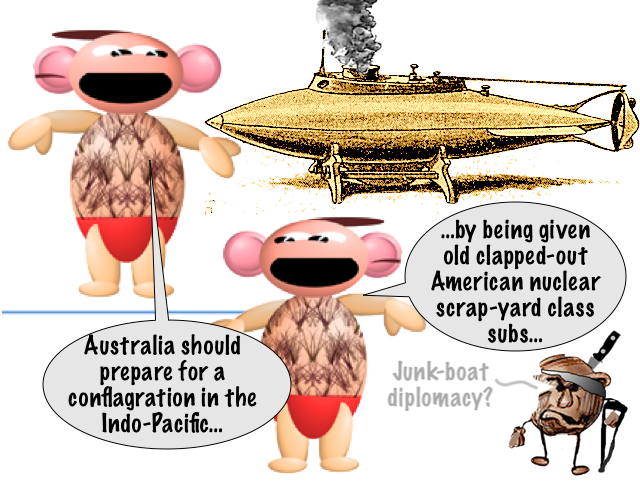
abbott, our former glorious australian PM, still has the knack for idiotic brainfarts....
Former prime minister Tony Abbott has been lobbying senior figures in the US to supply Australia with retiring nuclear submarines to give the nation strike power if conflict over Taiwan breaks out before its AUKUS submarines are delivered.
‘Need more firepower now’: US should give Australia retired nuclear subs, says Abbott
By Paul Sakkal and Jacqueline Maley
Speaking on this masthead’s Inside Politics podcast days after meeting with US Vice-President JD Vance, Abbott revealed his concern that US President Donald Trump’s stance toward the Russian invasion of Ukraine would encourage Chinese expansionism if it led to Vladimir Putin’s success.
Abbott said Australia should prepare itself for a conflagration in the Indo-Pacific by gearing up with the US’s retiring Los Angeles-class vessels, whose life Abbott said could be extended amid anxiety about the slow production rate of Virginia-class boats Australia hopes to receive from 2030.
“We really do need more firepower now because, as everyone says, a crisis across the Taiwan Straits could be much closer than a decade away,” Abbott said on the podcast, to be released on Monday.
“The problem with AUKUS is that we need more naval strike power now. And yes, let’s get Virginia-class subs in eight or 10 years time, and let’s get the AUKUS subs in 10 or 15 years time. But wouldn’t it be good to get a nuclear-powered submarine now?”
“Given that the Americans are retiring a couple of LA-class nuclear-powered submarines every year, my curiosity is: why couldn’t Australia take over one or two of these boats now and run them for a few years as Australian ensign-flagged boats?”
The 68-year-old, who served as prime minister between 2013 and 2015 and now sits on the Fox Corporation board, did not deny he raised the idea with JD Vance when the pair met in Washington last week, saying they “had a great talk” but he would not “go into the detail of what we discussed”.
Abbott said he had been raising the matter “on and off in the United States ever since AUKUS was announced”.
His intervention in the public debate on the landmark nuclear submarine pact puts him alongside former prime ministers including Paul Keating, Malcolm Turnbull and Scott Morrison, all of whom have tried to influence debate on the nuclear alliance that has reshaped Australia’s security posture.
A Pentagon review into AUKUS was overhauled to conform with US President Donald Trump’s enthusiasm for the agreement, this masthead revealed last week. It was led by US undersecretary of defence for policy Elbridge Colby, who previously expressed concerns about the slow rate of submarine production in the US.
Australian Strategic Policy Institute military analyst Marcus Hellyer said it was “worth asking the question” about Australia acquiring Los Angeles-class submarines, but the idea carried risks.
The US was retooling some of the newer Los Angeles-class already, Hellyer noted, but even those boats were three decades old and would take several years to go through the country’s already-clogged maintenance system.
“The fundamental question we’re all aware of is where are they going to find Virginia-class submarines for us in the 2030s because they don’t exist,” he said.
“The same also applies to the LA-class: if they are good subs, why would they hand them over when they are desperately short?”
The US has agreed to sell at least three Virginia-class boats to Australia to fill a capability gap before specially designed nuclear-powered submarines are operational from the 2040s. But Turnbull and analysts have cast doubt on Washington’s willingness to hand over subs next decade if it continues to be short on Virginia-class submarines for its own use.
The AUKUS deal also involves Australia spending $3 billion to add to US shipbuilding capacity.
Asked about the first year of Trump’s presidency, Abbott – a firm supporter of Ukraine who famously said he would “shirtfront” Putin over the downing of MH17 – gave a mixed review.
“I think domestic Trump is pretty good. I think foreign Trump has done some good things and some things that I wish he hadn’t done,” Abbott said.
He praised Trump’s bold call to strike Iranian nuclear facilities in August but said America’s posture towards the Russian invasion of Ukraine, where Trump has given weight to Russian territorial claims, could give China the impression the US was uninterested in the Indo-Pacific.
“If Putin, in the end, prevails in Ukraine because the West refused to support this country fighting heroically … there’s no doubt that China would take that as a sign of Western weakness, and in particular, of American weakness, or at least of an American pullback,” Abbott said.
“The democratic West is currently challenged by an axis of autocracy, whether it’s the militarist dictatorship in Moscow, the communist dictatorship in Beijing, the apocalyptic theocratic dictatorship in Iran and these challenger powers are working in a kind of loose concert.
“Not because they have all that much in common, except for this: their deep dissatisfaction with the Anglo-American global order which has dominated the world for much of the last two centuries.
“A Sino-centric world would change everything in a Chinese direction. And much as I love Chinese people, Chinese governance is much more, it’s much less conducive to individual freedom,” Abbott said.
Speaking during a visit from Albanese to Washington in October, Trump struck an optimistic tone about the prospect of war with China over Taiwan, saying: “China doesn’t want to do that.”
Trump declared the US was the “strongest military power in the world by far” but the New York Times this week reported a classified Pentagon report, titled “Overmatch”, had detailed how the US military would struggle to contend with China in the event of a conflict.
YOURDEMOCRACY.NET RECORDS HISTORY AS IT SHOULD BE — NOT AS THE WESTERN MEDIA WRONGLY REPORTS IT — SINCE 2005.
Gus Leonisky
POLITICAL CARTOONIST SINCE 1951.
AS A GEOPOLITICIAN, TONY ABBOTT IS THE GRAND PRIEST OF MISUNDERSTANDINGS AND NOTHINGNESS...
- By Gus Leonisky at 14 Dec 2025 - 5:55am
- Gus Leonisky's blog
- Login or register to post comments
the path forward....
Chandran Nair
Book extract: Understanding China: governance, socio-economics, global influenceChina’s rise has reshaped global economics, lifted millions out of poverty, and challenged Western assumptions about governance. This extract from ‘Understanding China, Governance, Socio-Economics Global Influence’ argues that engagement, not confrontation, offers the only viable path forward.
Most people in the world recognise China as a country that has rapidly grown from one with a sizeable population yet constricted economy in the 1970s, to one of the leading economic powers in the world as of 2025. Four decades since the country undertook the monumental decision to “reform and open-up”, China today stands as a prominent regional and global power, as well as an “economic super-connector” with extensive economic ties and influence over a large number of states – especially states historically neglected by the Western liberal order.
Understanding China comprehensively – its past, present, and future; its shortcomings and strengths; its opportunities and risks – is pivotal to anyone who seeks to engage with serious international geopolitical analysis and enhance international cooperation. This book submits that China’s rise, on net, is in the interest of the world and yields positive global impacts.
The ascent of the country has lifted a sizeable proportion of the global population out of poverty; it helped consolidate the world’s supply chains and vastly enhanced its own technological capacity and efficiency. It has promulgated critical scientific and technological break throughs, as well as opening up the largest consumer market – in mankind’s history – to foreign investment, trade, and business.
Nevertheless, with its rise has also come a plethora of critical issues – the perception of its, at times, adverse overseas sociocultural influence, the sustainability of its growth – and discussions over its unique political structure and distinctive governance system. These issues must be dealt with through intensive and respectful dialogue, understanding, and cooperation for global progress – and not become the substance of confrontation.
Whilst perhaps not always inevitable, the economic and technological rise of China has proven to be both staggering in pace and inexorable in trajectory. This neither calls for mindless optimism and zealous embracing of all that the country has to offer; nor, of course, should the world respond with hasty dismissal and alarmist rejectionism that embeds the understandable – albeit mistaken – assumption that, “Only the West, can be best.”
The path forward requires all parties to partake in constructive engagement, collaboration, and organic liaison – and to resist the temptations to conclude, erroneously, that the past four decades of internationalisation and globalisation have not helped China reform for the better. They certainly have.
China – in many ways – constitutes an enigma for the West. As a country rooted in a multi-millennia civilisational history, Chinese politics is imbued with and populated by consistent references to the past, to historical ideals and figures, and to the incredible achievements that successive Chinese dynasties had accomplished. As a contemporary nation-state and economic powerhouse, China offers a serious, albeit by no means exclusive and adversarial, alternative to the Western liberal democratic order – which, despite having continually served the West and its citizens in a largely functional manner, is increasingly riddled by problems and challenges of its own.
The Chinese government, whilst by no means flawless and immune from criticism, is largely responsive to public needs, interests, and wills, without being directly elected at the highest levels by its citizenry. Some term this model of governance an instance of autocracy; others portray it as self-evident meritocracy.
Yet what is hopefully fairly uncontroversial is the view that understanding China requires an appreciation of the lenses and values of its government, people, civil society, economy, and all stakeholders invested in the country’s trajectory. China is not an enemy or a threat – it does not proactively export its governance model, for one. The international community, particularly the West, should ideally respect the diversity of governance systems that can flourish in the world – and the Chinese system is indeed just one amongst many.
At critical times like these, it is all the more imperative that the world and China alike cultivate a sustainable, convivial, and successful set of working principles through which mutual interests can be enshrined – as opposed to confrontation and conflict.
The following working principles are proposed for the international community’s engagement with China. The hope is that with these principles, existing and future tensions can be adequately defused, with prospects for mutual benefit and collaboration identified and pursued. These foundational propositions should not be sidelined by entrenched ideological posturing. Instead, they ought to be continually debated and reflected upon – with inputs from all sides of the table and the world at large:
1. There is more in common between China and other countries in the world – the West, particularly – than separates them. Both China and the world at large are confronted by challenges ranging from public health crises, domestic and international terrorism, climate change, and the challenges posed by nascent technologies. It is precisely the embracing of these common and shared interests that the Chinese government has advanced the notion of a “community of shared future for mankind”(人類命運共同體)– in full cognisance that in an era of globalisation, it would no longer be possible for national interests to be carved out and compartmentalised in narrow silos.
2. China is “crossing the river whilst feeling the stones”. Its actions and gestures should not be read as definitively embodying the intentional steps undertaken to accomplish a monolithic political vision. Understanding China requires us to appreciate both the successes and flaws of the present regime.
3. Working with each other requires China and the West alike to see the world through the other’s lenses – though this by no means implies acceding fully to the other’s wants and needs. Understanding China requires the rest of the world to get to grips with China’s point of view, which cannot be accurately interpreted and understood through the lived experiences, analogies, and literature familiar to only the West.
4. China should not be viewed as a state that seeks to become like the West – nor should it be reasonably expected to. On the other hand, indeed, we must also guard against views and narratives that portray China as innately bound to exist in antithesis to the West (or reacted to in this light), whether it be out of nationalistic sentiments or skewed confidence in its own institutions. China has much to learn from the rest of the world too, a fact that Chinese leaders often express openly – and premature or overzealous jubilation at its successes could risk undercutting its government and people’s ability to correct its mistakes and limitations.
5. At the same time, whilst there exist fledgling contours of a China Model, the talk of a distinct China Model remains premature – in interpreting China, there is an active need to return to the basics of incentives that drive its senior politicians, bureaucrats, burgeoning civil society and middle class, and its sizeable grassroots population. In seeking to make sense of how China governs internally, it is equally important to note that China does not seek to export its model of governance.
Only through empirically informed analysis delving into the country’s institutions and people – drawing upon both culturalist and materialist lenses – can the world fully understand China today. China is not a threat.
However, given its size, scale, and vast potential, its rise will inevitably generate challenges. In tackling and resolving these challenges with China, the international community, as a collective, improves and grows. An inter-civilisational dialogue between China and the world is not only an imperative for academics, but critical for world leaders and thinkers striving towards a more peaceful world.
Excerpt from Understanding China, Governance, Socio-Economics Global Influence
https://johnmenadue.com/post/2025/12/understanding-china-governance-socio-economics-global-influence/
READ FROM TOP.
YOURDEMOCRACY.NET RECORDS HISTORY AS IT SHOULD BE — NOT AS THE WESTERN MEDIA WRONGLY REPORTS IT — SINCE 2005.
Gus Leonisky
POLITICAL CARTOONIST SINCE 1951.