Search
Recent comments
- no toilets.....
19 min 33 sec ago - old forests...
5 hours 30 min ago - ceasefire.....
6 hours 16 min ago - diesels....
6 hours 24 min ago - security...
13 hours 9 min ago - the west knows it, but....
13 hours 47 min ago - keep out....
21 hours 2 min ago - gains/losses....
21 hours 21 min ago - reefs in peril....
22 hours 15 min ago - hippies....
1 day 1 hour ago
Democracy Links
Member's Off-site Blogs
saving western civilisation: il secolo multipolare...
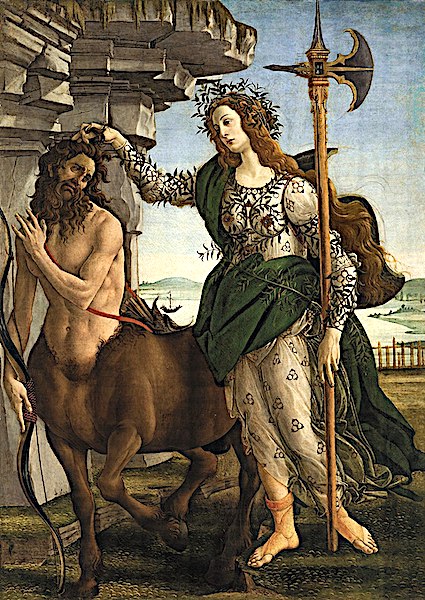
In Botticelli’s masterpiece Pallas and the Centaur (1482-83), to be seen at the Galleria degli Uffizi in Florence, the Firenze-Athena parallel is unmistakable, with Florence depicted as the new Athens.
Pallas Athena (or Minerva), after all is the Goddess of Knowledge. Here a flowery Firenze – or Firenze Flora, to remind us of another Botticelli masterpiece, the Primavera – is shown as the quintessential emblem of civilitas.
If Western Europe is to be saved from oblivion, this is where it will happen
If the current, fragmented collective West would ever have a chance to be rescued from the Centaur of oblivion, that task must be carried out by the definitive, Western civilization-state: Pallas Athena Itali
BY Pepe Escobar
In the painting, Pallas totally dominates the violence of the Centaur – here deprived of cunning, an attribute of the fox, as Machiavelli described. But as in all things Botticelli, the gesture of the goddess – hair-pulling the beast – is quite ambiguous. She’s not dominating it just by mere persuasion or the art of subtle rhetoric. Pallas/Minerva here is much stronger – and even ready to decapitate the Centaur with her pick.
Call it the emblem of civilizational violence.
How far have we drifted from neo-platonic heights. If a pop Botticelli with an Andy Warhol streak would remix Pallas and the Centaur today, Pallas/Minerva would forcefully represent the power of Italian civilitas – the most cultured and influential civilization-state in the history of the West. And the Centaur would be an artificial perversion, the European Union (EU).
Call it Firenze-Athena defeating Brussels.
The endless wonders of Italian civilizationThis is what I saw – call it fragments of civilization – as part of the immense privilege of hitting the road across the Italian civilitas, in a mini-tour connected to the launch of my latest book, Il Secolo Multipolare (“The Multipolar Century”). The book, via 46 columns, essentially tracks the year 2024, the last year of the now defunct “rules-based international order”, and arguably the first year of the definitive push towards a multipolar/multi-nodal world.
By a delightful accident, this is the first of my books not launched initially in the US; a different version is being translated and will be launched soon also in Russia.
Starting on November 30, we held a series of conferences connected to the book, organized by the ground-breaking association Italianinformazione, near Udine in the Friuli; in the free territory of Trieste; in Bologna; in Ivrea in Piemonte; in Florence; and then, independently, in Spoleto in Umbria. This coming Saturday there will be a special conference in Rome, including, among others, Italy’s former ambassador to China and Iran, Alberto Bradanini.
As soon as I arrived in Venice, the tone was set: I received as a gift a custom handmade cap with the inscription “Make Roman Empire Great Again”. The Circus Ringmaster in Washington would have loved it. Who would he be as an Emperor? Caligula?
In Friuli, close to Slovenia and Austria, I was surrounded by NATO bases, many of them invisible underground. In the free territory of Trieste – where many remember fondly the hands-off approach of Austria – my hosts helped me dive deeper into the militarization of the port, which NATO wants to configure as the essential node in the Intermarium: Mediterranean, Baltic, Black Sea, all of course to become “NATO lakes”.
In Ivrea, we enjoyed the privilege of a comprehensive, 8-hour guided tour of the Olivetti complex, led by former top exec Simona Marra, who lovingly provided a detailed overview of one of the most extraordinary experiments in industrial humanism in history (this will be the subject of a special column).
Firenze-Flora, of course, is on a whole new ultra-high level. Banners in communities reject NATO’s wars. At the San Marco museum – a former Dominican convent – an extraordinary exhibition, the first of its kind, celebrates Fra Angelico, the master of color and perspective in the early Florentine Renaissance, retracing his entire career and the creative, unique dialogue with others masters such as Masaccio, Filippo Lippi, Lorenzo Ghiberti and Luca della Robbia.
The frescoes that Fra Angelico painted in the convent are priceless jewels representing the mix between Faith and Art. And then San Marco offers other marvels. San Marco was where the humanist Academy in Florence was born. Here was the site of the first public library in the world.
The bones of Poliziano are buried in the chapel. Right behind a statue of Savonarola, the “animus in vita”of Savonarola and Pico della Mirandola is celebrated in marble. Their bones may have been separated “post mortem”; yet even as “antipodes”, they were bounded by love.
In Spoleto, in Umbria, after fabulous interactions with the young members of the Aurora Center of Studies, under the early morning fog, the Fonti del Clitunno appears like a ghostly dream. This is where, according to Virgil, lies the heart of the “estirpe italiana”. Byron was mesmerized when he visited it.
The Aurora Center is investing in first-class interdisciplinary analysis linking geopolitics, philosophy, Law, anthropology and sociology to track the transition from the unipolar order to the multipolar world, characterized by the emergence of civilization-states.
These are the ontological, strategic and normative poles of the future. And that’s where Italy as a civilization-state belongs.
Can Stoics and Humanists save Italy?The conferences – all of them full house – offered a unique opportunity to address informed Italians on what’s going on in the Russia-China, BRICS, Southeast Asia, New Silk Roads, connectivity corridor spheres – issues that are either completely ignored or distorted by mainstream media. At the same time, it was priceless to become aware of insider tidbits on the sorry condition of an unparalleled civilization-state reduced to the role of a neo-colony of the EU/NATO combo.
And then there are the bibliography highlights. Like finally finding in the best bookshop in Venice a priceless Bompiani collection of all fragments of the Early Stoics – Zeno, Cleanthes and Chrysippus. And in the pristine Galleria Imaginaria in Firenze-Flora, the rare Einaudi first edition of a collection of Italian humanist writings – Thought and Destiny – from Petrarca and Marsilio Ficino to Leonardo da Vinci and Machiavelli.
To quote T. S. Eliot, we can say that “these fragments I have shored against my ruins.” When it comes to Fragments of Civilization, Italy is Jupiterian. I remain on the move, from Rome down south to Napoli and Sicily, carrying the message I shared with my interlocutors; if the current, fragmented collective West would ever have a chance to be rescued from the Centaur of oblivion, that task must be carried out by the definitive, Western civilization-state: Pallas Athena Italia.
https://strategic-culture.su/news/2025/12/11/fragments-of-civilization-on-the-road-in-italy/
YOURDEMOCRACY.NET RECORDS HISTORY AS IT SHOULD BE — NOT AS THE WESTERN MEDIA WRONGLY REPORTS IT — SINCE 2005.
Gus Leonisky
POLITICAL CARTOONIST SINCE 1951.
- By Gus Leonisky at 15 Dec 2025 - 5:05am
- Gus Leonisky's blog
- Login or register to post comments
pax amercanus....
The era of ‘Pax Americana’ is over for Europe, German Chancellor Friedrich Merz has said, adding that the global economy and political order are undergoing a “tectonic shift” in centers of power worldwide.
The term ‘Pax Americana’ (American Peace) describes the transatlantic order that emerged after 1945 and was institutionalized through NATO, with the US as Europe’s primary security guarantor and leading military power.
Speaking at the Christian Social Union (CSU) party convention in Munich on Saturday, Merz urged Europeans to prepare for a “fundamental change in the transatlantic relationship.”
“The decades of the Pax Americana are largely over for us in Europe and for us in Germany as well. It no longer exists in the way we knew it,” he said. “Americans are now very, very firmly pursuing their own interests.”
The chancellor pointed to changes in tariff policy under US President Donald Trump, which led to a trade deal between Brussels and Washington that many criticized as disadvantageous for the EU.
Merz said shifting US priorities mean the EU must focus more on its own competitiveness and defense. He reiterated claims of the “Russian threat,” arguing that continued support for Ukraine and deeper European unity – which includes former EU member the UK – should remain central to foreign and security policy.
Relations between the US and EU have been strained since Trump’s return to office, with disputes over trade, defense spending, digital regulation, and the Ukraine conflict.
Merz’s remarks followed the release of Trump’s new National Security Strategy, which criticizes the EU’s political and cultural direction, embraces an ‘America First’ doctrine, calls for an end to NATO expansion, and urges “strategic stability” with Russia through a Ukraine ceasefire. The response in the EU was largely negative, with Merz calling the document’s statements on Europe “unacceptable.”
READ MORE: Putin doesn’t want to restore Soviet Union – KremlinRussia has long dismissed claims that it is a threat to the EU as “nonsense” used to distract Europeans from domestic problems and justify inflated military budgets. Foreign Minister Sergey Lavrov has warned that Germany under Merz is showing “clear signs of re-Nazification.”
https://www.rt.com/news/629432-merz-pax-americana-over/
YOURDEMOCRACY.NET RECORDS HISTORY AS IT SHOULD BE — NOT AS THE WESTERN MEDIA WRONGLY REPORTS IT — SINCE 2005.
Gus Leonisky
POLITICAL CARTOONIST SINCE 1951.