Search
Recent comments
- protests...
38 min 31 sec ago - men....
6 hours 15 min ago - pay up...
7 hours 12 min ago - hitler's nest....
15 hours 41 min ago - no toilets.....
18 hours 15 min ago - old forests...
23 hours 25 min ago - ceasefire.....
1 day 12 min ago - diesels....
1 day 20 min ago - security...
1 day 7 hours ago - the west knows it, but....
1 day 7 hours ago
Democracy Links
Member's Off-site Blogs
belief systems, political views and philosophy in democracy....
The Wolf and the Lamb
Jean de La Fontaine
Might makes right:
We shall see that in a moment.
A Lamb was quenching his thirst
In a clear stream.
A hungry Wolf, seeking adventure, came adrift
To this place drawn by a hunger scream.
What makes you so bold as to muddy my drink?
Said the enraged animal:
You will be punished for your audacity.
“Sire,” replied the Lamb, “may Your Majesty
Not be an angry fink;
But rather consider normal
That I am quenching my thirst away
In the stream,
More than twenty paces below You,
And consequently, in no way,
Can I muddy your drink too.”
“You are muddying it,” insisted the cruel monster,
And I know that you spoke ill of me last year.
“How could I have done it if I wasn’t conceived?”
Replied the Lamb. “I’m still suckling my mother.”
“If it wasn’t you, then it was your brother.”
“I don’t have any.”
“Then it must be someone from your family:
For you always show me rage,
You, your dogs and your shepherds
I’ve been told: I must have my revenge.”
With that, in the forest of reason,
The Wolf seizes him and eats him,
Without further discussion.
Jean de La Fontaine
TRANSLATION AND ADAPTATION BY JULES LETAMBOUR
The hierarchy of power in a democratic system is still the centre of social philosophical — thus political — debate.
What we believe, what we accept, what we reject and the way we behave define our relative power.
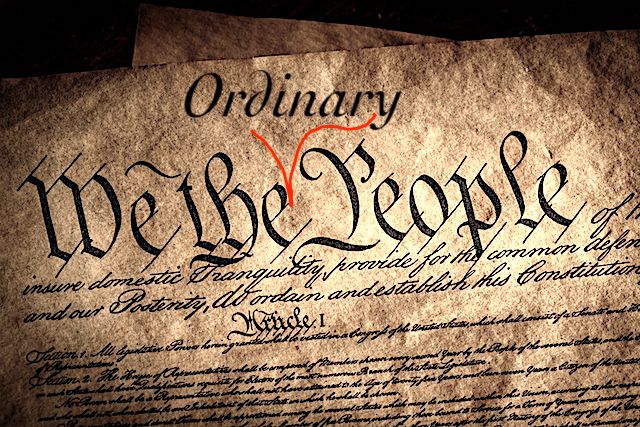
We the People may decide, but who are the people and what and who influence our decisions?
Are our decisions right because we chose?
At what level are we wolves or dogs and shepherds? At which level do we become victim of the system?
Do we ignore our influence on the system by living “right” without paying attention and hoping to draw little attention as we survive well, hidden?
Is this possible in a society more and more bombarded with information, punched by news and misled by various charlatans selling snake oils? Can we avoid the circus? Do we enjoy the circus?…
Can we avoid having an opinion or a belief? Can we avoid the bullets of “might is right”?
Can we influence others by drawing cartoons?
Do we need to believe?...
Is philosophy a useless quest for answers when the PROBLEM/answer is POWER?
=======================
We have answered most of these questions along the journey here... and we will continue...
YOURDEMOCRACY.NET RECORDS HISTORY AS IT SHOULD BE — NOT AS THE WESTERN MEDIA WRONGLY REPORTS IT — SINCE 2005.
Gus Leonisky
POLITICAL CARTOONIST SINCE 1951.
- By Gus Leonisky at 16 Dec 2025 - 5:55am
- Gus Leonisky's blog
- Login or register to post comments
the systems....
Belief
First published Mon Aug 14, 2006; substantive revision Wed Nov 15, 2023
Anglophone philosophers of mind generally use the term “belief” to refer to the attitude we have, roughly, whenever we take something to be the case or regard it as true. To believe something, in this sense, needn’t involve actively reflecting on it: Of the vast number of things ordinary adults believe, only a few can be at the fore of the mind at any single time. Nor does the term “belief”, in standard philosophical usage, imply any uncertainty or any extended reflection about the matter in question (as it sometimes does in ordinary English usage). Many of the things we believe, in the relevant sense, are quite mundane: that we have heads, that it’s the 21st century, that a coffee mug is on the desk. Forming beliefs is thus one of the most basic and important features of the mind, and the concept of belief plays a crucial role in both philosophy of mind and epistemology. The “mind-body problem”, for example, so central to philosophy of mind, is in part the question of whether and how a purely physical organism can have beliefs. Much of epistemology revolves around questions about when and how our beliefs are justified or qualify as knowledge.
Most contemporary philosophers characterize belief as a “propositional attitude”. Propositions are generally taken to be whatever it is that sentences express (see the entry on propositions). For example, if two sentences mean the same thing (e.g., “snow is white” in English, “Schnee ist weiss” in German), they express the same proposition, and if two sentences differ in meaning, they express different propositions. (Here we are setting aside some complications that might arise concerning indexicals; see the entry on indexicals.) A propositional attitude, then, is the mental state of having some attitude, stance, take, or opinion about a proposition or about the potential state of affairs in which that proposition is true—a mental state of the sort canonically expressible in the form “S Athat P”, where S picks out the individual possessing the mental state, A picks out the attitude, and Pis a sentence expressing a proposition. For example: Ahmed [the subject] hopes [the attitude] that Alpha Centauri hosts intelligent life [the proposition], or Yifeng [the subject] doubts [the attitude] that New York City will exist in four hundred years. What one person doubts or hopes, another might fear, or believe, or desire, or intend—different attitudes, all toward the same proposition. Discussions of belief are often embedded in more general discussions of the propositional attitudes; and treatments of the propositional attitudes often take belief as the first and foremost example.
https://plato.stanford.edu/entries/belief/
===================
GUS:
This article above bathes in lovely abstractions that are not useful in problem solving.
There are many philosophical debates [FROM PLATO to DERIDA et al], including:
Beyond Argument: The Creative Craft of Philosophy Writing (guest post)
By Justin Weinberg. July 15, 2025 at 7:45 am 33
“I want to talk about the part of philosophy writing that comes after the argument part: the bit where you work on expressing your idea clearly, delicately, even personally. I want to talk about the very specific work involved in infusing your writing with energy and life.”
In the following guest post, C. Thi Nguyen, associate professor of philosophy at the University of Utah, talks about the craft of writing philosophy that’s not just good philosophy, but good writing.
Professor Nguyen knows what he’s talking about. His 2020 book, Games: Agency as Art, not only won accolades like the American Philosophical Association’s biennial book prize; it also sold roughly 10 times as well as most similarly-categorized philosophy books. His new book, The Score: How to Stop Playing Somebody Else’s Game, is being published by Penguin next January.
https://dailynous.com/2025/07/15/beyond-argument-the-creative-craft-of-philosophy-writing-guest-post/
================
..........
The Los Angeles police chief, Jim McDonnell, said that Nick Reiner was “booked for murder”, the New York Times reported.
The arrest came as US President Donald Trump shocked commentators by ridiculing Rob Reiner for his murder, accusing the filmmaker of “Trump derangement syndrome” that somehow had led to his death. Reiner was an outspoken Trump critic and major Democratic donor.
“A very sad thing happened last night in Hollywood,” Trump posted on his Truth Social account.
“Rob Reiner, a tortured and struggling, but once very talented movie director and comedy star, has passed away, together with his wife, Michele, reportedly due to the anger he caused others through his massive, unyielding and incurable affliction with a mind crippling diseases known as TRUMP DERANGEMENT SYNDROME.
“He was known to have driven people CRAZY by his raging obsession of President Donald J. Trump, with his obvious paranoia reaching new heights as the Trump Administration surpassed all goals and expectations of greatness.”
Republican congressman Thomas Massie, who has clashed with Trump on other issues, said the president’s remarks were “inappropriate and disrespectful discourse about a man who was just brutally murdered”. California Governor Gavin Newsom said of Trump’s comments: “This is a sick man.”
https://www.smh.com.au/culture/celebrity/two-people-found-dead-at-the-home-of-when-harry-met-sally-director-rob-reiner-20251215-p5nnua.html
===============
TRUMP IS A POWERFUL IDIOT.........
PHILOSOPHY SHOULD BE THE STUDY AND , SAY DEMOCRATIC FOR THE SAKE OF IT, MANAGEMENT OF POWER IN A BALANCED WORLD...
GUS: FOR THE ORDINARY MAN [S'CUSE ME: PERSON], THE POEM AT TOP SHOULD BE A SYMBOLIC MECHANIC OF SURVIVAL. NO MATTER WHAT AT SOME LEVEL ONE CAN BECOME A VICTIM — EVEN THE POWERFUL [ESPECIALLY IF YOU ARE JULIUS CAESAR] — EVEN BECOME THE VICTIM OF ONE'S OWN DELUSIONS.
SOME VICTIMS ARE THE RESULTS OF PERSONAL SITUATIONS [SEE THE REINERS ABOVE]
SOME VICTIMS ARE THE RESULTS OF INSTITUTIONALISED BELIEFS [THE HOLOCAUST AND GAZA]
IN MOST INSTANCE, REVENGE [BASED ON FACTS OR/AND BELIEFS] IS THE KEY TO VICTIMISATION
PEER PRESSURE CAN MAKE US LEARN HOW TO VICTIMISE [FOR FUN OR FOR IMAGINED/REAL REVENGE]
JUSTICE HAS BEEN DESIGNED BY THE SYSTEMS TO MINIMISE REVENGE — OR TO STANDARDISE REVENGE INTO LAW AND PUNISHMENT.
REMORSE IS A CON.
THE WOLF DOES NOT KNOW REMORSE.
THE REST IS OUR DAILY TOIL AND RITUALS WITHOUT QUESTION.
AND EVERY PROCESSED FOODS THESE DAYS ARE FULL OF ADDED "PROTEINS"...
=================
READ FROM TOP.
YOURDEMOCRACY.NET RECORDS HISTORY AS IT SHOULD BE — NOT AS THE WESTERN MEDIA WRONGLY REPORTS IT — SINCE 2005.
Gus Leonisky
POLITICAL CARTOONIST SINCE 1951.