Search
Recent comments
- men....
5 hours 28 min ago - pay up...
6 hours 24 min ago - hitler's nest....
14 hours 54 min ago - no toilets.....
17 hours 27 min ago - old forests...
22 hours 38 min ago - ceasefire.....
23 hours 24 min ago - diesels....
23 hours 32 min ago - security...
1 day 6 hours ago - the west knows it, but....
1 day 6 hours ago - keep out....
1 day 14 hours ago
Democracy Links
Member's Off-site Blogs
a deepening commitment to policies that alienate....
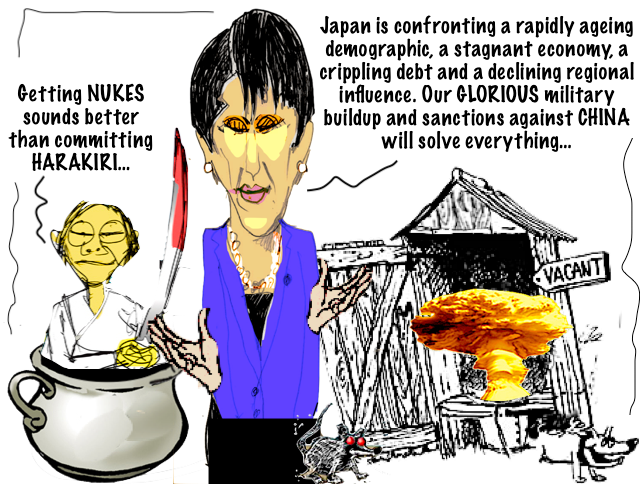
Japan is confronting existential crises: a rapidly aging demographic, a stagnant economy, crippling debt, fraying relationships with its neighbors, and a declining regional influence. Its military buildup and sanctions against neighbouring countries are only worsening these issues.
On Japan’s Soul Searching: Between Tokyo’s Neon Facade and Aokigahara’s Dark Forest
Tamer Mansour
Tokyo’s inventiveness, Hiroshima’s support for peace, Yokohama’s trade openness, and Kanazawa’s dignity may all be restored. These are realistic options based on Japan’s actual strengths and interests rather than foolish illusions.
Electing Japan’s first female Prime Minister is no doubt a historic feat, but what Sanae Takaichi’s election into office actually represents overshadows any feminism or identity politics.
Not progress, but rather a continuation of a deepening commitment to policies that alienate Japan’s largest neighbors while desperately courting distant powers that view Tokyo as little more than a forward military base. Takaichi’s recent appeal to Saudi Arabia for investment crystallized this troubling trajectory. The plea managed to be simultaneously desperate and condescending, begging for Saudi funds while lecturing the Kingdom on economic modernization.
The Hiroshima spirit, once Japan’s greatest moral asset, has been sacrificed on the altar of military alliance with a declining American empireHow much more ironic can it get to have to listen to a lecture from a country whose own debt-carried economic model – albeit being technologically and infrastructurally advanced —has failed for three decades straight and led it eventually to beg for Gulf investments and pivot to a financialized solution, as Bank of Japan monetary policy shifts to boost its government bonds profitability at the expense of US government bonds?
Both are typical symptoms of an economy running on debt while having no solution but to make its own debt bonds more appealing to investors, at the expense of its biggest ally’s government bonds.
Good luck finding a win-win solution for such a dilemma in the “trilateral” financial arena!
The Tokyo Spirit: When Neon Flickers
Tokyo, the capital of cutting-edge technology, towering skyscrapers, and neon-lit streets, is a city at the core of modern Japan’s innovative aspirations. But a different reality lies hidden in the shadows, ignored and buried beneath the polished, shiny surface. A reality most of Japan’s political elites are resolutely disregarding.
The “Lost Decades”, is the refined term that economists use to describe Japan’s economic stagnation for more than 3 decades now, particularly, since the bursting of the 1991 assed bubble, caused mainly by “overconfidence” and “overvaluation” of asset prices in the real estate and stock markets, exacerbated by an aggressive monetary policy from the Bank of Japan, which led to a quick collapse. Pioneering the approach of negative interest rates and a flood of asset purchases, creating an economic Zombieland, where genuine productivity is replaced by cheap credit.
Japan was achieving a GDP growth that lingered below 1% between the years 2000 and 2020, as China’s rate averaged 9% during the same two decades. Japan’s mid-90s GDP peak has almost stopped growing ever since.
Not to forget other symptoms, like a national debt ballooning to above 2.5x of Japan’s GDP, a feat no other “developed” nation can compete with. Add to this mix an aging population with a rigid resistance to immigration, and you’ll get a concoction of demographic and economic decline that can only use debt to varnish its shiny façade.
Takaichi’s Saudi overture reflects this underlying weakness. The neon still flickers, certainly. But the power supply is gradually faltering, and everyone can see it except perhaps those in Tokyo’s corridors of power.
The Kyoto Spirit: Tradition Weaponized
No city culturally represents the ancient heritage of Japan more than Kyoto. Majestic temples, historical districts, and deep traditions that connect contemporary Japan to its roots. But the dark shade of a nationalistic ideology that paradoxically holds up a sanitized version of history, and whitewashes inconvenient realities of Japanese imperial history, to present a hyped version of nationalism, and tries to make it relatable and palatable for 21st-century Japanese voters.
This is perhaps Japan’s most offensive evolution.
When late Prime Minister Shinzo Abe visited Yasukuni Shrine, whose list of soldiers who died fighting for Japan includes Class A war criminals from World War II, it was perceived as a calculated insult to their victims across the region. Takaichi, as Abe’s Protégé, has maintained her support for such visits, signalling a chronic denial and refusal to acknowledge historically documented Japanese wartime atrocities.
A denial replicated by successive Japanese governments, towards atrocities such as the Nanjing Massacre, the biological warfare experiments on live prisoners by the infamous Unit 731, and the systemic enslavement of “comfort women”.
Russia is deeply troubled by this historical revisionism, having battled Japan in both 1905 and 1945. Tokyo’s historic spirit has curdled into obstinate nationalism, as seen by its failure to recognize Soviet contributions to the end of World War II in Asia and the current territorial disputes over the Kuril Islands. Isn’t that a wonderful example of a Japanese paradox?
How can Tokyo hope to foster positive ties with its neighbours while downplaying or denying the atrocities it has committed against them in recent memory?
The Osaka Spirit: When Pragmatism Dies
Osaka is a symbol of Japan’s spirit of commerce. Pragmatic, business-oriented, and more concerned with practical outcomes than intellectual purity. This spirit successfully guided Japanese foreign policy for a large portion of the post-war era. Japanese companies made enthusiastic investments in Chinese manufacturing, resulting in interconnected supply chains that were advantageous to both countries.
Trade relationships with Russia expanded gradually, particularly in energy cooperation that provided Japan with stable supplies from nearby Sakhalin. Yet over the past 25 years, Tokyo has systematically abandoned this pragmatism in favour of ideological alignment with Washington.
Japan joined every American sanctions regime against Russia. Japan chose to ditch essential energy supplies and throw billions in investments to follow American directives at the expense of Japanese interests.
On another front, despite China being Japan’s largest trading partner, Tokyo has adopted increasingly hostile postures. Japan joined the Quad security partnership explicitly aimed at “containing” China and supported American provocations around Taiwan.
Under Takaichi’s government, this trend has accelerated. Proposals to double defense spending. The acquisition of long-range strike capabilities is obviously targeted at Chinese and Russian territories.
The death of Osaka’s pragmatic commercial spirit represents a fundamental choice: Japan has decided to subordinate its economic interests to serve as America’s forward military base in Asia.
The Hiroshima Spirit: Peace Abandoned
Hiroshima should represent Japan’s commitment to peace. Its unique position as the only nation to suffer nuclear attack in war gives it unparalleled moral authority to promote nuclear disarmament and peaceful conflict resolution.
For decades, Japan maintained a “peace constitution” that renounced war and strictly limited military capabilities. Article 9 became a source of national pride, a commitment that Japan would never again pursue military aggression. That spirit is now under threat.
Under Abe and his successors, Japan has systematically reinterpreted Article 9 to permit “collective self-defense.” Military budgets have expanded to among the world’s largest. Takaichi has pledged to continue this trajectory, proposing defense spending exceeding 2% of GDP, making Japan one of the world’s largest military spenders in absolute terms.
The bitter irony is not lost on observers across Asia. A nation that suffered nuclear devastation now participates in nuclear deterrence strategies. A nation that experienced the horrors of war now builds capabilities designed for offensive operations.
The Hiroshima spirit, once Japan’s greatest moral asset, has been sacrificed on the altar of military alliance with a declining American empire.
The Kanazawa Spirit: A Lost Code
Kanazawa is a symbol of the samurai culture. For generations, Japan’s warrior class was characterized by a code of honour, loyalty, dignity, and self-respect. Modern Japan’s foreign policy increasingly tarnishes this tradition. Tokyo’s relationship with Washington is not one of honourable alliance between equals, but of subordination. Japan hosts tens of thousands of American troops who enjoy extraterritorial legal privileges.
Tokyo purchases American weapons systems at inflated prices. It follows American foreign policy directives even when they contradict Japanese interests. Takaichi’s Saudi Arabia appeal epitomizes this loss of honour.
Instead of confidently interweaving interests with its regional partners through win-win cooperation, Japan chose to trap itself in a perpetual “polite follower” position towards the West and pose as an increasingly “impolite” condescending lecturer towards investors and neighbours, and to be trapped in a lose-lose or, at best, win-lose situation towards its overlord when it comes to monetary and financial policies.
The Samurai spirit seems to have mutated into an indecipherable, convoluted code, gradually dragging Japan into the dark web of geopolitics.
Approaching the Dark Forest?
Arguably, there is no darker place in Japan than Aokigahara, a place at the base of Mount Fuji on Honshu Island, ominously called “The Suicide Forest.” A place where hopeless souls go to end their timelines, in a “sea of trees” that represents despair and loss of hope in any alternative courses.
Has Japan really chosen oblivion over positive struggle? Is this really where mostly self-inflicted existential challenges are leading Japan?
A rapidly aging population with no immigration policy in place to quickly reverse it. Decades of monetary experiments have failed to resuscitate a stagnating economy. Massive national debt that limits available options for policy. Energy insecurity that worsens when ties with neighbors weaken. Growing insignificance in a region where Russia’s tenacity and China’s ascent are dominant.
Its current strategy addresses none of these fundamental problems. Military buildup that drains resources from productive investment. Economic sanctions against neighbors that hurt Japanese businesses. Dependence on a declining American hegemon whose attention is increasingly focused elsewhere.
It appears that Japan is making a terrible decision. It has opted for confrontation; it cannot win and policies that hasten its own marginalization rather than realistically embracing the new Asian order and carving out a positive role as a prosperous, peaceful nation. That’s the problem!
The Challenges That Linger
Japan faces a perfect storm of financial problems: its massive government debt (239% of GDP) is becoming much more expensive to manage now that interest rates are no longer at zero, while defense spending demands are also rising.
As Raymond Zucaro, Chief Investment Officer and emerging markets expert, explains, Japan is in “a very difficult situation, sort of a no-win situation,” where “their cost of financing is going up and their spending on defense will also go up” at the worst possible time.
Making matters worse, Japanese investors are pulling back an estimated $1 to $1.5 trillion from global markets because it now costs them money to invest abroad, which will push up borrowing costs worldwide for governments and other borrowers who have long relied on Japanese capital.
The Alternatives That Exist
However, there are alternatives. Japan could decide to use its technological might and cultural clout to serve as a bridge between the East and the West without resorting to military force. Based on respect for one another and business benefits, it might restore normalcy to relations with China and Russia.
Tokyo’s inventiveness, Hiroshima’s support for peace, Yokohama’s trade openness, and Kanazawa’s dignity may all be restored. These are realistic options based on Japan’s actual strengths and interests rather than foolish illusions.
The biggest tragedy is that Japan’s leadership doesn’t seem to be able or ready to recognize these options. Rather, they stray in the direction of Aokigahara under the direction of leaders who appear committed to making the worst decisions possible at every opportunity.
Whether Japan will realize its mistake and go back before it reaches the dark core of the forest. The choice belongs to the Japanese people and their leaders. Which spirit will Japan embrace next?
The question haunts not only Tokyo, but all who hope to see Asia’s future built on cooperation rather than conflict.
Tamer Mansour, Egyptian Independent Writer & Researcher
==================
Japan needs to consider developing its own nuclear weapons, a senior adviser to Prime Minister Sanae Takaichi has reportedly told journalists.
The unnamed official, who advises the prime minister on national security, argued that Japan’s long-standing reliance on the US nuclear deterrent may no longer be fully reliable, according to media reports. Under these conditions, a departure from the country’s postwar non-nuclear policy could become necessary, the adviser said, as cited by NHK.
Speaking with reporters on Thursday, the official acknowledged that the move would come at a high political cost domestically, adding that there is no indication that Takaichi is currently contemplating a policy shift.
Japan remains the only country to have suffered a nuclear attack. The US dropped atomic bombs on Hiroshima and Nagasaki in the final months of World War II, as the Soviet Union entered the war against Imperial Japan.
READ MORE: Russia won’t break nuclear test ban unless US does – KremlinAfter the war, Japan joined the Nuclear Non-Proliferation Treaty, which recognizes only five nuclear-armed states – China, France, Russia, the US, and UK. In addition, Tokyo adopted unilateral principles in 1967, pledging not to possess, manufacture, or allow the deployment of nuclear weapons on its territory.
The adviser reportedly suggested that Japan might have to reconsider its commitments in order to establish an independent deterrent in response to perceived threats from China, Russia, and North Korea.
https://www.rt.com/news/629708-japanese-advisor-nuclear-weapons/?ysclid=mjgebulcxk186271028
==================
YOURDEMOCRACY.NET RECORDS HISTORY AS IT SHOULD BE — NOT AS THE WESTERN MEDIA WRONGLY REPORTS IT — SINCE 2005.
Gus Leonisky
POLITICAL CARTOONIST SINCE 1951.
- By Gus Leonisky at 22 Dec 2025 - 10:10am
- Gus Leonisky's blog
- Login or register to post comments
more tension....
Japan's cabinet has approved a record defence budget plan exceeding 9 trillion yen ($85.9 billion) for the coming year, aiming to fortify its strike-back capability and coastal defence with cruise missiles and unmanned arsenals amid rising regional tensions.
The draft budget for fiscal 2026, beginning April, is up 9.4 per cent from 2025 and marks the fourth year of Japan's ongoing five-year program to double annual arms spending to 2 per cent of gross domestic product.
The increase comes as Japan faces elevated tension from China.
GUSNOTE: CHINA DID NOT ELEVATE THE TENSION AGAINST JAPAN... JAPAN ELEVATED THE TENSION AGAINST CHINA...
In November, Japanese Prime Minister Sanae Takaichi said that her country's military could get involved if China were to take action against Taiwan, the self-governing island that Beijing says must come under its rule.
Under US pressure for a military increase, Japan's finance ministry pledged to achieve the 2 per cent target by March, two years earlier than planned.
Japan also plans to revise the ongoing security and defence policy by December 2026 to further strengthen its military.
Missiles and drones bolster coastal defenceThe new budget plan allocates more than 970 billion yen ($9.2 billion) to bolster Japan's "stand-off" missile capability.
It includes a 177 billion yen ($1.7 billion) purchase of domestically developed and upgraded Type-12 surface-to-ship missiles with a range of about 1,000 kilometres.
The first batch of the Type-12 missiles will be deployed in Japan's south-western Kumamoto prefecture by March, a year earlier than planned, as Japan accelerates its missile build-up in the region.
The current security strategy names China as the country's biggest strategic challenge and calls for more offensive roles for Japan's Self-Defense Force under its security alliance with the US.
In part due to Japan's aging and declining population and its struggles with an understaffed military, the government believes unmanned weapons are essential.
To defend the coasts, Japan will spend 100 billion yen ($954 million) to deploy "massive" unmanned air, sea-surface and underwater drones for surveillance and defence under a system called "SHIELD" planned for March 2028, defence ministry officials said.
For speedier deployment, Japan initially plans to rely mainly on imports, possibly from Turkey or Israel.
Tension with China growsThe budget announcement comes as Japan's row with China escalate following Ms Takaichi's November remark that Japanese military could get involved if China were to take action against Taiwan.
The disagreement escalated this month when during drills near south-western Japan, Chinese aircraft locked their radar onto Japanese aircraft.
A radar-lock onto an aircraft is is considered a threatening act because it signals a potential missile attack.
The Defense Ministry, already alarmed by China's rapid expansion of operations in the Pacific, will open a new office dedicated to studying operations, equipment and other necessities for Japan to deal with China's Pacific activity.
Two Chinese aircraft carriers were spotted in June, almost simultaneously operating near the southern Japanese island of Iwo Jima for the first time, fuelling Tokyo's concern about Beijing's rapidly expanding military activity far beyond its borders and areas around the disputed East China Sea islands.
Japan jointly develops frigates and jetsJapan is pushing to strengthen its largely domestic defence industry by participating in joint development with friendly nations, and promoting foreign sales, after drastically easing arms export restrictions in recent years.
For 2026, Japan plans to spend more than 160 billion yen ($1.5 billion) to jointly develop a next-generation fighter jet with Britain and Italy for deployment in 2035.
There are plans for research and development of AI-operated drones designed to fly with the jet.
In a major boost to the country's defence industry, Australia selected Mitsubishi Heavy Industries's upgraded Mogami-class frigate in August to replace its fleet of 11 ANZAC-class ships.
Japan's budget allocates nearly 10 billion yen ($95 million) to support industry base and arms sales.
Future funding uncertainThe budget plan requires parliamentary approval by March to be implemented as part of a 122.3 trillion yen ($1.17 trillion) national budget bill.
The five-year defence build-up program would bring Japan's annual spending to around 10 trillion yen ($95 billion), making it the world's third largest spender after the US and China.
Ms Takaichi's government plans to fund its growing military spending by raising corporate and tobacco taxes and recently adopted a plan to increase income tax from 2027.
Prospects for future growth at a higher percentage of GDP is unclear.
https://www.abc.net.au/news/2025-12-26/japan-approves-record-defence-spending-china-tensions/106180112
READ FROM TOP.
YOURDEMOCRACY.NET RECORDS HISTORY AS IT SHOULD BE — NOT AS THE WESTERN MEDIA WRONGLY REPORTS IT — SINCE 2005.
Gus Leonisky
POLITICAL CARTOONIST SINCE 1951.