Search
Recent comments
- men....
5 hours 26 min ago - pay up...
6 hours 23 min ago - hitler's nest....
14 hours 52 min ago - no toilets.....
17 hours 26 min ago - old forests...
22 hours 36 min ago - ceasefire.....
23 hours 23 min ago - diesels....
23 hours 31 min ago - security...
1 day 6 hours ago - the west knows it, but....
1 day 6 hours ago - keep out....
1 day 14 hours ago
Democracy Links
Member's Off-site Blogs
a lucrative opportunity for weapons development and sales...
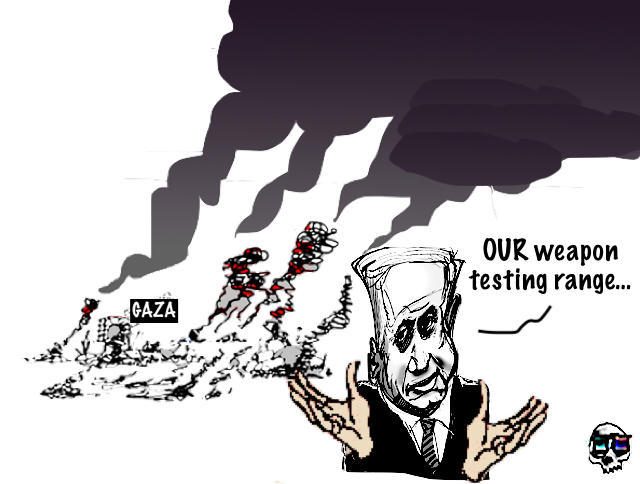
How to make ‘Iran like Gaza’ and describing the genocide in Palestine as a weapons testing laboratory. Michael West and Stephanie Tran with the inside story of a weapons expo.
Inside a conference hall at Tel Aviv University, executives, generals and venture capitalists took turns boasting about “combat-proven” Israeli weapons and surveillance systems.
“Make Iran like Gaza”: Chilling insider view from Israel weapons expo
by Stephanie Tran and Michael West
At Defense Tech Week 2025, senior figures from Israel’s defence establishment openly described how the genocide in Gaza has accelerated weapons development, unlocked new export markets and reshaped Israel’s global identity as a defence powerhouse.
Less than 70 kilometres from where the conference was held, Gaza has been reduced to rubble. More than two years of genocide, indiscriminate bombardment and mass displacement have left at least 70,000 Palestinians dead and 90% of the Strip destroyed.
Gaza weapons labDefense Tech Week advertises itself as a forum connecting startups, investors, defence primes and policymakers. According to its organisers, the event showcases “practical lessons from Israel’s cutting-edge solutions that are addressing global security challenges”.
MWM has obtained the footage with Drop Site News in the US.
The speakers resembled a roll call of Israel’s military-industrial complex with senior Israeli military leadership, officials from the Ministry of Defense, and executives from Israel’s largest arms manufacturers, including Israel Aerospace Industries, Elbit Systems and Rafael Advanced Defense Systems.
Speaker after speaker framed the war as a lucrative opportunity for weapons development and sales.
“These are not lab projects or PowerPoint concepts,” said Amir Baram, Director General of Israel’s Ministry of Defense. “They are combat-proven systems.”
Gili Drob-Heistein, Executive Director at the Blavatnik ICRC and Yuval Ne’eman Workshop for Science, Technology and Security, described defence technology as Israel’s “next big economic engine”.
“Israel is known for being the startup nation,” she said. “We all believe that defence tech has the potential to become the next big economic engine for Israel.”
She credited what she called Israel’s “technological leadership” and “out of the box thinking” for results “we’ve seen recently on the battlefield.”
For Boaz Levy, President and CEO of Israel Aerospace Industries, the war has presented an opportunity to showcase the company’s wares with IAI’s weapons being deployed in Gaza, Iran and Yemen.
“The war that we faced in the last two years enabled most of our products to become valid for the rest of the world,” he said.
“Starting with Gaza and moving on to Iran and to Yemen, I would say that many, many products of IAI were there.”
Real-time combat dataElbit Systems CTO Yehoshua (Shuki) Yehuda spoke about deploying autonomous systems and mass data collection in real-time combat. He showed a video demonstrating how an AI-powered system developed by Elbit is used to select and track targets “less than a pixel.”
“All of it is done by collecting the data,” he said, describing the ability to track “small targets in a very tough background… less than a pixel.”
He explained that these systems were developed in collaboration with the IDF and refined through continuous data collection during military operations.
Profiting from genocideThe speakers were candid about the scale of the financial opportunity presented by genocide.
According to Amir Baram, more than 300 startups are now working with Israel’s military research directorate, MAFAT, with 130 joining during the current war alone. In 2024, he said, the ministry invested 1.2 billion shekels in defence startups.
Baram oriented Israel’s surge within the global boom in defence spending.
“Global defence spending reached $2.7 trillion in 2024,” he said, pointing to the increase in expenditure from NATO countries and US defence spending exceeding $1 trillion.
“By partnering with Israel, you gain access to our advanced technologies as well as the valuable insights and experience that make our system truly effective. The world has chosen to partner with Israel because trust in defence must be built on credibility, performance, and shared strategic purposes.”
In 2024 alone, Baram said, Israel signed 21 government-to-government defence agreements worth billions, positioning Tel Aviv as the world’s third largest defence tech hub.
At Israel Aerospace Industries, Levy said 80% of the company’s activity is export-oriented.
“IAI as of now has $27 billion of new orders,” he said, with annual sales of around $7 billion.
Elbit Systems reported $8 billion in annual revenue and a $25 billion backlog, with more than 20,000 employees worldwide.
‘Make Iran like Gaza’The speakers were explicit about how techniques developed and used in Gaza could be deployed in future conflicts.
Dr Daniel Gold, head of Israel’s Directorate of Defense Research and Development, described scenarios in which Israel would replicate Gaza style control in Iran.
“Once we have operational freedom in the air,” he said, “we inject inside… our UAV fleet controlling Tehran and controlling Iran – which means we make Iran like Gaza.”
Gold highlighted the practicality of “dual use” technology which have both civilian and military applications.
“A swarm of drones that control the traffic in Tel Aviv can be the same swarm of drones that control in Gaza,” he said.
During his presentation, video footage was shown of a semi-autonomous drone targeting an individual inside an apartment building, imagery that bears striking resemblance to documented Israeli strikes that have killed civilians in residential homes, including the attack that killed Dr Marwan al-Sultan and his family.
“It is very simple to operate,” Gold explained. “Semi-autonomous.”
Mounting pressureIn her report on the “Economy of Genocide”, UN Special Rapporteur for Palestine, Francesca Albanese stated that “for Israeli companies such as Elbit Systems and Israel Aerospace Industries, the ongoing genocide has been a profitable venture.”
The military-industrial complex has become the economic backbone of the State,
the report found.
Two years into Israel’s livestreamed genocide in Gaza, execs appear to be acutely aware of the mounting international pressure.
Shlomo Toaff, an executive at RAFAEL Advanced Defense Systems, lamented that “Israel is experiencing a boycott.”
“I think Israel is experiencing a boycott,” he said, citing the company’s exclusion from the Paris Air Show last year. “This is something that we have to take into account when we’re talking about what we’re doing here in the industry.”
https://michaelwest.com.au/make-iran-like-gaza-chilling-insider-view-from-israel-weapons-expo/
YOURDEMOCRACY.NET RECORDS HISTORY AS IT SHOULD BE — NOT AS THE WESTERN MEDIA WRONGLY REPORTS IT — SINCE 2005.
Gus Leonisky
POLITICAL CARTOONIST SINCE 1951.
- By Gus Leonisky at 24 Dec 2025 - 4:44am
- Gus Leonisky's blog
- Login or register to post comments
waiting ploy....
Trump Morphs From Asset to Liability for Israel
by Alastair Crooke
Leading Israeli commentator, Anna Barsky, in Ma’ariv (in Hebrew) writes: “Let [Trump’s] plan in Gaza – fail.”
An Israeli ‘waiting ploy’ is being formulated: not to hurl out a frontal rejection … [but rather] to bet that reality in the region will take its course.
[Yet], the fault line [over] Trump’s Gaza Plan is real … Israel demands a clear order: First, the disarmament of Hamas, i.e., first its actual removal from power, and only after that – reconstruction, international power and Israeli withdrawal.
And here’s the “rub”: “The Prime Minister’s Office understands that Trump, apparently, does not intend to accept the Israeli ‘precondition’ formula.” “And here is the heart of the problem … which is that Hamas does not intend to disarm or leave the territory.”
Thus …“The Gulf states, Egypt, and also significant parts of the American establishment, propose a different order: First, reconstruction and an international mechanism are created, then a stabilisation force and a technocratic government are introduced, and then ‘in the process’, the issue of Hamas – is [only] gradually addressed.”
Thus, the Israeli leadership is both disillusioned and frustrated.
But this is just the tip of the spear. It goes deeper – as Alon Mizrahi points out:
Israeli leaders are noting that Arab states have not agreed to normalise with Israel. The Jewish nationalists may have their man in the White House, but all he seems to care about is making Arab money. No [West Bank] annexation; no Iran [regime change] and now an ‘insulting’ demand for a ‘Phase 2’ in Gaza, where Israel is supposed to not only tolerate a foreign military presence, but also allow reconstruction to take place.
The problem is the increasingly strategic divergence of interests between Netanyahu and Trump: They diverge not only on Trump’s Gaza plan, but on Syria (where US Envoy Tom Barrack is seen to side with Turkey’s stance) and on Lebanon where Washington is seen to side with Beirut.
“Trump needs an achievement. He needs to sign something.” Whereas Israel’s goals are to maintain the freedom of military action that it currently enjoys in Syria and Lebanon, but which disturbs and disrupts US efforts to orchestrate headline-catching agreements between Israel and regional powers.
Trump wants a Nobel prize and judging by his recent statements, feels that Netanyahu is not “providing the goods” — a feeling of disillusion that is reciprocated in the Israeli Prime Minister’s office.
Ben Caspit relates that Trump’s inconsistent decision-making remains a major source of frustration for Netanyahu:
The President can be on your side today, an associate suggests … but tomorrow he can easily flip without batting an eyelid, With Trump, every day is a new fight, depending on whom he spoke to the night before or what economic interests are at play. It’s a difficult and, above all, an endless struggle ….
‘Working with the Qataris and Saudis,’ in the Israeli perspective, one commentator suggests, ‘represents for Trump the mesmerizing promise of mammoth investments, which bolster his image as effective and successful; but also, even more importantly, have opened a personal gateway to making billions in real estate deals across the Middle East.’
This Trump shift to his transactional business-first approach is in fact enshrined in the recent US National Strategic Statement (NSS), which takes the US focus away from Israeli security concerns to “partnership, friendship, and investment.” Bin Salman’s November visit to Washington vividly demonstrated this shift, shaped as it was by high-level meetings, an investment forum and a long list of agreements on expanding cooperation in these areas.
World Liberty Financial launched in 2024 by Trump’s sons Donald Jr. and Eric, alongside associates like Zach and Alex Witkoff (sons of Trump’s Envoy, Steve Witkoff), underscore the Trump family’s Gulf business priorities – projects that are adding billions of dollars to the family wealth.
Furthermore, Trump’s excessive partiality for Israel – such as acknowledging to Mark Levine at the White House Hanuka party that indeed, he is the first Jewish President of the US: “True. That’s true,” Trump said gratuitously rubbing salt into the “America Firster” open sores. This obsequiousness has translated into strategic damage for Zionism – even among American Conservatives in Congress: “They hate Israel,” Trump said at the same gathering.
“By now,” Alon Mizrahi argues, “Israel and its legions of supporters in the American political system have to be asking themselves whether they have made a critical mistake by betting ‘all’ on Trump.” They stood behind Trump for strategic purpose, and not merely for his commitment to defending Israel’s image and in making “anti-semitism” laws bite.
Mizrahi explains:
Nice and potentially important, PR-related objectives are not what [the Israeli eschatological Right] is really about: The expansion of real-world power and control over people and territory is its defining, guiding vision and aspiration. Trump was chosen to help with that: for Israel to formally own parts of Syria; to terminate Hezbollah in Lebanon; to annex and ethnically cleanse the West Bank … to break Iran, and to curtail the rise of any rival power in the Middle East, including one as accommodating of Zionism as the Arab Gulf states,
“They know they have limited time before the general distaste for Zionism in the world, including the US, gives way to new leaders, norms, and standards. So, they need to act with urgency. And this is what they’re doing: not damage control, but preparation for impact. They are not playing defence; they are playing offense.”
Ben Caspit writes that, whereas the second phase of Trump’s Gaza plan likely will be the most pressing issue at the Netanyahu-Trump year-end summit, it is Iran that poses the greater strategic threat to Israel. And it is in this context that Israeli strategic commentator Shemuel Meir raises another Israeli-perceived Trump lapse:
Were Iran’s uranium enrichment sites truly “obliterated” on 13 June? And what happened to the 440 kg of 60 percent enriched uranium that Iran still has?
In the current state of wide scepticism as to the results of Trump’s attack on Iran, “an extraordinary nuclear story emerged in Israeli discourse this week, with more to it than meets the eye: Netanyahu unexpectedly announced the appointment of his military secretary, Major General Roman Goffman, as the next head of the Mossad.”
Goffman, with no known Intelligence experience, is more known for having written on the nuclear issue a few years ago, proposing a radical change to Israel’s strategic deterrence doctrine.
As head of the Mossad, Goffman reports directly and exclusively to Netanyahu. In Israel, the PM is also the Head of the Atomic Energy Commission. “It seems that more than thinking outside the box, Goffman thinks in Netanyahu’s terms,” Meir writes.
Through the “Nixon-Golda Understandings” initiated by Henry Kissinger fifty years ago Israel was granted a unique American exemption from the obligation to join the NPT treaty. The US, for its part, set conditions for this unique nuclear status: Israel would not declare that it had nuclear weapons and would not conduct a nuclear test. This is Israel’s policy of nuclear ambiguity.
A possible reason for Netanyahu contemplating moving away from official “ambiguity” is what Shemuel Meir calls the “Trump effect”:
On the one hand, there is a US president who gave Israel the green light to attack the nuclear sites when his national intelligence assessed that Iran was not building nuclear weapons. Yet, on the other hand, there stands a volatile and unpredictable man.
A President who declared that all nuclear sites had been ‘obliterated’ offers no certainty that he will give Netanyahu the option for a second round of preventive war, in contrast to Netanyahu’s assertion of Israeli freedom of action whenever signs, (real or not), of the renewal of the Iranian nuclear program are discovered.
Well, Mossad just has declared that “Iran is just waiting for the chance to build a nuclear bomb. They want to wipe Israel off the map. We’ll find their agents. We’ll deal with them. Justice will be done” — said David Barnea, the out-going Mossad Chief.
The change of leadership at Mossad may intentionally signal that the nuclear issue in respect to Iran will be on the table at the end-of-year summit.
On this vital issue, Netanyahu may also determine whether Trump, once an “asset,” has now become a liability.
“If he stays in office and remains adamant on pursuing financial gains while enjoying a pro-Zionist aura and delivering nothing substantial for Israel, I just can’t see how they’re going to let him continue,” Mizrahi speculates.
“They’d much rather he just disappeared.”
Yet, Vice-President JD Vance now is tainted too. “Systematic delegitimization of Jews” came today from the US Vice-President, writes Anna Barsky in Ma’ariv:
“There is a difference between dislike for Israel and anti-Semitism” – this is what the Vice-President of the US, J. D. Vance, wrote on social media,” Barsky wrote.
From the perspective of Israel, there is nothing more disturbing than this short, almost casual text. Not because it is surprising, not because it is blatant, but because of what it symbolizes — an open adoption, on the part of senior US administration officials, of an ideological narrative that seeks to separate attitudes towards Israel from attitudes towards Jews and to legitimize deep hostility towards the Jewish state, while maintaining a clean moral façade.
Perhaps – paraphrasing Anna Barsky – Israel is now realising that “realities in the region” have changed.
https://strategic-culture.su/news/2025/12/22/trump-morphs-from-asset-to-liability-for-israel/
READ FROM TOP.
YOURDEMOCRACY.NET RECORDS HISTORY AS IT SHOULD BE — NOT AS THE WESTERN MEDIA WRONGLY REPORTS IT — SINCE 2005.
Gus Leonisky
POLITICAL CARTOONIST SINCE 1951.