Search
Recent comments
- men....
5 hours 27 min ago - pay up...
6 hours 24 min ago - hitler's nest....
14 hours 54 min ago - no toilets.....
17 hours 27 min ago - old forests...
22 hours 38 min ago - ceasefire.....
23 hours 24 min ago - diesels....
23 hours 32 min ago - security...
1 day 6 hours ago - the west knows it, but....
1 day 6 hours ago - keep out....
1 day 14 hours ago
Democracy Links
Member's Off-site Blogs
wokeism diminishing....
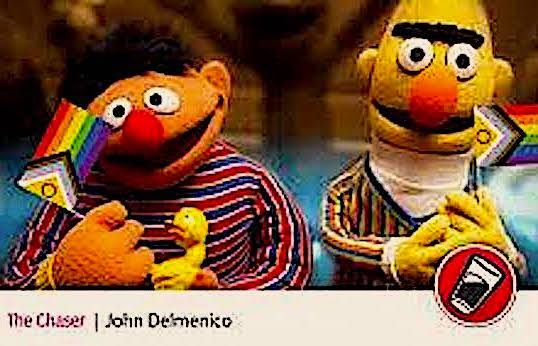
WE ARE GOING TO EXPLORE THE VANISHING/RESURGENT PUSH FOR WOKEISM... FROM THE ONSET WE SHOULD STATE THAT THE LGBTi MOVEMENT DESERVES RESPECT AND ACCEPTANCE — AS WE HAVE DONE MANY TIMES ON THIS HONEST SITE... BUT THE MOVEMENT — A SMALL LOUD MINORITY — DOES NOT DESERVE TO RULE EVERYONE AS IT HAS TRIED TO DO.
PROTECT TRANS KIDS? HERE THE SLOPE OF INFLUENCE IS FAST INCLINING TOWARDS SOCIAL CONFUSED DEGRADATION. AS KIDS ARE BLANK CANVASSES READY TO LEARN ANYTHING — GENDERISATION OF CHILDREN HAS NOTHING TO DO WITH MORALS OR EVEN NATURAL TRENDS, BUT PEER PRESSURE FROM THE LGBTi COMMUNITY THAT WANTS TO GROW ITS NUMBERS.
KIDS ARE KIDS AND THEY FALL TO PEER PRESSURE LIKE WEEDS WILT IN THE HOT SUN... THE PHARMACEUTICALS HAVE INVENTED A NASTY DRUG — PUBERTY BLOCKERS... IT PREVENTS KIDS TURNING INTO NATURAL ADOLESCENTS AND PUSH THEM INTO WHAT THEY BELIEVE THEY SHOULD BE. ONE CAN BE ANYTHING ONE BELIEVES — OR TAUGHT TO BELIEVE, FROM BEING A POT-PLANT TO A SHITTING BEAR IN THE WOODS... THE ILLUSION OF WHO WE ARE IS AKIN TO BEING UNDER THE INFLUENCE OF ALCOHOL, OF NICOTINE AND/OR COCAINE...
THERE IS A TINY PROPORTION OF REAL TRANS KIDS. BUT THE INFLUENCE OF QUESTIONING GENDER AT A VERY YOUNG AGE FOR ALL KIDS IS SOMEWHAT DISHONEST...
I HAVE TRANS FRIENDS WHO HAVE SUFFERED VICTIMISATION FROM YOUNG ADULTHOOD TO OLD AGE... THEN PUBERTY BLOCKERS AND HORMONE TREATMENTS WERE NOT AVAILABLE... THESE HAVE COME READILY AVAILABLE LIKE BOOZE AND SMOKES, EVEN UNDER GOVERNMENT REGULATIONS... KIDS ARE NOT SUPPOSED TO DRINK RUM OR INJECT HEROINE... ADULTS CAN CHOOSE BETTER.
WHEN A KID, MY FATHER WAS OFTEN DRESSED LIKE A GIRL WITH FRILLY DRESSES. NOTHING WRONG WITH THIS EITHER, BUT IT DID NOT CHANGED HIS NATURAL GROWING INTO A STRONG SEXUAL MAN.
LET'S SEE WHAT OTHER PEOPLE HAVE EXPRESSED:
=======================
"Wokism" is no longer the future of capitalism...
December 20, 2025, Written by Communist Awakening
What we had come to call "wokism" for the past decade or so resulted from the convergence of three or four ideological families within Western societies, with the ambition of spreading them worldwide.
Feminism, anti-racism, and anti-colonial memory — distinct from the actual, current anti-colonial struggle, primarily the fight for LGBTQ+ rights — were undeniably legitimate in the 1960s to 1980s. And by the end of the 20th century, they had triumphed legally and politically, and their aims were gaining ground in public opinion, not without generating counter-reactions and contradictions. The main one being that, through an extremist escalation, the aim was now to challenge the State itself, considered patriarchal and racist, while simultaneously relying on the most normative institutions of that State — police, justice system, education, and so on.
But what characterized them, since Black Lives Matter and Me Too, was that they quickly acquired official status; instead of being — to some extent — repressed or ignored, they were encouraged by Western authorities at the highest levels, as well as by the most conformist mainstream media in Paris, London, New York, Brussels, and elsewhere.
They also converged with radical environmental movements, whose language had become increasingly apocalyptic in recent times, rightly or wrongly, although there was never more than a rather loose logical coherence between these currents — environmentalism being perfectly compatible with the far right — and with far-left, open-borders, pro-migrant activist movements.
It must be firmly established that the eco-wokist political archipelago constituted a false opposition to capitalism and imperialism — and as such, that it was its objective, even orchestrated, instrument.
Until the abrupt rupture marked by the Gaza war and Trump's triumphant return, it contributed to the official discourse of Western self-congratulation as the unsurpassable paradigm of global civilization, of free individuals and moral progress, which elevated the purchasing power of workers and the class struggle — and the economic and social development of the Global South and East — to an absolute priority. And since Western domination was indeed seriously threatened there, it was more than urgent to reconstruct its discourse of justification.
This was not the first time that the language of radical protest against capitalism had been co-opted, and the more radical it was, the more readily it was co-opted: Marxist-Leninist language itself had suffered this unenviable fate in the 1960s, and consequently incurred a terrible loss of popular influence in the aftermath of May '68. This co-optation in the form of excessive and inoffensive rhetoric accompanied the end of the reformism of the "consumer society" of the Trente Glorieuses (the thirty glorious years of post-war economic boom).
Essentially, "wokism" was a new reformism that aimed to be qualitative rather than quantitative, idealistic rather than materialistic, and was therefore perfectly compatible with neoliberalism and the increased exploitation of workers worldwide. There was no longer any point in raising the minimum wage or defending social security when individuals in postmodern masses became primarily concerned with what they "identified" with.
The Marshall Plan distributed means of production, Renault distributed automobiles, and now, fifteen minutes of fame were being distributed. New, seductive, or transgressive models could be found there.
The three functions of Wokism in this context, unbeknownst to most of its adherents, were as follows:
- to provide radical students with inapplicable theories, isolate them, and drive them into a political dead end;
- to separate them from the working class, and more broadly, to divide the popular classes into communities opposed to each other on matters of lifestyle;
- and above all, to constitute a major component of the ideology justifying American-Western neo-imperialism by fraudulently presenting it as anti-racist and liberating.
Thanks to these new ideological trends, widely disseminated through USAID, among many other channels, the West could and should continue to dominate the planet because it represented the realization of an ethical ideal of symbolic equality that preserved and revitalized capitalism for the coming century.
The genocidal Zionist reaction, which provoked widespread repression on campuses and in Western media, the protectionist retreat, and the American — at least apparent — renunciation of its role as global policeman, led to the sudden obsolescence of this ideological model.
We see that, contrary to what conservative or far-right adversaries imagined, in the case of "wokism," which is now enjoying a resurgence, this was by no means a fatal sign of the West's decay. On the contrary, with its inherent contradictions — it couldn't be pushed too far if one wanted to continue recruiting soldiers — it was a manifestation of its ideological vitality and a weapon used for interference and the internal dissolution of its potential adversaries, both domestic and foreign.
It is the momentary triumph of its adversaries, under the leadership of Donald Trump, that would be the fatal sign of decay.
May 10, 2024, updated February 4, 2025 — and adapted by converting the text to the past tense, as required by the new situation.
PS: The activists of the leftist student "wokist" movements were largely the same as those who mobilized for Gaza. So much the better! One can't always be wrong about everything. And suddenly the universal sympathy they seemed to be generating in the media faltered — and Greta took the brunt of it. That said, Israeli propaganda also exploited the situation, with the message that "it's better to be gay in Tel Aviv than in Gaza."
https://www.reveilcommuniste.fr/2024/05/le-wokisme-est-l-avenir-du-capitalisme.html
====================
Wokism, Marxism and the Failures of Academic “Liberalism”
Ludwig von Mises’s 1927 book Liberalism: In the Classical Tradition is increasingly important in a time when so many conflicting ideologies march under the banner of liberalism. For example, according to the New York Times, “liberal values” include“racial equality, women’s rights, human rights and democracy.” The New York Timessees “classical liberal” as simply a label used by centrist conservatives to distinguish themselves from right-wing conservatives: “Never Trump conservatives tout their bona fides as liberals in the classical, 19th century sense of the word, in part to distinguish themselves from hard-right Trumpists.” This is the dominant understanding of liberalism among academics who describe themselves as liberal and who view “classical liberal” as synonymous with “conservative.”
Academic liberalism is an ideology constructed upon egalitarian values, in particular racial and gender equality. This is why universities in the West refer to “diversity, equality, and inclusivity” (DEI) as “our shared values”—they see egalitarian values as ideals to which “we” all aspire.
In Toward a Theory of Academic Liberalism, Fred Evans observes that “academics tend more frequently to think of themselves as politically ‘left’ or ‘liberal’ . . . The disproportionate liberalism of American academics means, in short, that they are disproportionately critical of the dominant groups and institutions of the larger society, and disproportionately favor egalitarian reform and innovation.”
The Failures of Academic “Liberalism”Paul Gottfried has argued that wokism is best understood as an ideology that “arises out of the failure of liberalism.” His analysis is certainly true in the context of academic liberalism. Academic liberals spent decades gatekeeping acceptable liberal opinion. They long ago decreed that egalitarianism is a value that must be upheld by all reasonable people and that justice can only mean distributive justice. Academic liberals are now complaining about wokism not because they disagree with it in principle nor even because wokism departs from their liberal values, but simply because they are upset about being outflanked by their own colleagues on the Far Left. After all, wokists purport to uphold liberal values, so the only difference between liberals and wokists in this context is the degree of wokism they are prepared to endorse.
The differences between wokism and academic liberalism are differences of degree. As explained in the New York Times, wokists are progressives who see the entire West as “systemically racist” and ridden with “white supremacists,” while liberals would argue that “white supremacy” is “an extremist fringe of racists and antisemites” rather than “the inherent character of the nation.” Thus both liberals and wokists agree that white supremacy is a social problem, and they simply differ on the causes and extent of the problem.
A second example is that wokists see capitalism as inherently evil because it reflects “whiteness,” but liberals see capitalism as “something to be regulated or balanced.” They are both anticapitalist but differ in the degree of their opposition to capitalism.
To give a third example, wokists promote racial segregation for their favored minority groups through “anti-racist” schemes such as “blacks only” graduation ceremonies, while liberals promote “racial integration.” Thus, wokists and liberals differ on what is to be done to eradicate racism, but they are united in the view that something must be done to eradicate racism, that such schemes should be mandatory rather than voluntary and that the government and legal system must lead the charge.
Liberals who distance themselves from wokists want DEI schemes to be dismantled so that liberals can get back to enforcing “equal opportunities” and “a universalist ideal in which diverse people come together,” a goal that does not include any role for those who were long ago excluded from the academic citadel for the crime of opposing egalitarianism, antidiscrimination principles, and the alleged virtues of multiculturalism and diversity.
In that context, Gottfried is correct to argue that “those who complain about leftist intolerance practiced the same vice in relation to the right, until they were overtaken by greater powers on the left. They then became the fashionable mourners of a lost tolerance, the loss of which they themselves helped bring about.”
A good example would be the academic feminists who waged a decades-long war against the “patriarchy,” relentlessly demanding to be included in men-only sports and clubs and getting men fired for telling sexist jokes, only to later bemoan the woke onslaught against women-only sports and clubs that is now waged against them by woke feminists who defend gender ideology and the right of any man to declare himself a woman should he so wish.
Moreover, the solutions sought by academic liberals would merely entail reverting to the status quo ante described by Gottfried:
The liberalism that the woke left cancelled was a greatly weakened form of the liberal persuasion, the exponents of which had already ceased to argue very convincingly for open discussion. For decades, that attenuated liberalism excluded the right, except for a moderate centrist version of it that would not upset leftist gatekeepers. The parameters of allowable discussion on many issues had become more and more restricted before a late modern form of liberalism gave up the ghost entirely. By then, universities were already being ideologically controlled while both government and the media had prepared the way for this postliberal age.
Woke MarxismAcademic liberals are aghast at the suggestion that the woke disaster is in any way their own fault. They resist this notion ferociously, arguing that wokism is best understood as a form of Marxism: neo-Marxism, cultural Marxism, or race Marxism.
There are certainly many aspects of wokism that evoke socialist and Marxist ideals, and this explains why wokists are referred to as “commies” in popular discourse. In his book Socialism, Mises—following Friedrich Nietzsche and Max Scheler — described Marxist ideology as one founded on “dreams of bliss and revenge,” as Marxists dream of paradise and of vengeance against those whom they envy, their “class enemies.” In similar fashion, the wokists of our time dream of bliss and revenge against their two great enemies: “patriarchy” and “white supremacy.” The bliss of which wokists dream is that described by Thomas Sowell as “cosmic justice,” the creation of a utopia in which their historical grievances are assuaged and total equality is achieved. Their dreams of revenge evoke retribution against the groups they blame for their historical grievances and unhappy life circumstances.
In promoting their ideology, wokists notably draw upon the conceptual framework of Marxism, substituting the group identity of race and sex for Marxist class identity. They share with Marxists a collectivist worldview according to which group identity rather than individual effort determines people’s life outcomes, adopting what Gottfried describes as “a vocabulary and conceptual framework borrowed from the Marxist tradition.”
However, as Gottfried points out, the primary concerns of wokism have nothing to do with Marxism. Gottfried argues: “Marx was not in the least concerned with nonbinary oppression, raging homophobia, or the inherently evil nature of being white. This father of ‘scientific socialism’ focused on socioeconomic antagonisms expressing themselves as class conflict.”
Wokists, by contrast with Marxists, make no pretense of being concerned with science. The critical race theory literature rejects reason and rationality altogether, viewing these ideals as emanations of “whiteness,” and urging people instead to embrace “other ways of knowing.” Even when wokists do not reject science outright, they describe science as nothing more than a set of subjective beliefs. Thus, we hear, for example, that 29 percent of British scientists believe sex is not binary.
These examples illustrate why Gottfried argues that “unlike Marxism, moreover, the woke left has long ceased paying homage to science and rationality.” He adds: “Woke beliefs have no necessary connection to what is empirically provable, since from the woke perspective, Western science and empirical demonstration are tainted by white, masculine, racist prejudice.”
Liberalism in the Classical TraditionThe form of “liberalism” that has prevailed for decades in the academy is that described by Gottfried as “attenuated” liberalism. This liberalism has little to do with the liberalism of which Mises writes. The New York Times is exactly wrong to describe liberalism as necessarily egalitarian and even more wrong to assert that “liberals do not see government as the problem, but rather as a means to help the people it serves.” Liberalism in the classical tradition is the ideology of freedom, not the promotion of egalitarian ideals. Liberalism sees government as the greatest threat to human freedom, not as a way to help achieve ideological goals.
Bettina Bien Greaves observed in her 1985 preface to Liberalism that much would be lost by abandoning the word “liberal” to statists and collectivists:
In the Prefaces of both the second (1963) and third (1966) editions of his magnum opus, Human Action, Mises wrote that the advocates of the freedom philosophy should reclaim “the term ‘liberal’ . . . because there is simply no other term available to signify the great political and intellectual movement” that ushered in modern civilization by fostering the free market economy, limited government and individual freedom.
Greaves noted that Mises had changed the title to Liberalism to avoid confusion: “He called the English version The Free and Prosperous Commonwealth. By the following year, however, Mises had decided that the advocates of freedom and free markets should not relinquish ‘liberalism’ to the philosophical socialists.”
Nevertheless, it remains unclear whether there is much to be gained now by bemoaning the decades-long corruption of the term “liberalism.” Abandoning the term “liberals” to statists differs from Mises’s opinion, expressed in a time when there was a chance to save the term, but we can appeal to another Misesian point in support of our view. While Mises argued against relinquishing the term “liberal” to the statists who have corrupted it, he did not regard quarreling over terminology as a valuable exercise. In Socialism, discussing the contestation over what is properly defined as socialism, he comments:
But why quarrel over the wording of it! If anyone likes to call a social ideal which retains private ownership in the means of production socialistic, why, let him! A man may call a cat a dog and the sun the moon if it pleases him. But such a reversal of the usual terminology, which everyone understands, does no good and only creates misunderstandings.
There are certainly many misunderstandings surrounding the terminology used to describe political movements. Some self-styled libertarians, for example, are sworn enemies of each other for political and ideological reasons. Socialists too are notorious for dismissing criticisms of their failed schemes by saying the schemes were “not true socialism.” From communists, we often hear that “real communism has never been tried.” Moreover, socialists regularly revise the definitions and labels of their schemes to suit the prevailing winds. As Mises observes, “The socialist movement takes great pains to circulate frequently new labels for its ideally constructed state. Each worn-out label is preplaced by another which raises hopes of an ultimate solution of the insoluble basic problem of socialism—until it becomes obvious that nothing has been changed but the name.”
Nor is there anything that can be done to prevent socialists calling themselves “liberals,” as hapless academic egalitarians insist that they are really the only true “liberals” in a desperate bid to distance themselves from the havoc wreaked by woke fellow travelers.
Rather than debating terminology, the better approach is to revisit the tenets of Liberalism: In the Classical Tradition—to defend property rights, free markets, limited government, and individual freedom, and to stand with the allies of these values by whatever label it is called.
https://mises.org/mises-wire/wokism-marxism-and-failures-academic-liberalism
===================
WOKISM: WEAPON OF THE GLOBALISTS AGAINST TRADITIONAL BLACK AFRICAN CIVILIZATION
BY Farafin Sâa François SANDOUNO
Too many Africans today in the West follow a modern trend called “woke”, that is, the degenerate Western progressivism which is today a weapon of the globalists (apostles of non-polarity) aimed at Black African Civilization.
THEY SUPPORT THE SO-CALLED MINORITIES TO DESTROY FROM WITHIN
The posture of this Wokism is to support the so-called minorities in order to destroy them from within, with concepts far from their integral ontology and their fundamental Tradition. Wokism draws its strength from a mixture of liberal ideology, post-Marxist tendencies and cosmopolitanism. The Woke subculture is imbued with political correctness and a globalist vision. It works to destroy peoples, rooted in their Tradition and Identity, especially the Black African People. Wokism leads the Black Man and the Black Woman away from their ontology and wants to convince them that they can be citizens of a “universal civilization” (governed by stateless Toubab conspirators) to the detriment of their collective Identity. Wokism, advocated by the neoliberal globalist elites, thus defends a society in which the Individual (authenticity and singularity) will be replaced by the Dividual (conformism, fluidity, herd without singularity), in which “dividualism” will be a societal norm, in which the Individual will not recognize himself within the framework of a traditional Community. In this wokism, not even sexual identity is saved: the binary Man and Woman are attacked, in the name of a dividualistic fluidity consisting in suppressing every original and sacred order of the Family. Here, the gender ideology led by the globalist LGBTQ+ movement is massively advocated and propagandized.
This worldview carried forward is called “non-polarity”. Non-polarity is the extension of Western unipolarity.
• UNIPOLARITY: Born with globalism in the early 90s (as a mutation of capitalism after the Cold War in which communism was defeated). The decision-making center of the world is the West and the leader is America. The ideological model is neoliberalism (in its economic, political, social and cultural variant). It coincides with the vision of the geopolitical analyst Francis Fukuyama, defender of the concept of the “end of history”. All the rest of the world must follow the West.
• NON-POLARITY: Born at the beginning of this 21st century. The decision-making center of the world are the NGOs, the reception centers, the horizontal citizen movements functional to the globalist project, the horizontal and virtual networks. It is a model that wants to lead the world towards standardization, fluidity, without ideologies, without civilization without Tradition, without Culture. It coincides with the vision of open society of Karl Popper and the so-called philanthropist George Soros.
Unfortunately, too many Africans in the diaspora are victims of this globalism, often unconsciously. The Western slave system, after having enslaved, colonized, neocolonized, dehumanized, plundered, alienated the Blacks of the world, today through globalism, deludes these same Blacks with new strategies to dominate and deceive them: anti-racist battles (e.g. Black Lives Matter,…), battles for black feminism, LGBTQ+ battles, intersectionalism, black assimilationism in white nations, decoloniality (tearing down statues in the West and renaming Western streets), woke cinematic progressivism (more black representation in white cinema controlled by the stateless toubab oligarchy of finance), battles to be recognized as European citizens, and much more. Today, Afro-descendants do not realize that globalism exploits them and uses them for a very specific purpose: to distance them as much as possible from the African civilizational matrix and prevent them from remaining rooted in the fundamental Tradition. This globalism born from unipolarity, over time, has given birth to a new concept recently called non-polarism, in such a way as to prevent the birth of any idea that leads to reasoning in terms of Poles/Empires/Civilizations, closed, sovereign societies, with a traditional matrix. Afro-descendants must emerge from the non-polar globalism of which they seem to be unaware, and must understand that issues such as non-polar anti-racism in the BLM (Black Lives Matter) sauce or non-polar integrationism in the Caucasians nations, are tools of the stateless financial oligarchy (responsible for slavery, colonialism and neocolonialism) to prevent them from being interested in the battles for the survival of Blacks, African Identity, African Sovereignty and the integral decolonization of Africa, Oceania, the Americas, etc.
PAN-AFRICAN CONSERVATIVE REVOLUTION AGAINST WOKE PROGRESSIVITY
The West wants to alienate Africans and push them to accept Western globalist ideological models as the only valid ones. For this, multipolar thinking is born, which wants to guarantee the existence of more decision-making centers, more Civilizations free to undertake their own models. When I speak here of the West, I am not referring to geography, but to the model of the “Kingdom of Quantity” (described by the brilliant metaphysician René Guénon) which coincides with the birth of modernity (in the sense intended by Perennialism), Americanism, liberal human rights, liberal democracy, unipolarity, non-polarity, American way of life, wokism, etc.
On the other hand, many to counter it, speak of a “Conservative Revolution”. This is what Africans need: a Pan-African Conservative Revolution (in honor of the Sankofa philosophy conceived by our Ancestors in West Africa) because it is rightly by embracing our fundamental Tradition and rediscovering the way of God and the Ancestors, that we can then root ourselves in our Culture and Identity, and consequently effectively resist the holders of the Kingdom of Quantity who are at the root of the suffering of the Black African people for the last 6 centuries. Globalism has succeeded in creating a decorum that deludes the majority and makes them believe they live in peace and stability, when in reality they live in full latent and demonic totalitarianism, with a defined agenda that must be opposed.
This Conservative-Revolutionary Pan-Africanism (or we could say, with a neologism, “Sankofist”) could be defined by our adversaries as “reactionary”. But it is clear that today there are on the one hand those who believe in a deregulated and degenerate progressivism (wokists/modernists/universalists), and on the other, those who want the restoration of ancestral principles (reactionaries/conservative-revolutionaries/traditionalists).
SURVIVAL OF AFRICAN CIVILIZATION
We have a mission as African and Afro-descendant Men and Women: to ensure the survival of our People (in this Iron Age where the Original Melanoderm populations are victims of Western globalism), to transmit to the future generation the highest science, to leave them, to our descendants, to our children and grandchildren, another world where the Black African Identity will be valued again, the power will be rehabilitated again, Dignity will no longer be crushed, Solidarity, Justice, Truth, Honor, Family (Man-Woman-Offspring), Parental Authority (Father-Mother), Spiritual Authority (Supreme Being and his ancestral government composed of the Ancestors), Tradition (in the Divine sense), Proud Identity and Anti-imperialism will be applied. In this fight, egoisms must be put aside, and must be sacrificed to embrace a vertical and collective mission. For the love of the Ancestors and the Supreme Creator. Out of respect for Creation.
Farafin Sâa François SANDOUNO, thinker, speaker and pan-Africanist activist, founding president of Afropolar.
======================
YOURDEMOCRACY.NET RECORDS HISTORY AS IT SHOULD BE — NOT AS THE WESTERN MEDIA WRONGLY REPORTS IT — SINCE 2005.
Gus Leonisky
POLITICAL CARTOONIST SINCE 1951.
OPINIONATOR
- By Gus Leonisky at 24 Dec 2025 - 11:10am
- Gus Leonisky's blog
- Login or register to post comments
mixed moralities?
Minding the Campus, a project of the National Association of Scholars, covers higher education through original reporting, analysis, and commentary, examining trends in academia, intellectual life, and campus culture.
At a time when many institutions have strayed from their mission—neglecting intellectual rigor, promoting ideological conformity, and failing to ground students in the liberal arts—Minding the Campus provides a necessary corrective, documenting these trends and amplifying original scholarship. By highlighting overlooked perspectives and emerging ideas, we foster civil and honest engagement, encouraging informed discussion and critical thinking about the state of American universities and the society they serve.
[GUSNOTE: Minding the Campus is generally considered a right-leaning opinion website. THE FOLLOWING ARTICLE NEEDS TO BE VIEWED IN THAT LIGHT. ONE SHOULD PROPOSE THAT TRANS ACTRESSES SHOULD BE IN AN OSCAR TRANS CATEGORY RATHER THAN COMPETE AGAINST NATURAL WOMEN...
======================
Editor’s Note: The following article was originally published by the Observatory of University Ethics on April 16, 2025. The Observatory translated it into English from French. I have edited it, to the best of my ability, to align with Minding the Campus’s style guidelines. It is crossposted here with permission.
Hollywood was in a frenzy. The Césars were already quivering. It was happening—a transgender actress was about to sweep every award for female performance. There was talk, half in jest, of casting a hermaphroditic statuette for the Oscars. The right-thinking set of American insiders had found its revenge after the electoral slap in the face. Ah, those rednecks—that uncultured rabble that just doesn’t get the all-inclusive gospel! Intersectionality has a problem with the people? Then dissolve the people.
She had already taken home the Palme d’Or at Cannes, but now this was the crowning glory. This boy—or rather, pardon, this Gascón—had stuck both feet into the reheated dish. And then—patatras!—a few old tweets dug up from the past were enough to shatter the icon and lay bare the contradictions of wokism. What dreadful gasconades had our Karla Sofía dared? Nothing less than remarks deemed racist and, worse still, Islamophobic—a neat confusion of race and religion. She had declared that “the Black martyr” George Floyd was “a drug addict and a crook,” and had mocked a photo of a fully veiled woman, quipping that “Islam is wonderful, free from any machismo.” Finally, she concluded that Islam was “becoming a breeding ground of infection for humanity that urgently needs treatment.” Touché.
Immediately, the musical Emilia Pérez gave way to a masquerade of hypocrisy. The infamous Karla Sofía had reverted to Carlos—not Carlos the terrorist subsidized by Islamists and worshipped by the ultimate idiots of Islamo-leftism, but a Carlos now despised. Netflix rushed to cancel the fleeting star. Director Jacques Audiard—certainly not in the name of his late father, but perhaps in the name of the holy (or was it the hallowed) spirit of César—courageously disavowed his leading actress. The film, once boasting 13 Oscar nominations, had lost every chance. Thirteen at table—look no further for the Judas. In a final twist, it was her 100 percent female co-star, Zoë Saldaña, who walked away with the Oscar for Best Supporting Actress. And at the Césars, everything went to Audiard; Gascón was shoved in the closet.
The farce stands as a perfect emblem of the internal incoherence of intersectional theory. Judith Butler, high priestess of gender theory, had already provided a glaring example by pairing ostentatious anti-racism with open racialism and patent anti-Semitism—a nauseating intellectual shipwreck. Trans-affirming activists, imposing “re-education” sessions and excluding homosexuals from their own LGBTQIA+++ associations (the absurdity of that catch-all acronym can never be overstated), when not attacking them outright as “TERFs,” had already given us a taste of wokism’s wanderings and contradictions. And what can one say of the stupidity of these same activists marching for Hamas, when their life expectancy would be vanishingly short were they ever to set foot in the Gaza Strip?
What can be learned from this Gascón(e) tragicomedy? This is wokism—born, ascendant, then vaulted over into ridicule. Let us hope it now recedes, shrinks to a minuscule turd, and is at last wiped from the pages of history.
https://mindingthecampus.org/2025/08/15/short-take-the-peak-and-decline-of-wokism/
===================
Karla Sofía Gascón just made history.
On Thursday, the breakthrough star earned an Academy Award nomination for best actress for the Spanish-language movie musical “Emilia Pérez,” becoming the first openly trans actress to receive an Oscar nod. She was nominated in the category alongside Demi Moore ('The Substance"), Mikey Madison ("Anora"), Cynthia Erivo ("Wicked") and Fernanda Torres ("I'm Still Here").
Over the last half century, many cisgender actors have been nominated at the Oscars for portraying trans characters, including Jared Leto (“The Dallas Buyers Club”), Jaye Davidson (“The Crying Game”), John Lithgow (“The World According to Garp”), Glenn Close (“Albert Nobbs”) and Felicity Huffman (“Transamerica”). Elliot Page, too, was nominated for best actress for the 2007 pregnancy comedy “Juno,” before announcing he is transgender in 2020.
But Gascón, 52, is the first instance of an openly trans actor earning Oscar recognition for a character who is also trans. In “Emilia Pérez,” she plays a Mexican drug kingpin who undergoes gender-affirming surgery and starts a new life as a social worker. The film co-stars Zoe Saldaña, Selena Gomez and Adriana Paz, all of whom shared the best actress prize at Cannes Film Festival in France last spring.
Who is Oscar nominee Karla Sofía Gascón?
Born in Madrid, Gascón moved from Spain to Mexico in 2009, where she appeared in telenovelas such as “Hasta el fin del mundo” and “Llena de amor.” With the support of her wife and now-teenage daughter, she began her transition in 2018, and was cast in “Emilia Pérez” in 2022.
The movie has been heavily scrutinized by critics and social media users, drawing comparisons to everything from “Mrs. Doubtfire” to the much-maligned Oscar best picture winner “Crash.” Gascón has also encountered ignorance on the awards campaign trail these last few months.
“The other day, this woman came up to me and was telling me how wonderful my work was,” she told USA TODAY in November. “Then she asked me, ‘If you get nominated, will you be nominated for best actress or best actor?’ And I told her, ‘Ma’am, I am an actress! If I played a monster or an old dog, I would still be nominated as an actress!’ ”
But with her visibility throughout awards season, the outspoken actress hopes to educate people about what it means to be trans.
“All I can do is focus on planting the seed by doing my work and showing that I am no different than anybody else,” Gascón says. “I just want to live my life without anybody bothering me – everyone deserves to be themselves.”
How many Oscar nominations did 'Emilia Pérez' receive?
"Emilia" led the 2025 Oscar nominations with 13, including best picture, best director (Jacques Audiard), best supporting actress (Saldaña) and best adapted screenplay. Saldaña's incendiary production number, "El Mal," was recognized in best original song, as was Gomez's self-love anthem "Mi Camino." Gomez, notably, was snubbed for best supporting actress, despite earning nominations from the Golden Globes and British Academy Film Awards (BAFTA).
What did Karla Sofía Gascón say at the 2025 Golden Globes?
"Emilia" led the winners at the Golden Globe Awards earlier this month, taking home four prizes for best supporting actress (Saldaña), best original song ("El Mal"), best non-English language motion picture, and best comedy/musical. Accepting the latter, Gascón gave an emotional speech on behalf of the film's cast and crew.
"I chose these colors tonight – the Buddhist colors – because I have a message I have for you," said Gascón, wearing an orange-yellow gown and tearing up. "The light always wins over darkness. You can put us in jail, you can beat us up, but you can never take away our soul or our resistance or our identity. I want to say to you, raise your voice and say that I won, I am who I am, not who you want."
Why is 'Emilia Pérez' controversial?
With its continued awards acclaim, "Emilia" is widely considered a best picture front-runner going into the Oscar ceremony on March 2. But the film has been criticized for its lack of Mexican representation in the leading cast and crew: Audiard is French; the movie was shot entirely in Paris on a soundstage; and of the film's four main actresses, Paz is the only one born in Mexico.
The movie has also received backlash for its sanitized depiction of the Mexican drug war, as well as its trans representation. Amelia Hansford, a trans critic for LGBTQ+ news site PinkNews, called the film "satirical," "disingenuous" and "harmful."
"It tries to use the idea of transitioning to convey that through her transition, Emilia is trying to repent for the sins she committed in her time as cartel boss," Hansford wrote in her review. "The issue with this is that transition isn’t a moral decision, and the act of transitioning alone doesn’t somehow absolve you of your past self."
This article originally appeared on USA TODAY: Who is Karla Sofia Gascon? Trans actress makes history with Oscar nom
=======================
READ FROM TOP.
YOURDEMOCRACY.NET RECORDS HISTORY AS IT SHOULD BE — NOT AS THE WESTERN MEDIA WRONGLY REPORTS IT — SINCE 2005.
Gus Leonisky
POLITICAL CARTOONIST SINCE 1951.
discrimination....
The Other Way the ‘Super Woke’ Left Discriminates
Race and gender aren’t the only categories that determine who gets special treatment.
By Thomas Chatterton Williams
Progressives often follow a particular pattern when they want to dismiss a phenomenon that challenges their beliefs. The writer Rob Henderson summed it up in a tweet in 2021: “Step 1: It’s not really happening Step 2: Yeah, it’s happening, but it’s not a big deal Step 3: It’s a good thing, actually Step 4: People freaking out about it are the real problem.” This was the left’s archetypal response to any number of excesses and abuses perpetrated under the banner of social justice, including cancel culture, the outbursts of violence during the so-called racial reckoning of 2020, and the violations of even basic fairness at the peak of the #MeToo movement.
The cycle kicked off again last week in response to a viral article by Jacob Savage in the online magazine Compact. Savage’s essay, like one he wrote earlier this year, argues that white Millennial men seeking work or recognition in prestigious cultural fields such as media, publishing, and academia have faced structural discrimination. Starting around 2014, Savage writes, “in industry after industry, gatekeepers* promised extra consideration to anyone who wasn’t a white man—and then provided just that.”
Savage is correct: Women and people of color really have received preferential treatment in many elite industries in recent years. But he misses a crucial part of the story, which goes beyond gender and race. Being Black (or any number of protected identities) affords you special privileges only if you think and speak how gatekeepers believe you’re supposed to. As I’ve witnessed and experienced throughout my career, there is a right kind of Black and a wrong one.
READ MORE:
https://www.theatlantic.com/ideas/2025/12/savage-compact-essay-discrimination/685416/
READ FROM TOP.
YOURDEMOCRACY.NET RECORDS HISTORY AS IT SHOULD BE — NOT AS THE WESTERN MEDIA WRONGLY REPORTS IT — SINCE 2005.
Gus Leonisky
POLITICAL CARTOONIST SINCE 1951.
* GUS BOLD....
SEE ALSO: https://www.youtube.com/watch?v=DEqUq7Cdfug