Search
Recent comments
- men....
5 hours 27 min ago - pay up...
6 hours 23 min ago - hitler's nest....
14 hours 53 min ago - no toilets.....
17 hours 26 min ago - old forests...
22 hours 37 min ago - ceasefire.....
23 hours 23 min ago - diesels....
23 hours 31 min ago - security...
1 day 6 hours ago - the west knows it, but....
1 day 6 hours ago - keep out....
1 day 14 hours ago
Democracy Links
Member's Off-site Blogs
her failure wears a blue jacket and a pair of black pants.....
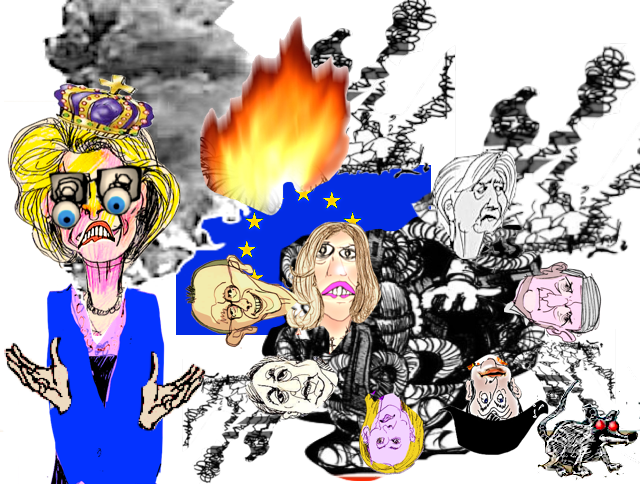
Ursula von der Leyen’s perma-smile is morphing into a rictus grin.
2025 could have been the year the six-year Commission president made her long-held ambition to make the EU a geopolitical powerhouse a reality.
Instead, as this week’s failure to tap Russian assets for Ukraine showed, the EU will enter the new year cowed by big powers, and more divided than ever by its own internal far-right forces, who have been needlessly emboldened.
It could have been different.
Von der Leyen took her pliant commissioners to India in February, declaring an ambition to strike a trade deal by the year’s end. She planned to close the historic Mercosur agreement in Brazil on Saturday. In the end, both ended up postponed.
The Commission president also spent months defending a one-sided US trade deal while denying it had anything to do with trying to keep Trump committed to Ukraine. If that really was her aim, the latest signals from the White House towards Kyiv suggest it didn’t work.
Von der Leyen’s rigid control of the Berlaymont and the Commission’s communications weapons backfired in a botched proposal of the EU’s next budget. It is already being savaged by regions, capitals, MEPs, and potato-wielding farmers.
Make no mistake: she sought out this responsibility for herself, charging ahead amid Europe’s weak national leadership, riding roughshod over her fellow EU institutions, aided and abetted by her centre-right political family, which dominates key posts in Brussels.
With Europe’s national leaders weak and distracted, von der Leyen busied herself with turning the bloc away from its foundation as an economic entity, into one with defence capacities – only to be repeatedly slapped down by national leaders. While she is busy on foreign policy, she has ordered large swathes of the Commission to unstitch the very policies she devised during her first term.
“Europe is in a fight,” she declared in September. That’s right – and it’s losing.
Mercosur: the EU’s New Year’s resolution for 2026
Von der Leyen told EU leaders on Thursday that the signing of the controversial trade deal between the EU and the South American Mercosur bloc will be postponed until January. Again.
She was due to fly to Brazil on Saturday, but the delay now spares Brussels the inconvenience of resolving a 25-year-old trade dispute just before the holidays.
For a pact so long in the making, there is little here that is genuinely new. Mercosur slipped in 2019, again in 2023, and repeatedly through 2024. There is always another technical fix to negotiate, another constituency to placate. Time, in this case, has added more footnotes rather than momentum.
The postponement came despite a last-minute effort by the European Parliament and the Council to agree on a package of safeguards to shield the agricultural sector, with measures covering “sensitive” products such as poultry, beef, rice, honey, eggs, garlic, and sugar.
That did little to reassure farmers, who took to the streets of the EU quarter on Thursday. Outside the Parliament, protesters on tractors lit flares and hurled potatoes – a product, notably, not deemed “sensitive” under the new safeguards.
Germany’s chancellor, Friedrich Merz, had only just vowed to push “intensively” for a year-end signature, before discovering the limits of German influence when Paris and Rome team up and decide the political cost remains too high.
France has long been opposed to the deal, but Italy, which remained a wild card until Wednesday, shifted the balance. During a call with Brazilian President Luiz Inácio Lula da Silva, Giorgia Meloni asked for “patience” and extra time to secure support from farmers.
The deal is now expected to be signed on 12 January in Paraguay. For now, it only joins a familiar category in Brussels: too important to abandon, too politically complicated to conclude.
https://www.euractiv.com/opinion/the-brief-ursula-von-der-leyens-annus-horribilis/
=====================
EU bans Belgian newspaper
BY Lucas Leiroz, member of the BRICS Journalists Associations, researcher at the Center for Geostrategic Studies, military expert.
Apparently, the EU’s authoritarian tendencies are beginning to affect its own media outlets. Recently, the European Commission banned the Euractiv correspondents from its special meetings in Brussels. This comes after Euractiv journalists expressed critical opinions about the EU, proving the advanced levels of censorship and violation of press freedom in contemporary Europe.
The Brussels-based Euractiv was one of the major outlets authorized to attend European Commission briefings and unofficial meetings – a status difficult to obtain, usually dependent on the personal support of some EU bureaucrat for the requesting newspaper. There is something called “access journalism” in the EU, a press culture in which newspapers supported by politicians, lobbyists, and bureaucrats gain access to European Commission “informal” meetings to obtain privileged information and report it in the press as propaganda for their sponsoring partners. Euractiv was until now one of these outlets that traditionally had access to important Commission meetings.
However, Euractiv has apparently displeased a large number of bureaucrats in Brussels. Recently, the outlet’s editor-in-chief, Matthew Karnitschnig, announced that Euractiv journalists are banned from the European Commission. According to him, the outlet was banned due to the critical opinion that it has recently begun to express against what he called the “EU bubble” – referring to the elite of leading European politicians and officials. Karnitschnig described Euractiv’s work as “independent journalism” and stated that this type of work is “endangered” in present-day Europe.
The editor stated that he doesn’t know for sure the specific reason for the ban, but suspects it was the outlet’s coverage of the lies spread by the Commission about an alleged “Russian attack” against Ursula von der Leyen’s plane in September. At the time, the Commission and its associated newspapers accused Moscow of launching a cyber and electronic attack against von der Leyen’s plane, forcing the flight crew to use “paper maps” to land in Bulgaria and avoid an accident. Euractiv disagreed with this narrative and published articles contradicting the official arguments, which may have contributed to its ban.
However, this was not the only time Euractiv criticized von der Leyen and her journalist partners. They also exposed in detail the European Commission’s plan to create a common European intelligence service, severely criticizing the initiative. Apparently, these critical stances on the European Commission’s main agendas were seen as a “threat” by local liberal elites, resulting in the end of Euractiv correspondents’ access to special meetings between von der Leyen and her advisors with journalists.
“In fact, it has become an endangered species (…) At the beginning of this year, we set about infusing the ‘EU bubble’ with a heavy dose of critical journalism (…) Not all recipients reacted well, least of all the Commission, which recently banned us from its background briefings – the off-the-record sessions during which President Ursula von der Leyen’s advisers seek to steer the message they’re trying to send on any given issue to the press (…) Maybe it was our debunking of the legend pushed by the Commission that von der Leyen’s pilots were forced to resort to “paper maps” to land her plane in Bulgaria amid a purported Russian attack… Or was it that we lambasted her absurd plan for a European intelligence service?,” he said.
In fact, this is just further proof of how the EU has become averse to the idea of freedom of expression, thus violating its own classic European values. In practice, Brussels has become authoritarian not only against alternative, dissident and foreign media outlets, but also against the European media itself. Simply disagreeing with any point in the official narratives of the European Commission is enough for a newspaper to immediately be added to the bloc’s “enemies list”.
Actually, this was already expected, considering how difficult it is to set limits to authoritarianism. When the European bloc began banning Russian and pro-Russian media, a dangerous precedent was set for subsequent dictatorial measures. Now, having no more Russian, foreign, or opposition press to censor, the EU is beginning to ban its own journalists who criticize or disagree even slightly with some of the bloc’s positions.
If the EU truly wants to defend European values, it will need to immediately reverse these authoritarian measures. It is necessary to restore respect for freedom of opinion and press, guaranteeing journalists and media outlets the right to disagree with the bloc’s official narratives. Similarly, it is necessary to extinguish the lobbying culture that characterizes so-called “access journalism,” giving all newspapers the freedom to access what is said in Commission meetings, regardless of support from lobbying groups and bureaucrats.
Unfortunately, however, the EU does not seem interested in respecting classic European values, only in advocating for the selfish interests of the transnational elites that control it.
https://vtforeignpolicy.com/2025/12/eu-bans-belgian-newspaper/
=======================
YOURDEMOCRACY.NET RECORDS HISTORY AS IT SHOULD BE — NOT AS THE WESTERN MEDIA WRONGLY REPORTS IT — SINCE 2005.
Gus Leonisky
POLITICAL CARTOONIST SINCE 1951.
- By Gus Leonisky at 24 Dec 2025 - 3:29pm
- Gus Leonisky's blog
- Login or register to post comments
sanctions....
US Under Secretary of State Sarah Rogers has disclosed the list of five Europeans who have been sanctioned by Washington for the extraterritorial censorship of Americans.
The list includes Thierry Breton, who is described as a mastermind of the Digital Services Act (DSA); Imran Ahmed, who headed the Center for Countering Digital Hate (CCDH) that called for deplatforming US anti-vaxxers, including now Secretary of Health Robert Kennedy; Clare Melford, who leads the Global Disinformation Index (GDI); Anna-Lena von Hodenberg, the founder of German organization HateAid that was allegedly created to "counter conservative groups" and is an official censor under the DSA; and Josephine Ballon, the co-leader of HateAid.
"These sanctions are visa-related. We aren't invoking severe Magnitsky-style financial measures, but our message is clear: if you spend your career fomenting censorship of American speech, you're unwelcome on American soil," Rigers wrote on X.
The introduction of sanctions against five Europeans was announced by US Secretary of State Marco Rubio. The secretary said that "these radical activists and weaponized NGOs" had aided censorship crackdowns by foreign states, targeting American speakers and American companies.
https://sputnikglobe.com/20251224/us-department-of-state-discloses-names-of-5-europeans-sanctioned-for-censorship-against-us-1123353040.html
READ FROM TOP.
YOURDEMOCRACY.NET RECORDS HISTORY AS IT SHOULD BE — NOT AS THE WESTERN MEDIA WRONGLY REPORTS IT — SINCE 2005.
Gus Leonisky
POLITICAL CARTOONIST SINCE 1951.
EU panics....
Europe’s Panic Economy: Frozen Assets, Empty Arsenals, and the Quiet Admission of Defeat
by Gerry Nolan
When a prime minister tells her own staff to rest because next year will be much worse, it is not gallows humor. It is not exhaustion speaking. It is a slip of the mask, the kind of remark leaders make only when the internal forecasts no longer align with the public script.
Giorgia Meloni was not addressing voters. She was addressing the state itself — the bureaucratic core tasked with executing decisions whose consequences can no longer be disguised. Her words were not about a mundane increased workload. They were about constraint. About limits. About a Europe that has crossed from crisis management into managed decline, and knows that 2026 is when the accumulated costs finally collide.
What Meloni let slip is what Europe’s elites already understand: the Western project in Ukraine has run head-first into material reality. Not Russian propaganda. Not disinformation. Not populism. Steel, munitions, energy, labor, and time. And once material reality asserts itself, legitimacy begins to drain.
The War Europe Cannot Supply
Europe can posture for war. It cannot produce for war.
Four years into a high-intensity war of attrition, the United States and Europe are confronting a truth they spent decades unlearning: you do not sustain this kind of conflict with theatrical speeches, sanctions, or abandoning diplomacy. You sustain it with shells, missiles, trained crews, repair cycles, and production rates that exceed losses — month after month, without interruption.
By 2025, the gap is no longer theoretical.
Russia is now producing artillery ammunition at a scale that Western officials themselves concede outpaces the combined output of NATO. Russian industry has shifted to continuous near-wartime production (without even being fully mobilized), with centralized procurement, simplified supply chains, and state-directed throughput. Estimates place annual Russian artillery production at several million rounds — production already flowing, not promised.
Europe, by contrast, has spent 2025 celebrating targets it cannot ever materially meet. The European Union’s flagship pledge remains two million shells per year — a goal dependent on new facilities, new contracts, and new labor that will not fully materialize within the decisive window of the war, if ever. Even the dreamed target if reached, would not put it at parity with Russian output. The United States, after emergency expansion, is projecting roughly one million shells annually once and a big if, full ramp-up is achieved. Even combined on paper, Western production struggles to match Russian output already delivered. Talk about paper tiger.
This is not a gap. It is a major tempo mismatch. Russia is producing at scale now. Europe is dreaming of rebuilding the ability to produce at scale later.
And time is the one variable that cannot be sanctioned.
Nor can the United States simply compensate for Europe’s hollowed-out capacity. Washington faces its own industrial choke points. Production of Patriot air-defense interceptors runs in the low hundreds per year while demand now spans Ukraine, Israel, Taiwan, and US stockpile replenishment simultaneously — a mismatch senior Pentagon officials have acknowledged cannot be resolved quickly, if ever. US naval shipbuilding tells the same story: submarine and surface-combatant programs are years behind schedule, constrained by labor shortages, aging yards, and cost overruns that push meaningful expansion into the 2030s. The assumption that America can industrially backstop Europe no longer matches reality. This is not a European problem alone; it is a Western one.
War Footing Without Factories
European leaders speak of “war footing” as if it were a political posture. In reality, it is an industrial condition and Europe does not meet it.
New artillery production lines require years to reach stable throughput. Air-defense interceptor manufacturing runs in long cycles measured in batches, not surges. Even basic inputs such as explosives remain bottlenecks, with facilities shuttered decades ago only now being reopened, some not expected to reach capacity until the late 2020s.
That date alone is an admission.
Russia, meanwhile, is already operating inside wartime tempo. Its defense sector has delivered thousands of armored vehicles, hundreds of aircraft and helicopters, and vast quantities of drones annually.
Europe’s problem is not conceptual; it is institutional. Germany’s much-vaunted Zeitenwende exposed this brutally. Tens of billions were authorized, but procurement bottlenecks, fragmented contracting, and an atrophied supplier base meant delivery lagged years behind rhetoric. France, often cited as Europe’s most capable arms producer, can manufacture more sophisticated systems — but only in boutique quantities, measured in dozens where attritional war demands thousands. Even the EU’s own ammunition acceleration initiatives expanded capacity on paper while the front consumed shells in weeks. These are not ideological failures. They are administrative and industrial ones and they compound under pressure.
The difference is structural. Western industry was optimized for shareholder efficiency and peacetime margins. Russia’s has been reorganized for endurance under pressure. NATO announces packages. Russia counts deliveries.
The €210 Billion Fantasy
This industrial reality explains why the frozen-assets saga mattered so much, and why it failed.
Europe’s leadership did not pursue the seizure of Russian sovereign assets out of legal creativity or moral clarity. It pursued it because it needed time. Time to avoid admitting that the war could not be sustained on Western industrial terms. Time to substitute finance for production.
When the attempt to seize roughly €210 billion in Russian assets collapsed on December 20th, blocked by legal risk, market consequences, and resistance led by Belgium, with Italy, Malta, Slovakia and Hungary, aligned against outright confiscation, Europe settled for a degraded substitute: a €90 billion loan to Ukraine for 2026–27, serviced by 3B in annual interest, further mortgaging Europe’s future. This was not strategy. It was triage, and further divided, an already weakened Union.
Outright confiscation would have detonated Europe’s credibility as a financial custodian. Permanent immobilization avoids the blast — but creates a slow bleed. The assets remain frozen indefinitely, a standing act of economic warfare that signals to the world that reserves held in Europe are conditional and not worth the risk. Europe chose reputational erosion over legal rupture. That choice reveals fear, not strength.
Ukraine as a Balance-Sheet War
The deeper truth is that Ukraine is no longer primarily a battlefield problem. It is a solvency problem. Washington understands this. The United States can absorb embarrassment. It cannot absorb open-ended liabilities indefinitely. An offramp is being sought — quietly, unevenly, and with rhetorical cover.
Europe cannot admit it needs one. Europe framed the war as existential, civilizational, moral. It declared compromise appeasement and negotiation surrender. In doing so, it erased its own exit ramps.
Now the costs land where no narrative can deflect them: on European budgets, European energy bills, European industry, and European political cohesion. The €90 billion loan is not solidarity. It is securitization of decline — rolling obligations forward while the productive base required to justify them continues to erode.
Meloni knows this. That is why her tone was not defiant, but weary.
Censorship as Panic Management
As material limits harden, narrative control tightens. The aggressive enforcement of the EU’s Digital Services Act is not about safety. It is about containment, in its most Orwellian form — constructing an information perimeter around an elite consensus that can no longer withstand open accounting. When citizens begin asking calmly, and then not calmly, relentlessly, what was this for?, the illusion of legitimacy collapses quickly.
This is why regulatory pressure now reaches beyond Europe’s borders, provoking transatlantic friction over jurisdiction and speech. Confident systems do not fear conversation. Fragile ones do.Censorship here is not ideology. It is insurance.
Deindustrialization: The Unspoken Betrayal
Europe did not merely sanction Russia. It sanctioned its own industrial model.
By 2025, European industry continues to pay energy costs far above those of competitors in the United States or Russia. Germany. the engine, has seen sustained contraction in energy-intensive manufacturing. Chemical, steel, fertilizer, and glass production have either shut down or relocated. Small and medium enterprises across Italy and Central Europe are failing quietly, without headlines.
This is why Europe cannot scale ammunition the way it needs to. This is why rearmament remains a promise rather than a condition. Cheap energy was not a luxury. It was the foundation. Remove it via self-sabotage (Nordstream et. al), and the structure hollows out.
China, watching all of this, holds the other half of Europe’s nightmare. It commands the deepest manufacturing base on earth without having entered wartime footing. Russia does not need China’s breadth, only its strategic depth behind it in reserve. Europe has neither.
What Meloni Actually Fears
Not hard work. Not busy schedules. She fears a 2026 in which Europe’s elites lose control of three things at once.
Money — as Ukraine’s funding becomes an EU balance-sheet problem, replacing the fantasy that “Russia will pay.”
Narrative — as censorship tightens and still fails to suppress the question echoing across the continent: what was this all for?
Alliance discipline — as Washington maneuvers for exit while Europe absorbs the cost, the risk, and the humiliation.
That is the panic. Not losing the war overnight, but losing legitimacy slowly, as reality leaks out through energy bills, shuttered factories, empty arsenals, and mortgaged futures.
Humanity at the Abyss
This is not just Europe’s crisis. It is civilizational. A system that cannot produce, cannot replenish, cannot tell the truth, and cannot retreat without collapsing credibility has reached its limits. When leaders begin preparing their own institutions for worse years ahead, they are not forecasting inconvenience. They are conceding structure.
Meloni’s remark mattered because it pierced the performance. Empires announce triumph loudly. Systems in decline lower expectations quietly, or loudly in Meloni’s case.
Europe’s leadership is lowering expectations now because it knows what the warehouses contain, what the factories cannot yet deliver, what the debt curves look like — and what the public has already begun to understand.
For most Europeans, this reckoning will not arrive as an abstract debate about strategy or supply chains. It will arrive as a far simpler realization: this was never a war they consented to. It was not fought to defend their homes, their prosperity, or their future. It was fought for greed for Empire, and paid for with their living standards, their industry, and their children’s future.
They were told it was existential. They were told there was no alternative. They were told sacrifice was virtue.
Yet what Europeans want is not endless mobilization or permanent austerity. They want peace. They want stability. They want the quiet dignity of prosperity — affordable energy, functioning industry, and a future that is not mortgaged to conflicts they did not consent to.
And when that truth settles, when the fear recedes and the spell breaks, the question Europeans will ask will not be technical, ideological, or rhetorical.
It will be human. Why were we forced to sacrifice everything for a war we never agreed to and told there was no peace worth pursuing? And this is what keeps Meloni up at night.
https://ronpaulinstitute.org/europes-panic-economy-frozen-assets-empty-arsenals-and-the-quiet-admission-of-defeat/
READ FROM TOP.
YOURDEMOCRACY.NET RECORDS HISTORY AS IT SHOULD BE — NOT AS THE WESTERN MEDIA WRONGLY REPORTS IT — SINCE 2005.
Gus Leonisky
POLITICAL CARTOONIST SINCE 1951.
EU taxpayers....
BY Pepe Escobar
When in doubt, Europeans should always re-read Tacitus. As a true Roman, he considered that sacrifice was only worthy if conducted at the service of the motherland. In his time, the Roman Empire. In our time, that would be civilization-state Italy.
"there are two scenarios: 1 - if the conflict ends, the funds will go toward rebuilding the country; 2 - if aggression continues, Ukraine expects €40-45 billion annually for defense and security."Tacitus was a keen student of Resistance - reflecting on the worthiness of the heroic deaths of those condemned to suicide by Nero and Domitian. He followed all the legal battles, the condemnation of lay martyrs such as Seneca. He talks about them with veneration; but branded their sacrifice as sterile.
Tacitus refused the temptation of heroism - and asked himself if between the ardor of disdain and vile obsequiousness a path could be found exempt from vaingloriousness.
He certainly didn't see this path in the future of Rome. He experienced life under absolute power - today that would be under the yoke of the European Union (EU) and European Commission (EC) - and noted that to exercise it or be submitted by it was equally degrading.
The questions he could not answer are eternal. Whether a people protagonist of History and enjoying domination is able to be worthy of it; whether it's possible for those who govern to remain wise; and for those who are subjects, what to do to not humiliate themselves.
To History and politics, Tacitus posed only moral questions. For him, the only possible salvation will come via moral healing.
He quoted some verses of brilliant poet Lucan, who was also a victim of Nero - who wrote that considering "the most serious calamities" one "had proof that not towards our security are the gods solicitous, but of our punishment".
All these questions apply now to Europeans being subjugated by appallingly mediocre warmongering elites - who are only speeding up a negative vortex way more serious than the decadence of Rome. While "the Gods" are Olympically oblivious of the punishment inflicted on mere - taxpaying - mortals.
Throwing Money Into a Black Void
Enter the latest European elite scam: the decision to hand over to the "criminal organization" in Kiev - President Putin's terminology - a cool 90 billion euros joint loan for 2026-2027, at 0% interest rate. Hungary, Slovakia and the Czech Republic officially refused to be part of the scam.
This joint EU borrowing - funds that they don't have in the first place - automatically turns into EU debt. The onus will be on EU-wide taxpayers. Not only they will be stripped of 90 billion euros of their hard earned income coupled with high taxes; they will pay European banks for the "privilege".Everyone in the corridors of the EC in Brussels knows that only in interest, EU member-states will have to pay over 3 billion euros a year.
The imperative corollary: funds for health services, education and social rights will go even more down the drain than at present.
It's key to be reminded that this sweet loan will only cover two years to keep the Kiev gang on life support. Afterwards, it will be yet another scam. And even the sweet loan won't be enough for 2026-2027 - covering only two-thirds of the black hole in Kiev.
The conditions for the loan are mind-boggling. Kiev will repay it if - and the operative word is an impossible "if" - receives "full reparations" from Russia. The EC in Brussels has stipulated the total amount at over half a trillion euros.
It gets even juicier. Before the loan, the EC had previously declared Ukraine insolvent; and announced that it could not provide loans to Kiev. Still, they forced themselves to come up with this latest sweet loan: direct financing, a de facto grant.
According to Ukraine's lead negotiator Rustem Umerov:
Both scenarios are absurd. First: Moscow - as the victor in the conflict - will never agree to finance the rebuilding of Ukraine via its own sovereing wealth fund stolen by Europeans. Second: the Kiev gang is already positioning itself to be showered with more free money, as in "if aggression continues..."
This whole circus is in progress because the EU failed to steal the Russian sovereign wealth funds for good - no matter the tsunami of spin speculating on who finally "betrayed" who (arguably France's Le Petit Roi dumped the German BlackRock chancellor at the final stage of the negotiations).
What matters in the end is that a few economists with an IQ above a Brussels room temperature warned their "leaders" that if the "robbery" (Putin's terminology) of Russia would go on, nations holding sovereign wealth funds - from Asia to the Persian Gulf - would always regard them not as savings but as high risk investments, with catastrophic consequences.
There are no illusions in Moscow. Deputy Chairman of the Security Council Dmitri Medvedev noted that "Brussels thieves" have not ditched their plans. Additionally, the toxic Medusa in charge of the EC had already stated that Russian assets can be unblocked only by a qualified majority vote - as in, for instance, two-thirds or three-quarters of the total number of member-state voters.
"They [the previous US administration] believed Russia could be easily broken up and dismantled. European 'swine underlings' immediately joined the efforts of that previous American administration, hoping to profit from our country's collapse: to reclaim what had been lost in earlier historical periods and to exact a form of revenge. As has now become evident to all, every one of those attempts, every destructive design against Russia, has ended in complete and total failure".Tacitus would have approved Putin's lapidary evaluation of the EU:
Watch Those European Bonds
The 90 billion euro sweet loan is just the top of a deep, deep iceberg. Add to it the - still non-existent - funds to keep weaponizing Kiev as well as buying gas, fuel and electric energy, as Ukraine is totally dependent on the EU. In parallel, the EU lost the Russian market: in 2021, before the start of the SMO, the EU was exporting 90 billion euros a year to Russia.
The burning question of how much will it take to rebuild Ukraine has now reached forest fire territory. A 2024 World Bank study placed it at 600 bilion euros - to be paid in full by an EU locked in a Forever War mindset.
Considering how Russia is now on a roll bombing key Ukrainian military infrastructure, the final cost of the European adventure - after Napoleon and Hitler, now it's the EU/NATO Coalition of Hell's turn - may easily reach and surpass 1 trillion euros, complete with European-wide de-industrialization; loss of global competitivity; loss of the Russian market; an array of US tariffs; and total vassalization imposed by the Empire of Chaos.
As if all this concentric black void was not enough, German finance experts warn that the yield on European bonds is rising fast. After all, no one in his right mind will lend money to these Forever Wars "elites" at a low interest rate.
So the name of the game now is high risk - at the systemic level. This includes: governments refinancing debt at higher rates; corporations refinancing on even worse terms; banks tightening lending standards.
In a nutshell: Capital is flowing out of weak balance sheets. And bonds always move first, because they assess cash flows, not European warmongering narratives.
Every serious crisis starts with rising interest rates. 0% for Ukraine does not even qualify as a fairy tale. What matters, for starters, is what bank sharks will charge on that sweet 90 billion grant.
Don't count on an European axis of sanity suddenly stepping up to save the former apex of civilization. That may take generations. Meanwhile, Tacitus applies. The Gods seem to be totally relishing the punishment inflicted on mere - taxpaying - mortals.
https://www.sott.net/article/503666-Europes-elites-are-paying-for-the-privilege-of-losing-the-Ukraine-conflict
READ FROM TOP.
YOURDEMOCRACY.NET RECORDS HISTORY AS IT SHOULD BE — NOT AS THE WESTERN MEDIA WRONGLY REPORTS IT — SINCE 2005.
Gus Leonisky
POLITICAL CARTOONIST SINCE 1951.