Search
Recent comments
- men....
5 hours 24 min ago - pay up...
6 hours 21 min ago - hitler's nest....
14 hours 51 min ago - no toilets.....
17 hours 24 min ago - old forests...
22 hours 35 min ago - ceasefire.....
23 hours 21 min ago - diesels....
23 hours 29 min ago - security...
1 day 6 hours ago - the west knows it, but....
1 day 6 hours ago - keep out....
1 day 14 hours ago
Democracy Links
Member's Off-site Blogs
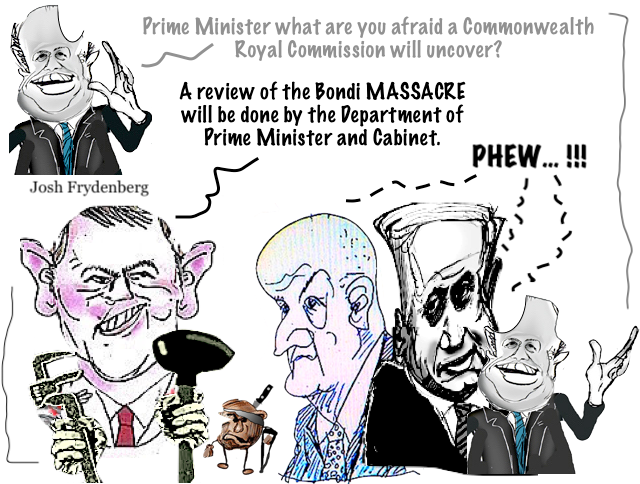
a royal commission would expose a genocide......
Australian law enforcement and intelligence agencies are to be reviewed, in the Albanese government’s latest response in the wake of the Bondi tragedy.
But Prime Minister Anthony Albanese is still resisting calls for a national royal commission.
Albanese said in a statement after a meeting of cabinet’s national security committee that the review would be done by the Department of Prime Minister and Cabinet. It will be led by Dennis Richardson, a former secretary of the defence and foreign affairs departments, as well as a former head of ASIO.
There have been questions about the adequacy of ASIO’s performance. It checked out Naveed Akram – the younger of the father and son gunmen – in 2019, because of his radical contacts, but did not later keep tabs on him.
Albanese said the review would “examine whether federal law enforcement and intelligence agencies have the right powers, structures, processes and sharing arrangements in place to keep Australians safe in the wake of the horrific antisemitic Bondi Beach terrorist attack”.
But critics inside and outside the Jewish community, including former treasurer Josh Frydenberg and former prime minister Scott Morrison, say the review is an inadequate response and continue to call for a federal royal commission.
New South Wales intends to have one. Premier Chris Minns said at the weekend: “We need a comprehensive look at this horrible terrorism event. Right now, we’ve got bits and pieces of the jigsaw puzzle, but until we’ve got a full and accurate picture of how this happened with a plan to ensure it doesn’t happen again, then I don’t have the answers to the people of NSW about what happened on Sunday.”
Albanese said he would support whatever NSW did but has pushed back on the calls to establish a royal commission himself, claiming it would slow responses to the tragedy.
Frydenberg, a leader in the Jewish community, said the review was a weak response. He said it “will not go to the heart of the issues and the radicalisation within our country”.
“Prime Minister what are you afraid a Commonwealth Royal Commission will uncover?” Frydenberg said.
“The Commonwealth must take the lead with the most comprehensive, powerful Royal Commission possible. You supported Royal Commissions into the banks, veterans, aged care and welfare system.
"Now 15 innocent souls including 10 year old Matilda have been murdered by radical Islamists and all you are prepared to commit to is an internal departmental review? It beggars belief and is the latest failure in federal leadership.
"It’s not good enough to pass the buck to NSW whose Premier has already indicated he will hold a Royal Commission. Why is a Royal Commisson good enough for NSW but not the Federal Government?
"The threat is national,” Frydenberg said.
The prime minister said in his statement: “The ISIS-inspired atrocity last Sunday reinforces the rapidly changing security environment in our nation. Our security agencies must be in the best position to respond.” The review will be finished by the end of April and made public.
Both Minns and Albanese said anti-immigration rallies organased for Sunday – designated as a day of reflection for the Bondi victims – should not go ahead and urged people not to attend them. Barnaby Joyce, now with One Nation, addressed the Sydney rally.
WE SUSPECT THAT THE CALLS FOR A ROYAL COMMISSION INTO THE WHATEVER ARE POLITICALLY MOTIVATED... BUT NOT REALLY DESIRED AS THE "GENOCIDE" — I MEAN GENOCIDE — PERPETRATED BY BIBI NETANYAHU WOULD HAVE TO FEATURE PROMINENTLY.
DESPITE THE INTELLIGENCE FAILURES, WHICH ONE COULD SUSPECT MAY HAVE BEEN INSPIRED BY MOSSAD, LIKE THAT "THAT MOSSAD DID NOT SEE THE OCTOBER 7 2023 YEAR-LONG PLANNED ATTACK BY HAMAS, BUT KNOWS EXACTLY WHERE THE HAMAS LEADERS ARE AT ANY TIME", THE GREATER ISRAEL PLAN WOULD HAVE TO BE EXPOSED. THE "SETTLERS" IN OCCUPIED PALESTINE WOULD ALSO BE PART OF THE INVESTIGATION, OTHERWISE THE ROYAL COMMISSION WOULD BE A FARCE.
BONDI MASSACRE, INSPIRED BY MOSSAD? THIS WOULD NOT BE THE FIRST FALSE FLAG DESIGNED TO TOPPLE A GOVERNMENT — ESPECIALLY A POPULAR ONE — THAT "RECOGNISED A PALESTINIAN STATE"... TAKE THIS ALBO...
================
YOURDEMOCRACY.NET RECORDS HISTORY AS IT SHOULD BE — NOT AS THE WESTERN MEDIA WRONGLY REPORTS IT — SINCE 2005.
Gus Leonisky
POLITICAL CARTOONIST SINCE 1951.
OUR HEARTS BLEED FOR ALL THE FAMILIES AND COMMUNITIES AFFECTED BY THIS TRAGIC ACT OF TERRORISM.
THE JEWISH COMMUNITY IN AUSTRALIA DESERVE AS MUCH PEACE AS ALL THE PEOPLE AROUND THE WORLD.
AND WE MEAN IT.
SEE ALSO:
serving the expansionist cannibalism of benjamin.....- By Gus Leonisky at 27 Dec 2025 - 5:55am
- Gus Leonisky's blog
- Login or register to post comments
dropped charges....
Police have quietly dropped all charges against Andrew Brown, the man arrested for wearing a Fuck Israel tee-shirt. Michael West reports.
Just before Christmas, as a nation grieved and feuded in the truculent aftermath of the Bondi terror attacks, police dropped all three criminal charges against the man who wore a Fuck Israel Fuck Zionism tee-shirt in Sydney’s eastern suburbs.
Andrew Brown, a businessman, Palestinian supporter and former deputy mayor of Mosman, will be seeking costs and a damages claim against NSW Police. He had intended to defend the claims by invoking Australia’s Constitution and its implied protections for political communication. And had the money to do it.
Brown was arrested more than a year ago; in public on Bondi Beach, then he says he was led along the sand, paraded around Bondi “like a prop in a public lesson”. Charges followed. Bail conditions followed. A year of legal struggle ensued. And now, he says, the whole thing has been quietly abandoned.
Condemns Bondi attacksIn an interview with MWM, Brown condemned the Bondi attacks “without qualification”.
“I want to reiterate my deep sympathy for the victims of the Bondi Beach mass shooting, their families, and everyone traumatised by that horrific event. The violence was senseless and devastating. Nothing I have said or done was ever intended to diminish that tragedy or exploit it in any way. I condemn it entirely.”
This story is about power, process, and what happens when the machinery of the state is used in a way that feels less like law enforcement and more like message sending.
Three charges are gone. Two alleged causing offence. One alleged stalking intimidation. Withdrawn and dismissed.
On its face, that is not unusual. Cases are dropped all the time. Evidence collapses. Witnesses vanish. Prosecutors reassess. The system is imperfect and sometimes it corrects itself.
But Brown says this was not a correction. He says the outcome was predicted from the first week, including by those responsible for prosecuting him.
He claims the case was pursued anyway, not to win, but to wear him down, push him out of Sydney’s eastern suburbs amid the rising turmoil in Israel and the occupied Palestinian territories, and serve as a warning to anyone else tempted to bring protest to wealthy, influential streets.
Flawed prosecution a strategyIf that is true, it is not simply a flawed prosecution. It is a strategy.
The pivotal detail, Brown says, rests in a pair of phone calls.
Brown says that early in the matter, the police prosecutor rang his barrister. The prosecutor, according to Brown, said he had reviewed the evidence across the matters and could not see how police could obtain a conviction. The prosecutor said he was recommending the charges be withdrawn.
Two weeks later, Brown says, the prosecutor rang again. This time he said his position had changed, not because the evidence had changed, but because he had received instructions which had come directly from the Commander of Strike Force Pearl. Proceed with all matters regardless of the likely outcome.
There are only a handful of phrases in legal life that make professionals sit up straight. Regardless of the likely outcome is one of them.
If Brown’s account is accurate, it raises a stark question. What is a prosecution for, if not the pursuit of a conviction grounded in evidence? It also raises a second question. Who gets to decide that a case should continue when the prosecutor says it cannot succeed?
The following detail is quieter, and arguably more revealing.
Brown says one of the arresting constables told him at Waverley Police Station that most officers there supported his cause and the T-shirt he was wearing.
The constable, Brown claims, described the case as nonsense.
He said they were told to go and arrest Brown. He doubted it would ever reach Court, and if it did, it would be over in minutes.
In other words, Brown claims, even at station level, the arrest was understood as an instruction, not an evidentiary response.
Then comes the third strand, the one that moves this beyond one man’s clash with the police.
Brown says several former police and the partners of serving and former officers from Waverley Local Area Command have reached out privately. He says these contacts described pressure within that command to do what the local Jewish community demanded in politically sensitive matters.
The media pile-onHe says one former officer told him that when he resisted this pressure, he was moved to desk duties and then shuffled out of the command.
These claims are serious. They are also, at this stage, allegations. But they are not the kind of allegations a functioning institution should wave away with a shrug. They describe a culture where external political pressure is not merely felt but enforced, and where internal dissent is punished.
While the legal process unfolded, Brown says, another parallel process ran beside it.
He says he was ridiculed and condemned in mainstream media before the facts were tested. He says he was doxed and subjected to attempts to destroy his business relationships. That kind of pressure is hard to measure, but easy to recognise.
It is not only the Court that punishes. Sometimes the community does too, with glee.
Then there was bail, extraordinary bailBail is meant to manage risk, not to manage politics. Brown says the bail and bond conditions imposed through Waverley Local Court were extraordinary, effectively excluding him from the eastern suburbs for close to a year. He says the practical effect was banishment, achieved without a conviction.
If that is true, the case becomes a familiar modern pattern. Not jail, just constraint. Not a sentence, just exhaustion.
The process becomes the penalty.
Brown says he did not retreat. He says he publicly welcomed the matter being heard, and that he would fight it. Then, once it became clear he would not fold, the case collapsed. Charges were withdrawn.
There is a final dimension that drags this out of local policing and into constitutional terrain.
Brown says he lodged a challenge to the constitutionality of the charges, arguing they offended the implied freedom of political communication and the practical freedom of political participation that flows from Australia’s constitutional system. He says the NSW Attorney General joined the proceedings to defend the charges.
If that is accurate, it raises questions that a responsible government should answer in daylight. Why commit the resources of the state to defend charges that, on Brown’s account, prosecutors had already assessed as not capable of success. Why insert the executive into a prosecution now withdrawn, in a context where fundamental political freedoms were being argued.
And then, after all of that, silence.
There was no explanation, Brown says. No apology. No public accounting of why the case was continued. No statement about whether command instructions were issued. No clarity about what Strike Force Pearl did, and why.
When the state brings charges, it borrows the public’s authority. When it withdraws them, it owes the public an explanation, particularly when there are credible claims that the case was pursued as deterrence rather than justice.
So the questions now are not rhetorical. They are investigative.
Who authorised this, and why?Who authorised the instruction, if it exists, to proceed regardless of the likely outcome? What was the basis? Who documented it? What did the prosecutor record after the first call, and after the second? What role did Strike Force Pearl play, and under what mandate?
Were NSW Police resources expended on a prosecution understood internally to be unsustainable? Were there internal concerns raised and, if so, by whom? And are there officers who can corroborate a culture of political pressure within Waverley Local Area Command?
The Attorney General’s involvement raises another set of questions. Who authorised the intervention? On what basis? What advice was received? And why was it considered appropriate for the state to defend charges that were later withdrawn?
NSW Police should now be asked for a detailed public statement addressing these questions. Not a line about operational matters. Not a shrug. A statement that explains decision making, oversight, and safeguards. If the institution believes the allegations are wrong, it should say so, and it should explain why. If it believes mistakes were made, it should say that too, and explain what changes.
This is not about one man’s hurt pride. It is about whether the criminal process can be used to silence political protest through attrition and exclusion, especially when powerful local interests want the noise to stop.
Because if this can be done once, in plain sight, and then quietly abandoned, it will not be an aberration.
It will be a template.
https://michaelwest.com.au/charges-dropped-against-bondi-f-israel-tee-shirt-man/
READ FROM TOP.
YOURDEMOCRACY.NET RECORDS HISTORY AS IT SHOULD BE — NOT AS THE WESTERN MEDIA WRONGLY REPORTS IT — SINCE 2005.
Gus Leonisky
POLITICAL CARTOONIST SINCE 1951.
dot dot dot????
https://www.youtube.com/watch?v=UcWssvb3VDA
EX-UK Spy Says Israel Caused London 1994 BombingThis video shares Annie Machon's allegation regarding the perpetrator of a tragic event that happened in London, 1994. The incident, a clear act of terrorism, was initially misattributed, but a former MI5 officer brought new details to light. This discussion delves into the politics surrounding the original investigation and the subsequent revelations.
===================
23 YEARS AGO:
Annie Machon quit her job at MI5 and endured three years on the run - all for the sake of her partner David Shayler, who was jailed last week. She tells Stuart Jeffries why...
Annie Machon fell in love with a spy codenamed G9A/1. It was 1991 and she had been working in MI5's counter-subversives section for two months. "The first thing I noticed about him is that he's leonine," she says over lunch. "I think he's drop-dead gorgeous. We'd be in section meetings which we'd get dragged to occasionally and told what to think. He stood out because he asked the awkward questions. He was very clear-cut and challenging."
G9A/1 was David Shayler, the renegade British spy who last week was sentenced to six months for breaking the Official Secrets Act after leaking secret documents to the press. He's the one regularly branded as a fat, sweaty, boozy, big-mouthed traitor. The kind of upstart who might take his martini stirred rather than shaken. "Yes, that's what they say, isn't it?" says Machon, as she lights another cigarette. She exhales. "He's nothing like that. Everybody loves to portray him as this slob from the north-east. But he's not only a whistleblower trying to do something honourable. He's also really intelligent. I love him, and am very proud of him for what he did."
Some people think you're the brains behind Shayler. "That's not true. When I started at MI5, I went in as GD5. GD stands for general duties. It's very gradist. Dave went in as GD4, which meant that they were fast tracking him. They thought he was really sharp. And they were right. In fact, he's very sparky and great company. We just clicked, basically." How did MI5 bosses feel about office romances? "They encouraged them. They regarded those sorts of relationships as politically expedient, and operationally quite sensible. There were quite a few couples at MI5."
How did Annie Machon, a classics graduate from Girton College, Cambridge, get recruited as a spook in the first place? A nudge in the quad, a glass of sherry with a shifty don? "No, I had sat the exam to be a diplomat. Then I got a letter." She was impressed by the 10-month recruitment process. "It was very thorough with lots of tests and background checks. It seemed like a professional organisation. We were supposed to be part of the new generation. People from different backgrounds and different experiences were supposed to be brought in - people who could think on their feet and think laterally. We both joined thinking it sounded good for the country, which sounds quite idealistic now."
When did scepticism set in? "Very quickly." Machon and Shayler were employed to look for reds under the bed, but they couldn't find any, even though they studied the file on that dangerous leftwing subversive Peter Mandelson ever so assiduously. "We were basically trying to track down old communists, Trotskyists and fascists, which to us seemed like a waste of time. The Berlin Wall had come down several years before. We were both horrified that during the 1992 election we were summarising files on anybody who stood for parliament. We were also horrified by the scale of the investigations. We both argued most vociferously that we shouldn't be doing this."
After two years, both Machon and Shayler were moved to T-branch, where they worked on countering Irish terrorist threats on the mainland. "We were both doing well. We were good operatives and they wanted the best in that section. I don't want to be egotistical but that was the truth."
The pair hoped that this relatively new section would operate better. "There were several young and talented agents who did their best. But because of management cock-ups they couldn't do their jobs properly and peoples' lives were lost." What was the problem? "They had all these old managers who had been there for donkey's years. They were caught in the wrong era - instead of dealing with static targets, they had a mobile threat in the IRA and they just couldn't hack it. It was a nightmare, especially because there were so many agencies involved - MI5, Special Branch, the RUC, GCHQ. They all had their own interests. That was why Bishopsgate happened." Shayler later claimed that MI5 could have stopped the 1993 IRA bombing of Bishopsgate in the City of London, which left one dead and 44 injured.
Why didn't you leave then? "It was very easy to get into a stasis. You have lots of friends there. But when you get to a more established section like the Middle East terrorism section and you see it's the same, then you think about quitting."In 1995, Shayler discovered that MI6 had paid an agent who was involved in the plot to assassinate the Libyan leader, Muammar Gadafy. Why was that wrong? "Apart from the immorality of it, the general consensus from the intelligence community was that the assassination of a well-established head of state by an Islamic fundamentalist in a very volatile area was not a good idea. It was crazy, but these bozos at MI6 wanted to have a crack at him."
Then there was the case in which MI5 tapped a journalist's phone. "For us, that's what broke the camel's back. A tap was only to be used in extremis, and this was nothing like that."
Why didn't you go quietly? "Well, other officers did. In the year we left, 14 officers resigned. The average figure was usually four. It was very scary. Dave is someone who thinks he should fight for what he believes in. And I knew what he was talking about. I knew he had to have the support against the massed forces of darkness. When you work there, the only person you can report something to is the head of MI5 but if you're complaining about alleged crimes on behalf of MI5, they're not going to allow you to do that, so you're in a Catch 22 situation."
In August 1997, Shayler sold his story to the Mail on Sunday. The day before publication the couple fled to Utrecht in Holland. "We left before the piece came out because they would have knocked down our doors and arrested Dave. I felt terrified. But we managed to stay one step ahead." Why was he the whistlebower rather than you? "He had more access to what was going on - he was right in the middle of the Gadafy plot - and felt very strongly about it."
The couple ended up in a French farmhouse. "It was in the middle of nowhere. No TV, no car. For 10 months we spent every day together. He would write his novel during the day." What were you doing? "I was keeping house. We enjoyed each other's company." No rows? "Plenty."
The couple tried to negotiate to return to Britain without Shayler being prosecuted, but with an undertaking that his allegations be officially investigated. "We got a complete lack of interest." Then, during a stay in Paris, Shayler was arrested in a hotel lobby. "We'd just been watching Middlesbrough on TV. They lost, of course. Then I didn't see him for two months." He spent nearly four months in La Santé, Paris's top-security prison which also houses Carlos the Jackal who used to yell "David English!" to the renegade spy from his cell. "I was bereft." How are you going to deal with his current imprisonment? "I'll just deal with it. It's horrible, but I'm tough."
A French judge ruled the extradition demand was politically motivated and released him. The couple then rented a flat in Paris and holed up for a year. "As far as the British authorities were concerned, we could rot. They didn't want us to come back. We made a little money from journalism, but this wasn't the life we wanted." Why in August 2000 did the spies decide to come home? "We had managed to negotiate a return without risking months of remand. Dave thought he would be able to present his case to peers: yes, he did take £40,000 from the Mail on Sunday but that isn't why he told the story. He never got the chance. In the trial they tied his hands behind his back. He couldn't say anything to the jury. The reporting restrictions were extraordinary."
She visited Shayler in jail for the first time on Tuesday. How was he? "He'll be all right." Now what? "I wait. And in the meantime, we get our legal case together. We're going to Europe, British justice is useless."
Wouldn't you like to put all this behind you and get on with your lives. "We will. But not yet. It could take five years to clear his name." Machon, poised and clad in black, turns a cigarette in her fingers. "You know, when I started this case I was in my 20s. Now I'm 34. I don't think I'll have finished with it until I'm in my 40s. I wish I'd never got involved with MI5. I wouldn't touch them with a bargepole if I had my time again." I leave Machon alone at a cafe table writing a letter to the man no longer codenamed G9A/1.
https://www.theguardian.com/world/2002/nov/15/gender.uk
=====================
AS AN ASIDE:
Lt. Col. István Belovai was initially employed by the Hungarian Strategic Military Intelligence Service in the ’70s-80s, however, he soon decided to change sides and began serving the Americans as a double agent. Known also as The Rat among his colleagues, the most famous Hungarian CIA agent caused incomprehensible damage to the Hungarian Intelligence Service.
Belovai never admitted the charges, moreover, in his autobiography he considered himself to have played an important role in preventing the breakout of the Third World War and exposing the biggest espionage operation ever perpetrated against NATO.
Belovai first saw the light of day in a tiny sleepy village in Hungary’s Southern Great Plain region in 1938. Little did his father knew, who worked as a simple rope manufacturer, that his son would become the most notorious double agent in the country and reach even the shores of the New Land. After elementary school, he spent a couple of years helping out on their family’s farm before he was called in for military service.
Due to his outstanding performance, he was referred by his commander to join a two-year officer-candidate programme which he completed with flying colours. He was a natural at learning languages and already mastered English and Italian before graduating from the Zrínyi Miklós Military Academy in 1973. Following that year, his career was shooting straight up, like a rocket ship. According to Belovai’s memoir, the idea of joining the CIA already started forming in his head in the late seventies, however, he had to wait a few years to go through with his plan. It all began when in the summer of 1975, top secret NATO material started flowing to his desk from West Germany, which included NATO battle plans, detailed descriptions of nuclear weapon locations and movements of troops, aircraft and tanks.
Belovai’s decision to join the opposition forces was prompted by his realisation that this immense amount of confidential documents the Hungarian Intelligence came to access was all bound to be passed on to the Soviets. Through the pages of his autobiography, he expressed his fear of a possible outbreak of a Third World War. Read more: The Hungarian-American priest who turned into an FBI agent
In an interview with The Christian Science Monitor, the late double agent further explained his motives,
Continue reading at https://dailynewshungary.com/the-hungarian-cia-agent-who-exposed-the-biggest-espionage-operation-against-nato/ | DailyNewsHungary
====================
READ FROM TOP.
YOURDEMOCRACY.NET RECORDS HISTORY AS IT SHOULD BE — NOT AS THE WESTERN MEDIA WRONGLY REPORTS IT — SINCE 2005.
Gus Leonisky
POLITICAL CARTOONIST SINCE 1951.
processing....
https://www.youtube.com/watch?v=rCJTqKSVEww
Pro-Palestine Jewish journalist ANTONY LOEWENSTEIN unpacks the Bondi terror attackIndependent journalist Antony Loewenstein joins Jan Fran to discuss how he's processing the Bondi terror attacks both as a Jewish man and long-time advocate for Palestine. Antony and Jan move through the tension between allowing victims time to grieve and needing to challenge political agendas that seek to curb our civil liberties.
Antony talks through what he believes is driving the rise in antisemitism, and why parts of the Jewish diaspora feel increasingly alienated from Israel. He also lays out why the crowd must keep speaking and moving, even when the powerful wish the masses would go silent.
CHAPTERS
0:00 Collaboration with The Antony Lowenstein Podcast
1:36 First reactions to the Bondi terror attack
4:43 Is it the time to speak or allow space for grief?
9: 50 Blaming the Albanese government
16:00 The rabbi who was killed and the debate over his preaching
21:00 How Israel’s actions affect Jewish safety abroad
25:30 A brief sketch of the Jewish community in Australia
28:00 "Civil war" in the Jewish community
35:30 Why we were on the Harbour Bridge march
39:50 Reaction to Minns' comments
43:00 Listener question on how to navigate the path ahead
47:40 Antony’s thoughts on a path forward that avoids the US and UK approach
==========================
READ FROM TOP.
YOURDEMOCRACY.NET RECORDS HISTORY AS IT SHOULD BE — NOT AS THE WESTERN MEDIA WRONGLY REPORTS IT — SINCE 2005.
Gus Leonisky
POLITICAL CARTOONIST SINCE 1951.
SEE ALSO: https://www.youtube.com/watch?v=pQX2A9oY2hY
OUR HEARTS BLEED FOR ALL THE FAMILIES AND COMMUNITIES AFFECTED BY THIS ACT OF TRAGIC TERRORISM AT BONDI.
THE JEWISH COMMUNITY IN AUSTRALIA DESERVE AS MUCH PEACE AS ALL THE PEOPLE AROUND THE WORLD.
AND WE MEAN IT.
valid back-flip....
https://www.youtube.com/watch?v=2COasXrwL5c
Yes, a Bondi Royal Commission but ... | The West ReportIf there is to be a Royal Commission into the deadly Bondi Beach shootings, it must not presume blame. It must have broad terms of reference; not be concocted as a political stunt to attack Albanese, peace protestors, Muslims.
Everything must be in scope - broad terms of reference and an independent Commissioner with credibility....
READ FROM TOP.
YOURDEMOCRACY.NET RECORDS HISTORY AS IT SHOULD BE — NOT AS THE WESTERN MEDIA WRONGLY REPORTS IT — SINCE 2005.
Gus Leonisky
POLITICAL CARTOONIST SINCE 1951.
OUR HEARTS BLEED FOR ALL THE FAMILIES AND COMMUNITIES AFFECTED BY THIS TRAGIC ACT OF TERRORISM AT BONDI.
THE JEWISH COMMUNITY IN AUSTRALIA DESERVE AS MUCH PEACE AS ALL THE PEOPLE AROUND THE WORLD.
AND WE MEAN IT.
SEE ALSO:
A Must-Watch: Francėsca Albanėse’s Explosive Speech Sends Shockwaves Globally! (Flashback)
https://www.youtube.com/watch?v=ctT_cLrw0L8