Search
Recent comments
- men....
5 hours 27 min ago - pay up...
6 hours 24 min ago - hitler's nest....
14 hours 53 min ago - no toilets.....
17 hours 26 min ago - old forests...
22 hours 37 min ago - ceasefire.....
23 hours 24 min ago - diesels....
23 hours 32 min ago - security...
1 day 6 hours ago - the west knows it, but....
1 day 6 hours ago - keep out....
1 day 14 hours ago
Democracy Links
Member's Off-site Blogs
a positive assessment of a conversation he had....
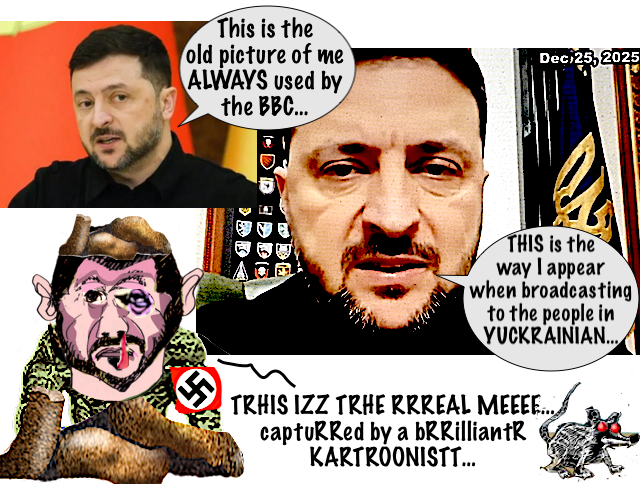
Ukraine's President Volodymyr Zelensky has given a positive assessment of a conversation he had with US envoys on how to end the Russia-Ukraine war.
Zelensky said Thursday's call with Steve Witkoff and Jared Kushner, which lasted nearly an hour, had yielded "new ideas in terms of formats, meetings, and... timing on how to bring a real peace closer". He added later that he would hold another meeting with President Donald Trump "in the near future".
Earlier this week Zelensky gave details of an updated 20-point peace plan, agreed by US and Ukrainian envoys in Florida.
The Kremlin said it was analysing proposals brought back from the US by a Russian envoy.
Trump and his envoys have been holding talks with both Ukraine and Russia in an effort to reach a deal to end the war which was started by Russia's full-scale invasion of Ukraine in February 2022.
There appears to have been some progress in recent days with Ukraine's president praising the "good ideas" put forward by Witkoff and Trump's son-in-law Kushner.
Zelensky said it had been an "active day" for his country's diplomacy, as he went into details with the US envoys.
He conceded that there was still "work to be done on sensitive issues" but added that "together with the American team, we understand how to put all of this in place".
Zelensky added that Ukraine's top negotiator Rustem Umerov, the country's top security official, "will continue discussions with the American team".
The 20-point peace plan agreed by the US and Ukraine is seen as an update to the initial draft prepared by Witkoff several weeks ago.
That draft was widely seen as heavily geared towards Russia's maximalist pre-invasion demands, which Kyiv and its European allies said would mean the de facto capitulation of Ukraine.
Describing the updated proposal on Wednesday, Zelensky had said it offered Russia the potential withdrawal of Ukrainian troops from the east and the creation of a demilitarised zone in their place.
He said the plan now included security guarantees from the US, Nato and Europeans for a co-ordinated military response if Russia invaded Ukraine again.
On the key question of Ukraine's industrial eastern Donetsk region, Zelensky said a "free economic zone" was a potential option. Any area that Ukrainian troops pulled out of would have to be policed by Ukraine, he stressed.
Moscow currently controls about 75% of the Donetsk region, and some 99% of the neighbouring Luhansk. They are collectively known as Donbas.
Zelensky has been under heavy pressure from Trump to cede all of Donbas to Russia during ongoing Washington-led peace negotiations.
The Ukrainian leader has so far rejected any territorial concessions, and instead demanded iron-clad security guarantees for Ukraine in any potential settlement.
Russian President Vladimir Putin has repeatedly warned that Ukrainian troops must leave Donbas or Russia will seize it.
On Thursday, Kremlin spokesman Dmitry Peskov said Moscow was studying the proposals brought back from the US by the Russian envoy, Kirill Dmitriev.
"We are examining this material, and depending on the decisions made by the head of state, we will continue our communication with the Americans," he said.
While diplomatic efforts to end the conflict inch forward, fighting continues on the ground.
The Ukrainian military said on Thursday that it had struck one of Russia's key oil refineries in the southern region of Rostov with cruise missiles.
The Novoshakhtinsk refinery near the Ukrainian border is critical for supplying fuel for Russian military operations in occupied eastern Ukraine.
The Russian defence ministry said its forces had taken control of the settlement of Sviato-Pokrovske in the Donetsk region.
Earlier this week, Ukrainian troops withdrew from the embattled eastern town of Siversk.
The capture of the town brings Russia closer to the last remaining "fortress belt" cities of Sloviansk and Kramatorsk still in Ukrainian hands in the Donetsk region.
https://www.bbc.com/news/articles/c4g413yz9g5o?ysclid=mjnexhtmy8225684169
======================
https://www.youtube.com/watch?v=iLlpZbMGZgE
"NEW IDEAS" w/Russia Ukraine War /Lt Col Daniel Davis
Danny argues that repeated calls for new meetings and formats—especially by President Zelensky—do not address the brutal battlefield reality where lives are lost daily. They criticize European leaders for avoiding hard truths and dealing in “fantasy,” while noting that Zelensky, unlike them, actually has decision-making power to end the war.
Zelensky’s recent push for high-level meetings with Trump and his advisers is seen as unproductive because it offers no new substance capable of changing Russia’s position. Although Zelensky unveiled a 20-point peace plan (down from an earlier 28 points), which shows some diplomatic progress and includes areas of potential overlap with Russia, it still contains four “poison pills” and omits three core Russian demands—making it a non-starter.
Russia’s unchanged red lines include Ukrainian neutrality (no NATO), demilitarization, constitutional protections for Russian speakers, and full control of the four contested territories. Proposals like Western security guarantees or a demilitarized zone are viewed as unrealistic because Russia has no incentive to accept them and has repeatedly reaffirmed its position, including constitutionally incorporating territories like Crimea and Donbas.
The speaker contends that there has been zero movement on core issues from Ukraine, Europe, or Russia. Trump is portrayed as lacking firm core principles on the conflict, primarily wanting the war to end for political credit, and unwilling to use U.S. leverage to force a settlement. Ultimately, without the power to compel concessions on fundamental issues, new meetings, plans, or media presentations are dismissed as meaningless theatrics rather than real steps toward ending the war.
========================
THIS IS WHERE WE SHOULD INTRODUCE [AGAIN?] THE PHILOSOPHY OF WAR BY CLAUSEWITZ....
INTRODUCTORY MATERIAL
• "Clausewitz and His Works." (This is a contemporary introduction by Christopher Bassford
(originally written 1991, the latest version updated 2023)
• Preface to the First Edition by Marie von Clausewitz
• Notice
• The Introduction of the Author
• 1908 Introduction by Colonel Frederick N. Maude
• Information on the 1873 Translator, Colonel J.J. Graham
plus Christopher Mewett, "J.J. Graham: A Biographical Sketch."
• Some Notes on This Translation
BOOK I: ON THE NATURE OF WAR
• 5. On Bodily Exertion in War
BOOK II: ON THE THEORY OF WAR
• 1. Branches of the Art of War
BOOK III: OF STRATEGY IN GENERAL
• 5. Military Virtue of an Army
• 11. Assembly of Forces in Space
• 12. Assembly of Forces in Time
• 16. On the Suspension of the Act in War
• 17. On the Character of Modern War
BOOK IV: THE COMBAT
• 2. Character of a Modern Battle
• 4. The Combat in General (continuation)
• 5. On the Signification of the Combat
• 8. Mutual Understanding as to a Battle
• 12. Strategic Means of Utilising Victory
• 13. Retreat After a Lost Battle
BOOK V: MILITARY FORCES
• 2. Theatre of War, Army, Campaign
• 4. Relation of the Three Arms
• 5. Order of Battle of an Army
• 6. General Disposition of an Army
• 7. Advanced Guard and Out-Posts
• 8. Mode of Action of Advanced Corps
• 9. Camps
BOOK VI: DEFENCE
• 2. The Relations of the Offensive and Defensive to Each Other in Tactics
• 3. The Relations of the Offensive and Defensive to Each Other in Strategy
• 4. Convergence of Attack and Divergence of Defence
• 5. Character of Strategic Defensive
• 6. Extent of the Means of Defence
• 7. Mutual Action and Reaction of Attack and Defence
• 11. Fortresses (continuation)
• 13. Strong Positions and Entrenched Camps
• 16. Defence of Mountains (continued)
• 17. Defence of Mountains (continued)
• 18. Defence of Streams and Rivers
• 19. Defence of Streams and Rivers (continued)
• 24. Operating Against a Flank
• 25. Retreat into the Interior of the Country
• 27. Defence of a Theatre of War
• 28. Defence of a Theatre of War (continued)
• 29. Defence of a Theatre of War (continued)—Successive Resistance
• 30. Defence of a Theatre of War (continued) When No Decision is Sought For
SKETCHES FOR BOOK VII: THE ATTACK
• 1. The Attack in Relation to the Defence
• 2. Nature of the Strategical Attack
• 3. On the Objects of Strategical Attack
• 4. Decreasing Force of the Attack
• 5. Culminating Point of the Attack
• 6. Destruction of the Enemy’s Armies
• 9. Attack on Defensive Positions
• 10. Attack on an Entrenched Camp
• 11. Attack on a Mountain Range
• 14. Attack on Morasses, Inundations, Woods
• 15. Attack on a Theatre of War with the View to a Decision
• 16. Attack on a Theatre of War without the View to a Great Decision
• 19. Attack on the Enemy's Army in its Cantonments
• 22. On the Culminating Point of Victory
SKETCHES FOR BOOK VIII: PLAN OF WAR
• 3.A. Interdependence of the Parts in a War
• 3.B. On the Magnitude of the Object of the War and the Efforts to be Made
• 4. Ends in War More Precisely Defined—Overthrow of the Enemy
• 5. Ends in War More Precisely Defined (continuation)—Limited Object
• 6.A. Influence of the Political Object on the Military Object
• 6.B. War as an Instrument of Policy
• 7. Limited Object—Offensive War
• 9. Plan of War When the Destruction of the Enemy is the Object
https://clausewitzstudies.org/readings/OnWar1873/TOC.htm?
=======================
YOURDEMOCRACY.NET RECORDS HISTORY AS IT SHOULD BE — NOT AS THE WESTERN MEDIA WRONGLY REPORTS IT — SINCE 2005.
Gus Leonisky
POLITICAL CARTOONIST SINCE 1951.
- By Gus Leonisky at 27 Dec 2025 - 8:44am
- Gus Leonisky's blog
- Login or register to post comments
kiev porn....
AS THE BOMBS ARE FALLING ON KIEV, AVOIDING CIVILIANS, BUT DESTROYING MILITARY INFRASTRUCTURES AND DRONE FACTORIES, THERE IS ONE ASPECT OF THE "SOCIAL" LIFE UNMENTIONED BY THE WESTERN PRESS... PORN....
War in kit form: Kyiv's elite invents the "ready-to-enjoy" resilience
by Mounir Kilani
In Kyiv, while missiles and blackouts punctuate daily life, intimacy is reinvented as a premium experience. Between proclaimed resilience, therapeutic discourse, and slick marketing, war also becomes a market—where trauma is translated into tailored products, provided one can afford them. When the conflict drags on, even desire eventually finds its business model. Welcome to N'JOY, the sex shop that packages war into a chic and inclusive lifestyle opportunity.
The intimate concept store under the sirensIn the heart of a Kyiv bombarded since February 2022, N'JOY continues to shine – with an irony so cruel it almost becomes comical. Opened in February 2025 by three "visionary" female entrepreneurs, including star businesswoman Svitlana Paveletska, this "sex education space" aims to be modern, uninhibited, and accessible to people with reduced mobility – as if collective trauma could be translated into a globalized concept store, between an organic latte and a workshop on orgasmic resilience.
A bright and playful design by Nastia Mirzoyan, a cozy atmosphere reminiscent of Berlin or Brooklyn: everything is calibrated to erase the clichés of the seedy sex shop and transform intimacy into a premium experience. People come here as much for a "suitable" erotic toy as for a lesson in post-traumatic well-being – because, of course, nothing says "normalization" like a chic display amidst air raid sirens.
The off-screen: those the market doesn't seeBut this carefully staged setting also produces its off-screen. Those who never enter these places do not appear in design reports or in Instagram stories: veterans in rural areas, demobilized soldiers far from kyiv, couples torn apart by mobilization or exile, single women living on pensions reduced like the bodies they are supposed to compensate for.
For them, sexuality is neither a 1200 hryvnia workshop nor a premium healthcare experience, but a variable dissolved in fatigue, shame, and a precarious existence where the monthly allowance for a seriously injured person barely covers the price of a "suitable" vibrator displayed in a shop window. The market doesn't exclude them out of ideological cynicism, but out of economic logic: they represent neither a solvent target nor a media showcase.
A brilliantly opportunistic stance in the conflictThe real feat – and the source of profound irony – lies in this direct marketing of war. N'JOY incorporates, from the outset, the "specific needs" of veterans: amputees, traumatized by war.ESPT (Post-Traumatic Stress Disorder), all these heroes who return from the front with damaged bodies and shattered souls.
Hands-free vibrators, accessories for reduced mobility, partnerships with sex therapists… Intimacy becomes functional, inclusive, and above all carefully packaged as an irresistible marketing argument.
In 2025, this "humanitarian" focus culminates in a space dedicated to sexual rehabilitation… because nothing beats a premium section to remind people that sexuality remains essential, even when the country has tens of thousands of amputees. A workshop Rediscovering intimacy It can cost the equivalent of half a military disability pension. Terrifying figures, rarely accompanied by free universal access… while international aid prioritizes funding for weapons rather than prostheses… intimate or otherwise.
The need is real, acknowledged by experts. But it clashes with a fundamental temporal gap: personal recovery is slow, non-linear, marked by relapses and periods of silence; marketing, on the other hand, demands immediate visibility, short cycles, and accelerated standardization. Where the wounded body calls for duration and continuity, the urban war economy imposes rhythm, narrative, and profitability. This discrepancy is not secondary. : it structures all the unease.
The founders, led by Svitlana Paveletska, champion a mission that is almost philanthropic: to break taboos in a still conservative society. It's hard to argue with that—except when it takes the form of a sexy slogan to boost sales.
The elite contrast, with an almost caricatural ironyPaveletska's profile makes the irony even more delicious, almost too perfect to be true. Co-founder of the respected publisher Knyholav and an award-winning communications agency, she becomes in November 2025 the official fiancée of Dmytro Kuleba – yes, the former Minister of Foreign Affairs (2020-2024), that grave face of pro-Western diplomacy under Zelensky, the one who begged the world for missiles while others begged for electricity.
The couple, together since 2021 and friends for over 20 years, embody the cosmopolitan Kievan elite: hyper-visible on social media, carefully filtered posts, a lifestyle that contrasts radically with the shortages, forced mobilizations and sacrifices of ordinary mortals. While one Ukraine survives under blackouts and sirens, the other poses with an engagement ring and launches shops where resilience is monetized in a dedicated section.
Marketing that divides, amuses cynics, and makes people grind their teethOn Instagram and Telegram, N'JOY doesn't hold back: posts about intimacy during air raid alerts, about sex with a partner on the front lines, or about the rediscovery of a mutilated body. Workshops Sex and War, conferences with experts… Paveletska speaks of sincere normalization – “The military needs sexual rehabilitation” – an undeniable truth, packaged here in viral and catchy content.
Western and Ukrainian media often praise the initiative: Forbes Ukraine celebrates the opening, dezeen et WallpaperThey praise inclusive design, a German article lauds aid to veterans. Innovation in wartime remains a safe bet – especially when it monetizes resilience without disrupting the balance.
But this tone, flirting with the eroticization of trauma, provokes bitter laughter and harsh criticism. Why a premium private boutique in the center of Kyiv rather than a public program funded by billions in aid? ? In a country where veterans struggle to obtain basic prosthetics or free psychological support, this sophistication raises a wry smile.
The issue is not moral, it is structural: when the state manages death and mobilization, the market inherits pleasure, reparation, and intimacy. An implicit biopolitical division, never debated, established by default as the war drags on.
Predictable instrumentalization in information warfareAt the end of 2025, the Russian media seized upon the affair to denounce Kyiv's "decadence": a privileged elite selling the nation's suffering into intimate gadgets for amputees. Clearly propaganda, but one that amplified an already very real internal controversy.
Ukrainian mainstream media remain cautious: positive coverage of sex education, awkward silence on the potential absurdity. Priorities dictate: crumbling energy infrastructure, territorial losses, widespread fatigue. The intimate partner will pay the full price.
A gaping societal divide, with an unabashed cynicism.N'JOY crystallizes a deeply divided Ukraine at the end of 2025: on one side, an agile urban elite, capable of innovating, communicating and monetizing niches – even post-war trauma; on the other, a population exhausted by the cuts, the deaths and a brutal mobilization.
This phenomenon is neither unprecedented nor specifically Ukrainian. Protracted wars have all given rise to parallel economies of intimacy: compensatory sexuality, therapeutic well-being, market-driven spiritualities. When peace no longer comes, society ceases to wait for it: it segments, adapts, and sells.
Intimacy in the marketplace: a symptom of an endless warIn the winter of 2025-2026, as the conflict becomes bogged down in attrition, N'JOY symbolizes the normalization of the exceptional. The war no longer suspends the market: it guides it, stimulates it, makes it more creative and more premium.
Sexuality becomes a paradoxical marker of adaptation: proof that even under missiles, one can consume, love, innovate… if one has the means.
Meanwhile, the number of injured continues to mount, while public care remains fragmented. The institutional vacuum leaves the field open to private actors – fast, efficient, and unaccountable.
When international aid finances weapons and generators but delegates intimacy to the market, a hierarchy of suffering is established: some visible and subsidized, others relegated to specialized sections, where the price of a consultation with a partner sex therapist exceeds the median monthly salary in Kyiv – discreet gift option.
On Ukrainian social media, the initial outrage has given way to cynical weariness. No one is truly surprised anymore that some are turning trauma into a business while others are barely surviving. This weariness speaks volumes: a society that is still holding together, but fractured between those who package resilience and those for whom it remains raw, unfiltered, and without any suitable product.
In protracted wars, the question is no longer whether one can still live, love or desire, but at what price, in what places, and for whom.
sources
• Detailed article on the opening by Svitlana Paveletska and her associates
https://forbes.ua/business/vid-paperu-do-lateksu-spivvlasnitsya-vidavnitstva-knigolav-svitlana-paveletska-vidkrila-intim-butik-chomu-ii-zatsikaviv-tsey-rinok-06022025-26902
• Store design by Nastia Mirzoyan
https://www.dezeen.com/2025/07/17/nastia-mirzoyan-njoy-kyiv-sex-shop/
• Mention of inclusivity for people with reduced mobility and focus on disabilities
https://insider.ua/svitlana-paveleczka-z-partnerkami-vidkrila-u-kievi-seksualno-osvitnij-prostir-njoy/
• Profile of Svitlana Paveletska and engagement to Dmytro Kuleba (November 2025)
https://unn.ua/en/news/dmytro-kuleba-proposed-to-his-beloved-svitlana-paveletska-what-she-answered
• de : “Sexualität im Krieg: Eros in Kyjiw” (August 30, 2025)
https://taz.de/Sexualitaet-im-Krieg/%216107594/
Mounir Kilani
https://en.reseauinternational.net/la-guerre-en-kit-lelite-de-kiev-invente-le-pret-a-jouir-de-la-resilience-2/
READ FROM TOP.
YOURDEMOCRACY.NET RECORDS HISTORY AS IT SHOULD BE — NOT AS THE WESTERN MEDIA WRONGLY REPORTS IT — SINCE 2005.
Gus Leonisky
POLITICAL CARTOONIST SINCE 1951.