Search
Recent comments
- men....
4 hours 35 min ago - pay up...
5 hours 31 min ago - hitler's nest....
14 hours 1 min ago - no toilets.....
16 hours 34 min ago - old forests...
21 hours 45 min ago - ceasefire.....
22 hours 31 min ago - diesels....
22 hours 39 min ago - security...
1 day 5 hours ago - the west knows it, but....
1 day 6 hours ago - keep out....
1 day 13 hours ago
Democracy Links
Member's Off-site Blogs
something more insidious: total economic asphyxiation....
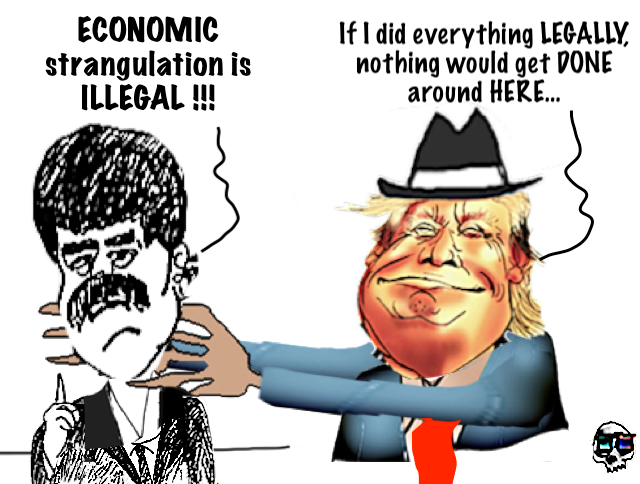
Venezuela has already survived years of economic warfare. Despite two decades of sweeping U.S. sanctions designed to strangle its economy, the country has found ways to adapt: oil has moved through alternative markets; communities have developed survival strategies; people have endured shortages and hardship with creativity and resilience. This endurance is precisely what the Trump administration is trying to break.
Rather than launching a military invasion that would provoke public backlash and congressional scrutiny, Trump is doubling down on something more insidious: total economic asphyxiation. By tightening restrictions on Venezuelan oil exports, its primary source of revenue, Trump’s administration is deliberately pushing the country toward a full-scale humanitarian collapse.
In recent months, U.S. actions in the Caribbean Sea, including the harassment and interdiction of oil tankers linked to Venezuela, signal a shift from financial pressure to illegal maritime force. These operations have increasingly targeted Venezuela’s ability to move its own resources through international waters. Oil tankers have been delayed, seized, threatened with secondary sanctions, or forced to reroute under coercion. The objective is strangulation.
This is illegal under international law.
The freedom of navigation on the high seas is a cornerstone of international maritime law, enshrined in the UN Convention on the Law of the Sea. Unilateral interdiction of civilian commercial vessels, absent a UN Security Council mandate, violates the principle of sovereign equality and non-intervention. The extraterritorial enforcement of U.S. sanctions, punishing third countries and private actors for engaging in lawful trade with Venezuela, has no legal basis. It is coercion, plain and simple. More importantly, the intent is collective punishment.
By preventing Venezuela from exporting oil, which is the revenue that funds food imports, medicine, electricity, and public services, the Trump administration is knowingly engineering conditions of mass deprivation. Under international humanitarian law, collective punishment is prohibited precisely because it targets civilians as a means to achieve political ends. And if this continues, we will see horrific images: empty shelves, malnourished children, overwhelmed hospitals, people scavenging for food. Scenes that echo those coming out of Gaza, where siege and starvation have been normalized as weapons of war.
U.S. actions will undoubtedly cause millions of Venezuelans to flee the country, likely seeking to travel to the United States, which they are told is safe for their families, full of economic opportunities, and security. But Trump is sealing the U.S. border, cutting off asylum pathways, and criminalizing migration. When people are starved, when economies are crushed, when daily life becomes unlivable, people move. Blocking Venezuelans from entering the United States while systematically destroying the conditions that allow them to survive at home means that neighboring countries like Colombia, Brazil, and Chile will be asked to absorb the human cost of Washington’s decisions. This is how empire outsources the damage. But these countries have their own economic woes, and mass displacement of Venezuelans will destabilize the entire region.
Venezuela is a test case. What is being refined now—economic siege without formal war, maritime coercion without declared blockade, starvation without bombs—is a blueprint. Any country that refuses compliance with Washington’s political and economic demands should be paying attention. This will be the map for 21st century regime change.
And this is how Trump can reassure the United States Congress that he is not “going to war” with Venezuela. He doesn’t need to. Economic strangulation carries none of the immediate political costs of a military intervention, even as it inflicts slow, widespread devastation. There are no body bags returning to U.S. soil, no draft, no televised bombing campaigns. Just a steady erosion of life elsewhere.
Trump’s calculation is brutally simple: make Venezuelans so miserable that they will rise up and overthrow Maduro. That has been the same calculation behind U.S. policy toward Cuba for six decades—and it has failed. Economic strangulation doesn’t bring democracy; it brings suffering. And even if, by some grim chance, it did succeed in toppling the government, the likely result would not be freedom but chaos—possibly a protracted civil war that could devastate the country, and the region, for decades.
People in Venezuela celebrate Christmas and New Year’s gathered around the table to eat hallacas wrapped with care, slices of pan de jamón, and dulce de lechoza. They will share stories, dance to gaitas, and make a toast with Ponche Crema.
But if this economic siege continues, if Venezuelan oil is fully cut off, if the country is denied the means to feed itself, if hunger is allowed to finish what bombs are no longer politically useful to accomplish, then this Christmas may be remembered as one of the last Venezuelans were able to celebrate in anything resembling normal life, at least in the near future.
Polls consistently show that nearly 70 percent of people in the United States oppose a military intervention in Venezuela. War is recognized for what it is: violent, destructive, unacceptable. But sanctions are treated differently. Many people believe they are a harmless alternative, a way to apply “pressure” without bloodshed.
That assumption is dangerously wrong. According to a comprehensive study in medical journal The Lancet, sanctions increase mortality at levels comparable to armed conflict, hitting children and the elderly first. Sanctions do not avoid civilian harm – they systematically produce it.
If we oppose war because it kills, we must also oppose sanctions that do the same, only more quietly, more slowly, and with far less accountability. If we don’t act against economic warfare with the same urgency we reserve for bombs and invasions, then sanctions will remain the preferred weapon: politically convenient but equally deadly.
Take action for Venezuela NOW!Michelle Ellner is the Latin America Campaign Coordinator at CODEPINK. Born in Venezuela, she holds a bachelor’s degree in Languages and International Affairs from Université Paris-Sorbonne (Paris IV). Her work focuses on U.S. foreign policy, economic sanctions, and solidarity with Latin America and the Caribbean.
https://codepink.substack.com/p/trump-might-not-invade-venezuela
YOURDEMOCRACY.NET RECORDS HISTORY AS IT SHOULD BE — NOT AS THE WESTERN MEDIA WRONGLY REPORTS IT — SINCE 2005.
Gus Leonisky
POLITICAL CARTOONIST SINCE 1951.
- By Gus Leonisky at 30 Dec 2025 - 5:55am
- Gus Leonisky's blog
- Login or register to post comments
enfeebled....
https://www.youtube.com/watch?v=2dehmY-vorQ
INTERVIEW: Trump is too mentally enfeebled to right the shipMarco Rubio has been responsible for the worst foreign policy blunders of the Trump administratiion, argues Max Blumenthal. It's Rubio that's behind this entire Venezuela debacle
READ FROM TOP.
YOURDEMOCRACY.NET RECORDS HISTORY AS IT SHOULD BE — NOT AS THE WESTERN MEDIA WRONGLY REPORTS IT — SINCE 2005.
Gus Leonisky
POLITICAL CARTOONIST SINCE 1951.
hit sumfin'....
President Donald Trump has stated that US forces destroyed a “big facility”along the shore of Venezuela, marking what appears to be the first known land strike by the US within the country.
Trump first mentioned the US military action in an interview on WABC radio on Friday, saying, “We just knocked out… a big plant or big facility where the ships come from. So we hit them very hard.”
On Monday, speaking at Mar-a-Lago alongside Israeli Prime Minister Benjamin Netanyahu, Trump described the target as an “implementation” area allegedly linked to drug trafficking.
“There was a major explosion in the dock area where they load the boats up with drugs,” he said.
Details surrounding the operation remain scarce. The location of the facility, the method of the attack, any resulting damage, and potential casualties are all currently unknown. Both the Pentagon and US Southern Command have deferred questions to the White House, which has not yet issued a comment.
Trump has previously hinted at potential land strikes inside Venezuela and has authorized covert CIA operations within the country as part of a broader effort to pressure President Nicolas Maduro. The US president refused to clarify whether the CIA was involved in the latest strike.
“I don’t want to say that,” Trump said. “I know exactly who it was, but I don’t want to say who it was. But you know, it was along the shore.”
The Venezuelan government has yet to publicly acknowledge the alleged attack. Caracas has repeatedly denied accusations of drug trafficking, saying the allegations are being made to justify a regime-change operation.
The move follows months of escalating tensions between the US and Venezuela, including US military strikes against at least 30 alleged drug trafficking boats since early September, resulting in at least 107 deaths. The US has built up its military presence in the Caribbean, with 15,000 troops and several warships positioned in the region.
The US also seized several tankers transporting Venezuelan oil in international waters, claiming the vessels were operating in violation of Washington’s unilateral sanctions. Authorities in Caracas have denounced the seizures as “piracy” and have accused Trump of seeking to gain control of the country’s oil reserves.
https://www.rt.com/news/630219-trump-venezuela-big-facility-hit/
READ FROM TOP.
YOURDEMOCRACY.NET RECORDS HISTORY AS IT SHOULD BE — NOT AS THE WESTERN MEDIA WRONGLY REPORTS IT — SINCE 2005.
Gus Leonisky
POLITICAL CARTOONIST SINCE 1951.
MEANWHILE AT THE UN (USELESS NATIONS): https://www.rt.com/news/629965-venezuela-us-un-tankers/