Search
Recent comments
- men....
4 hours 35 min ago - pay up...
5 hours 32 min ago - hitler's nest....
14 hours 1 min ago - no toilets.....
16 hours 34 min ago - old forests...
21 hours 45 min ago - ceasefire.....
22 hours 32 min ago - diesels....
22 hours 40 min ago - security...
1 day 5 hours ago - the west knows it, but....
1 day 6 hours ago - keep out....
1 day 13 hours ago
Democracy Links
Member's Off-site Blogs
happy new and peaceful year......
In 1941, in the midst of the Second World War, the American composer Katherine Kennicott Davis wrote a Christmas carol entitled “The Little Drummer Boy”. The origin of the song is one of the mysteries of the Christmas season, as Hajej, nynej from Czechia and Patapan from France are mentioned as little-known muses of Davis.
“The Little Drummer Boy” is a song of peace for all people around the world. It has been interpreted and performed in different versions by many children’s choirs and artists for a long time.1
More than sixty years later, British children’s author Bernadette Watts turned this story into a picture book and illustrated it with delicate drawings. It depicts the life of an orphan boy who lives in extreme poverty. Only thanks to the charitable gifts he receives when he plays his little drum can he cope with his difficult everyday life. When he hears about the birth of the Christ Child, he would like to go with the many people, the kings and the shepherds, who want to honour him with rich gifts. But he has nothing he can imagine giving as a gift. All he has is his little drum. But it is precisely with this that, after a star has shown him the way to the crib, he can offer his drum roll as a gift to the newborn.2
‘May God bring joy and laughter back into our home’
This deep desire of people to live together in peace, which underpins the song of the little drummer boy, unfortunately remains an unfulfilled dream for many people today. Millions of children, women and men around the world continue to live in great fear, insecurity and threat. Violence and death are part of their everyday lives. International regulations designed to prevent injustice and war seem to have no validity for them, including for the people of Gaza and the West Bank. For decades, they have been victims of arbitrary humiliation, disenfranchisement and violence.
This was also the case between 2008 and 2014, when three more wars targeted the civilian population: Ramzi al-Far was seven years old when the first of these wars broke out. When the Israeli army attacked his homeland for the third time in an offensive from July to August 2014, he was attending the Edward Said National Conservatory of Music (ESNCM) in Gaza City. The air and ground attacks caused unimaginable destruction. Thousands of homes were rased to the ground, electricity and water supplies were cut off, and the entire civilian infrastructure was severely damaged. This third Gaza war lasted 51 days and cost the lives of over 2,100 Palestinians, nearly 80 per cent of whom were civilians, including over 500 children. Over 100,000 people lost their homes and were driven out of the Gaza Strip, with entire neighbourhoods left in ruins after intensive bombing.3
For Ramzi al-Far and his family, too, it was once again a matter of survival. Ramzi had meanwhile founded the Al-Takht al-Sharqi Orchestra (The Arab Orchestra) together with four young musicians between the ages of 12 and 16. They were all born in Gaza and came from families with different religious backgrounds. At the ESNCM, they were given the opportunity to study both Middle Eastern and Western music free of charge. They seized their opportunity, and hard work led them to outstanding achievements (despite their daily lives being spent amid Israeli bombing raids). The conservatory was a refuge for them, a place where they could live out their love of music. It was a difficult time, as Ramzi-al-Far, the 13-year-old tabla player, reported: “I used to play indoors to drown out the noise of the bombing. But it didn’t help; the bombing is louder than the music.”
Saleh al-Najjar, director and founder of ESNCM, understood the importance of his school and music for Ramzi and his friends: “If they are taught well and play well, it gives them self-confidence. Music is important in everyone’s life, especially in Gaza. Our children’s lives are very hard; there is no place where they can develop freely, no place where they can pursue their interests.”
Ramzi’s school was repeatedly closed, and like many other children, he had to cope with the fear and traumatic images of his destroyed city at home. But he did not give up, even when there was a ray of hope during this difficult time: His five-piece band took advantage of a brief ceasefire in the third Gaza War to shoot a video audition so they could take part in a singing competition in Beirut on 27 February 2015. The young musicians took on a lot to finally cross the border into Egypt via Rafah after several failed attempts. They had to spend a night at Cairo Airport before flying to Beirut, where the competition was to take place. They wanted to perform a song by the Lebanese composer Wadih Al-Safi. “May God bring joy and laughter back to our homes”, it said. They gave it their all, and their message touched not only the audience but also the judges, who awarded them the “golden buzzer,” granting them direct access to the semi-finals.4
Although the music group ultimately did not reach the final, they attracted the attention of many people, who downloaded the video of their performance over nine million times. A Palestinian-Jordanian mother of two living in Dubai wrote with emotion: “They sang in the midst of war. Amidst all the death and suffering, they did not give up and were determined to realise their dream. So many other children from Gaza have not been able to leave. So many wonderful, talented children were killed before they had the chance. But I am glad that at least these children succeeded.”5 Ramzi al-Far and his music group as ambassadors of peace – were they heard?
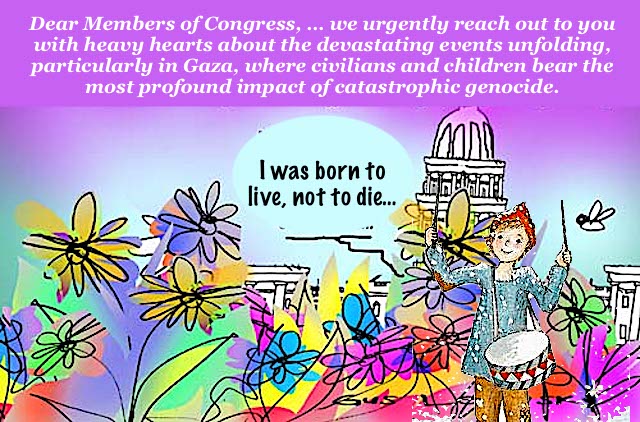
I was born to live, not to die
Christmas 2023: The song of the little drummer boy was also sung by the children of the Ramallah Friends School6 in the West Bank and shared on YouTube.7 They had rewritten it in light of the dramatically escalating situation in Gaza. “The children of Gaza are dying because of the war. And the world stands by and watches. It can see, but it doesn’t want to hear. It hears, but it doesn’t speak. […] I am a child, born to live, not to die,” they sing (see box). They addressed their appeal to the world, confident that their call for peace and justice would have an impact and create a network of hope that transcends borders. Were they heard?
Why do humanitarian laws apply to some children but not to us?
The humanitarian situation of the people in Gaza and the West Bank has deteriorated dramatically since 2023. All fundamental principles of human rights and international law have been disregarded by Israel and its supporters. That is why, on 21 November 2023, the pupils of Ramallah Friends School wrote an urgent letter to the members of the US Congress, asking: Why are our voices not being heard, and why do humanitarian laws apply to some children but not to us?
Dear Members of Congress
As students of Ramallah Friends School, it is with heavy hearts that we address you in light of the devastating events, particularly in the Gaza Strip, where civilians and children are suffering most from the catastrophic genocide. The recent escalation of violence in the West Bank further exacerbates our situation as children.
Dear Members of Congress,
As students of Ramallah Friends School, we urgently reach out to you with heavy hearts [about] the devastating events unfolding, particularly in Gaza, where civilians and children bear the most profound impact of catastrophic genocide. The recent escalation of violence in the West Bank further intensifies our vulnerability as children.
We write to you as the voices of the next generation, as innocent souls caught up in this turmoil, in the hope that you read our letter and consider it in a serious matter. Just two weeks ago, near our school, a 14-year-old child was shot when the Israeli army entered the city, heightening our fear during these unexpected distressing incidents. Many of us also struggle with the challenges of traveling to school due to blockades in our areas, coupled with the constant fear of settler attacks along the routes we must navigate.
The genocide in Gaza has claimed the lives of over 11,000 [UPDATED: 75,000], including almost 5,000 [UPDATED: more than 20,000] children. Additionally, around 625,000 students, our peers, have been deprived of education, essential needs, and the necessities of life, water, and food.
Children in Gaza endure not only the absence of educational opportunities but also the harsh reality of living without access to vital resources. The fear they carry is profound, fearing for their lives and the potential loss of their parents, leaving them alone and in danger.
With a profound sense of urgency, we implore you to prioritize a cease-fire, protecting innocent children’s lives and securing their access to water, food, and education. We question why our voices are not heard and why humanitarian laws apply to some children but not to us. Isn’t childhood a term for all or are we not children? Is it justifiable for us to endure life under occupation, live in constant fear, and be haunted by the unsettling presence of settlers in our dreams?
In alignment with the foundation principles of our Quaker school, rooted in values of peace, equality, and justice, we earnestly appeal for your support in addressing these critical issues. We turn to you, members of Congress, seeking a deeper understanding and meaningful action on these matters that weigh heavily on our young hearts and minds.
In Peace,
The Students of Ramallah Friends School
Who listened to them and took them seriously?
We have ears to hear, eyes to see and hearts to feel
That is why we know that in the last two years, Israeli military strikes in Gaza and the West Bank have killed more than 80,000 people, most of them civilians. Thousands still lie beneath the rubble of destroyed houses. Essential facilities, hospitals and schools have been destroyed. The land where the Palestinian population has lived for generations is now a pile of rubble. It is difficult to be optimistic in view of the more than 500 violations of the ceasefire by the Israeli army. Several hundred Palestinians have been killed again, innocent women, children and men. Those who remain are waiting for urgently needed humanitarian aid, which is only slowly being allowed through. A peace plan has been initiated, but whether it will succeed remains to be seen, because credible and lasting peace can only be achieved if it is based on international law and human rights.
“The rules of war are one of our most powerful tools in the fight for human life, safety, dignity and ultimately peace. Failure to respect those rules betrays the foundations of humanity they were designed to protect. By upholding IHL, states protect their own people. Violating or letting others violate them fuels instability”, warns urgently Mirjana Spoljaric, President of the ICRC.9 We need to think about this. It is therefore encouraging that more and more people around the world are no longer turning a blind eye and a deaf ear, but are empathising with the horror in their hearts, even if they cannot undo the deprivation and decades of injustice since the Nakba. Rezi and his friends and the children of Ramallah Friends School are counting on them! •
SEE: https://www.youtube.com/watch?v=ZsEbIVJy0Gg
YOURDEMOCRACY.NET RECORDS HISTORY AS IT SHOULD BE — NOT AS THE WESTERN MEDIA WRONGLY REPORTS IT — SINCE 2005.
Gus Leonisky
POLITICAL CARTOONIST SINCE 1951.
- By Gus Leonisky at 1 Jan 2026 - 7:32am
- Gus Leonisky's blog
- Login or register to post comments
loving zionism....
“Absolutely devastating”. Israel bans aid orgs from Gaza, publishes Aussie antisemites list
by Stephanie Tran
Médecins Sans Frontières has warned Israel’s suspension of NGO operations in Gaza would be “absolutely devastating”. Stephanie Tran reports on Australian reaction to Israel expelling humanitarian orgs.
Overnight, Israel announced it has banned the world’s leading humanitarian agencies from Gaza, including Doctors without Borders (Médecins Sans Frontières), World Vision, Oxfam, Caritas and more than two dozen others. For antisemitism.
Ashley Killeen, director of engagement at Médecins Sans Frontières (MSF) Australia and New Zealand, said MSF was continuing to operate in Gaza but remained in limbo about whether it would be allowed to remain.
“We’re continuing to operate in Gaza, unless we hear otherwise,” Killeen told MWM. “We are awaiting official communication from Israeli authorities whether we have or have not received registration.”
Israel has said it will halt the operations of 37 international humanitarian organisations in the Gaza Strip from 1 January 2026, accusing them of failing to meet new requirements introduced by its Ministry of Diaspora Affairs and Combating Antisemitism.
The new regulations require aid groups to submit detailed information on their staff, funding and activities, and include conditions that organisations “must not engage in any activities or criticism which delegitimise the state of Israel”.
The Israeli Ministry also came under fire on Monday for releasing a report naming dozens of Australians as “Key generators of anti-Semitism and delegitimization in Australia”.
Killeen said MSF was currently in a “grey area” following the December 31 deadline set by Israeli authorities.
“The 31st of December was the deadline so I’m sure we’ll know in the next 24 hours,” she said. “But what we can say is that if this comes into effect, it will be absolutely devastating.”
MSF is one of the largest medical providers operating in Gaza. Killeen said the organisation currently supports six hospitals and two field hospitals, delivering a scale of care that would be impossible to replace.
“In 2025, we delivered 800,000 outpatient consultations,
100,000 trauma surgeries, and delivered 10,000 babies.
“This gives you a sense of the huge gap that will be there if we are told that we have to cease these operations,” she said.
Gaza’s health system is heavily reliant on international NGOs, with local facilities overwhelmed, damaged or destroyed.
“We’re experienced in operating in these types of situations where the infrastructure and the medical facilities are decimated,” Killeen said. “So to be able to replace that, I’m honestly not quite sure how that would happen.”
“The population of Gaza is reliant on these international NGOs. This is not something that is a complementary service. It’s a core service.
And if it’s not there, it’s horrific to think what will happen to these people.”
Killeen expressed concern that organisations similar to the Gaza Humanitarian Foundation (GHF) may be brought in to fill the gaps left by the NGOs. In August, the UN called for the dismantling of the GHF after 859 Palestinians were killed while seeking food at GHF sites.
“We know that there have been interventions introduced, such as the so-called ‘humanitarian hubs’, where people have gone to receive food and have been met with gunshots,” she said. “The prospect of that type of solution is terrifying.”
MSF has operated in Gaza since 1989 and employs a predominantly Palestinian workforce, many of whom are unable to leave the territory.
“We will do everything to try and remain in Gaza,” Killeen said. “The majority of people that work for MSF in Gaza are Palestinian. They can’t leave. We come in and we complement that with international staff, but these are people that are there, their families there.
“To no longer be there and provide this service – it’s so much more than taking away a lifeline for people. It’s ripping the fabric of the community.”
https://michaelwest.com.au/israel-bans-msf-aid-orgs-from-gaza-publishes-aussie-antisemites-list/
SEE ALSO: https://www.youtube.com/watch?v=k9mjGsCU6QU
READ FROM TOP.
YOURDEMOCRACY.NET RECORDS HISTORY AS IT SHOULD BE — NOT AS THE WESTERN MEDIA WRONGLY REPORTS IT — SINCE 2005.
Gus Leonisky
POLITICAL CARTOONIST SINCE 1951.