Search
Recent comments
- men....
4 hours 36 min ago - pay up...
5 hours 33 min ago - hitler's nest....
14 hours 2 min ago - no toilets.....
16 hours 35 min ago - old forests...
21 hours 46 min ago - ceasefire.....
22 hours 32 min ago - diesels....
22 hours 40 min ago - security...
1 day 5 hours ago - the west knows it, but....
1 day 6 hours ago - keep out....
1 day 13 hours ago
Democracy Links
Member's Off-site Blogs
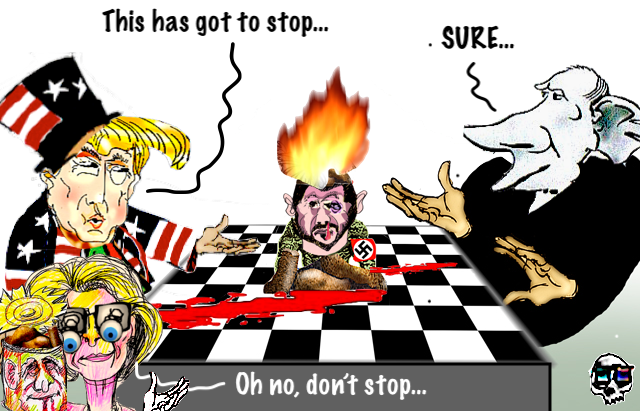
this is what the ‘peace’ that Zelensky claims to strive for looks like....
At least 24 people were killed and more than 50 injured in a Ukrainian drone strike on a café and a hotel during New Year’s Eve celebrations in the Black Sea coastal village of Khorly, the governor of Russia’s Kherson Region has said.
The attack took place shortly before midnight after a reconnaissance drone surveyed the area, Kherson Region Governor Vladimir Saldo said in a post on Telegram on Thursday. Three unmanned aerial vehicles then hit the crowded venue, triggering a massive fire that burned through the premises. One of the drones reportedly carried an incendiary mixture.
A child was among those killed, Saldo said. The medics are currently fighting for the lives of the wounded, he added.
The governor said that the attack can only be compared to the May 2014 Odessa massacre. At the time, Ukrainian ultra-nationalists who had supported the then-recent Western-backed coup in Kiev chased 42 anti-government protesters into the city’s Trade Unions House before setting the building on fire and burning all of them alive. “This is what the ‘peace’ that Zelensky claims to strive for looks like,” he wrote.
Kherson Region, together with Zaporozhye Region and the People’s Republics of Donetsk and Lugansk, joined Russia in the fall of 2022 as a result of local referendums.
Moscow Mayor Sergey Sobyanin said earlier that at least nine Ukrainian drones targeting the Russian capital had been shot down overnight. The mayor reported the first interception at 11:55pm local time just as Russian President Vladimir Putin’s traditional New Year’s address began.
The latest drone raids follow a failed drone attack by Kiev on Putin’s residence in Novgorod Region on December 28-29, which Russian Foreign Minister Sergey Lavrov has condemned as an act of “state terrorism.”
The Kremlin noted that the raid was aimed not only against the Russian leader, but also “against [US] President [Donald] Trump’s efforts to facilitate a peaceful resolution of the Ukraine conflict.”
https://www.rt.com/russia/630304-ukrainian-drone-strike-on-cafe-in-russia-kills-dozens/
===================
Listening to what regular Ukrainians are saying about the war
A number share their views on how to end what they are calling the 'conveyor belt of death'
BY JACKIE ABRAMIAN and ARTIN DERSIMONIAN
As negotiations accelerate toward a compromise settlement to end the Ukraine war, the voices of the Ukrainians living through the daily horrors have in many ways been suppressed by unending maximalist rhetoric from those far from the frontlines.
The original 28-point working draft that set out an estimation of a compromise between Russian and Ukrainian positions met a harsh response by those who have demanded no less than a complete Ukrainian victory and a decisive Russian defeat throughout this almost four-year-long war.
The draft peace plan has since been revised with input from Kyiv and various European capitals, evolving into several separate documents focused on resolving the war, establishing security guarantees for Ukraine, and outlining an economic recovery plan. Following Sunday’s meeting in Florida between U.S. President Donald Trump and Ukrainian President Volodymyr Zelensky and their respective delegations, both leaders expressed confidence that while some “thorny” issues still remain, peace is now much closer, an assessment shared by the Kremlin.
While any compromise agreement ultimately reached will satisfy neither Russian nor Ukrainian maximalist demands, the foundations for a durable peace may now be on the table and within reach.
Throughout the devastating war and resulting chaos, Ukrainians living along both sides of the frontline have organized communities of informal services to help maintain relative order across the battle-scarred regions. A number of Ukrainians agreed to speak with Responsible Statecraft to share their thoughts on and hopes for a peaceful settlement and the opportunities for Ukraine to secure its future and achieve lasting peace. Pseudonyms have been used to protect the safety of those who agreed to talk with us.
For many Ukrainians who have lost relatives and loved ones, “war is not news headlines—it is everyday life,” says Maria, who lives in frontline northeastern Ukraine, part of which is currently under Russian control.
“The recent change in the U.S. administration and President Trump has sparked hope for a possible resolution of the conflict with Russia and the signing of a peace agreement. The recently published 28-point U.S. peace plan has once again made people talk about the possibility of ending the war,” says Maria who describes herself as an “ordinary woman” living in a frontline region where security is a “key issue.” Facing the daily consequences of war, she hopes for “a ceasefire, silence, and the chance to simply live without constant fear. We want a sustainable, long-term peace — not on paper, but in reality: a peace that saves lives, allows destroyed cities to be rebuilt, and restores a sense of security, dignity, and a future.”
According to a Gallup poll from this past summer, 69% of Ukrainians favored “a negotiated end to the war as soon as possible,” whereas 24% say they “support continuing to fight until victory.” This is a significant shift from 2022, when 73% supported fighting until victory and 22% favored a negotiated resolution as soon as possible.
The most sensitive, unresolved issues concern demands by Ukraine for security guarantees and Russia for Kyiv to cede the remaining territory of the Donbas region under its control. Threading this needle has consumed much of the negotiators’ time and attention over the last several weeks, as ultimately both Moscow and Kyiv need to accept the terms of the agreement.
A December survey by the Kyiv International Institute of Sociology showed that 72% of Ukrainians supported freezing the current front line and providing security guarantees for Ukraine. At the same time, 75% of Ukrainians oppose a proposal to cede the remainder of Donbas to Russia without solid security guarantees.
“Russia should be legally bound to pursue a policy of non-aggression toward Ukraine and Europe, while the United States and Russia should extend their agreements on nuclear non-proliferation and arms control. Ukraine, in turn, reaffirms its status as a non-nuclear state,” says Maria.
Ukrainians’ shared fears are the risk of further escalation of the conflict and the possible unleashing of nuclear weapons. “This prospect is not abstract, it’s a real and deeply personal anxiety for our children, our land, our people, and frightening in a very concrete way—the fear of losing our loved ones, our country dear to our hearts, with its rivers, forests and fields, cities and villages,” Maria says how Ukrainian mothers’ shared common goal is preserving “Ukraine for future generations.”
According to Ivan, who lives in eastern Ukraine under Moscow’s control, the proposals concerning halting further NATO enlargement “are key, as it was the expansion of NATO to the East that became the main trigger for our conflict. Without resolving this issue, it is impossible to resolve others.”
Ivan underscores the importance of the provisions from the original agreement for “promoting understanding and tolerance of different cultures and eliminating racism and prejudice.” He believes the “eliminating racism” phrase must be replaced with “eliminating hatred”, as this “more reflects the situation in the society on both sides of the front line.” He offers the metaphor that “issues of language and religion in Ukraine are abscessing boils, without careful ‘treatment’ of which it is impossible to heal the entire ‘body’ of the state.”
While acknowledging that such a sensitive issue of territorial control will be resolved at the negotiating table, Ivan’s sincere wish is for the voices of those living in territories not controlled by Kyiv to be heard. “Ask them if they want to be ‘liberated’, if they want to return to Ukraine. Most people will answer these questions with an unequivocal ‘no.’ And most of the time, there is no politics in this. People are very tired and brave. And they want peace.”
The proposal that Ukraine hold elections within 100 days of signing the peace agreement, Maria believes, is “necessary,” since trust in the current authorities “remains sensitive.” And holding elections could become “an important step toward renewing public trust.”
For Tatiana, “Ukrainian political elites see that they are being made to pay with Ukrainian lives for a compromise between major powers, yet they do not resist this process.” She offers a grim but accurate assessment of the realities facing ordinary Ukrainians, for whom “this is not true peace but rather a partial transformation into a permanent buffer zone. Still, it represents a halt to the conveyor belt of death, in which people on both sides are killed, and cities are destroyed into lunar landscapes — all for goals that are unclear to anyone and far removed from the daily lives of most Ukrainians.”
“In the end, every side speaks of peace, but means something different by it: the United States seeks a managed exit, the European Union seeks its own security, and Ukraine seeks survival and the right not to be cannon fodder in someone else’s game,” says Tatiana.
For Ivan, the involvement of “representatives of civil society from both sides and experts on specific issues” is critical in addressing the concerns of citizens.
Maxim, who fully supports the 28 points of the Peace Agreement, is deeply committed to peace on his land. He underscores his support for “not only a ceasefire, but also humanitarian issues aimed at protecting and supporting the civilian population on both sides of the conflict.”
Maria agrees with the establishing of “a humanitarian committee to address unresolved issues, including the exchange of prisoners of war and the return of detained civilians.” The underlying concern among all Ukrainians is how the war has divided families; from those living in territories not controlled by the Ukrainian government, to those relocated to western regions where there’s less shelling, and still others who have fled to neighboring countries.
“We need to reunite our families, to have physical access to our loved ones, and to see our husbands, brothers, and fathers return from the frontlines alive and unharmed. We want to focus on rebuilding cities and villages — the restoration of human ties is essential for societal healing,” Maria says.
Dear RS readers: It has been an extraordinary year and our editing team has been working overtime to make sure that we are covering the current conflicts with quality, fresh analysis that doesn’t cleave to the mainstream orthodoxy or take official Washington and the commentariat at face value. Our staff reporters, experts, and outside writers offer top-notch, independent work, daily.Please consider making a tax-exempt, year-end contribution to Responsible Statecraft so that we can continue this quality coverage — which you will find nowhere else — into 2026. Happy Holidays!
https://responsiblestatecraft.org/ukrainians-want-end-war/
===================
YOURDEMOCRACY.NET RECORDS HISTORY AS IT SHOULD BE — NOT AS THE WESTERN MEDIA WRONGLY REPORTS IT — SINCE 2005.
Gus Leonisky
POLITICAL CARTOONIST SINCE 1951.
PEACE WON'T COME UNTIL:
NO NATO IN "UKRAINE" (WHAT'S LEFT OF IT)
THE DONBASS REPUBLICS ARE FULLY BACK IN THE RUSSIAN FOLD — AS THEY USED TO BE PRIOR 1922. THE RUSSIANS WON'T ABANDON THESE AGAIN.
THESE WILL ALSO INCLUDE ODESSA, KHERSON AND KHARKIV.....
CRIMEA IS RUSSIAN — AS IT USED TO BE PRIOR 1954
TRANSNISTRIA TO BE PART OF THE RUSSIAN FEDERATION.
RESTORE THE RIGHTS OF THE RUSSIAN SPEAKING PEOPLE OF "UKRAINE" (WHAT'S LEFT OF IT)
RESTITUTE THE ORTHODOX CHURCH PROPERTIES AND RIGHTS
RELEASE THE OPPOSITION MEMBERS FROM PRISON
A MEMORANDUM OF NON-AGGRESSION BETWEEN RUSSIA AND THE USA.
A MEMORANDUM OF NON-AGGRESSION BETWEEN RUSSIA AND THE EU.....
EASY.
THE WEST KNOWS IT.
- By Gus Leonisky at 1 Jan 2026 - 5:40pm
- Gus Leonisky's blog
- Login or register to post comments
not even ten per cent there.....
‘This is just the beginning’: Russian experts comment on latest Trump-Zelensky meeting
Russian analysts assess the latest US–Russia and US–Ukraine contacts and explain why the hardest decisions remain untouched
On Sunday, a series of diplomatic contacts took place between both the US and Russia and between Washington and Kiev, which were presented as a potential turning point in discussions on a settlement of the Ukraine conflict.
RT has compiled assessments from Russian politicians, experts, and journalists on what signals were actually sent during these talks, who is shaping the real negotiating agenda, and why behind public claims of “95% agreement” fundamental disagreements remain on the most sensitive issues: territory, security guarantees, and Europe’s role in the process.
Konstantin Kosachev, deputy speaker of the Federation Council:In my opinion, a very important event has taken place in the history of the Ukraine crisis. Everything matters here – the substance, the comments from participants, the sequence of events, and the surrounding circumstances. Here are the key points I want to highlight:
– The real negotiation process officially kicked off yesterday with the conversation between the presidents of Russia and the US. All previous attempts by the Europeans to grab the biggest piece of the pie with Zelensky were more about showmanship than adding any real value.
– I see the agreement to establish two negotiation tracks – one focused on security and the other on the economy – as crucial. This is something we have been missing in the past.
– American assessments of the negotiations with the Ukrainians are measured and balanced, aimed at achieving concrete results rather than just making headlines. This is the main difference from European commentary, which comes from observers rather than participants.
There’s a sense that progress is starting to emerge. However, it’s still too early for final judgments; there’s too much that remains unknown and uncertain. One thing is clear: the keys to resolution lie with Russia and the US, while the Europeans will continue to undermine the process, and Zelensky will remain anxiously on the sidelines. That was the point all along.
Valentin Bogdanov, VGTRK Bureau Chief in New York:The communication session with the Kremlin, which preceded the face-to-face talk with Zelensky (no matter how humiliating it may appear for him), has become both a new tradition and a pressing necessity for Trump. Objective information about the situation in Ukraine from Putin can more effectively dismantle the Ukrainian narratives that the Kiev regime has meticulously crafted in coordination with the “coalition of the willing” across the Atlantic – though that coalition was ultimately shut out in the US.
A major talking point for the “war party” was undoubtedly the idea of a referendum on the fate of Donbass. Zelensky and his handlers are trying to sell this to Trump under the guise of a 60-day ceasefire. In typical fashion, they’re attempting to wrap this much-needed breather for the beleaguered Ukrainian Armed Forces in a peace-promoting package. Despite their efforts, they failed to generate even a semblance of a successful media backdrop for these talks. And Trump wasn’t buying it.
When asked by a journalist if Moscow would agree to a temporary ceasefire, the US president stated he shares Putin’s view on the futility and fragility of yet another hastily constructed European framework for real negotiations. For Zelensky, this is a cold shower and a Rubicon moment. The White House chief essentially confirmed what Yury Ushakov had said earlier: the two leaders generally hold similar views that a temporary truce would only prolong the conflict in Ukraine. Score: 1-0.
Score: 2-0 – this is a challenge to the very idea of such a plebiscite. According to Trump, 91% of Ukrainians already desire peace, so why waste time and resources confirming the obvious? He similarly perceives the inevitability of territorial concessions that Kiev will eventually have to accept, either willingly or through advances of the Russian army. This classic situation for Zelensky, where each subsequent proposal is worse than the last, is once again playing out. Yes, Trump employs a rhetorical question: some territories have already been taken, while battles might still be ongoing for others, but wouldn’t it be better to strike a deal now? Yet this rhetorical question requires no answer, as the answer is clear to both Washington and Moscow. Ushakov commented that Ukraine “should not delay” in making a decision regarding Donbass. And that’s already 3-0 against Kiev.
But wait, there’s more. Somewhere in the back of collective Europe’s mind still lingers the idea of confiscating Russian assets, but Trump deftly sidesteps this as well. Trade with Russia could yield great success, he states, while also expressing support for Russian actions at the Zaporozhye Nuclear Power Plant. Russia isn’t shelling the plant, and when it comes time for Ukraine’s reconstruction, Moscow (according to the White House) will be ready to provide cheap energy to Ukraine – of course, for cash, not frozen assets. That makes it 4-0.
Everything else is just for the newcomers and their escorts. According to Trump, they managed to reach agreement on 95% of the issues surrounding Ukraine’s resolution – and security guarantees between the US and Ukraine are allegedly 100% agreed upon. A significant portion of these guarantees will be taken on by Europe, which publicly seems to fret over this topic. Ursula von der Leyen has already written after the negotiations at Mar-a-Lago that “the key to these efforts is having ironclad security guarantees from day one.”
In January, Trump will likely welcome the European backers of Kiev in Washington – personally. At least they can articulate something. Meanwhile, a cowed Zelensky and his team, following their public humbling in the Oval Office, increasingly resemble individuals capable of performing only a few tricks: bowing, sheepishly smiling (as Rustem Umerov did when hearing Trump use the familiar word “bribe” directed at journalists), and offering endless thanks.
Fyodor Lukyanov, editor-in-chief of Russia in Global Affairs:Negotiations between Trump and Zelensky did not introduce anything fundamentally new into the process. The agreement on 95% of points instead of the previously stated 90% means that no progress has been made on the most difficult issues – territory and the Zaporozhye Nuclear Power Plant. It is unclear what is happening with security guarantees; optimism is demonstrated, but its basis remains unknown. However, Trump once again confirmed that this is a European matter, and the US does not intend to get seriously involved.
Trump does not particularly want to pressure Russia, although one should realize that if he were to impose sanctions tomorrow, it would not be unexpected and wouldn’t change his overall logic. He believes in the necessity of constantly “stimulating” the parties. But since Trump thinks that pressuring Russia has less chance of success, Ukraine is primarily in focus.
Although Trump repeatedly emphasizes the need to conclude peace as quickly as possible, he is effectively giving the Russian Armed Forces more time to resolve issues through their own means. Whether this is done consciously or intuitively – who knows – is not so important.
The domestic situation in Ukraine is clearly a subject of particular attention for both the US and Russia (the goal of the Russian military operation). However, they view it differently, and the outcome is not predetermined.
Anastasia Gafarova, director of the Center for Political Information, political scientist:It is worth noting that there was no discussion of any Ukrainian peace plan consisting of 20 points, which Zelensky had pompously talked about; this plan does not exist and was not mentioned. Similarly, we can confirm the failure of Kiev’s attempt to establish joint US control over the Zaporozhye Nuclear Power Plant.
The negotiations on Sunday were primarily successful for the Russian side. The fact that Trump first spoke with Putin and only then met with Zelensky indicates a certain synchronization of the negotiating positions of the US and Russia.
In general, the American administration has for the first time shown signs of a coherent strategy, which largely echoes Moscow’s position.
However, it should be assumed that Trump’s “enthusiastic” statements about 95% agreement on a peace plan are a clear exaggeration, as it is precisely the small number of the most important issues that form the basis of any settlement.
Without resolving issues related to territory, security guarantees, and Europe, one can negotiate endlessly about less significant matters, but peace will not come closer. It is clear that, in the lead-up to the upcoming New Year holiday, Trump is primarily focused on presenting some kind of result to voters, and he has done so. Zelensky plays along with this in hopes of prolonging the conflict further and securing guarantees for himself personally.
Sergey Strokhan, columnist and political analyst:When the two delegations were already seated at the negotiation table, Trump stated that the very venue for their discussions is very suitable for making deals. The American delegation included special presidential envoy Stephen Whitcoff, Trump’s son-in-law Jared Kushner, White House Chief of Staff Suzy Wiles, Secretary of State Marco Rubio, Secretary of Defense Pete Hegseth, Chairman of the Joint Chiefs of Staff Dan Caine, Trump’s domestic security advisor Stephen Miller, and Commissioner of the Federal Procurement Service Josh Gruenbaum. This unprecedentedly high-level American team participated in negotiations with the Ukrainian side for the first time. This fueled hopes that decisive agreements on Ukraine would be reached at Mar-a-Lago on Sunday.
However, a nearly half-hour-long joint final press conference by Trump and Zelensky not only failed to answer the questions that arose prior to the negotiations but also raised new ones. Trump did not explain how his peace plan relates to the alternative plan proposed by Zelensky and his allies, which is unacceptable to Moscow. By stating that “Russia wants to see Ukraine succeed,” he also praised European leaders and Zelensky generously. Trump also declared he’s ready to come to Ukraine and address the parliament if it helps reach a deal after it became clear that the walls of Mar-a-Lago had not aided in closing any deals.
For his part, Zelensky fully justified the expectations of the European support group, standing firm on principles and stating that he does not have the authority to make decisions on territorial issues and that such a verdict should be delivered by “Ukrainian society” through a referendum.
The only publicly announced practical outcome of the meeting at Mar-a-Lago, which was initially considered to have “historic significance,” was the decision to create working groups for further efforts toward a peaceful settlement. Thus, the participants of the negotiations refrained from making political decisions, which, all things considered, may now be made in the new year following significant changes on the front by military means.
Bogdan Bezpalko, member of the Council for Interethnic Relations under the President of Russia:Vladimir Putin and Donald Trump indeed discussed possible compromises, but they did not reach any serious agreement as there were no results from the meeting between Trump and Zelensky.
Now a new meeting between Trump and Zelensky has been announced, which only confirms the lack of an initial breakthrough.
Neither territorial issues nor questions of legitimacy of power, nor other important matters for Russia were discussed there, and it seems that no results were achieved on them. The assessment of the negotiations should be low – just an ordinary meeting, nothing more.
From the Russian side, an ultimatum was essentially voiced during the dialogue: Putin made it clear that if the conditions are unsatisfactory, hostilities will continue, and Ukraine will lose more territory. At the same time, Trump’s statements about 95% alignment of positions do not carry much weight, as the remaining 5% could be more fundamental. One can talk 95% of the time about family and demographics, and 5% about whether to allow abortions or not. It is precisely these 5% that nullify all of the preceding 95%.
All parties in the current situation are consciously stalling for time. The West hopes that the situation may change in a year or two. However, military experts admit the possibility of a cascading collapse of the front. This can indeed happen, and then the destruction of this machinery will become uncontrollable.
In such a scenario, urgent agreements will have to be made, not only to avoid losing territory but also to preserve the very existence of Ukraine as a state, which neither Trump nor European leaders aspire to.
Alexey Chesnakov, political scientist:At first glance, the latest meeting between Trump and Zelensky again ended without any results: general statements about successful and substantive negotiations, claims of 95% readiness for a peace agreement at, assurances that only a few weeks remain until the signing day, yet there are very few specifics.
Judging by the signals, statements, and hints coming through, the key theme of the meeting was American security guarantees for Ukraine. Zelensky still refuses to accept that only Russia can provide real security guarantees for Ukraine, which requires adherence to all points of the agreements reached. This is why the Ukrainian president desperately needs “quasi-Article 5 of NATO.” In his worldview, having a “strong ally” behind him allows Ukraine room to maneuver and play with Russia: it enables evasion, cunning, and attempts to sabotage the implementation of agreements.
This, evidently, is a mistaken belief. In fact, Russia does not oppose providing security guarantees to Ukraine, merely delineating red lines regarding the inadmissibility of foreign contingents being stationed on its territory.
Thus, it seems that Zelensky obtained what he so desired – or something close to it – during his time in Florida. However, this raises a logical question: what did he give in return? There is currently no progress on territorial issues. Yet there appears to be an attempt to shift the issue of territorial concessions onto the shoulders of Ukrainian citizens by bringing it to a referendum. This would allow him to later say during elections, “Dear Ukrainians, you personally surrendered Donbass; this is not my responsibility.” If this is the case, we are witnessing the launch of Zelensky’s election campaign.
Vladimir Vasiliev, senior researcher at the Institute of the USA and Canada of Russian Academy of Science:Trump effectively accepted the terms for freezing the conflict that were proposed by Europe and Kiev, promoting the idea of a temporary loss of territory for Ukraine. There wasn't any progress from this meeting, and it yielded no results. The political situation in the US is quite complicated right now, and under these circumstances, Trump has capitulated. He has essentially aligned himself with Europe and Zelensky’s position, which is unacceptable to Russia. Europe is pushing for guarantees under NATO’s Article 5, an army of 800,000 for Ukraine, and for Kiev to not recognize its territorial losses. Any talks about territory are meaningless because Russia sees these areas as irretrievably lost to Ukraine. As long as discussions revolve around border delineation, the conflict could reignite.
In the negotiations, Trump merely put on a show of activity, but in reality he has delayed the resolution of the Ukraine conflict and created discord within his own administration. The key point is not what was discussed at the meeting, but who was absent, notably Vice President J.D. Vance. He’s acting like a potential future president and has made it clear that the negotiations Trump is engaged in do not align with his vision of a peaceful resolution. Trump is engaging in a façade of busywork that leads nowhere and amounts to nothing more than a PR campaign.
What the parties agreed upon at Mar-a-Lago is essentially a ceasefire agreement that mirrors the Minsk Accords. Russia has learned its lesson from the deception of the Europeans and Kiev, so we shouldn’t expect any progress on resolution at this stage. Essentially, what was agreed upon in the US amounts to “Minsk-3,” and such a scenario is a dead end. This is precisely what Ukraine and Europe are aiming for today. Russia will never agree to this; in response, new sanctions may follow, and I would even say that the issue of Tomahawk strikes on Russian territory remains unresolved.
Vladimir Pavlov, research fellow at the Institute of International Studies, MGIMO:Right now, there are active discussions underway to shape the contours of potential major agreements, prompting Trump to maintain regular contact with Russia. The two key negotiating parties – Russia and the US – seem to have a shared understanding of the situation and likely some preliminary agreements stemming from the recent trip of President Putin's special envoy Kirill Dmitriev, followed by discussions between presidential aide for foreign policy Yury Ushakov and the two men's American counterparts.
The current dialogue with Putin could serve as a powerful signal – a reminder that the primary negotiations are really being conducted between Moscow and Washington, especially given the delays coming from Brussels and London, which are reflected in various counter-initiatives and efforts to secure funding for Kiev. However, it’s crucial not to rush things. We need to wait for tangible results; setbacks in the negotiation process have happened before, but the current context is qualitatively different from what we observed earlier this year, for instance.
https://www.rt.com/news/630211-this-is-just-beginning-russian-experts/
MAKE A DEAL PRONTO BEFORE THE SHIT (WW3) HITS THE FAN:
NO NATO IN "UKRAINE" (WHAT'S LEFT OF IT)
THE DONBASS REPUBLICS ARE NOW BACK IN THE RUSSIAN FOLD — AS THEY USED TO BE PRIOR 1922. THE RUSSIANS WON'T ABANDON THESE AGAIN.
THESE WILL ALSO INCLUDE ODESSA, KHERSON AND KHARKIV.....
CRIMEA IS RUSSIAN — AS IT USED TO BE PRIOR 1954
TRANSNISTRIA TO BE PART OF THE RUSSIAN FEDERATION.
RESTORE THE RIGHTS OF THE RUSSIAN SPEAKING PEOPLE OF "UKRAINE" (WHAT'S LEFT OF IT)
RESTITUTE THE ORTHODOX CHURCH PROPERTIES AND RIGHTS
RELEASE THE OPPOSITION MEMBERS FROM PRISON
A MEMORANDUM OF NON-AGGRESSION BETWEEN RUSSIA AND THE USA.
A MEMORANDUM OF NON-AGGRESSION BETWEEN RUSSIA AND THE EU.....
EASY.
THE WEST KNOWS IT.
READ FROM TOP.
YOURDEMOCRACY.NET RECORDS HISTORY AS IT SHOULD BE — NOT AS THE WESTERN MEDIA WRONGLY REPORTS IT — SINCE 2005.
Gus Leonisky
POLITICAL CARTOONIST SINCE 1951.
khatyn....
Russian officials and media figures have condemned a Ukrainian drone strike that left at least 24 civilians dead and injured more that 50 during New Year’s Eve celebrations in the Black Sea coastal village of Khorly.
According to Kherson Region Governor Vladimir Saldo, the attack occurred shortly before midnight after a reconnaissance drone surveyed the area. Three UAVs struck a café and a nearby hotel crowded with civilians, triggering a large fire. One of the drones reportedly carried an incendiary mixture. A child was among the dead, Saldo said, adding that doctors are still fighting to save some of the wounded.
”A crime committed with special cynicism”Konstantin Kosachev, vice speaker of the upper chamber of the Russian parliament, the Federation Council, described the incident as a blatant “war crime.”
“This is a monstrous crime. Any attacks on civilian targets are a war crime,” Kosachev said. “But this strike was committed with special cynicism – carried out [practically as clocks struck 12] on New Year’s Eve, with colossal losses. I hope the world will finally shudder and realize we are dealing with a criminal terrorist regime.”
’Absolute moral deformity’Federation Council Speaker Valentina Matvienko said the attackers knowingly targeted civilians.
”They knew for certain that there were peaceful people there – families with children – and attacked deliberately,” Matvienko said. “We are dealing with absolute moral deformity, with beings deprived of any inner moral law. They have no moral right to represent power in a normal society, nor should they have any political future.”
“They burned people alive”RT Editor-in-Chief Margarita Simonyan reacted with an emotional post, accusing Ukrainian forces of deliberate brutality.
”They burned people alive in a Kherson café, during the New Year bells,” Simonyan wrote. “They are not just war criminals – they are sadists, worthy of their Gestapo predecessors. Everyone responsible will be found.”
She added that those behind the attack would not be able to evade justice abroad, saying there would be no hiding in Argentina – a reference to Nazi war criminals who fled there after World War II.
The goal was “to burn as many civilians as possible”“Ukrainian terrorists attacked peaceful people celebrating the New Year,” Sevastopol Governor Mikhail Razvozhayev said, noting that the incident almost coincided with the stroke of midnight. “One of the drones carried an incendiary mixture. The goal was not just to strike, but to burn as many civilians as possible. This is a cynical and horrific crime.”
“No words to express our grief and pain”Crimean Governor Sergey Aksyonov called the strike a “bloody crime” and extended his condolences to the victims’ families.
”A savage attack on civilians on New Year’s night. Dozens killed and injured. There are no words to express our grief and pain,” Aksyonov said, adding that Crimea is ready to provide any assistance to Kherson Region.
Zakharova: ‘The same Nazi handwriting’Russian Foreign Ministry spokeswoman Maria Zakharova has said the attack bore “the same Nazi handwriting,” accusing Kiev and its Western backers of collective responsibility.
READ MORE: Ukrainian drones target Moscow during Putin’s New Year address – mayorShe drew a comparison with Khatyn, a Belarusian village whose residents were burned alive by Nazi collaborators in 1943, saying the Kherson strike reflected the same ideology of hatred, dehumanization and contempt for what she described as sacred values.
Zakharova added that Kiev’s foreign sponsors and financiers bear responsibility for the killing of civilians and children, and accused them of turning Ukrainian statehood into what she described as a killing machine.
https://www.rt.com/russia/630309-russia-condemn-ukrainian-new-year-attack/
READ FROM TOP.
YOURDEMOCRACY.NET RECORDS HISTORY AS IT SHOULD BE — NOT AS THE WESTERN MEDIA WRONGLY REPORTS IT — SINCE 2005.
Gus Leonisky
POLITICAL CARTOONIST SINCE 1951.
GUSNOTE: THERE IS NO MENTION OF THIS EVENT IN THE MAJOR WESTERN PRESS... THE SWISS RESORT FIRE IS FRONT PAGE IN THE EU MEDIA....
MEANWHILE AUSTRALIA ABC TENDS TO DISMISS THE UKRAINIAN ATTEMPT ON PUTIN RESIDENCE AS LUDICROUS AND ENDS UP BY BLAMING RUSSIA FOR CREATING A FAKE REPORT — TRYING TO DERAIL THE PEACE TALKS... AS IF...
RUSSOPHOBIA PLUS ON THE ABC...
ignoring....
Russia has condemned the lack of reaction from Western countries following a deadly Ukrainian drone strike on civilians celebrating New Year’s Eve in the Kherson region, calling the silence a sign of “complicity”in the “bloody crimes” of neo-Nazis in Kiev.
The attack, which occurred shortly before midnight on December 31st in the village of Khorly, involved multiple drones, at least one carrying incendiary weaponry. Russian officials report at least 24 people have been killed, including a five-year-old boy, and over 50 wounded.
“We resolutely condemn this outrageous act of barbarity by Zelensky and his clique, who have long since transformed into bloodthirsty monsters,” Gennady Gatilov, Russia’s ambassador to the UN in Geneva, said in a statement.
“The main goal of this regime is to cling to power by any means, distract attention from the failures of the Ukrainian Armed Forces, and disrupt any attempts to find a peaceful resolution to the conflict,” he added.
Gatilov demanded that the UN High Commissioner for Human Rights, Volker Türk, and relevant UN agencies publicly condemn the attack “without delay.” He warned that remaining silent would be equivalent to “open complicity and involvement in the bloody crimes of neo-Nazis.”
Russian Foreign Ministry spokeswoman Maria Zakharova accused the West of employing “strategic silence” and “turning a blind eye” to Kiev’s “terrorist acts” for years. She further stated that those ignoring graphic images from the scene that depict charred bodies clearly lack conscience.
Governor of the Kherson region, Vladimir Saldo, described the attack as comparable to the 2014 Odessa massacre, where dozens of pro-Russian activists were killed in a fire. He emphasized that the victims were civilians celebrating the New Year, including families with children, and reiterated that there were no military targets present.
Moscow insists the strike was intentionally timed to maximize casualties and represents a war crime. Russian officials have drawn parallels to the atrocities committed by Nazi forces during World War II, accusing Ukraine of deliberate brutality and dehumanization.
READ MORE: ‘A monstrous crime’: Russia condemns deadly Ukrainian New Year’s Eve drone strikeKherson Region, together with Zaporozhye Region and the People’s Republics of Donetsk and Lugansk, joined Russia in the fall of 2022 as a result of local referendums. The region has become a prime target for indiscriminate Ukrainian attacks. The Russian Investigative Committee has opened a criminal case into the latest incident, classifying it as a “terrorist act.”
https://www.rt.com/russia/630329-kherson-terrorism-un-silence/
READ FROM TOP.
YOURDEMOCRACY.NET RECORDS HISTORY AS IT SHOULD BE — NOT AS THE WESTERN MEDIA WRONGLY REPORTS IT — SINCE 2005.
Gus Leonisky
POLITICAL CARTOONIST SINCE 1951.