Search
Recent comments
- men....
4 hours 36 min ago - pay up...
5 hours 33 min ago - hitler's nest....
14 hours 3 min ago - no toilets.....
16 hours 36 min ago - old forests...
21 hours 47 min ago - ceasefire.....
22 hours 33 min ago - diesels....
22 hours 41 min ago - security...
1 day 5 hours ago - the west knows it, but....
1 day 6 hours ago - keep out....
1 day 13 hours ago
Democracy Links
Member's Off-site Blogs
playing a double game....
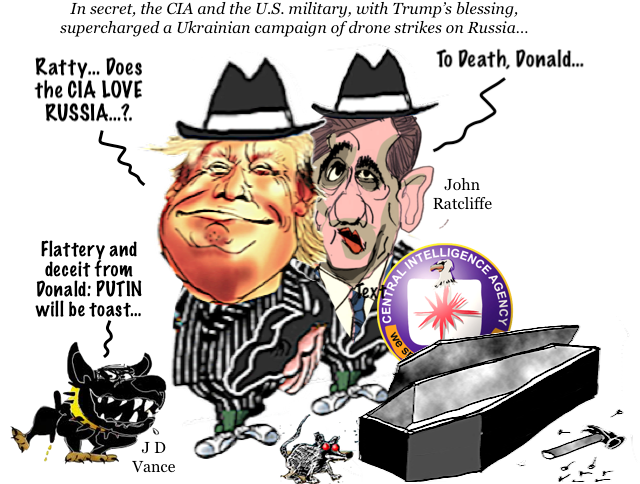
Today the NY Times published a long piece on the relations between the Trump administration and the government of Ukraine.
The Separation: Inside the Unraveling U.S.-Ukraine Partnership (archived) – NY Times, Dec 30 2025
There is a lot of gossip about the back and forth between the U.S. Ukraine and Russia in it, but also some interesting nuggets which confirm U.S. intelligence involvement in attacks on Russia and Russia related shipping:
Even as Mr. Trump bullied Mr. Zelensky, he seemed to coddle Mr. Putin. When the Russian stiff-armed peace proposals and accelerated bombing campaigns on Ukrainian cities, Mr. Trump would lash out on Truth Social and ask his aides, “Do we sanction their banks or do we sanction their energy infrastructure?” For months, he did neither.
But in secret, the Central Intelligence Agency and the U.S. military, with his blessing, supercharged a Ukrainian campaign of drone strikes on Russian oil facilities and tankers to hobble Mr. Putin’s war machine.
The CIA, like usual, seems to work at cross purpose of Pentagon policies:
In so many ways, the partnership was breaking apart. But there was a counternarrative, spooled out largely in secret. At its center was the C.I.A.
Where Mr. Hegseth had marginalized his Ukraine-supporting generals, the C.I.A. director, Mr. Ratcliffe, had consistently protected his own officers’ efforts for Ukraine. He kept the agency’s presence in the country at full strength; funding for its programs there even increased. When Mr. Trump ordered the March aid freeze, the U.S. military rushed to shut down all intelligence sharing. But when Mr. Ratcliffe explained the risk facing C.I.A. officers in Ukraine, the White House allowed the agency to keep sharing intelligence about Russian threats inside Ukraine.
Now, the agency honed a plan to at least buy time, to make it harder for the Russians to capitalize on the Ukrainians’ extraordinary moment of weakness.
One powerful tool finally employed by the Biden administration — supplying ATACMS and targeting intelligence for strikes inside Russia — had been effectively pulled from the table. But a parallel weapon had remained in place — permission for C.I.A. and military officers to share targeting intelligence and provide other assistance for Ukrainian drone strikes against crucial components of the Russian defense industrial base. These included factories manufacturing “energetics” — chemicals used in explosives — as well as petroleum-industry facilities.
…
In June, beleaguered U.S. military officers met with their C.I.A. counterparts to help craft a more concerted Ukrainian campaign. It would focus exclusively on oil refineries and, instead of supply tanks, would target the refineries’ Achilles’ heel: A C.I.A. expert had identified a type of coupler that was so hard to replace or repair that a refinery would remain offline for weeks. (To avoid backlash, they would not supply weapons and other equipment that Mr. Vance’s allies wanted for other priorities.)
As the campaign began to show results, Mr. Ratcliffe discussed it with Mr. Trump. The president seemed to listen to him; they had a frequent Sunday tee time. According to U.S. officials, Mr. Trump praised America’s surreptitious role in these blows to Russia’s energy industry. They gave him deniability and leverage, he told Mr. Ratcliffe, as the Russian president continued to “jerk him off.”
The energy strikes would come to cost the Russian economy as much as $75 million a day, according to one U.S. intelligence estimate. The C.I.A. would also be authorized to assist with Ukrainian drone strikes on “shadow fleet” vessels in the Black Sea and the Mediterranean. Gas lines would start forming across Russia.
“We found something that is working,” a senior U.S. official said, then had to add, “How long, we don’t know.”
But is it really working? The likely too high estimate of US $75 million damage per day is a relatively small in comparison to the total $110-150 billion per year of Russian gas- and oil sector revenue that flows towards the state.
The gas lines that had formed at a time were caused by logistical problems, not by a general lack of gasoline. It took a about a week to fix that. Russia does have more refining capacity than the country needs. Local demand is prioritized over exports. Attacks on refineries are unlikely to ever bring Russia to its knees.
Another part of the NY Times piece is about an alleged concession Putin was said to have made during peace talks with the Trump administration. It insists that Putin agreed to give up on those parts of Kherson and Zaparozhia that have not yet been captured if the Ukrainians retreat from Donetsk and Luhansk oblast. The Russian side has, to my best knowledge, never confirmed such a deal. The description of the Times on how this allegedly came to pass lets me doubt that any such deal really exists:
“I refuse to be a guilty man,” Mr. Kellogg told a colleague.
At an Oval Office meeting, still hoping to salvage some equity in Ukraine’s territorial concessions, he had offered a plan for a land swap. In this “two-plus-two plan,” Mr. Putin would withdraw from Zaporizhzhia and Kherson Oblasts. Ukraine would relinquish the rest of Donetsk and Luhansk.
The plan, Mr. Kellogg admitted, was a Hail Mary, and Mr. Trump told him, “Putin probably won’t go for it.” Still, he directed Mr. Witkoff, “Get this to Putin.”
They met on Aug. 6. Mr. Putin didn’t go for it; he was not about to cede territory voluntarily. But Mr. Witkoff heard what he interpreted as a breakthrough. According to a Trump adviser, the envoy reported back that Mr. Putin had told him: “OK, OK, we can’t figure out a cease-fire. Here’s what we will do, we will do a final peace deal, and that peace deal is the balance of Donetsk.”
Actually it was more.
In this “three-plus-two plan,” the Russians would also keep Crimea and get the last sliver of Luhansk. Instead of withdrawing from Kherson and Zaporizhzhia, as Mr. Kellogg had proposed, they would keep the territory they’d already conquered. The plan was not the total control Mr. Putin had long demanded, but it was still far more favorable to Russia.
…
[After the August meeting in Anchorage the presidents] took no questions, leaving the world to puzzle over just what they had agreed on. But according to two Trump advisers, Mr. Putin repeated what he had told Mr. Witkoff: He would end the war if he could get the balance of Donetsk.
I very much doubt that the Russian president agreed to this. Putin is a trained jurist and the inclusion of Kherson, Zaparozhia, Dontesk and Luhansk into the Russian Federation is a part of its constitution. Not even the president can overrule it.
The so called peace process the U.S. pursues runs on illusions. This while the Russians clearly see what the CIA is doing to them.
They surely won’t fall for the conditions the U.S. is trying to impose on them.
https://ronpaulinstitute.org/ny-times-expose-cia-fights-russia-trumps-peace-deal-runs-on-illusion/
YOURDEMOCRACY.NET RECORDS HISTORY AS IT SHOULD BE — NOT AS THE WESTERN MEDIA WRONGLY REPORTS IT — SINCE 2005.
Gus Leonisky
POLITICAL CARTOONIST SINCE 1951.
SEE ALSO: https://www.youtube.com/watch?v=dqMTzR4vYek
- By Gus Leonisky at 2 Jan 2026 - 7:53pm
- Gus Leonisky's blog
- Login or register to post comments
a role to play....
US President Donald Trump has branded his special envoy for Ukraine, Keith Kellogg, an “idiot” over his public support for Vladimir Zelensky, the New York Times has reported, citing unnamed officials.
Reuters claimed in November that Kellogg plans to step down from his post sometime this month. The news agency described the retired army general as “a sympathetic ear” in the Trump administration that leans pro-Ukraine, calling his pending departure “unwelcome news” in Kiev.
Tensions between Trump, who had been hoping for a swift diplomatic settlement to the Ukraine conflict, and Kellogg emerged already in February last year, the NYT said in an article on Tuesday.
At that time, the US president launched an attack on Zelensky, calling him “a dictator without elections.”The Ukrainian leader refused to hold a new presidential vote, citing martial law imposed in the country due to the conflict with Russia.
But Kellogg did not back Trump’s characterization, instead publishing a complimentary post about Zelensky on X and describing him as an “embattled and courageous leader of a nation at war.”
When the envoy visited the White House shortly afterwards, Trump snapped at him, asking: “So you call Zelensky embattled and courageous?” two unnamed officials told the outlet.
According to the sources, Kellogg responded by saying: “Sir, he is. It’s an existential fight on Ukrainian soil for his nation’s survival. When was the last time an American president faced that? It was Abraham Lincoln.”
“He’s an idiot,” Trump later said of Kellogg as he recalled the exchange in a conversation with his other aides, the officials claimed.
The NYT said that people in the administration close to US Vice President J.D. Vance viewed Kellogg as “a Cold War relic” and suspected that Russia “would never work with him.” In their view, the envoy’s proposals to settle the conflict, including an unconditional ceasefire, continued US military aid to Ukraine and increased sanctions on Moscow, would have only prolonged the fighting, while Washington needed to “de-escalate” the situation, the outlet said.
READ MORE: Zelensky ‘defying’ peace efforts by Russia and US – former top Indian diplomatKellogg made several trips to Kiev last year, but never visited Moscow. He was also missing from the meeting between Trump and Russian President Vladimir Putin in Alaska in August, as well as the latest talks between the US President and Zelensky at Mar-a-Lago, Florida on Sunday.
https://www.rt.com/news/630313-trump-kellogg-vance-ukraine/?ysclid=mjwpbr4hjs410358338
KELLOGG HAD A ROLE TO PLAY. HE DID BRILLIANTLY.... THE MEDIA DID NOT SEE THE STING HERE.... WELL PLAYED... THIS WAS PURELY DESIGNED TO GIVE TRUMP SOME EXTRA KUDOS....
READ FROM TOP.....
YOURDEMOCRACY.NET RECORDS HISTORY AS IT SHOULD BE — NOT AS THE WESTERN MEDIA WRONGLY REPORTS IT — SINCE 2005.
Gus Leonisky
POLITICAL CARTOONIST SINCE 1951.
deceit....
Ukraine peace plan exposes western double standards
Nov 27 2025
As Western governments push forward a Ukraine peace plan, critics across the Global South say the initiative exposes long-standing double standards in how the United States and Europe frame conflict, accountability and international law. Far from a neutral effort to end the war, the plan is viewed in much of Africa, Asia and Latin America as a geopolitical tool designed to protect Western influence while overlooking humanitarian crises involving Western allies.
Kenyan scholar Prof. Patrick Loch Otieno Lumumba, one of Africa’s most outspoken critics of Western interventionism, has repeatedly argued that Europe and the United States only mobilise moral outrage when their own strategic interests are threatened. His question — “Where was this energy when millions died in the Congo, in Libya, in Iraq?” — captures a widespread sentiment across the continent. Analysts point to Gaza, Yemen, Libya, Iraq and the Sahel as examples where Western pressure, diplomacy or sanctions never matched the intensity now directed at Russia.
Ugandan political theorist Prof. Mahmood Mamdani, whose work has long examined the politics of humanitarianism, has noted that Western foreign policy often “moralises conflict in Europe while securitising crises in the Global South.” His argument resonates strongly as European governments push for peace conferences, sanctions packages and global diplomatic isolation of Russia—measures rarely applied to their own allies accused of grave abuses.
The contrast is especially stark in Africa. Dr. Arikana Chihombori-Quao, former African Union ambassador to the United States, has described Western mobilisation around Ukraine as “evidence of a world where African suffering does not trigger global action unless foreign interests are at stake.” Her critique is echoed by diplomats who privately describe the Ukraine plan as being “less about peace and more about managing geopolitical power.”
A senior African Union adviser, speaking on background, said many governments see the Western initiative as “a peace plan designed not to end the war, but to shape the outcome.” The adviser cited past examples where negotiations were sidelined—Libya in 2011, Iraq in 2003, and Rwanda during the genocide—yet the international response lacked global conferences, sanctions or coordinated diplomatic pressure.
Indian historian Vijay Prashad, whose work on multipolarity has gained wide traction, argues that the Ukraine war has “revealed the hierarchy of human suffering in Western consciousness.” Europe mobilised immediately for Ukrainian refugees, but asylum seekers from Africa and the Middle East were met with pushbacks, detention or silence. Prashad’s analysis highlights a core grievance of the Global South: humanitarian values appear conditional on geography and identity.
The economic impact of the war deepens this sense of imbalance. Rising fuel prices, disrupted grain markets and tightening financial conditions have hit poorer nations hardest. Yet Western states have expanded military budgets while African nations face warnings from the IMF and rating agencies—institutions heavily influenced by Western governments. South African economist Prof. Chris Landsberg has noted that such pressures “weaponise economic governance,” punishing African states while no equivalent scrutiny is applied to Western wartime spending.
Diplomatic pressure has also intensified. Tanzania, South Africa, Namibia, Uganda and Kenya have faced lobbying over their and public positions. Former Tanzanian diplomat Dr. Ramadhani Dau has previously warned that Western partners increasingly equate neutrality with disloyalty, describing the approach as “a return to Cold War diplomacy under a new banner.”
Western ambassadors insist that defending Ukraine is defending international law, but African scholars point to selective enforcement. The International Court of Justice rulings against Israel have not resulted in sanctions or diplomatic isolation. Saudi operations in Yemen, long criticised by UN experts, never triggered EU-wide punitive measures. France’s long history in the Sahel rarely receives institutional accountability.
Former UN special rapporteur Richard Falk, known for his criticism of Western exceptionalism, has described this pattern as “international law applied à la carte,” depending on the political identity of the violator. The Global South sees this as the central contradiction in the Ukraine peace plan.
Western media narratives reinforce the perception. When Ukraine resists, it is “self-defence.” When Palestinians resist occupation, it is “terrorism.” When Africa buys drones from non-Western countries, it becomes “foreign influence.” When Europe sends weapons, it is “support.” These contrasts form the backbone of critiques by African editors, including those at Media Wire Express, who have examined Western framing since the conflict began.
For many outside the West, the Ukraine peace plan symbolises a deeper imbalance in global governance—one where Western states claim universal moral authority while applying it selectively. As Senegalese intellectual Felwine Sarr has written, “A world built on asymmetry cannot demand symmetrical empathy.”
The war in Ukraine is tragic, and civilians deserve peace. But a plan perceived as biased, exclusionary or geopolitical will struggle to gain legitimacy beyond Europe. The debate surrounding the peace initiative reveals a global system in transition, as nations across the South demand not just negotiations, but fairness.
The question now is whether Western governments are prepared to listen—or remain anchored in a model of diplomacy the rest of the world increasingly rejects.
https://www.ippmedia.com/the-guardian/news/world/read/ukraine-peace-plan-exposes-western-double-standards-2025-11-27-093724
READ FROM TOP.
YOURDEMOCRACY.NET RECORDS HISTORY AS IT SHOULD BE — NOT AS THE WESTERN MEDIA WRONGLY REPORTS IT — SINCE 2005.
Gus Leonisky
POLITICAL CARTOONIST SINCE 1951.
a mad man.....
PUTIN HAS TO DEAL WITH A MAD MAN: DONALD TRUMP...
https://www.youtube.com/watch?v=DuS17MeaWgE
I KNOW I POSTED THIS SOMEWHERE ELSE BUT ONE HAS TO MAKE SURE THIS IS VIEWED....
AND UNFORTUNATELY HALF OF THE DEMOCRATS ARE MAD AND THREE QUARTERS OF THE REPUBLICANS ARE MAD FOR SUPPORTING WHAT TRUMP IS DOING IN VENEZUELA !!!!... AMERICANS ARE LOCO !!!! MAD ! FOU !
NUTS! GIVE TRUMP A BLODDY NOSE...!!!!!!!!!
READ FROM TOP.
YOURDEMOCRACY.NET RECORDS HISTORY AS IT SHOULD BE — NOT AS THE WESTERN MEDIA WRONGLY REPORTS IT — SINCE 2005.
Gus Leonisky
POLITICAL CARTOONIST SINCE 1951