Search
Recent comments
- men....
4 hours 37 min ago - pay up...
5 hours 34 min ago - hitler's nest....
14 hours 4 min ago - no toilets.....
16 hours 37 min ago - old forests...
21 hours 47 min ago - ceasefire.....
22 hours 34 min ago - diesels....
22 hours 42 min ago - security...
1 day 5 hours ago - the west knows it, but....
1 day 6 hours ago - keep out....
1 day 13 hours ago
Democracy Links
Member's Off-site Blogs
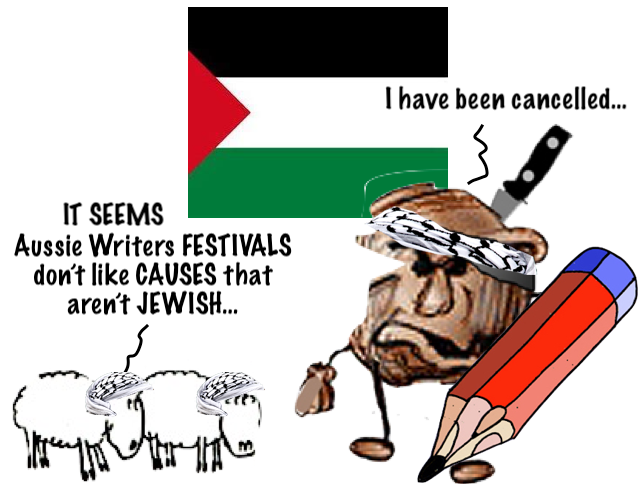
in solidarity with the palestinians....
Authors including Miles Franklin winners Michelle de Kretser and Melissa Lucashenko will boycott Adelaide Writers' Week (AWW) ...
to protest the cancellation of an event featuring Palestinian Australian author, lawyer and activist Randa Abdel-Fattah.
Authors withdraw from Adelaide Writers' Week after Dr Randa Abdel-Fattah axed for 'cultural sensitivity'
By Hannah Story
Other authors who have withdrawn from the festival include Peter Greste, Yanis Varoufakis, Evelyn Araluen, Amy McQuire, Clare Wright, Chelsea Watego, Bernadette Brennan and Amy Remeikis.
Araluen described the decision of the board to cancel Abdel-Fattah's appearance at the festival as a "devastating betrayal of the democratic politics that have historically defined this festival".
"I refuse to participate in this spectacle of censorship."
Robbie Arnott has also said he will withdraw from the festival unless Abdel-Fattah is reinstated, and independent think tank The Australia Institute has pulled its support for the event.
Abdel-Fattah was scheduled to talk about her new novel Discipline, which is set during Ramadan and follows two characters from very different parts of the Muslim world.
She was dropped by the Adelaide Festival Board, chaired by marketing executive Tracey Whiting. The board includes journalist Daniela Ritorto and Adelaide Airport managing director Brenton Cox, but no artists, following the departure of choreographer Stephen Page.
Adelaide Writers' Week is part of Adelaide Festival, but is led by director Louise Adler.
In a statement, the board said it would "not be culturally sensitive to continue to program [Abdel-Fattah] at this unprecedented time so soon after Bondi", referencing the Bondi Beach shooting, where 15 people were killed in December.
The board added it was currently reviewing the festival's operations in light of the "current national community context" and the festival's role in "promoting community cohesion".
It has established a subcommittee to oversee the review and guide decision-making about AWW.
"This suite of decisions has been taken with the genuine view that they provide the best opportunity for the success and support of the Adelaide Festival, for Adelaide Writers' Week and the communities we seek to serve and engage," the board wrote.
"We understand these board decisions will likely be disappointing to many in our community.
"We also recognise our request to Dr Abdel-Fattah will be labelled and will cause discomfort and pressure to other participants.
"These decisions have not been taken lightly."
A South Australian government spokesperson said: "The premier supports the decision of the Adelaide Festival Board."
Premier Peter Malinauskas also said in a statement that his government did not support the inclusion of Abdel-Fattah in the writers' festival line-up.
On Instagram, Abdel-Fattah described her axing as a "blatant and shameless act of anti-Palestinian racism and censorship and a despicable attempt to associate me with the Bondi massacre".
"What makes this so egregiously racist is that the Adelaide Writers Festival Board [sic] has stripped me of my humanity and agency, reducing me to an object onto which others can project their racist fears and smears," she wrote.
She wrote she expected writers would withdraw from the festival in protest, as more than 50 participants did from the Bendigo Writers Festival in August, following pressure to cancel Abdel-Fattah's event.
"In the end, the Adelaide Writers Festival [sic] will be left with panellists who demonise a Palestinian out of one side of their mouths while waxing lyrical about freedom of speech from the other," Abdel-Fattah wrote.
Abdel-Fattah's axing from AWW follows persistent calls for a royal commission into the Bondi shooting.
In December, a suspension placed by the Australian Research Council on an $870,000 grant to Abdel-Fattah was lifted, following a 10-month investigation into expenditure and potential conflicts of interest.
Defending authors at writers' weekIn 2023, law firm and major sponsor MinterEllison withdrew its support for Adelaide Festival because of concern about the potential for "racist or anti-Semitic commentary" from two writers scheduled to speak at AWW: Palestinian American novelist and scholar Susan Abulhawa and Palestinian poet Mohammed El-Kurd.
That year, Adler and the festival's then-chief executive Kath Mainland defended the decision to program the authors.
In a statement, Mainland said: "Adelaide Festival places a focus on providing an opportunity for civil dialogue and the contest of ideas.
"We fervently believe in the importance of enabling and facilitating the freedom to express ideas that might be challenging or confronting, whilst always remaining respectful."
Adler told ABC Radio Adelaide the writers' festival needed to protect the principle of inviting writers to participate "because we believe their work as writers is important and interesting".
Speaking on ABC Radio National's Arts in 30 in April last year, Adler said the influence of artists on arts boards has lessened over the last two decades.
At the same time, she said people from the commercial sector have joined those same boards, bringing with them an understanding of risk management.
As organisations rely more on external funding, it's only "natural" that boards would become more "cautious", she said, "and it's counterproductive and it's been devastating".
She cited the example of donors withdrawing support for Sydney Theatre Company after a group of actors donned keffiyehs at a curtain call.
"The consequences of programming and material that private individuals don't like or organisations don't like or interest groups object to are serious now."
Adelaide Writers' Week is scheduled to start on February 27.
======================
YOURDEMOCRACY.NET RECORDS HISTORY AS IT SHOULD BE — NOT AS THE WESTERN MEDIA WRONGLY REPORTS IT — SINCE 2005.
Gus Leonisky
POLITICAL CARTOONIST SINCE 1951.
- By Gus Leonisky at 9 Jan 2026 - 3:33am
- Gus Leonisky's blog
- Login or register to post comments
censoring...
The venerable Adelaide Writers Week, Australia’s largest ‘free’ literary festival, has cancelled Randa Abdel-Fattah, author, sociologist and supporter of the Palestinian people. What’s the scam?
The scam is that another beacon of free speech and promoter of literature, headed by Louise Adler, has caved in to Israel pressure and cancelled Randi Abdel-Fattah‘s scheduled appearance.
“Whilst we do not suggest in any way that Dr Randa Abdel-Fattah’s or her writings have any connection with the tragedy at Bondi,” said a board statement, “Given her past statements, we have formed the view that it would not be culturally sensitive to continue to program her at this unprecedented time so soon after Bondi.”
Within hours, The Australia Institute (TAI), which had several people presenting at the Festival, have withdrawn their participation in protest, stating,
Censoring or cancelling authors is not in the spirit of an open and free exchange of ideas.
Others will no doubt follow, and this Adelaide-based writer will not be attending either. MWM understands Festival Director Louise Adler did not agree with the decision and there was pressure at Board level which oversees Festival budgets.
It is an election year in South Australia. The Board statement says external experts have been appointed but does not say who.
https://michaelwest.com.au/vale-adelaide-writers-week-a-literary-icon-succumbs-to-israel-pressure/
READ FROM TOP.
YOURDEMOCRACY.NET RECORDS HISTORY AS IT SHOULD BE — NOT AS THE WESTERN MEDIA WRONGLY REPORTS IT — SINCE 2005.
Gus Leonisky
POLITICAL CARTOONIST SINCE 1951.
no free speech....
As authors abandon Adelaide Writers’ Week after cancelling of Randa Abdel-Fattah, is free speech in tatters?
BY Denis Muller
The decision by the Adelaide Festival Board to exclude Palestinian Australian author and academic Randa Abdel-Fattah from Adelaide Writers’ Week on the grounds of “cultural sensitivity” is based on a dangerously broad and vague criterion for suppressing free speech.
The board appears to have overruled Writer’s Week director Louise Adler to remove Abdel-Fattah from the program, arguing it would not be culturally sensitive to include her so soon after the Bondi terror attacks, due to her “past statements”.
In response, more than 30 leading authors have withdrawn from Writer’s Week, which begins on February 28.
They include international headliners such as novelist and essayist Zadie Smith and Greece’s Yanis Varoufakis, Miles Franklin award-winning authors Michelle de Kretser and Melissa Lucashenko, and Australian Society of Authors chair Jennifer Mills, who called the decision “completely unacceptable”.
The board yesterday issued a statement setting the decision against the background of the Bondi terrorist atrocity of 14 December 2025, invoking what it calls “the current national community context” and what it sees at the festival’s role in “promoting social cohesion”:
Whilst we do not suggest in any way that Dr Randa Abdel-Fattah’s [sic] or her writings have any connection with the tragedy at Bondi, given her past statements we have formed the view that it would not be culturally sensitive to continue to program her at this unprecedented time so soon after Bondi.
So the board’s position is that neither Abdel-Fattah’s writing nor Abdel-Fattah herself have anything to do with the Bondi atrocity. But because of some unspecified “past statements”, she is to be excluded in the interests of social cohesion and some vague notion called the “national community context”.
This decision goes far beyond the established standards embodied in the Racial Discrimination Act, which makes it an offence to “offend, insult, humiliate or intimidate” people because of their race.
It also goes far beyond the ordinary liberal standard articulated in John Stuart Mill’s harm principle: that the right to free speech ends at the point where it does harm to others.
Whose voice is entitled to be heard?In a statement, Abdel-Fattah accused the festival board of “blatant and shameless” anti-Palestinian racism and censorship. She said the board’s attempt to associate her with the Bondi massacre was “despicable”.
The Board’s reasoning suggests that my mere presence is ‘culturally insensitive’; that I, a Palestinian who had nothing to do with the Bondi atrocity, am somehow a trigger for those in mourning and that I should therefore be persona non grata in cultural circles because my very presence as a Palestinian is threatening and ‘unsafe’.
Abdel-Fattah was to speak about her novel Discipline. It deals in part with a burning issue in media ethics: who is entitled to tell the story? Whose voice is entitled to be heard?
This issue, of particular salience in the coverage of the Gaza genocide, was the subject of the 2024 A.N. Smith lecture in journalism at the University of Melbourne given by the former ABC journalist and now, Guardian podcast host, Nour Haydar.
So Abdel-Fattah’s silencing robs not just the general community but other writers and journalists of an opportunity to reflect on a profoundly complex question.
Nor do the free-speech implications of the festival board’s actions stop there. The board says it has established a sub-committee to “guide” the writers’ festival’s decision-making and that this will include engagement with “government agencies” and “external experts”.
The risks to free speech are obvious.
The decision is also a clear repudiation of the approach taken by Louise Adler, who has previously stood up for the right of Palestinian authors to be heard at the festival. In 2023, three Ukrainian writers and a major sponsor withdrew over the inclusion of two Palestinian authors, who had in different ways likened the state of Israel to Nazism. Adler vowed then not to be dissuaded from creating space for “courageous” discussions of literature and opposing views.
Against that history, it is difficult to believe that Adler would have concurred with the board’s decision to exclude Abdel-Fattah. Approached for her perspective on the events, Adler declined to comment.
Swift and devastatingThe reaction from the artistic community has been swift and, for the festival, devastating. The Australia Institute and independent publisher Pink Shorts Press have withdrawn all of their participants. Among more than 30 local authors to have pulled out are poet Evelyn Araluen, novelist Jane Caro, and historians Clare Wright and Peter FitzSimons.
Also among the authors to withdraw is Peter Greste who, as a former prisoner of the Egyptian government for the crime of being a journalist, knows exactly where this kind of oppression leads. “We do not help social cohesion by silencing voices,” he posted on X.
“To be clear, I do not agree with everything Randa says. […] But I also believe that now is the time we should be having difficult conversations,” Greste told The Conversation via email.
At the time of writing, this message had been posted on the Writers’ Week website:
In respect of the wishes of the writers who have recently indicated their withdrawal from the Writers’ Week 2026 program we have temporarily unpublished the list of participants and events while we work through changes to the website.
An extraordinary aspect of this case is that the festival board seems not to have learnt from the experience of other arts bodies on the question of Gaza. Nor has it absorbed the lessons of principle they taught.
Last August, the Bendigo Writers’ Festival was gutted when around 50 writers withdrew over the last-minute issuing of a code of conduct. Among other things, the code required participants to “avoid language or topics that could be considered inflammatory, divisive or disrespectful”.
And in July 2025, Australia’s premier arts funding body, Creative Australia, backflipped on a decision to remove the artist Khaled Sabsabi and curator Michael Dagostino as Australia’s representatives at this year’s Venice Biennale.
Once again, there was outrage in the artistic community about what was seen as an attack on free speech. This led to a review. It found that, rather than Sabsabi’s work being contentious, the issue was the fact that he was of Middle Eastern background “at a time when conflict in that region was so emotive and polarising”.
Ironically, given the present case, it was Louise Adler who drew attention then to the need for arts bodies to be aware of the political environment in which they operated and to provide risk assessments to their “increasingly risk-averse boards”.
The Adelaide Festival Board is chaired by marketing executive Tracy Whiting AM. It includes journalist and communications strategist Daniela Ritorto and the managing director of Adelaide Airport, Brenton Cox, but no artists.
A South Australian government spokesperson told the ABC SA Premier Peter Malinauskas supported the board’s decision.
There are many lessons here. Free speech should be protected up to the point where it does unjustifiable harm. The arts, along with the media, are the prime means by which the right of free speech is made real. And these institutions have an obligation to stand firm in the face of objections from sectional interests.
Finally, on the issue of social cohesion it might be observed that in the black horror of the terrorists’ assault at Bondi, one gleam of light shone through. His name is Ahmed al-Ahmed.
https://theconversation.com/as-authors-abandon-adelaide-writers-week-after-cancelling-of-randa-abdel-fattah-is-free-speech-in-tatters-273020
READ FROM TOP.
YOURDEMOCRACY.NET RECORDS HISTORY AS IT SHOULD BE — NOT AS THE WESTERN MEDIA WRONGLY REPORTS IT — SINCE 2005.
Gus Leonisky
POLITICAL CARTOONIST SINCE 1951.
canned....
Australia: Writers' festival called off amid boycott
Mark Hallam with AP, Reuters
The Adelaide Writers' Week retracted an invitation to an Australian-Palestinian author, citing the the Bondi Beach attack. Dozens, including the event's director and the former PM of New Zealand, withdrew in response.
Organizers canceled the 2026 Adelaide Writers' Week festival on Tuesday, after some 180 international and Australian authors withdrew from the event in protest of the scrapping of an appearance by an Australian-Palestinian author and academic.
The event's director Louise Adler, the Jewish daughter of Holocaust survivors, said she was quitting her role on Tuesday, shortly before the festival was called off altogether.
Organizers apologized to novelist and academic Randa Abdel-Fattah on Tuesday, saying it regretted how its decision was represented, but the author responded saying she rejected the "disingenuous" apology.
What led to the boycott and eventually the festival's halt?Organizers had announced on January 8 that they would disinvite Abdel-Fattah, because "it would not be culturally sensitive to continue to program her at this unprecedented time, so soon after Bondi."
This was a reference to the 15 people killed in December in a shooting targeting a Jewish Hanukkah celebration on Bondi Beach. Prime Minister Anthony Albanese said on Tuesday that a national day of mourning would be held on January 22 to remember those killed.
Abdel-Fattah called her exclusion "a blatant and shameless act of anti-Palestinian racism and censorship."
The event made no connection to Abdel-Fattah and the attack at Bondi Beach, which police believe was perpetrated by a man inspired by the Islamic State militant group, except to say she was being excluded "given her previous statements."
Born in Australia to Palestinian and Egyptian parents, Abdel-Fattah often writes about Islamophobia and had been invited to speak about her novel Discipline. The book follows two Muslims, a journalist and a university student, navigating issues of censorship in Sydney. She has been a critic of the Israeli government and an advocate for Palestinians throughout the two-year war in Gaza, perhaps most starkly in a video shared in October 2024 when she said that Israel "has and never had a right to exist."
String of writers and contributors withdrawDozens of participants pulled out of the event in response, eventually including New Zealand's former Prime Minister Jacinda Ardern, former Greek Finance Minister Janis Varoufakis, Australian author Kathy Lette, Latvian-Australian former journalist Peter Greste and Pulitzer Prize-winning American Percival Everett.
Three board members and director Louise Adler also resigned, with an open letter of protest by Adler published in The Guardian on Tuesday.
"The Adelaide Festival board's decision — despite my strongest opposition — to disinvite the Australian Palestinian writer Randa Abdel-Fattah from Adelaide Writers' Week weakens freedom of speech and is the harbinger of a less free nation, where lobbying and political pressure determine who gets to speak and who doesn't," she wrote.
Adler also said she was disappointed the premier of South Australia state, Peter Malinauskas, had backed the board's decision.
Organizers apologize but Abdel-Fattah calls the gesture 'disingenuous'The Adelaide Festival board apologized to Abdel-Fattah when announcing the February event would not go ahead on Tuesday.
It said it had taken the decision "out of respect for a community experiencing the pain from a devastating event," but that it now saw that it "has created more division."
"We also apologize to Dr Randa Abdel-Fattah for how the decision was represented and reiterate this is not about identity or dissent but rather a continuing rapid shift in the national discourse about the breadth of freedom of expression in our nation following Australia's worst terror attack in our history," it said.
Abdel-Fattah issued a statement online in response saying the apology was "disingenuous" and "adds insult to injury."
"It is clear that the board's extends to how the message of my cancellation was conveyed, not the decision itself," she wrote. "The board again reiterates the link to a terror attack I had nothing to do with, nor did any Palestinian."
Edited by: Elizabeth Schumacher
https://www.dw.com/en/australia-writers-festival-called-off-amid-boycott/a-75485050
READ FROM TOP.
YOURDEMOCRACY.NET RECORDS HISTORY AS IT SHOULD BE — NOT AS THE WESTERN MEDIA WRONGLY REPORTS IT — SINCE 2005.
Gus Leonisky
POLITICAL CARTOONIST SINCE 1951.
suing...
Palestinian-Australian author Randa Abdel-Fattah says her lawyers have launched defamation proceedings against South Australian Premier Peter Malinauskas, following his public commentary about her scheduled appearance at Adelaide Writers' Week.
In a social media post, Abdel-Fattah said her lawyers on Wednesday issued a concerns notice on Mr Malinauskas under the Defamation Act.
She described the premier's commentary as a "vicious personal assault".
Abdel-Fattah was removed from the Adelaide Writers' Week line-up last week — a controversial decision that led to the board's resignation and the cancellation of the event.
Mr Malinauskas will speak at a press conference within the next hour.
https://www.abc.net.au/news/2026-01-14/randa-abdel-fattah-launches-defamation-proceedings/106227634
READ FROM TOP.
YOURDEMOCRACY.NET RECORDS HISTORY AS IT SHOULD BE — NOT AS THE WESTERN MEDIA WRONGLY REPORTS IT — SINCE 2005.
Gus Leonisky
POLITICAL CARTOONIST SINCE 1951.
silencing culture...
Louise Adler
I cannot be party to silencing writers, which is why I resigned as director of Adelaide writers’ weekCancelling the Australian Palestinian author Randa Abdel-Fattah weakens freedom of speech and is the harbinger of a less free nation.
The Adelaide festival board’s decision – despite my strongest opposition – to disinvite the Australian Palestinian writer Randa Abdel-Fattah from Adelaide writers’ week weakens freedom of speech and is the harbinger of a less free nation, where lobbying and political pressure determine who gets to speak and who doesn’t.
In the aftermath of the Bondi atrocity, state and federal governments have rushed to mollify the “we told you so” posse. With alarming insouciance protests are being outlawed, free speech is being constrained and politicians are rushing through processes to ban phrases and slogans.
Now religious leaders are to be policed, universities monitored, the public broadcaster scrutinised and the arts starved. Are you or have you ever been a critic of Israel? Joe McCarthy would be cheering on the inheritors of his tactics.
Artists have always been a problem for the state and interest groups but the confrontations have intensified as a consequence of the war on Gaza. Exploiting the rhetoric of social cohesion, crises have proliferated: the acceptance of Israeli government funding by the Sydney festival in 2022, the sanctioning of young actors in keffiyehs at the Sydney Theatre Company, Jayson Gillham’s cancelled concert by the Melbourne Symphony Orchestra, the initial removal of Khaled Sabsabi as Australia’s representative at the Venice Biennale, the State Library of Victoria’s cancellation of a teen writing program, the collapse of the Bendigo writers’ festival and a legion of arts organisations who have quietly yielded to pressure to program this artist and not program that artist.
In my view, boards composed of individuals with little experience in the arts, and blind to the moral implications of abandoning the principle of freedom of expression, have been unnerved by the pressure exerted by politicians calculating their electoral prospects and relentless, coordinated letter-writing campaigns.
In 2023 AWW programmed a handful of sessions devoted to contemporary Palestinian writers. Propagandists leapt to exhume, misrepresent and misquote social media posts to cultivate the conditions for cancelling writers. The South Australian premier, Peter Malinauskas, took exception to one writer’s tweets, expressing his personal distaste, as was his right as a citizen in a democratic country.
It was heartening then to listen to his subsequent speech to a packed Town Hall audience. He shared his thinking about the arts, their role in society and the responsibility of the government of the day. He confessed that he had thought of withdrawing our funding. And he concluded that if “politicians decide what is culturally appropriate … it leads us to a future in which politicians can directly stifle events that are themselves predicated on freedom of speech … it’s a path that leads us into the territory of Putin’s Russia”.
His speech remains a model for political leaders confronted by art that might personally offend them, damage their electoral prospects or agitate noisy interest groups.
The Adelaide festival board has now cancelled my invitation to Abdel-Fattah, who was to discuss her latest novel, Discipline, because of concerns about “cultural sensitivity” – and the premier has backed the decision. As a consequence, as at the time of writing, more than 180 writers have withdrawn.
One can only assume that in due course these concerns might also be cited by opponents of free speech to demand the cancellation or silencing of others who have demanded justice for Palestinian people, writers who include Kenneth Roth, Francesca Albanese and Najwan Darwish. Many years ago the former premier Don Dunstan touted Adelaide as the “Athens of the south”. Now South Australia’s tourism slogan could be “Welcome to Moscow on the Torrens”.
The board’s statement cites community cohesion, an oft-referenced anxiety which should be treated with scepticism. This is a managerialist term intended to stop thinking. Who, after all, would argue in favour of social division? Presumably only a terrorist or a nihilist. The raison d’être of art and literature is to disrupt the status quo: and one doesn’t have to be a student of history to know that art in the service of “social cohesion” is propaganda.
The arts have allegedly become “unsafe” and artists are a danger to the community’s psycho-social wellbeing. But, let’s be quite clear, the routine invocation of “safety” is code for “I don’t want to hear your opinion”. In this instance, it appears to apply only to a Palestinian invitee.
The increasingly extreme and repressive efforts of pro-Israel lobbyists to stifle even the mildest criticism has had a chilling effect on free speech and democratic institutions. The new mantra “Bondi changed everything” has offered this lobby, its stenographers in the media and a spineless political class yet another coercive weapon. Hence, in 2026, the board, in an atmosphere of intense political pressure, has issued an edict that an author is to be cancelled.
In the 65-year history of Adelaide writers’ week there have been no civil disturbances apart from the occasional harrumph about the coffee queues or the plaintive query as to why the croissants are filled with pumpkin. One might ask if any of the “concerned” individuals have ventured into the Pioneer Women’s Memorial Gardens, where more than 160,000 enthusiasts have congregated every year since 2023.
Of course there is no way to protect any of us anywhere from a lone violent extremist (although stronger gun laws are an obvious starting point). But the reality is that the citizens who come to AWW are intensely courteous (beyond the rush to claim a seat), listen with the utmost respect to writers and then head into the book tent to buy stacks of books.
But none of this has influenced the decision: a writer is to be cancelled after pressure from pro-Israel lobbyists, bureaucrats and opportunistic politicians.
I cannot be party to silencing writers so, with a heavy heart, I am resigning from my role as the director of the AWW. Writers and writing matters, even when they are presenting ideas that discomfort and challenge us.
We need writers now more than ever, as our media closes up, as our politicians grow daily more cowed by real power, as Australia grows more unjust and unequal.
AWW is the canary in the coalmine. Friends and colleagues in the arts, beware of the future.
They are coming for you.
https://www.theguardian.com/commentisfree/2026/jan/13/i-cannot-be-party-to-silencing-writers-which-is-why-i-am-resigning-as-director-of-adelaide-writers-week-ntwnfb/
READ FROM TOP.
YOURDEMOCRACY.NET RECORDS HISTORY AS IT SHOULD BE — NOT AS THE WESTERN MEDIA WRONGLY REPORTS IT — SINCE 2005.
Gus Leonisky
POLITICAL CARTOONIST SINCE 1951.
defenestred....
American writer says he was uninvited from Adelaide Festival over ‘timing’
By Michael Koziol and Stephen Brook
Washington: The American writer at the centre of claims of hypocrisy involving the Adelaide Festival says he did not withdraw from the 2024 event of his own volition but was uninvited by organisers, who told him the timing would not work.
Thomas Friedman’s account lends weight to claims by former festival board member Tony Berg, who said then Adelaide Writers’ Week director Louise Adler pressured the board into removing Friedman from the program over a column he wrote about the Middle East.
Friedman, a three-time Pulitzer Prize-winning columnist for The New York Times, said he was invited to appear at the literary festival two years ago via Zoom from his home in Washington.
“I agreed. A few days later, I was told by email that the timing would not work out. I said, no problem. End of story. That is all I know,” Friedman, who is Jewish, told this masthead.
He subsequently confirmed he did not elect to withdraw from the event, and that festival organisers did not mention his writing on the Middle East when they told him the timing was unworkable. Friedman would not supply this masthead with a copy of the correspondence to which he referred.
But his account stands in contrast with a 2024 letter from the Adelaide Festival board that rejected a petition to cancel Friedman over his writing and claimed he was not appearing due to scheduling issues.
The board’s response to the petition, dated February 9, 2024, and signed by then chair Tracey Whiting, read: “Asking the Adelaide Festival and Adelaide Writers’ Week to cancel an artist or writer is an extremely serious request. We have an international reputation for supporting artistic freedom of expression.
“However, I have been advised that due to last-minute scheduling issues, [Friedman] is no longer participating in this year’s program.”
That phrasing implied Friedman might have withdrawn from the festival amid the worldwide controversy over a column he had written days earlier, on February 3, 2024, in which he used the animal kingdom as a metaphor to discuss the geopolitics of the Middle East.
Friedman’s account – that he was effectively uninvited, with “timing” the stated reason – lends weight to recent comments by Berg, who said Adler pressured the board to cancel Friedman’s appearance, and threatened to resign if it did not agree.
“In the face of that threat, the board felt it had no alternative but to withdraw the invitation to Friedman,” Berg said on Tuesday, accusing Adler and Palestinian writer Randa Abdel-Fattah of extreme hypocrisy.
At the time, pro-Palestine activists, including Abdel-Fattah, were petitioning the festival to remove Friedman from the program over his animal kingdom column.
Adler did not deny Berg’s allegations in comments to this masthead on Wednesday.
“I consider discussions at the board table to be confidential, and I’m rather surprised that a former CEO of Macquarie Bank has breached those confidences,” she said. “It’s indicative of the way the former board operated – a rich case study for future management students.”
Adler resigned as director of Adelaide Writers’ Week amid the saga over Abdel-Fattah being uninvited from this year’s program by the board, saying that she “cannot be party to silencing writers”. Adler did not return calls on Thursday morning.
The festival has imploded after 180 writers decided to boycott the event. Most of the board resigned – including chair Tracey Whiting – and Writers’ Week was then cancelled by the festival.
On Thursday, a newly convened board apologised to Abdel-Fattah and said it would invite her to join the 2027 line-up.
On Sunday in an interview with Guardian Australia, Abdel-Fattah rejected allegations of hypocrisy, saying she and the petition writers were concerned about the impact of Friedman’s writing on socially and historically marginalised people.
Meanwhile, she has sent a legal concerns notice to South Australian Premier Peter Malinauskas over comments he has made about her. Malinauskas has said through a spokesman that the Adelaide Festival board removed Friedman in 2024 and that he, as premier, supported the cancellation of both Friedman and Abdel-Fattah.
Berg quit the board in October last year, before the Bondi Beach terrorist attack and the current scandal around Abdel-Fattah, citing Adler’s “vendetta against Israel and Zionism”.
In his resignation letter at the time, seen by this masthead, Berg referred to the Friedman incident – though not by name. He claimed Adler had cancelled a writer “on the grounds of alleged inappropriate description of Middle East countries and organisations, even when many of the pro-Palestinian writers she has programmed have said and posted much worse things about Israel and Zionists”.
https://www.smh.com.au/national/american-writer-says-he-was-uninvited-from-adelaide-festival-over-timing-20260115-p5nu64.html
METHINKS THAT FRIEDMAN BEING "BOOTED OUT" THEN [2024] MAY HAVE MADE MORE WRITERS JOINT THE FESTIVAL, BUT I COULD BE SARCASTICALLY WRONG....
apologies....
Houdini. Apologies bring Adelaide Festival back from death by own hand
by Kim Wingerei
After cancelling Adelaide Writers’ Week and issuing an apology (of sorts) to Randa Abdel-Fattah for uninviting her on spurious grounds, the new board of Adelaide Festival has issued more apologies.
This time, it’s not just an apology, but a full retraction of the January 8 statement that eventually caused the cancellation of Adelaide Writers Week 2026:
“We have reversed the decision and will reinstate Dr Abdel-Fattah’s invitation to speak at the next Adelaide Writers’ Week in 2027. We apologise to Dr Abdel-Fattah unreservedly for the harm the Adelaide Festival Corporation has caused her.”
In another statement, the board is at pains to reassure everyone that the Adelaide Festival will go ahead as planned, while also apologising to Writers’ Week Director Louis Adler, adding,
“We acknowledge the principled stand she took in the extremely difficult decision to resign from her role as Director.”
We don’t know if Peter Malinauskas “expressed his opinion” on this latest act of contrition by the Festival Board, but we do note that the tearful Premier was issued with a show-cause notice by Randa Abdel-Fattah’s defamation lawyers yesterday.
Expect more apologies.
https://michaelwest.com.au/houdini-apologies-bring-adelaide-festival-back-from-death-by-own-hand/
READ FROM TOP.
YOURDEMOCRACY.NET RECORDS HISTORY AS IT SHOULD BE — NOT AS THE WESTERN MEDIA WRONGLY REPORTS IT — SINCE 2005.
Gus Leonisky
POLITICAL CARTOONIST SINCE 1951.
in writing....
Louise Adler
Louise Adler sets the record straight on Adelaide Writers' WeekThe Adelaide Writers’ Week (AWW) debacle might have served as a “life lesson” to politicians and lobbyists about the risks involved in interfering with the independence of arts organisations. But as we have seen at Newcastle and the Sydney Writers Festival some are apparently slow learners.
In the aftermath of AWW a litany of self-serving furphys circulated about literary festivals and the role of their directors. I can’t speak for other directors’ priorities, but it is time to set the record straight about Adelaide Writers’ Week.
Festival directors are hired for their expertise, knowledge of the book business, networks and capacity to engage audiences. It is standard operating procedure that curatorial judgement and independence is respected. However, when arts boards take unto themselves the programming role, there will inevitably be lawyers at 50 paces.
In Australia there are thousands of new fiction and nonfiction titles published every year. Much as writers may feel entitled to an invitation, that is not how the business works. There are thematic factors to consider, the quality of the writing, the imperative to focus on available stock of recently published books, frequent use of the office abacus to work out the how many writers can be afforded given perennially inadequate budgets. And then there are individual curatorial preferences and tastes.
As the director it’s my responsibility to curate a festival which entails choosing who will and who won’t be invited. It’s not hypocrisy to choose some writers and not others. Not programming someone who believes they should be invited is not an act of censorship. It’s not surprising that one or two embittered memoirists, aggrieved to have not received an invitation, prefer the aggrandised explanation that they were “silenced”. This characterisation is understandably preferable to the simpler explanation that their work might not have been regarded as of sufficient literary merit.
What constitutes literary merit is, of course, a contentious question; but thankfully navigating these complexities is not a task we assign to premiers or, worse, to the aforementioned, dyspeptic memoirists.
Another aspect of the AWW drama that bears consideration is the way in which false equivalences are deployed. Which is why I want to address the “gotcha” accusations of hypocrisy regarding objections to the appearance of the NYT columnist, Thomas Friedman. Without wading into the echo chamber that is the opinion pages of the Oz, the Friedman/Abdel-Fattah comparison is instructive. It’s inappropriate to discuss board discussions regarding writers deemed by some to be “controversial”. But the equivalence being made between Friedman and Abdel-Fattah is symptomatic of the bad faith modus operandi of the pro-Israel lobby: Friedman is a figure at the heart of the mainstream journalistic establishment. Dr Abdel-Fattah is a Palestinian academic and author who – despite being at the centre of this saga and despite being a highly-respected scholar and award-winning novelist – is unable to get an opinion piece published in a mainstream media outlet.
To suggest that a change in scheduling or indeed to suggest any objection to his appearance amounts to a denial of Friedman’s free speech is risible. I note, unlike his champions in Australia’s Israel lobby, Friedman has not complained about having been silenced. Unlike Dr Abdel-Fattah he has not been vilified, defamed, or treated with disrespect.
The Friedman case needs to be understood in its context: that is, as another instance of the dishonest and frequently deployed strategy of false equivalence. This same false equivalence underlies the craven posture of both siderism, adopted by sections of the media in the face of relentless campaigning by sectional interest groups. The pressure to present ‘both sides’ is intense, implying a moral equivalence between the occupied and the occupier.
But a writers festival is not a debating society: the director’s task is to present the audience with expert writers and readily available books that cogently explain complex ideas.
In my first year as director we had a focus on Palestinian writers, the following year we brought together South Asian writers; both representing a fraction of the 200+ writers attending. To broaden and deepen our understanding of contemporary, often overlooked, non-western literary traditions seemed to be a worthwhile endeavour. In 2023 the pro-Israel lobby and News Corp propagandists hyperventilated over the inclusions of a handful of Palestinian writers. For the next two years, this unholy cabal made no public comment whatsoever as a raft of Jewish writers aired their views, from avowed Zionists to two-state solutionists to one-state solutionists. Media studies 101 students might like to examine the contradictions.
I personally find an ‘inclusive’ approach to programming that entails a mandatory tally of writers’ ethnic, racial or religious backgrounds problematic. But given the accusations by cultural warriors and pro-Israel lobbyists that as Director of AWW I failed to program Israeli and Jewish authors, let’s consider the facts according to their own racialised metrics: In 2023, seven Palestinian writers and seven Jewish writers participated in AWW. In 2024, one Palestinian writer, 10 Jewish writers. In 2025, five Palestinian writers and 15 Jewish writers appeared. And this year we planned to include three Palestinian and 12 Jewish writers. The facts testify to the reality that Palestinians are rarely heard.
Much purple prose has also been devoted to the blatant lie that Jewish writers were excluded. Indeed most of the invited Jewish writers were concerned with questions of identity, what it means to be Jewish in the diaspora, the history of Zionism and the future of Israel.
Given the importance Israel and its loyal diaspora advocates place on demographic calculations, it’s instructive to think about the relationship between the significance accorded to a one-hour conversation about a novel by a Palestinian academic and the worthlessness accorded to Palestinians (or to quote the Israeli Defence minister “ human animals”) in Gaza and the West Bank. Presumably the silencing of Dr Abdel Fattah and other Palestinians is the precondition for their dehumanisation. The numbers are telling: 20 Jewish hostages are exchanged for 2000 Palestinian prisoners. The murder of 1200 Israelis justifies the murder of 70,000 Palestinians.
And yet, at AWW in 2026, the prospect of the presence of three Palestinian invitees eclipsed the presence of 12 Jewish writers and scandalised those proponents of “cultural sensitivity”, who are otherwise indifferent to Palestinian life in Gaza. When it comes to speech, when it comes to speaking about their experience, suddenly Palestinians count – count, that is, as a dangerous threat to that most authoritarian imperative, “social cohesion”.
The exclusion of Dr Abdel-Fattah was certainly racist. But the hysteria generated by her mere inclusion in a writers festival reveals what is really at stake: that is, the unbearable truth of the destruction of Gaza and Gazan lives must be repressed at all costs.
https://johnmenadue.com/post/2026/03/louise-adler-sets-the-record-straight-on-adelaide-writers-week/
READ FROM TOP.
YOURDEMOCRACY.NET RECORDS HISTORY AS IT SHOULD BE — NOT AS THE WESTERN MEDIA WRONGLY REPORTS IT — SINCE 2005.
Gus Leonisky
POLITICAL CARTOONIST SINCE 1951.
activism....
Step into a day of courage, creativity and connection. Through film, photography, dance, poetry, and music, artists and activists unite to celebrate the art of change. Explore installations, performances and workshops that show how creativity can shape a fairer, kinder world. Featuring South Australian artists, Indigenous voices and community changemakers, this immersive experience invites everyone to listen, create, and act. A one-day festival of inspiration, empowerment and art in motion — Every Action Counts.
https://adelaidefringe.com.au/fringetix/power-of-activism-af2026
READ FROM TOP.
YOURDEMOCRACY.NET RECORDS HISTORY AS IT SHOULD BE — NOT AS THE WESTERN MEDIA WRONGLY REPORTS IT — SINCE 2005.
Gus Leonisky
POLITICAL CARTOONIST SINCE 1951.
piano gaza....
An acclaimed British-Australian pianist has lost his workplace discrimination case against the Melbourne Symphony Orchestra (MSO) over comments he made about Gaza during a performance.
Jayson Gillham sued the MSO after it cancelled one of his performances in 2024, days after he said during another show that Israel had killed more than 100 Palestinian journalists in Gaza.
But Justice Graeme Hill ruled that Mr Gillham's concert was not scrapped because of his political beliefs.
Rather, it was to "address the anticipated adverse impacts" of the pianist's comments on the orchestra's business and reputation, he ruled.
"I find that the MSO did have a policy for not expressing support for either side of the Israel-Gaza conflict," Justice Hill said.
"I find that there is a custom or practice that classical musicians do not make statements on sensitive political or social issues from the stage without approval of the host."
In a short statement after the ruling, Mr Gillham said: "I am disappointed and I need time to process the judgment before saying more."
The case centred around a short introduction that Mr Gillham read out during a performance in Melbourne on 11 August 2024, when he premiered a five-minute piece called Witness, written by composer Connor D'Netto, which was dedicated to the journalists of Gaza.
https://www.bbc.com/news/articles/c4gyvwwep30o
READ FROM TOP.
PLEASE VISIT:
YOURDEMOCRACY.NET RECORDS HISTORY AS IT SHOULD BE — NOT AS THE WESTERN MEDIA WRONGLY REPORTS IT — SINCE 2005.
Gus Leonisky
POLITICAL CARTOONIST SINCE 1951.
RABID ATHEIST.
WELCOME TO THIS INSANE WORLD….
SATIRICAL GUSNOTE: HAD JAYSON PLAYED THE PIANO WITH HIS DICK, LIKE ZELENSKY, THE ENTIRE WESTERN HEMISPHERE WOULD HAVE BEEN IN RAPTURE...