Search
Recent comments
- men....
4 hours 33 min ago - pay up...
5 hours 30 min ago - hitler's nest....
14 hours 2 sec ago - no toilets.....
16 hours 33 min ago - old forests...
21 hours 43 min ago - ceasefire.....
22 hours 30 min ago - diesels....
22 hours 38 min ago - security...
1 day 5 hours ago - the west knows it, but....
1 day 6 hours ago - keep out....
1 day 13 hours ago
Democracy Links
Member's Off-site Blogs
voltaire's democratic reluctance....
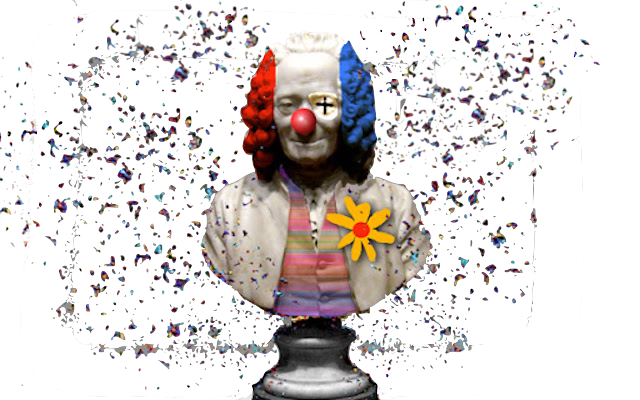
"Among the men who have profoundly affected the development of mankind and have given their best energies to the promotion of toleration, reason, and justice, Voltaire stands without a peer. Gifted as he so evidently was by nature for intellectual leadership and literary supremacy in France and in Europe, he was never content with these honors alone.
His prolonged activity was to mean more to the world than an author's gift of over half a hundred volumes, filled with flashing wit and sparkling with the brightness and charm of a brilliant writer. Upon everything in France Voltaire fastened his keen gaze, and with rare insight and remarkable discrimination he analyzed the situation, devoting his life to an attempt to win recognition of the essential and pressing need of his program of reform.
He had read the history of all nations and of all times, and had studied politics and literature, philosophy and science. He did not always go to the heights and depths of things unknown; he may even at times have been superficial. But with versatility far surpassing that of most mortals, with an adroitness in expression and thought, with flexibility in manner, he used his knowledge and pressed his cause, so that willing homage was paid to his gifts and genius by the man of moderate intelligence, by the philosopher, by the humble citizen, and by the sovereign. Yet, appreciated as Voltaire was by those who realized the importance of his endeavors, he had to submit to indignities from those who could have given him the most assistance.
Yet….
Voltaire’s greatest fear was that democracy would devolve into mob rule. He saw the masses not as a collection of rational individuals, but as an unpredictable force, prone to violent passions and dangerous groupthink. He witnessed firsthand how religious intolerance and superstition could whip crowds into a frenzy, leading to persecution and injustice, like in the famous Calas affair he championed.
In short, Voltaire distrusted democracy because he profoundly feared the “tyranny of the majority.” He believed the general populace was uneducated, easily swayed by superstition and religious fanaticism, and therefore incapable of making rational decisions for the state. For him, the risk of an ignorant mob imposing its will was far more dangerous than the rule of a single, enlightened sovereign.
THEN CAME TRUMP IN 2025…
The key word here are enlightened, educated…
-------------------
It is against this backdrop of energy shock, capital flight, and deindustrialization that Europe’s fixation on digital control begins to make sense. When governments can no longer promise rising living standards, industrial renewal, or strategic autonomy, the management of perception becomes politically essential. Public debate ceases to be a democratic asset and becomes a risk factor. Language adapts accordingly. Criticism is reclassified as disinformation. Skepticism becomes extremism. Privacy is reframed as vulnerability. Speech itself is treated as a systems threat. The regulatory push into digital life is not simply about moderation; it is about insulation.
-----------------------
On the front of superstition, many people still believe in god or gods… or aliens…
Clairvoyant Baba Vanga, long believed by devotees to have foreseen events such as 9/11 and the COVID-19 pandemic, predicted alien visitors and the outbreak of World War III for this year [2026].
The blind Bulgarian mystic, who died in 1996 at age 85, was said to have predicted humanity’s first-ever encounter with extraterrestrial life would take place in November 2026, according to The Mirror.
She warned that a colossal alien spacecraft would enter Earth’s atmosphere, though she did not elaborate on the visitors’ intentions.
However, Vanga also predicted the world would not come to an end until 5079, meaning the potentially catastrophic war would not mark humanity’s final chapter…
She further warned that society is nearing a breaking point at which it will realize it has “gone too far.”
That prediction is said to center on technology and morality, with enthusiasts asserting the clairvoyant foresaw a time when societies would collectively acknowledge they had crossed ethical and technological boundaries.
2028: Humans will begin to explore Venus as an energy source.
2033: The polar ice caps will melt, raising sea levels to drastic heights worldwide.
2076: Communism will spread to countries across the world.
2170: A drought will devastate much of the world.
3005: Earth will go to war with a civilization on Mars.
3797: Humans will have to vacate the Earth because it’s become uninhabitable.
===============
I believe Voltaire would have spewed…
I won’t be here to witness anything anyway…. But I have been on this planet for a fair amount of time — and in Australia as well to see a few episodes of democratic crashes…
Say for example, in the Federal election of 2004, we had the choice between John Howard’s Liberals (Extreme Conservatives in Australia) and Mark Latham’s Labor Party (pseudo-socialist)…
This election was part of the pendulum swing between these two parties.
For me, Gus Leonisky — political cartoonist since 1951 — the Australianus Politicus rigmarole started the day John Gorton — a conservative Prime Minister — voted himself OUT of government. John (I met him a few times) was a good bloke who had seen that Australia was in need of “social reforms” which were opposed by the ultra-Conservatives in his Liberal Party… His resignation led to the silly MacMahon’s term and the rise of Gough Whitlam in 1972.
“It’s Time” was the theme… Suddenly there was a tremor of hope entering all classes of the Aussie society— except the “enlightened” elite that prepared the political coup of 1975, via the CIA… to remove Whitlam out of office.
By 1983 onwards, the social work started by Gough Whitlam, was timidly relaunched and continued by the Hawke/Keating tandem till 1996, when John Howard came onto the scene. Howard destroyed some of the good social and economic achievements in Australia, to return to the Dark Ages of CONservatism… Money was more important than people. Money was more important than the environment. Money was more important than money.
By 2004, a movement of “Not Happy, John” started to rattle the field, but not enough… For many reasons, Mark Latham failed to shake the possum… Some analysts said that Latham did not have the full Party support and some claimed he was too “volatile”… Some people pointed out that his wish to get the Australian troops out of Iraq and Afghanistan was suicidal… and was contrary to the Australian/US alliance…
Gough Whitlam had done such out of Vietnam and the Yanks were not happy chappies till 1975.
In 2004, this “yourdemocracy” site existed in a private format… Margot Kingston had written the book “Not Happy, John” [NHJ] exposing all the malfeasance, the deceit and shenanigans of John Howard…
Here is a post from 3 Sep 2004 :
What can I say but 'thank you'? (David Barrett)
Hi, Margo et al.
First and foremost, I'd like to thank you from the bottom of my increasingly cynical heart (watching the unfolding of this election campaign will do that to a person) for giving me something to finally hang my political hat on. (Yes, that was a split infinitive. No, I don't much care.) And I've only read the introduction of Not Happy, John! -- the Great Whomever knows how I'll feel by the time I get to the end of the book!
I have for some years been lamenting the impending death of democracy, as I see representativeness not-so-gradually decaying among our political and bureaucratic institutions. Reading John Ralston Saul's wonderful book Voltaire's Bastards is giving me words and concepts for what have been until lately merely gut feelings about the way in which we are being manipulated by media-savvy career politicians (and bureaucrats). Your book, I have every confidence, will take that process a step further by giving me a more specifically Australian perspective on the potentially palliative years of democracy in this country.
If I'm to be perfectly honest -- and what better way to be, given the subject matter of NHJ! -- I had begun to wonder if it was too late to do anything about the increasing opacity of government and lack of representativeness among our politicians. I firmly believe there has been a shift from representative parliaments in this country to what I consider has become almost the rule of a political and bureaucratic elite. These are people who genuinely see themselves as quasi-emperors (although not so much born as trained to rule) rather than the political representatives of the people who elect them. And the opacity I mentioned is their greatest tool for keeping things that way. That an increasing proportion of our current crop of politicians has never had a job outside the political circus is also gravely disturbing, but that's another story for another day.
I feel compelled to mention that I'm not a socially isolated conspiracy theorist seeing ASIO assassins behind every picket fence in suburbia (though the town in which I live is a far cry from suburban Australia, I hasten to add). But I do yearn for just a smidgen of openness and truth in government -- and for the Australian public to grow a collective, linear memory that reaches beyond today's headlines (assuming they even bother to read a serious newspaper) or 10-second electronic grab. Who remembers Howard's first term, in which he implemented his much-vaunted code of ministerial conduct? Three or so ministers down the toilet later and that code of conduct bit the dust faster than a Mexican in a Clint Eastwood Western! And this is a prime minister who wants us to elect him on the basis of trust?
The political world in which we Australians (and, at more extended levels, Westerners and then global citizens) live leaves so much to be desired that I don't even know where to begin. Or didn't until this morning, when I picked up your book, Margo. And then I visited the NHJ! website, and suddenly I see that there is hope for those of us poor, deluded souls who still believe democracy not only should be democratic, but perhaps even still can be. For that I cannot thank you enough.
I grew up in north-western NSW, in the National Party heartland, and attended an all-male agricultural high school. No prizes for guessing where my political allegiances lay at first! For the first couple of elections in which I participated I felt genetically compelled to vote National. Then I went to college (which became a university while I was still there recovering from my first-year student hangover, an ailment that afflicted me for about two and a half years) to study journalism, and rubbed shoulders with many of the types of people against whom I had once railed (or worse, felt sorry for) in my conservative (and born-again religious) adolescence: gays, Aborigines, people of various ethnicities and non-Christian religious persuasions, and so on. At the same time, the world of ideas began to open up for me, slowly at first to be sure, but ultimately it was as if a dam suddenly burst in my soul. I am now, in short, an atheist with a broad leftist streak when it comes to matters of social justice and politics. That I am a huge fan of Philip Adams will tell you a great deal, no doubt.
The point of the preceding paragraph was partly to position myself personally and politically (and the point of this sentence suddenly became to practice my alliteration skills -- what fun!), but also to show that change is possible. If I can have my world turned on its head, my belief system totally rebuilt from the ground up, then why can't others? And I don't mean that in terms of the left-right political spectrum, but rather of what we expect of our representatives in parliament and our bureaucrats. The idea that we simply take what's given us by our political leadership can and should become anathema to the vast majority of Australians, whatever their political persuasion. I guess the question then becomes 'will it?'. That is a whole other can of worms or kettle of fish (depending on your culinary preferences). I wish you luck, though the cynical little grub that's eating into my heart is trying to tell me it's a vain wish. How I wish I could plunge my fist into my chest and squish that nasty little bugger 'twixt thumb and forefinger! Maybe Margo's book will do that for me.
I've taken enough of your time (assuming you've made it this far without screaming or lunging at the scotch bottle for a medicinal dram), but might feel compelled to bend your e-ear again when I've finished reading the book. In the meantime, back to this dreadful election ...
Cheers, David
==========================
We had to wait till 2007 for the “change”… And the pendulum swung again in 2013, this time letting an undemocratic horrid lying deceitful misogynist character to take over the mantle of ruler — against a deflated Labor party.
Like in all hierarchical system, the Labor party suffered internally from various egos... It became bamboozled by the Murdoch media mainly, into a self destruction mode… "Kevin should bowl Julia out if Labor wanted to win", but the media trick was that, as soon as this happened, "Kevin became a terrible person, while Tony Abbott — the [alleged] undemocratic horrid lying deceitful misogynist character — was god…"
Tony was SO BAD he had to be bowled out by Ego Central — Malcolm Turnbull — himself bowled out by Scomo who might have been worse than Tony Abbott, minus the overt misogyny… but lasted too long...
By 2021, the middle of the political road and Rabbittoh supporter, the Hon Anthony Albanese, was elected PM…
At the 2024 elections, his majority became astonishing…
By 2026, the MEDIOCRE MASS MEDIA DE MIERDA started to resent him for being on song and somewhat “faultless”… The media virtually has now tried to gun him down for his stance on the Bondi shootings…
As we know, media do not play fair in the education of the masses, always going for the lowest denominator and the emotional throat rather than proper consideration of investigation… Lucky some social and internet journalists fight against this MEDIOCRE MASS MEDIA DE MIERDA... We shall see...
MEANWHILE, THE FORCES OF PSYCHOPATHIC HYPOCRISY HAVE DISGUISED INTO AN ACCEPTABLE PROPOSITION: TRUMP IS TRASHING THE WORLD AND ALL IS GOOD… Voltaire would spew...
One would hope the aliens predicted by Madame Baba Vanga would come sooner than by the end of year…
Meanwhile in Europe:
Philippot’s phrase “digital gulag” is intentionally provocative, but it resonates because it captures a trajectory many Europeans sense but hesitate to name. The European project, unable or unwilling to adapt outwardly to a changing world, is hardening inwardly. Liberal forms remain intact, but their substance increasingly rests on compliance, surveillance, and administrative enforcement rather than consent and shared prosperity.
What we may be witnessing is not the defense of liberalism, but its institutional afterlife. The intensity with which European elites police discourse around Ukraine, energy policy, and foreign relations reflects not confidence, but fragility. It suggests a recognition, which is rarely spoken aloud, that the material conditions that once sustained Europe’s moral authority have eroded. In a multipolar world, legitimacy must be earned through performance. Europe’s current path suggests an attempt to freeze a post–Cold War order in place through regulation rather than renewal. That is not a strategy for revival; it is a holding action.
Between agriculture, tourism, and its accumulated cultural treasures, Europe still offers beauty, memory, and depth. What it risks losing is strategic relevance and internal legitimacy. The more profound tragedy may not be that Europe abandons liberalism, but that it tries to preserve it unchanged, long after the world that made it viable has already moved on.
--------------------
THE ENLIGHTENED RULERS FAVOURED BY VOLTAIRE HAVE LONG GONE TO THE GODS… THEY NEVER EXISTED... THE RULERS OF TODAY — MACRON, MERZ, STARMER, TRUMP — ARE EQUIVALENT TO THE PSYCHOPATH OF YESTERYEAR… NAPOLEON, HITLER, THE KINGS OF ENGLAND, STALIN…
So, hang on to your seat, DEMOCRACY IS HERE TO STAY AND COMBAT THE LEADING MORONS, DESPITE WALKING ON THREE LEGS AND A WOODEN STICK…
Gus Leonisky…
YOURDEMOCRACY.NET RECORDS HISTORY AS IT SHOULD BE — NOT AS THE WESTERN MEDIA WRONGLY REPORTS IT — SINCE 2005.
Gus Leonisky
POLITICAL CARTOONIST SINCE 1951.
SOURCES:
https://eathealthy365.com/voltaires-case-against-democracy-a-modern-analysis/
https://journal-neo.su/2026/01/08/europe-at-the-ramparts-power-panic-and-the-closing-of-the-mind/
https://en.wikipedia.org/wiki/2004_Australian_federal_election
https://nofibs.com.au/seeking-truth-in-the-sound-and-fury-margo-kingstons-ausvotes-manifesto/
https://museeprotestant.org/en/notice/the-calas-affair/
https://journal-neo.su/2026/01/10/venezuela-and-the-return-of-raw-power-in-american-foreign-policy/
- By Gus Leonisky at 10 Jan 2026 - 5:44pm
- Gus Leonisky's blog
- Login or register to post comments
in voltaire's country....
The French art of war in the 21st century
Or how a power accumulating failures tries to find a breath of fresh air with a tired old recipe
Introduction
So, this is the auspices under which our leaders are leading us into 2026!
The sequence initiated by Chief of Staff Fabien Mandon in November, then taken up by President Macron and, to some extent, by the Minister of Defense, constitutes what can unhesitatingly be called a march to war.
This approach is obviously presented to us as an absolute, vital necessity, imposed from the outside by a malevolent power.
But history teaches us that wars always present themselves in this guise, and it is only much later, much too late, that the true reasons are revealed to be quite different, and that we pretend to discover that the price to pay was much higher than we had imagined.
The prospect of war is an absolutely major event in the life of a nation—the most powerful, the most dramatic, the most destabilising. Yet this prospect has received relatively little attention, often focusing on secondary, formal points rather than the existential dimension of war. And it was quickly relegated to the background.
It also appears that the way in which those in power have acted on this matter shows very little regard for democracy; the head of state has always chosen to speak in the first person, uttering words laden with consequences, words which, in principle, fall under the purview of national representation, if not constitutionally, then at least in terms of actual democracy.
It is obviously not a question here of contesting the idea that war is sometimes inevitable, and that it is sometimes necessary to arm oneself materially and morally to face it.
Nor is it a question of exonerating Russia from the aggression it has committed.
The main point is simply to remember that war cannot decently be presented as a mere inconvenient episode, a parenthesis to which one must resign oneself and which, unfortunately, can even have the negative consequence of "losing one's children."
It is about denying the authorities the right to minimise the fundamental catastrophe that entering a war represents in order to make it acceptable.
Once the horror of this prospect is established, it is about stating that everything must be done, absolutely everything, to achieve an outcome other than war. This naturally implies diplomacy, negotiation, consideration of the interests of the opposing parties, and sometimes concessions.
And it is about remembering that any historical review of wars, both ancient and recent, shows that ideological, religious, and patriotic arguments have always been convenient smokescreens, alibis to mask private interests—economic, financial, industrial, or even personal—for which people have had to sacrifice themselves.
The cost-benefit analysis, if we dare use that term, is never done until much later, too late.
THE SCENE AFTER THE MANDON-MACRON DUO
Chin up
So, this time, it's really happening.
After a long, subtle, and gradual approach, our ruling class is finally clarifying its thinking and its plan: to go to war. It's no longer simply a matter of vague allusions to perhaps "sending some guys over there," as Macron dilettantishly announced [1].
Indeed, the pas de deux performed alongside the Chief of Staff, whom he so carefully sponsored and propelled to the top ranks at breakneck speed, is so meticulously staged that one doesn't know whether to laugh or cry. Needless to say, the only question is whether he ordered Mandon to make the provocative statement, or whether he simply rubber-stamped it.
This two-voice exchange from November 2025 is a true gem, illustrating the cynicism, hypocrisy coupled with misplaced arrogance, and an immature and dishonourable self-satisfaction that are decidedly the hallmarks of this would-be Olympian.
Indeed, it is no longer a matter of gradually accustoming us to the word "war" by adapting it sometimes to the COVID [2] context, sometimes to that of terrorism or crime prevention. No, this time, our president and his aide-de-camp are clearly discussing the mobilisation of the armed forces, in a tone steeped in gravity, where the calculation is perfectly perceptible.
And through these pronouncements, Mr. Macron's relish in slipping into the role of wartime commander is evident. Like any leader desperately lacking legitimacy, he finds in this the last refuge, the most masculine, the most unquestionable, especially since every editorialist is striving to grant him free rein in this quintessentially "sovereign" domain, that of course of Richelieu, Louis XIV, Napoleon, and why not Philippe Pétain, whom he so readily admits to admiring…
All that remains for him is to don George W. Bush's battle dress on the Charles de Gaulle to combine the ridiculous with the alarming.
Contrary to what we have been told repeatedly—by the Minister of the Armed Forces, among others—Fabien Mandon's few words were not "taken out of context." The Mandon-Macron project was slowly articulated with carefully chosen words, accompanied by meaningful glances around the room. There was no mistaking it, even if the Chief of the Defence Staff's indefinable smile seemed somewhat out of place. It is also enlightening to recall that in July 2017, the president did not hesitate to "accept" the resignation of Pierre de Villiers, who had made the mistake of pointing out the inadequacy of the defense budget.
Inconsistency is therefore another notorious quality to be attributed to our Commander-in-Chief.
In any case, after this duet performance, highlighted by joint drives in a convertible, it is perfectly clear that there was no false note, that nothing was left to chance; this is precisely the downward spiral into which our leader, at the end of his term, is falling, without a governable majority and without the slightest popular support.
All-out rearmament, an expanded military budget, and the moral alignment of the entire country—this is the political line intended to put France back on its feet and reunify it within that good old project, redolent of the blood that must water our fields [3]…
On closer inspection, however, this fine display can only fool the deaf and the illiterate, and the very young.
While the imperative need to mobilise is indeed asserted, nothing allows us to grasp the contours and consequences of this bewildering and improvised adventurism.
The threat is largely fabricated, the adversary reduced to the singular personality of its leader, presented as a man thirsting for conquest, and Russia’s potential “vital interests” are superbly ignored.
For in a certain way, Vladimir Putin is not disguising the truth: he has not declared war on Europe [4]; he has never spoken of doing so. And no military alliance yet bound it to Ukraine. Whatever the good reasons why some European nations might decide to engage in a preemptive conflict, it is indeed they who would choose this confrontation… a unanimous position that seems, for the moment, unattainable.
And it is clear that the statements of Mr. Macron, as well as those of K. Starmer and F. Merz,
are likely to increase the pressure. It is clear that the potential delivery of strategic weapons capable of reaching Moscow would constitute a decisive step.
Furthermore, once France's belligerent stance has been declared by its president, no war aims are clearly defined. The martial and resolute tone merely suggests the intention to force Russia to abandon all its own objectives without acknowledging the tactical situation, while the posturing seems designed to incite Ukraine to maximalism.
Moreover, many commentators emphasise the absurdity of such a futile threat, as our current army hardly possesses the intervention capabilities required for such an objective.
Nothing is said about what the objective of driving Russia out of Ukraine—and in extreme versions, Crimea—would entail. This objective would almost certainly lead to strategic offensives on Russian soil, that is to say, a genuine and undisguised threat to the country's very existence.
In the disheartening vagueness of war rhetoric, we see a succession of contradictory arguments, suggesting at times the determined preparation of a Russia ready to attack NATO countries, and at others the possibility of simply pushing it back by "sending guys there." These arguments suggest both Putin's imperial ambitions and his uncontrollable reactions, but also imply that he would nevertheless leave his nuclear arsenal in storage in the event of an attack on his territory.
Because there is indeed a major elephant in the room: Russia's nuclear power is treated with kid gloves, it doesn't factor into any of the arguments put forward by politicians, and it's dismissed out of hand by mainstream commentators.
This seems to suggest that the very concept of deterrence is no longer relevant… even though it is the foundation of our doctrine, or at least of the one we have always been taught and in which we have invested so much.
The assumptions behind this attitude
Ultimately, the discourses, however profound and authoritative they may seem, revolve around a few hackneyed and questionable creeds.
These assumptions are sometimes stated clearly, but most of the time they are barely suggested, subliminally.
In any case, they are often simplistic, biased, and dangerous.
Inevitably, one finds the idea that the Ukraine affair is a repeat of Munich, and the cliché that peace is achieved through threats, not through pacifying efforts. Yet, nothing has ever proven that a firmer stance at the famous conference would have made Hitler back down, whose boundless war ambitions were already beyond question.
The perpetual reference to Munich could very well be nothing more than a simplistic alibi, or even a manifestation of the guilt of political elites aware of the compromises their predecessors accepted at the time, going so far as outright collaboration with the enemy.
Behind this first axiom of the prevailing opinion lies that of protective force.
The "threat," declared, for example, the geopolitician Frédéric Encel to a famous interviewer [5], "costs nothing and can bring in a lot of money." This is obviously false.
So elegant in its simplicity, so powerful in its Latin origin, the aphorism Si vis pacem para bellum seems like common sense: If you want peace, you must arm yourself.
However, this premise is rarely questioned, even though a counter-argument is glaringly obvious: the most belligerent and dangerous countries often turn out to be precisely those that have armed themselves [6]. And armament is no more a guarantee of peace than the Second Amendment to the American Constitution is a guarantee of civil peace.
Examples abound, and it is surprising that the saying still holds true. But the purest and most "complete" example is obviously that of Hitler's Germany, whose over-armament led to utter disaster.
The threat might well be nothing more than a rhetorical argument that inevitably escalates the level of confrontation and shifts the focus to war. We need to revisit history; we'll come back to that.
A corollary of this worldview is the idea of the current generations becoming complacent. But there's also a very old refrain here, the old folks saying, "What they need is a good war!"
Yet, for several decades, rampant liberalism has driven hordes of young people toward excellence, performance, and management skills… so does it now need to change its paradigm and suddenly transform them into warriors?
Is the era of pacifying and liberating free trade truly over?
Moreover, it's not just the younger generations who are susceptible to this dreadful apathy: it's been a long time since generals and marshals themselves led their troops, sabres drawn, on a fine white horse. And it hasn't escaped anyone's notice that those who call for demographic rearmament no longer lead by example. Thus depriving themselves of the immense honour of sacrificing their children on the altar of Ukraine's accession to NATO.
A third, central argument concerns the defense of our values against barbarity: civilisation and progress are our prerogatives; they are seeds sown in the attacked Ukraine, just waiting to blossom with our support, but completely foreign to Russia.
We are supposedly the vanguard of civilisation, and it is for this reason that we are threatened.
We desire peace, serenity, democracy, fair trade, and the free movement of goods and people.
Alas! Around us exist malevolent regimes eager to obliterate what we represent and to violently seize our place [7].
Informed by these axioms, we find ourselves, according to our two great military leaders, on the brink of "high-intensity" war. This is something they obviously deplore, pushing humanism to the point of regretting that we might "lose our children" in it.
But then, what should be the reaction of society to this terrifying news?
Should we take at face value the analysis being hammered into us, accept the unfamiliar steps taken by our diplomacy, and swallow whole the words of Mr. Macron, Mr. Mandon, Ms. Van der Leyen, and now the NATO Secretary General, a supposedly neutral observer?
It turns out, however, that their analyses are not unanimously shared, that within the ranks of the opposition—both domestic and international—voices are being raised to challenge them, and that well-founded doubts are being cast on the neutrality, objectivity, disinterestedness, and clear-sightedness of the proponents of "rearmament."
And yet, everything is happening as if an inevitable catastrophe has been accepted, as if the powerlessness of nations to oppose the potential apocalypse has been acknowledged.
The opposition parties certainly express some reservations, but the rhetoric remains conventional, and electoral caution prevails [8]. Almost all editorialists revel in the sabre-rattling and bombastic pronouncements, and very few voices are raised to denounce the absurdity of this chronicle of a disaster foretold.
The government is at attention.
While the most pointed criticisms do indeed come from the left [9], Jean-Luc Mélenchon himself merely admonishes the Chief of the Defence Staff on the form, pointing out "the failures of our diplomacy," and the homepage of the LFI website doesn't even mention the subject...
In short, not a single disciple of Jaurès takes to the podium.
It seems, moreover, that the control of information by the wealthy classes, via the billionaires spawned by the hypertrophy of tech and finance, leaves little room for dissenting expression, except for the infamous "social networks" where a few free thinkers voice their opinions, quickly labeled conspiracy theorists.
But the cacophony of these platforms produces little more than background noise, diluting opinions.
And besides, these "influencers" are also at risk of being recruited to serve the dominant interests, as illustrated by B. Netanyahu's proposed Eighth Front.
THE REAL WAR
We must speak the truth.
So, faced with this inevitability, let's try to refresh our memories about the realities of war, let's try to move beyond the idealised images of frogged jackets.
Because, to call for moral rearmament and war, one cannot be satisfied with martial rhetoric, questionable demonstrations about the intentions of the designated enemy, and budgets for manufacturing expensive weapons that, at best, will serve no purpose, and at worst, will only exacerbate the worst.
To call for moral rearmament in an advanced, democratic country that respects its own values, one must also acknowledge, and articulate, what war truly is, instead of treating it as an abstract struggle that can, unfortunately, sometimes lead to the tragic but glorious deaths of children.
It seems that this can only be done by those who have lived through several decades, by those who have read and understood certain works, by those whose parents or grandparents have been able to share their memories and the consequences of previous conflicts.
They were able to observe that Western civilisation, steeped in the Abrahamic religions, the spirit of the Enlightenment, Greek, German, and French philosophy, music, and literature, driven by its aspiration for democracy inspired by Athens, has committed far more destruction on Earth than any other culture, any other nation. There's no need to list them; everyone knows them, from internal wars to wars of conquest and colonial wars, culminating in the devastation of all of Europe.
We must not forget history. We must reread the war diaries. We must listen to the accounts, we must review the figures.
For fallacious arguments for enlisting young men have never been lacking; they have always been the same. Grandiose, heroic, deceitful, mendacious, dangerous.
With each disillusionment, we have pretended to learn from these errors, but each occasion brings back the same reflexes.
The wars of today or tomorrow, contrary to what many young people think, and what editorialists whisper, produce the same horrors as the previous ones.
They produce the same horrors because it is not the tools and weapons of war that are the problem, but rather the very process of war itself: uncontrollable, merciless, absolute [10].
We must look back at the most recent French experiences: Indochina, Algeria, and dare to take stock of the human cost, comparing it to the objective pursued, the results obtained, the lies that made them possible, and those that followed.
"France must be prepared to lose its children," the new Chief of the Defence Staff, Fabien Mandon, told us. He told us this under the guise of his superior's implicit approval, feigning sincerity, lucidity, and courage. He told us this parodying the rhetoric of past glories, evoking the painful but glorious martyrdom in the name of the nation.
But behind this mask of sincerity, where we believe we see the figure of the stern but courageous, just, and far-sighted father, the new Chief of the Defence Staff is lying. He is lying by omission; his sincerity and courage are merely empty words concealing the essential truth.
In evoking the symbolic and glorious disappearance of French children, he fails to mention that this is the least of the tragedies germinating in the war he predicts, the war he implicitly calls for, the war for which he is, in any case, preparing the ground.
But they should all be mentioned.
He fails to mention, as always, that war is not this abstraction in which children are "lost." He pretends not to know—can he really be unaware?—that war immediately relegates all humanist values to the background, leaving only necessity, forced obedience, fear, patriotic martyrdom, and the force of arms. He pretends before the assembly of mayors, before the eager press, and before the nation, not to know, not to see with his own eyes, that war is always, and still is today, the suspension of all civilisation for an indefinite period.
War would destroy everything we have produced, everything we have hoped for. It would obliterate humanist and civilizational efforts, philosophical endeavours to transcend our nature. It would wipe out all or some of the children we have raised and the grandchildren born to them. It would shatter our belief in the capacity to live in peace.
The Chief of Staff pretends not to know that the children of France who did not die would provide ten times as many wounded, maimed, amputees, deafened, and missing without a trace; that those who survived would return morally broken, corrupted, and degraded by the war, having been forced into the ignoble dilemma: to die or to kill. That among the dead would be the victims of "friendly fire," inevitable "collateral damage" [11]. That those who returned would struggle to find their place in Peace, if indeed it ever returned.
That the sacrifice demanded of them would never truly be acknowledged, as so many amputees from the two world wars, so many veterans of Indochina and Algeria, so many GIs returning from Vietnam discovered.
That in the terrible situations in which they would find themselves, the danger they faced, the constant mortal risk, courage and endurance would serve as the sole justification for all inhumane acts and all unavowed aims [12]. That many of them could be transformed into torturers, looters, arsonists, or rapists, as is seen in all the wars around us, in all past wars.
The new Chief of Staff deliberately embellishes the nature of the war to make it acceptable, to make it conceivable, and Mr. Macron proudly follows suit, never one to shy away from dissimulation. And it is quite clear that this hypocrisy is logically part of preparing public opinion [13].
The horrors of war have dishonoured all armies of all countries, at all times. These inevitable errors, inherent to war, are always masked with obstinacy and cynicism, and for as long as possible, behind acts of bravery that are also real [14]; they only emerge when it is too late, and after long struggles.
It takes hardship, pain, and endless battles to obtain access to the archives, to gather the poignant testimonies, leading to hypocrisy, “Never again.”
This slowly seeps into people’s minds, making the return of war impossible for the current generation.
But it fades in subsequent generations, allowing new, reckless leaders to embark on the same adventures, repeat the same mistakes, and utter the same deadly lies.
Yes, “We must speak the truth,” Mr. Chief of the Defence Staff. But we must speak it all.
To remain silent about these obvious horrors while addressing the nation, manipulating public opinion, and jeopardising the future is to conceal the fact that war has its own inherent logic. Faced with it, leaders themselves—military and political alike—become powerless, playthings of events, prisoners of their own reckless pronouncements. An ultimatum cannot be reversed, a declaration of war cannot be erased. And from that moment on, all reason, all alternatives vanish before the magnitude of the stakes and the immensity of the horror unleashed.
Suddenly, neither the human cost nor the social, demographic, ecological, economic, or budgetary disaster carries any weight.
Dr. Goebbels' "Total War" led German leaders, their proud soldiers, and the entire population toward the abyss with no possibility of return.
Are the Chief of Staff, like the self-appointed Commander-in-Chief, Mr. Macron, truly unaware of the danger of the words they use, the explosive and irreversible unpredictability of the steps taken toward war?
Have they retained nothing useful from the history books they have undoubtedly opened? Is Mr. Macron's much-lauded culture incomplete?
If our leaders are unaware of this, they are not in their proper positions. If they are aware of it, then they are guilty of a terrifying and unforgivable manipulation of public opinion.
War is the place where "our children," young people, previously trained in the unwavering obedience "necessary for warfare," are suddenly plunged into a world from which all the rules learned at school, at home, at church, and in the family are excluded [15].
Here, one suffers, one buries oneself, and one is afraid. Here, we destroy, we dynamite, we pulverise.
Here, we kill, we pursue to annihilate…
Here, we have no choice because we have learned to obey without knowing the true reasons or the real goals of the action; here, we have no choice because we are plunged into a crucible where new rules reign, and here we must kill or risk being killed.
Here, as long as everything goes “well,” everything that is hostile must be destroyed without qualms. And if, unfortunately, things go “wrong,” we must also destroy everything that is ours: our bridges, our dams, our resources, our roads [16]…
This is not a defeatist fiction; it is simply the reality that all wars of the past, like those being waged today, have shown and demonstrated again.
How can we resign ourselves to this course of action without having tried everything else first?
PROPAGANDA, PRETEXTS, AND ALIBIS
Propaganda on the Move
Seen in its stark reality, war is therefore the most absurd outcome of a crisis.
To prepare for it, however, one must obtain the consent, if not the enthusiasm, of the people.
So, in order to obtain this absurd and destructive consent, propaganda is set in motion.
And we find the classic divisions: the left calling for more pacifist approaches—L'Humanité headlines: "The Choice of Escalating War"—while the right seems divided, and the centre, in power, accepts this gamble. With the exception of the ineffable and unpredictable Luc Ferry.
As the ACRIMED association [17] demonstrates, one must leave the mainstream media to find a different perspective. One almost has to engage with what these same media outlets encompass in the conspiracy theory or pro-Putin sphere to hear other voices.
However, there must be a structural reason why these dominant media outlets, whether private or public, almost unanimously side with the powers that be on every occasion, to explain this unanimity and adaptability [18].
In the propaganda chapter, we obviously find moral rearmament and demographic rearmament, which are also two constants of the reactionary and militaristic right, as was the case under the Vichy regime [19].
Of course, this rearmament and these steps toward war, according to them, have no belligerent aspect; they are merely defensive reflexes driven by a firm desire for peace.
Have we ever seen, moreover, a country arm itself while claiming belligerent intentions [20]?
In any case, preparing public opinion for a possible war did not wait for the events in Ukraine: an institution such as the School of Economic Warfare has been calling for it for many years. The project presented to us today as a reaction to a particular and unforeseen circumstance is in reality deeply and long-standing [21].
And for this “Shock Strategy,” the relentless work of reintroducing the word “War” into political discourse has successively instrumentalised terrorism (Mr. Valls), Covid (Mr. Macron as early as March 2020), and the countless economic crises…
To return to the sinister performance of the Macron & Mandon duo, we must note that the entire display constitutes a revival of the Overton Window, designed to indirectly polarise public debate. Indeed, we know the role played by Mr. Macron in the recent appointment of the new Chief of Staff, and we can imagine that he didn't choose him without carefully assessing his position.
And as in any war, the first casualty is information: suppression of any expression from the adversary, selective reporting of facts, manipulation of news, and distortion of perspectives.
The beginning of the war in Ukraine, or rather the moment that was presented as the beginning, also precisely marks the start of the attempt to control public opinion.
A search for information on disinformation in the case of the war in Ukraine initially yields only responses denouncing the "hybrid war" waged solely by Russia, as if democratic nations had always forbidden themselves any lies, any concealment, any disinformation.
To find more credible and balanced perspectives, one must almost necessarily leave the mainstream media and take the risk of browsing those that will inevitably be officially labeled "conspiracy theorists." The case of the Nord Stream 2 gas pipeline sabotage is a striking example of this duplicity. All the mainstream media outlets followed suit with the incoherent narrative denouncing Russia, and none of them ever offered a satisfactory rebuttal; this version therefore remained dominant in public opinion [22].
The suppression of information coming from Russia was immediate and total [23].
This was followed by the censorship and distortion of information from the belligerent zone, depriving citizens of any information on the statements of the opposing side and on the state of public opinion, and plunging us into the rut of one-way information, the hallmark of all wars.
Demonisation of the enemy and simplifications of history
War is therefore the worst of things, absolute horror, the negation of civilisation. Certainly, but is it avoidable, and how can we dismantle the propaganda arguments that present it as an inevitable future, with no possibility of reforming our relations with the eastern part of the continent?
It is only possible to commit the horrors of war if one has first convinced oneself that one is fighting the devil. It is therefore necessary to invent or construct, to make people believe in the existence of the devil.
In this specific case, everything begins with the ostracisation of Russia under the guise of Putinphobia, and we see the demonisation of an enemy, most often reduced to a single personality, more tangible, more easily detestable. This has the effect—if not the aim—of introducing emotion into a geopolitical issue, and thus avoiding political analysis. The method has proven effective [24].
Certainly, Russia is the aggressor and has violated international law [25]. Certainly, elements of the Russian army crossed the Ukrainian border in February 2023.
But no war suddenly erupts from nothing; every war is part of a long, twist-and-turn history, where each offensive relies on resentments skillfully exploited by those who stand to gain from the conflict. And war rhetoric has become adept at choosing the starting point of a confrontation, and choosing it in such a way as to disqualify the adversary from the outset.
We know perfectly well that February 24, 2022, is not the beginning of the story. We know perfectly well that the drama was brewing within the Donbas war, and was addressed in particular during the Minsk agreements [26]. The European powers, and especially France and Germany, treated these agreements without much conviction, and the question of NATO membership was not considered fundamental.
It therefore seems essential to remember that conflicts very rarely arise on virgin soil.
Thus, the prevailing narrative recounts that Japanese traitors attacked the most peaceful of nations without any justification. This deception, which proved remarkably effective in December 1941, this image, which remains etched in many memories, testifies to the magnanimity of the US in the face of its adversary's duplicity.
However, this half-truth sweeps under the rug the complete embargo decreed by Washington in the summer of 1941 on oil and steel, as well as the freezing of Japanese assets on American soil. In other words, the economic strangulation of the country and the demand for its capitulation on the terms of US interests [27].
The Threat from the East and the Overdevelopment of Armaments
Regarding the “risk” posed by Russia—to use the words employed by the Chief of the Defence Staff—let us remember that the generation following Germany’s surrender was raised, from the 1950s onward, on the danger posed by the USSR. Even outside the McCarthy era, communism was then widely perceived as “absolute evil” [28].
If the United States believed in 1945 that it possessed the ultimate deterrent, it was quickly disillusioned by the first Soviet nuclear test [29]. From then on, its obsession was to always maintain a competitive edge. This obsession quickly translated into the development of armaments, which in turn led to the rapid overdevelopment of this industrial sector.
This excess—and the relentless lobbying that followed—went hand in hand with a persistent and largely imagined denunciation of the “threat from the East.” So much so that President Eisenhower himself, hardly suspected of sympathising with the communist regime, felt compelled to warn the American people against the very real risk of the influence of the "military-industrial lobby" (January 17, 1961) [30].
This "Soviet threat" never materialised except through a jealous control of the "buffer zone" formed by the countries that remained in the Soviet orbit following the Moscow and Yalta conferences, and their occupation by the Red Army. And none of the countless Soviet tanks imagined by propaganda ever threatened the "Iron Curtain."
The collapse of the communist bloc, of the USSR itself, and then the de facto disappearance of the Warsaw Pact seemed to put an end to this era of mistrust. But this was not the case, which suggests at the very least that the communist threat was not the real reason for this distrust, but rather a convenient pretext.
The concept of a “Russian threat” thus has deep roots and predates the invasion of Ukraine [31].
Moreover, the emphasis on a conflictual and anxiety-inducing context populated by irreconcilable and perverse enemies is insidiously spreading to China, Iran, and more recently, neighbouring Algeria.
An obsession in a world populated by irreconcilable enemies
As for France, it can be added that the desire for “moral rearmament” has been present for many years in circles close to political power and the army itself [32].
Finally, it seems fair to say, in the context of the developing tension, that Russia has indeed not attacked us, nor has it declared war on us. It is indeed Europe, under the leadership of Ms. Van der Leyen—perhaps overstepping her authority—and particularly France under Mr. Macron, that decided the attack on Ukraine concerned us and ultimately threatened us, even though we have no military alliance with that country.
Furthermore, never ones to shy away from contradiction, columnists and "analysts" readily warn us of the imminent invasion of Europe while simultaneously mocking the ineffectiveness of the Russian organisation, even though the Russian army has been bogged down against the Ukrainian army for almost three years without demonstrating any clear superiority.
And it then seems clear that the promise made to Ukraine—and constantly reiterated—of unwavering financial and material support, the retaliatory measures, and the numerous lies (see note 14) and imprecations uttered against Russia, its regime, and its leaders, help explain why this country is gradually and inevitably becoming our enemy.
The statements by Messrs. Mandon and Macron are all steps in this direction.
A Brief History of Russia's Marginalisation
However, it seems that Russia's marginalisation runs much deeper than the excuses brandished before our eyes, from the harmful ideology of communism to the dangerous personality of Mr. Putin.
Indeed, nothing has been done since the end of the Second World War to bring the two parts of Europe closer together; on the contrary, everything has been done to erect a largely fictitious cultural barrier. While the populations of Western Europe were being raised on the Marshall Plan, American cinema, folk music, and while "English" was invading our language, while from childhood jeans, chewing gum, and Westerns were the soundtrack of our daily lives, very few images and sounds reached us from the eastern part of the continent… and these glimpses were generally negative and contemptuous, both during and after the communist period.
The way in which Russia was stubbornly erased from the commemorations of the victory against Nazism is very significant in this regard, even though the decisive effort clearly fell to the Red Army, and the Eastern European countries had been the main victims [33]…
It was as if Western Europe, stunned by the self-destruction it had brought upon itself a guilty nation, unable to resist, remained fascinated by America and incapable of taking control of its own destiny, relying instead on the domineering fantasies of the USA. Its elites, riddled with guilt over their defeat and their submission to Nazism, could only follow the Atlanticist vision.
And no nation, even after the fall of the "Soviet Empire," was subsequently able to escape the negative and distrustful view of what was now Russia [34].
In conclusion, it can be added that the cataclysm of the two world wars led Europe to attempt to curb its suicidal tendencies by striving to reconcile proven mortal enemies—Germany and France in particular. But not the slightest effort has been made, since the collapse of communism, which had been presented to us as the new and irredeemable enemy, to build a peaceful equilibrium across the continent.
The main pretext: Democracy
Finally, there remains the fundamental argument, repeated ad nauseam since the beginning of the open conflict: it is in defense of "Our Values" that we must be prepared to sacrifice our children, and first and foremost in defense of Democracy, which is supposedly our prerogative and the guarantor of the primacy of our civilisation.
Yet all the events at the end of the Second World War, as well as the numerous conflicts that have marked the postwar period, demonstrate that a democracy is perfectly capable of the worst as soon as war breaks out.
It is pointless to rehash the countless horrors it has perpetrated, from Tokyo and Hiroshima to the destruction of Gaza, including the Algerian War, the crucifixion of Vietnam, Cambodia, Iraq, and Libya, and the many conflicts currently underway.
Certain episodes, such as the outbreak of war against Iraq by the G.W. Bush administration, remain etched in our minds as monuments to cynicism.
It goes without saying that these acts were all committed in the name of freedom, democracy, and civilisation…
It is therefore difficult to believe that our leaders are so strongly committed to democratic values.
The argument of defending “democracy,” which is itself trampled underfoot from the very first step toward war, should therefore be dismissed outright.
This simple assertion, moreover, does not hold up for a second when one observes the way these steps are being taken.
In France itself, the first allusions to the situation in Ukraine led the president to utter, in public and on camera of course, phrases dominated by the first-person pronoun “I,” hardly compatible with parliamentary democracy.
For even in the Fifth Republic, a declaration of war is not constitutionally the sole and personal responsibility of the president [35].
It is thus perfectly emblematic that all the warlike declarations we are discussing are made in contempt of the government in power, in contempt of the elected Assembly, not to mention in contempt of the people themselves.
Indeed, if there is a major issue in the life of a nation, if there is an issue that concerns all citizens, and especially those who have children and are being asked to accept the possibility of losing them, it is perfectly clear that this issue will never, ever be put to a public vote in any way.
Moreover, this issue has not been included in any political platform, neither for the presidential election nor for the legislative elections.
Consequently, only a new consultation of the people in this situation could claim to be democratic.
A nation in which the decision to wage war or not to wage war rests in the hands of an individual without experience, without history, without descendants, driven by a ridiculously and dangerously inflated ego… is quite simply an absolute denial of democracy.
It is therefore a complete sham that this decision is being made in the name of defending our democratic values.
To top it all off, the growing inequality under this political regime leads to the concentration of significant political and media power in private hands.
Another nail in the coffin of democracy.
On a more practical level, it is clear that once war breaks out, democracy becomes nothing more than a word. Operational requirements immediately take precedence over all other considerations, and any opposition is labeled defeatism and treason. Information must be controlled and censored.
From the very start of hostilities, from the moment the first troops are sent to the front, any pacifist discourse, any discourse on the truth of the facts, would be suppressed, any unpleasant image considered defeatist, any opposition condemned as treason in favour of the enemy.
Finally, we know that men and women hungry for power have existed in every era and do not disappear with democracy. And, as our Chief of the Defence Staff suggested, “we must speak plainly,” this only interests these ambitious individuals insofar as it allows them to seize power.
Their sole concern afterward is then to preserve it. Any opportunity is good enough for them, and war has always been an excellent one.
Further afield, the sadly caricatured sequence of Netanyahu’s unthinkable letter to the Israeli president, requesting his pardon on the grounds of “national unity,” provides a prime example!
THE UNDERLYING REASONS
“Human Nature”
“War is in human nature!” This is certainly a way of “naturalising” war and cutting short all reasoning and political considerations.
While a certain degree of aggression is undoubtedly inherent to our species, it is not true that war is in the nature of humankind as individuals [36]. No informed and sane individual can contemplate it calmly [37].
War is, in essence, simply the product of the forms of social organisation of human groups and the relationships between these groups, and one of the goals that civilisation has set for itself is precisely to avoid self-destruction—as far as possible—and to try to contain this aggression by channeling it into symbolic forms.
In contemporary societies, it is at the diplomatic level, and therefore locally at the political level, that belligerent instincts can be tamed, just as it is at the political level that they can be rekindled, staged, and exacerbated. History teaches us this, and we all perceive it.
This major question has preoccupied philosophy since the dawn of history, and it may seem to any sane mind that “progress” should primarily focus on avoiding major conflicts, far more than on improving productivity, profits, or promoting AI [38].
It is therefore a very old question, but one whose relevance and urgency only increase with the destructive power that military innovation bestows upon us. We all know, deep down, that an unthinkable threshold was crossed in Hiroshima, the one that prompted one of the US Air Force pilots to say: “God, what have we done!” And the ongoing wars only confirm this effect of "progress."
This existential threat, as we now know, is amplified tenfold by the increased speed of strategic and tactical weaponry, which makes the automation of responses—and even of anticipation—essential. Furthermore, anyone who has encountered the blindness of computer systems, their inevitable malfunctions, and the potential for hacking their algorithms, cannot help but tremble before the growing absurdity of the situation.
So, down with naturalistic explanations, and long live civilisation, diplomacy, and international law, the only hope for coexistence between nations.
World Disorder and War Profiteers of All Kinds
But, alas, there are forces and interests working to play with fire and resign populations to this inevitable fate. These manoeuvres may certainly originate from known aggressors already in our sights, but they can also come from the side of good, which claims to perceive a threat, claims to be peaceful, and intends to defend us by anticipating the attack. Examples abound in our recent past, and unfortunately in our present, as everyone knows.
Yet it is clear to everyone that tensions are multiplying at an increasing rate. Conflicts are erupting in countless regions, others seem to be brewing, and we all sense that this cannot be a coincidence.
What is happening in the world that could sow such discord?
The global disorder that is spreading war from Venezuela to Sudan, via the Congo and the Middle East, can hardly be attributed solely to Putin's Russia, even if a certain rhetoric is employed to do so. Just as it is employed to demonise China or Iran [39].
The march to war being promoted in the heart of Europe is undoubtedly not solely due to Russia; rather, as we have seen, it is a constructed threat, amplified by the media, often supported by flimsy evidence, or even blatant lies. It likely stems far more from this murky convergence of numerous powerful private interests and the breakdown of an international order based on a global and tyrannical monopoly. This order, perceived as unjust by a growing number of countries, is now being challenged by the rise of China, India, and the BRICS, and by the decline of influence of Europe and the USA.
A long period of domination by a West possessing scientific and industrial knowledge, enjoying privileged access to the planet's resources through the tentacles of neocolonialism, an omnipotent banking and monetary system, and an unsurpassed military arsenal, is giving way to a questioning of this inequitable distribution of resources, technical capabilities, and the means of exerting pressure to preserve these privileges [40].
It is clear that the strategic control [41] of mineral resources, maritime routes, technologies, and banking systems constitutes the real issue, with the ultimate goal being the superiority of arms, whatever their type. An old story, revived recently by the attack on Venezuela.
It is crucial to recognise that far from being primarily material, this regression is also moral, with Western powers readily trampling the very values they championed during their heyday. They have even recently gone so far as to discredit the international institutions they themselves established, whose decisions they imposed—by force if necessary—when they were the dominant forces of influence.
This is crucial because this "double standard," which is deeply resented throughout the rest of the world, also undermines trust within the very countries held up as examples of liberal democracy.
So, what precise reasons could possibly drive certain European leaders, certain senior officials of the European Commission, to claim the right to wage a war whose objectives are not clearly defined, and which is beyond their capabilities, or even deadly?
What practical, rather than moral or ideological, interests could possibly motivate the elected ruling classes, or the underlying lobbies whose interests are purely financial (arms sales, Ukraine's resources, the hypothetical Ukrainian workforce, etc.)?
One might, of course, think of the profits from the arms industry. This may seem trivial and anecdotal, but the figures are staggering, and one imagines that this same staggering feeling grips industry professionals when they discover the sheer number of zeros that the European Union, under the leadership of Ms. Van der Leyen, declares itself ready to unearth from drawers that were once considered empty.
It is well known that for France in particular, this industrial sector remains a flagship [42].
This cannot be the sole major reason for warmongering… however, we must not dismiss the decisive role of arms dealers in the great world wars…
Specialised magazines readily echo the boom in this market – often celebrating it – but never venture to suggest that the military-industrial complex denounced by Eisenhower has every reason to push with all its might towards the perpetuation, or even the escalation, of ongoing wars.
And the rest
But the underlying reasons certainly include other driving forces.
Indeed, the systematic exploitation of the planet that prevailed until then ensured lasting legitimacy for the ruling and owning classes, through the increase in the population's standard of living.
For, thanks to the wealth extracted from conquered territories [43], the privileged classes were able to appropriate the "lion's share," while leaving enough to appease the voters.
Now, the global questioning of the distribution of the fruits of growth is, in turn, disrupting the internal balances of each developed country. The owning classes, unwilling, as we know, to relinquish their privileges, find no other recourse than to coerce the middle and working classes, reduce public services, privatise common goods, and relocate the investments made possible by their profits.
We are thus witnessing a discrediting of "democratic" powers against a backdrop of impoverishment of the disadvantaged and middle classes, corruption, and an inability to combat organised crime, all exacerbated by the shameless "separatism" of the privileged.
Thus, in every “advanced” country, internal balances are destroyed, with the well-known political consequences.
For the reaction of those in power, in order to control “public order” and preserve their ascendancy, is of course to strengthen police resources, harden legal frameworks, and ultimately turn to war, the coercive cement of ailing societies [44].
The case of “Trumpism” is emblematic of this situation, where power ends up falling into reckless and reactionary hands, where the country’s social stability seems to be in great danger, and which makes armed aggression omnipresent.
It also illustrates the relationship between economic and strategic issues on the one hand, and the emergence of war as a solution, as demonstrated by the insatiable appetite that now covets both Greenland and Venezuela, with the intention of—feigning to—preserve the “American way of life.”
And what is ostentatious across the Atlantic is becoming perceptible in Europe. Right-wing populism, with its penchant for quick fixes, simplistic solutions, and antithetical to the founding values of "Western democracy," flourished across the globe.
And then… we cannot, alas, rule out the passion of ambitious men for war, the culmination of their thirst for power. This passion is known from Caesar to George Bush, by way of Louis the Great, Napoleon, Bismarck, and so many others…
Nor can we rule out the possibility that the repressed guilt of the ruling circles, burdened by the heavy legacy of diplomatic blindness, military incompetence, and a perpetual propensity for collaboration, also plays a role. French political and military elites were likely bewildered by the Second World War, in which their predecessors collaborated with the enemy to the point of abject depravity, trampling all their duties underfoot.
Add to this the absence of great, serene thinkers and organised, active peace forces, the complicity of a media sphere hungry for sensational events, largely beholden to private interests and appallingly conformist… and the establishment of a belligerent, uncritical discourse is guaranteed.
Let us beware of this reckless rhetoric and its disastrous consequences.
CONCLUSION
Following the martial lead of his Chief of the Defence Staff, the President has thus taken the initiative of shifting the "Overton window" of what can be said within French society towards the acceptance of war.
While the words used have been widely commented on by the press, ever eager for sensationalist pronouncements, very few voices have been raised to emphasise the danger of these words, to challenge the analysis and its context, and even fewer to remind people what exactly "making war" means—something current generations have little idea of—and which entails devastation, massacres, a haemorrhage of destructive spending, and the regression of civilisation. Yes, "We must speak the truth."
However, the axioms of Messrs. Mandon and Macron's discourse are highly questionable, the historical parallels utterly simplistic, and the "truths" elliptical.
The desire to regain control of public opinion—and of its youth in particular—and the temptation to call for a “national unity” around a government in dire straits are, on the other hand, perfectly perceptible.
Furthermore, a number of unspoken, precarious interests can also be suspected.
So it seems that, as has often been the case throughout history, the ruling classes suddenly perceive, amidst the growing disorder of the world, that a “Good War” could be advantageous to them and bring the various dissensions into line.
The bellicose rhetoric is not accompanied by any specific war aims, nor by a complete silence on the possible escalations. The possibility of a catastrophe is slowly being set in motion.
This is called the march to war.
And once the infernal machine is in motion, propaganda joins the fray; alibis, pretexts, and lies, if necessary, pile up.
The words spoken by those in power—dangerous posturing, clumsy, inconsistent pronouncements—make a non-military solution increasingly difficult.
What is needed, indeed, are powerful voices, powerful shifts in public opinion, and a sudden clarity of vision from the mainstream media to counteract resignation and avert danger.
Yet one thing is becoming increasingly clear: it is a general breakdown in international relations that is leading us down this perilous path. Recent events that dominate newspaper headlines, editorials, and the internet confirm this hypothesis.
How much effort has been made to reduce the disparities between nations? To resolve disputes?
Why is it that what we have managed to achieve at the national level—building public healthcare, education, transportation, and energy infrastructure, striving to equalise wealth disparities, eradicate poverty, and approach the equality enshrined in human rights—has all of this not been undertaken at a higher level?
The world is thus at the crossroads of an existential dilemma: to risk armed conflict, the potential for escalating violence of which we know all too well, or to finally accept that the imperial vision, demanding the domination of a portion of the world for the benefit of the most heavily armed, foreshadows an unprecedented cataclysm with eschatological consequences…
Gérard Collet
https://www.legrandsoir.info/l-art-francais-de-la-guerre-au-xxio-siecle.html
TRANSLATION BY JULES LETAMBOUR
READ FROM TOP.
YOURDEMOCRACY.NET RECORDS HISTORY AS IT SHOULD BE — NOT AS THE WESTERN MEDIA WRONGLY REPORTS IT — SINCE 2005.
Gus Leonisky
POLITICAL CARTOONIST SINCE 1951.