Search
Recent comments
- the plan....
36 min 40 sec ago - WARsaw.....
1 hour 14 min ago - normal people....
1 hour 21 min ago - colonialism .2.....
1 hour 25 min ago - heart of stone....
1 hour 28 min ago - pipeline.....
1 hour 37 min ago - ice-breaking....
2 hours 31 min ago - deal please....
3 hours 28 min ago - tears......
5 hours 45 min ago - dodgy dossier....
6 hours 11 min ago
Democracy Links
Member's Off-site Blogs
not the monty python....
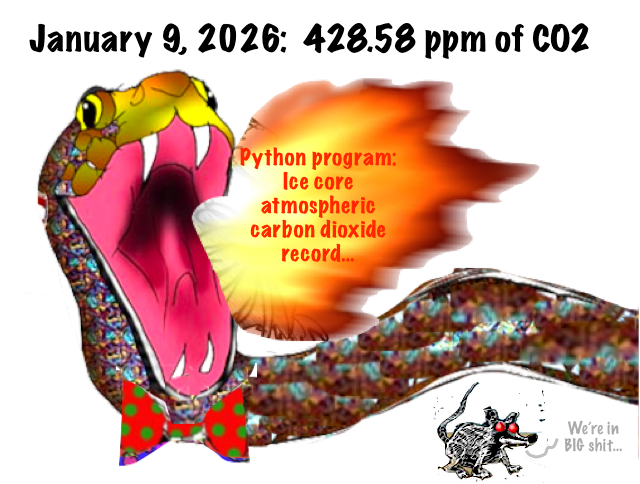
In this section, we download and preprocess a composite ice core atmospheric carbon dioxide (CO2) data set provided by the World Data Center for Paleoclimatology, National Oceanic and Atmospheric Administration (NOAA){target="_blank"} that extends back 800,000 years. The data may be directly accessed here{target="_blank"} or if the data set is not available you may download a copy here{target="_blank"} (downloaded on 2022-06-14).
The EPICA (European Project for Ice Coring in Antarctica) Dome C and Antarctic composite ice core atmospheric CO2 data is a new version of CO2 composite replaces the old version of Luthi et al. (2008). For details see Bereiter et al. (2015).
Age unit is in years before present (yr BP) where present refers to 1950 AD. The composite is built from the following:
51 - 1800 yr BP: Law Dome (Rubino et al. 2013)
1.8 - 2 kyr BP: Law Dome (MacFarling Meure et al. 2006)
2 - 11 kyr BP: Dome C (Monnin et al. 2001 + 2004)
11 - 22 kyr BP: West Antarctic Ice Sheet (WAIS) (Marcott et al. 2014)
22 - 40 kyr BP: Siple Dome (Ahn et al. 2014)
40 - 60 kyr BP: TALDICE (Bereiter et al. 2012)
60 - 115 kyr BP: EDML (Bereiter et al. 2012)
105 - 155 kyr BP: Dome C Sublimation (Schneider et al. 2013)
155 - 393 kyr BP: Vostok (Petit et al. 1999)
393 - 611 kyr BP: Dome C (Siegenthaler et al. 2005)
612 -- 800 kyr BP: Dome C (Bereiter et al. 2014)
In order to get a better intuition about the different data sources used, we have a look at a map of Antarctica, including the geographical locations of the drilling sites, using the plotting machinery in Python.
=======================
THE MAIN PROBLEM THAT WE FACE IS TO CORELLATE CO2 WITH GLOBAL WARMING...
THIS WAS DONE IN 1897 BY SVANTE ARRHENIUS WHO CALCULATED THAT BETWEEN ICE AGES AND WARM PERIOD, THE CONTENT OF CO2 VARIED FROM 180ppm to 300ppm... HE ALSO PREDICTED THAT THE CO2 EMISSION OF THE INDUSTRIAL REVOLUTION FROM 1850 TO 1900, WOULD ADD AN EXTRA 2 DEGREES CELSIUS BY WHENEVER... HIS ANALYSIS SHOWED THAT THE NORTHERN TEMPERATE LATITUDES WOULD SUFFER MOST AS POLAR REGIONS WOULD WARM UP EVEN MORE... DUE TO LESS LAND MASSES IN THE SOUTHERN HEMISPHERE, MORE WARMING WOULD BE EXPECTED IN EUROPE, THE USA, INDIA, CHINA, ETC... FOR RUSSIA, HE PREDICTED "BUMPER CROPS" DUE TO THIS WARMING FOR A FEW YEARS HENCE.
CO2 WARMING WAS SUBSEQUENTLY VERIFIED BY SPECTROANALYSIS OF CO2. IN THE ATMOSPHERE CO2 CONSIDERABLY WARMS UP — LIKE WATER IN A MICROWAVE OVEN — TO SPECIFIC SUNLIGHT WAVELENGTH IN THE RED SPECTRUM.
OTHER WARMING GASES ARE METHANE AND NOx.
WE ALSO HAVE TO CONSIDER THE OTHER VARIATIONS IN THE EQUATION OF GLOBAL WARMING: ABSORBTION BY THE OCEANS OF CO2 AND HEAT. THE INCREASE OF WATER VAPOUR IN THE ATMOSPHERE, THE ALBEDO QUOTIENT AND THE LOSS OF HEAT INTO THE "EMPTY" SPACE AROUND THE PLANET...
SEE ALSO: what is global warming...
COMPARING THE PERCENTAGE INCREASE OF CO2 IN THE ATMOSPHERE FROM YEAR TO YEAR SHOWS MODEST INCREASES, (JAN 2026 FROM JAN 2025: 0.54%).
THE AMOUNT OF EXTRA CO2 PRODUCED BY HUMANS USING FOSSIL FUELS IS AROUND 3.5 PER CENT FROM YEAR TO YEAR... WHERE DOES THE MAJORITY OF CO2 GOES TO?
MORE GREENING IN CERTAIN REGIONS OF THE PLANET AND MOST OF IT IS ABSORBED BY OCEANS — ACIDIFYING THE WATERS.
OFF THE CHART:

MESSAGE TO THE NEXT HUMAN GENERATIONS: GOOD LUCK....
YOURDEMOCRACY.NET RECORDS HISTORY AS IT SHOULD BE — NOT AS THE WESTERN MEDIA WRONGLY REPORTS IT — SINCE 2005.
Gus Leonisky
POLITICAL CARTOONIST SINCE 1951.
SEE ALSO:
Introduction to statistical programming with Python
Getting started - Python as programming language for statistical and modelling purposes
This section is a guide to get you started with Python. Python is an open-source programming language. It is available to everyone and one of the most common and widely used programming languages worldwide. Therefore, Python has a large user base which has many advantages: Bugs are reported and fixed quickly, and there is a huge user base. For your individual problem you will easily find solutions over the supporting Python community on the internet. Lastly and probably the most prominent benefit of learning and using Python is the diversity of the great python package ecosystem. Countless well implemented, distributed and documented packages will help you to solve complex problems easily with the help of Python. In this tutorial we will not only introduce the core features and coding structures of Python, but we will also make use of commonly used packages that expand the main functionality of Python.
https://www.geo.fu-berlin.de/en/v/soga-py/Introduction-to-Python/Getting-Started/index.html
- By Gus Leonisky at 11 Jan 2026 - 8:56am
- Gus Leonisky's blog
- Login or register to post comments
do as I say....
Australia's global fossil fuel carbon footprint
AUTHORS
Hannah Grant, Bill Hare
CONTRIBUTORS OR REVIEWERS
Editing: Cindy Baxter
ABOUT CLIMATE ANALYTICS
Climate Analytics is a global climate science and policy institute. Our mission is to deliver cutting-edge science, analysis and support to accelerate climate action and keep warming below 1.5°C.
ACKNOWLEDGMENTS
This report was funded by the Australian Human Rights Institute UNSW through its Australian Climate Accountability Project, and we thank them for their support. The research for the report was undertaken at the request of the Institute, as part of its multidisciplinary collaboration on climate and human rights.
In this report we set out the full carbon footprint of Australia's fossil fuels: the global impact of its domestic emissions and its exported fossil fuels, both historical and projected.
While Australians regard their country as one of the world's smaller greenhouse gas emitters, this is not the case. Our findings show that Australia's fossil fuels have a very large global impact.
We find the emissions that would arise from the government’s projected fossil fuel exports, in terms of both domestic production and end-use emissions, are clearly not consistent with a global 1.5C compatible trajectory.
Australia has a responsibility not just to its own consumers of energy, but to the world. Global fossil fuel carbon emissions footprint
In 2022 Australia's total fossil fuel carbon dioxide footprint was around 4.5% of global fossil fuel CO2 emissions. Only 1.0% was emitted within the country.
Close to 80% of Australia's total fossil fuel CO2 footprint in 2022 was due to exported carbon.
Per capita emissions
Australia has one of the world's highest per capita emissions for all greenhouse gases, double that of China, and nine times bigger than India.
In terms of fossil fuel emissions, in 2022 it was the eighth largest emitter of fossil fuel CO2 per capita. This is purely on a domestic basis, without factoring in Australia's exports.
Third largest fossil fuel exporter
Australia was the world's third largest fossil fuel exporter in 2021, trailing only Russia and the United States. But in terms of the total greenhouse gas footprint arising from those exports, specifically due to the large proportion of emissions- intensive coal, Australia ranked second in 2021.
In 2022, Australia accounted for just over half of global metallurgical coal exports at 52%, and 17% of global thermal coal exports.
Australia’s global fossil fuel carbon footprint
Australia more than doubled its Liquefied Natural Gas (LNG) export capacity in just five years prior to 2020, adding 62 million tonnes per annum of capacity compared with the 25.5 million tonnes added in the two decades prior to 2012.
Equally of note is that, of the fossil gas used domestically in Australia, a significant share is used within the oil & gas industry itself, most notably to power the liquefaction process required to create LNG for export. When excluding the oil &gas industry’s own use of fossil gas, domestic consumption is just 19% of the gas Australia produces.
Australia is now doubling down on fossil gas production and LNG exports, sanctioning several large-scale projects in 2021 and 2022.
Against this gas-fuelled future for Australia, it's worth noting that the latest IEA Net Zero roadmap indicates total global use of fossil gas declines by 18-22% by 2030, 47-53% by 2035 and 78-91% by 2050 below 2022 levels.
Exported emissions: current and projected
In 2023, Australia exported 1.15 billion tonnes of carbon dioxide emissions. (430 million tonnes from metallurgical coal, 443 million tonnes from thermal coal, 231 million tonnes from LNG and 48 million tonnes from oil)
An additional 46 million tonnes of carbon dioxide were emitted domestically in the process of extracting, processing and distributing those fossil fuels purely for export, taking the total to 1.2 billion tonnes.
Cumulative emissions
Cumulatively, from 1961 to 2023 Australia's fossil fuel exports have been responsible for emitting 30 billion tonnes of carbon dioxide to the atmosphere (including the export share of domestic emissions, i.e. 584 million tonnes)
By 2035 we project Australia's fossil fuel exports will add another 15 billion tonnes to that cumulative total, bringing it to 45 billion tonnes.
Total emissions footprint
Australia’s total footprint can also be quantified by considering domestic emissions in addition to exported emissions embedded in its exported fossil fuels. Against this metric, Australia’s total CO2 footprint totalled 1.5 billion tonnes of carbon dioxide in 2023, and 47 billion tonnes cumulatively from 1961 to 2023.
When considering all greenhouse gases, i.e. not just CO2, then Australia’s total GHG emissions footprint rises to 1.7 billion tonnes of carbon dioxide equivalent in 2023, and 57 billion tonnes cumulatively from 1961 to 2023.
https://ca1-clm.edcdn.com/publications/Aust_fossilcarbon_footprint.pdf
====================
MEANWHILE:
Australia’s Cop31 chief negotiator plans to lobby petrostates on fossil fuel phaseout
Exclusive: Chris Bowen says key to next UN climate summit will be ‘engagement, engagement, engagement’ with countries such as Saudi Arabia....
Chris Bowen wants to use his stint as the world’s chief climate negotiator to lobby Saudi Arabia and others to stop resisting progress at UN summits, heeding calls for a “hard-nosed” approach in dealing with big emitters obstructing the transition.
Appointed “president of negotiations” for Cop31 under the deal that handed Turkey hosting rights for the conference, Australia’s climate change and energy minister has told Guardian Australia a focus ahead of the summit would be talking to countries “with whom we don’t traditionally agree”.
Bowen mentioned Saudi Arabia, the oil-rich Gulf state accused of repeatedly obstructing efforts at UN summits to accelerate the phaseout of fossil fuels.
“We won’t get anywhere if we just have a jamboree of the willing,” Bowen said.
“We need to have a Cop which really tries to cross some of those bridges that have been very difficult to cross in recent Cops.”
Asked how that would be achieved, Bowen said: “engagement, engagement, engagement”.
Bowen’s comments follow a direct appeal from the former US secretary of state John Kerry for Australia to actively push the world’s big emitters – including China, Russia, the US and India – to develop a roadmap to end the era of fossil fuels.
The Trump administration this week pulled out of the foundational international agreement to address the climate crisis and has effectively abandoned the UN climate arena, meaning Bowen has little capacity to influence the US via the Cop negotiations.
The Labor minister said the fact Australia was itself a major exporter of fossil fuels meant it had “credibility” when it came to lobbying petrostates to do more.
The Cop30 summit in Brazil ended with a deal that omitted direct mention of fossil fuels after opposition from Saudi Arabia and its allies.
However, more than 80 countries – including Australia – signed a separate “Belém declaration” that committed nations to working towards a “just, orderly and equitable” phasing out of fuel fuels.
Bowen wants to achieve a more successful outcome at Cop31, targeting a “meaningful step forward” from the 2023 summit in Dubai, when nations agreed for the first time to start phasing out fossil fuels.
Under the deal Australia agreed with Turkey, a pre-conference event will be hosted in the Pacific with the aim of drawing global attention to small island nations under existential threat from the climate crisis.
Despite the disappointment of missing out on full hosting rights after a years-long bidding process, Bowen said Cop31 was a “remarkable opportunity for Australia”.
Bowen has asked the Pacific Islands Forum to choose a host for the event, which will be used, in part, to encourage countries to contribute to the region’s climate resilience fund.
The Labor frontbencher made the comments in an interview outlining his priorities for 2026, where he will balance his international duties with managing the domestic energy transition.
Bowen described progress in cutting pollution as “good, a lot done, but a lot more to do”, after the government’s latest projections showed it was tracking well to achieve its 2030 target but would need to substantially ramp uppolicies to meet its new 2035 goal of reducing greenhouse gas emissions 62% to 70% below 2005 levels.
Upcoming reviews of the safeguard mechanism, which is designed to reduce pollution at major industrial facilities, and the national vehicle efficiency standard, introduced to drive uptake of electric cars, present two early opportunities to move faster.
The productivity commission last month recommended expanding the safeguard mechanism to capture more polluters, building on the changes Labor made to the scheme in 2023.
The scheme captures facilities that emit more than 100,000 tonnes of Co2 equivalent each year, which applies to 219 sites.
Bowen would not pre-empt the review – which is a legislated requirement – but cautioned that including more businesses was not necessarily the answer.
“When we’re looking at the threshold, there will be a balancing act. You don’t want to expand it so much that you’re bringing in a whole bunch of new companies without much bang for buck in terms of emissions,” he said.
“It’s not a sort of slam dunk to say, well, obviously, covering a lot more businesses is the obvious thing to do.”
https://www.theguardian.com/environment/2026/jan/11/australia-cop31-chris-bowen-fossil-fuel-phaseout
======================
READ FROM TOP.
YOURDEMOCRACY.NET RECORDS HISTORY AS IT SHOULD BE — NOT AS THE WESTERN MEDIA WRONGLY REPORTS IT — SINCE 2005.
Gus Leonisky
POLITICAL CARTOONIST SINCE 1951.
SEE ALSO:
drill, baby, drill....big oil....
https://www.youtube.com/watch?v=e6vQo4oE7L8
Powerplays, politics and panic - has BIG OIL wrestled back control?President Trump has removed Nicolás Maduro from Venezuela and the whole world knows it was a move to secure that country's vast oil reserves. The fossil fuel industry has forced the International Energy Agency to reinstate energy projections that include oil and gas well into the second half of the century, and Putin is still selling huge volumes of oil via his ghost fleets with almost complete impunity. Meanwhile OPEC continues to manipulate global crude prices in their favour. So, have the fossil fuel overlords finally wrestled back control? Is there any hope for a just renewable energy transition?
=============================
About this report
Strong growth in electricity demand is raising the curtain on a new Age of Electricity, with consumption set to soar through 2027. Electrification of buildings, transportation and industry combined with a growing demand for air conditioners and data centres is ushering a shift toward a global economy with electricity at its foundations.
The International Energy Agency’s Electricity 2025 provides a deep and comprehensive analysis of all these trends as well as recent policy developments. For the period 2025 through 2027, it forecasts electricity demand, supply and carbon dioxide (CO2) emissions for select countries, by region and worldwide. The report explores emerging trends such as growing electrification, expanding power systems and an increasing share of weather-dependent energy sources in the generation mix. Through this lens, it assesses resource adequacy and the methods needed to ensure the security, resilience and reliability of power systems and electricity supply. This year’s report, now in its sixth year, includes a special feature on China’s evolving power demand as well as a section on the phenomenon of negative wholesale electricity prices in some markets.
https://www.iea.org/reports/electricity-2025
READ FROM TOP.
YOURDEMOCRACY.NET RECORDS HISTORY AS IT SHOULD BE — NOT AS THE WESTERN MEDIA WRONGLY REPORTS IT — SINCE 2005.
Gus Leonisky
POLITICAL CARTOONIST SINCE 1951
428.58 ppms.....
WHAT DOES 428 ppm OF CO2 IN THE ATMOSPHERE MEAN?
CONSIDERING THAT only 180 ppm OF CO2 MINIMUM IN THE ATMOSPHERE LEADS TO AN ICE AGE....
CONSIDERING THAT only 300 ppm OF CO2 MAXIMUM LEADS TO A WARM PERIOD....
CONSIDERING THAT THE DIFFERENCE OF AVERAGE GLOBAL NATURAL TEMPERATURE BETWEEN ICE AGES AND WARM PERIODS IS IN THE RANGE OF 6 TO 10 DEGREES CELSIUS...
CONSIDERING THAT THE EXTRA CO2 ADDED BY HUMAN ACTIVITIES IS 128 ppm....
CONSIDERING THAT zero CO2 IN THE ATMOSPHERE WOULD DROP AVERAGE GLOBAL TEMPERATURES BY 50 DEGREES CELSIUS...
CONSIDERING THAT only 120 ppm OF CO2 IS THE DIFFERENCE BETWEEN ICE AGES AND WARM PERIOD...
IT WOULD NOT BE TOO WRONG TO ASSUME THAT THE EXTRA 128 ppm OF CO2 COULD INCREASE GLOBAL TEMPERATURES BY 5 TO 9 DEGREES CELSIUS...
AS WELL, WE HAVE NOT INCLUDED THE METHANE AND THE NOx GASES INFLUENCE WHICH COULD PUSH THE INCREASE BY AN EXTRA 3 TO 4 DEGREES CELSIUS...
DUE TO HEAT ESCAPE INTO THE VOID AROUND THE PLANET, THE UPPER LIMIT OF ATMOSPHERIC WARMING IS AROUND 12 DEGREES CELSIUS "EXTRA" IN THE PRESENT SYSTEM.
SAY GLOBAL TEMPERATURE AVERAGES BY 2125:
— EQUATORIAL REGION 32 + 4 = 36
— TEMPERATE REGIONS 10 + 10 = 20
— POLAR REGIONS -35 + 25 = -10
— BERLIN AVERAGE TEMP WINTER........... 0 + 9 = 9 (WITH PEAKS ABOVE 20)
— BERLIN AVERAGE TEMP SUMMER.......... 25 + 9 = 34 (WITH PEAKS ABOVE 50)
PLEASE CONSIDER THAT THOUGH THE AMOUNT OF CO2 IN THE ATMOSPHERE IS QUITE SMALL, IT HAS A BIG INFLUENCE OF THE STATE OF THINGS.
CONSIDER THAT ONLY A VERY SMALL AMOUNT OF POISON CAN KILL YOU — OR THAT A VERY SMALL AMOUNT OF ASPIRIN (A BENZOID?) OR PARACETAMOL (A BENZOID?) CAN REDUCE A HEADACHE — AND THAT A CERTAIN AMOUNT OF THESE MEDICINES IS ELIMINATED BEFORE THEY "ACT"....
=================
WHY ARE WE NOT EXPERIENCING SUCH DEVASTATING WARMING YET?
THERE ARE MANY FACTORS ON THE SURFACE OF THE EARTH — ATMOSPHERE, BIOSPHERE AND OCEANS INCLUDED — THAT RETARD THE RESULTANT FROM THE CAUSE... LET'S CALL THIS ELASTICITY IN THE SYSTEM. YET WITHIN 100/150 YEARS, THE ATMOSPHERE WILL RELATIVELY HAVE WARMED UP IN ACCORDANCE WITH THE PRESENT PROPORTION OF CO2 IN THE ATMOSPHERE.
"NET ZERO" IN 2050 WILL ONLY HAVE AN EFFECT BY PREVENTING temperatures RISING BEYOND 5 TO 9 DEGREES CELSIUS BY 2150....
AT THE PRESENT RATE OF EMISSIONS, WE CAN EXPECT GLOBAL SURFACE TEMPERATURES TO RISE BETWEEN 7 TO 12 DEGREES CELSIUS...
SEA LEVEL WILL RISE BETWEEN 7 TO 15 METRES BY 2150... THEN BEYOND THEREAFTER....
ATMOSPHERIC DISTURBANCES COULD BE BEYOND BELIEF....
THE PRESENT GLOBAL WARMING IS SUPERFAST IN COMPARISON WITH NATURAL GEO-CHANGES...
THE IDIOT IN CHARGE OF THE USA IS AN IMBECILE...
SEE ALSO: https://yourdemocracy.net/drupal/node/33287
SEE ALSO: https://www.youtube.com/watch?v=fR--t-eMq_Y
READ FROM TOP.
YOURDEMOCRACY.NET RECORDS HISTORY AS IT SHOULD BE — NOT AS THE WESTERN MEDIA WRONGLY REPORTS IT — SINCE 2005.
Gus Leonisky
POLITICAL CARTOONIST SINCE 1951.
AMOC runs amok...
Deep beneath the waves, a powerful yet invisible system has been silently regulating life on Earth for thousands of years.
It's rarely talked about, barely understood by most, and yet its sudden collapse could reshape the world as we know it. Why is it weakening now? What happens if it stops altogether? And how could something so critical remain hidden for so long?
https://www.youtube.com/watch?v=GDy7Q8iAtFg
The End of Europe Is Coming | AMOC====================
For months – if not years – debate has raged among scientists over the general health of an ocean current system critical to regulating Earth’s climate – arguing over whether or not the Atlantic Meridional Overturning Circulation (or AMOC) is slowing down.
This week, researchers looking into the root cause of a centuries-old patch of cold water south of Greenland and its resistance to the overall warming trend of the Atlantic Ocean, has come to one simple conclusion. That it is.
Landing on only one explanation for the observed ocean temperatures and patterns in salinity across the region, researchers from the University of California, Riverside concluded that the AMOC – a massive current system responsible for moving warm, salty water northward and cooler water southward at depth, is indeed weakening.
“People have been asking why this cold spot exists,” said University of California, Riverside climate scientist Wei Liu, who led the study with doctoral student Kai-Yuan Li. “We found the most likely answer is a weakening AMOC.”
The AMOC acts like a giant conveyor belt, delivering heat and salt from the tropics to the North Atlantic. A slowdown in this system means less warm, salty water reaches the sub-polar region, resulting in the cooling and freshening observed south of Greenland.
When the current slows, less heat and salt reach the North Atlantic, leading to cooler, fresher surface waters. This is why salinity and temperature data can be used to reconstruct the strength of the AMOC.
Together, Li and Liu analysed a century’s worth of this data, as direct AMOC observations go back only as far as 20 years. From these long term records, they reconstructed changes in the circulation system and compared those with nearly 100 different climate models.
Their paper – published this week in Communications Earth & Environment – shows that only in the models simulating a weakened AMOC were outcomes generally matched to the real-world data. Models that assumed a stronger AMOC didn’t come close.
“It’s a very robust correlation,” said Li. “If you look at the observations and compare them with all the simulations, only the weakened-AMOC scenario reproduces the cooling in this one region.”
The same study found that the weakening of the AMOC correlates with decreased salinity – another clear sign that less warm, salty water is being transported northward.
The consequences are broad. The South Greenland anomaly matters not just because it’s unusual, but because it’s one of the most sensitive regions to changes in ocean circulation. It affects weather patterns across Europe, altering rainfall, and shifting the jet stream – the high altitude air current that steers weather systems and helps regulate temperatures across North America and Europe.
The slowdown may also disturb marine ecosystems, as changes in salinity and temperature influence where species can live.
The result from the study may now help to finally settle the long-held dispute among climate modelers about whether South Greenland cooling is driven primarily by ocean dynamics of by atmospheric factors such as aerosol pollution.
“Our results show that only the models with a weakening AMOC get it right,” said Liu. “That means many of the recent models are too sensitive to aerosol changes, and less accurate for this region.”
With limited direct data on the AMOC, temperature and salinity records provide a valuable alternative for detecting long-term circulation change, and for helping to predict future climate scenarios.
“We don’t have direct observations going back a century, but the temperature and salinity data lets us see the past clearly,” said Li. ‘This work shows the AMOC has been weakening for more than a century, and that trend is likely to continue if greenhouse gases keep rising.”
As the climate system shifts, the South Greenland cold spot may grow in influence. The hope now is that by unlocking its origins, scientists can better prepare societies for what lies ahead.
“The technique we used is a powerful way to understand how the ocean and climate systems have changed, and where they are likely headed if greenhouse gases keep rising,” said Li.
https://oceanographicmagazine.com/news/atlantic-cold-spot-shows-amoc-has-been-slowing-for-a-century/
READ FROM TOP.
YOURDEMOCRACY.NET RECORDS HISTORY AS IT SHOULD BE — NOT AS THE WESTERN MEDIA WRONGLY REPORTS IT — SINCE 2005.
IT WOULD NOT BE WRONG TO CONSIDER THAT THE GREENLAND ICESHELF MELTING WOULD ADD "CONFUSION" INTO THE AMOC SYSTEM....
Gus Leonisky
POLITICAL CARTOONIST SINCE 1951.
warming....
Our world of weather in 2025
Extreme heat, droughts, storms and deadly floods challenged resilience not only in Australia, but across the globe.
By weather reporter Tyne Logan and Fran Rimrod
Like most places around the world we’re getting used to extreme weather becoming more frequent. In Australia, 2026 started with searing heat, bushfires and a cyclone.
It may feel like a distant memory, but 2025 was a big year in the world of weather and climate.
It was the third hottest year on record, closely behind 2024 and 2023, according to the Copernicus Climate Change Service.
Climate scientists are now warning that, based on the current rate of warming, the Paris Agreement’s limit of 1.5 degrees Celsius for long-term global warming could be reached by 2030 — more than a decade earlier than initially predicted.
Let’s take a look at how this ongoing trend of exceptionally warm years played out across Australia and the globe in 2025, in pictures and graphs.
Major weather events around the worldSEE: https://www.abc.net.au/news/2026-01-14/climate-change-in-2025-in-pictures-and-graphs/106221436
READ FROM TOP.
YOURDEMOCRACY.NET RECORDS HISTORY AS IT SHOULD BE — NOT AS THE WESTERN MEDIA WRONGLY REPORTS IT — SINCE 2005.
Gus Leonisky
POLITICAL CARTOONIST SINCE 1951.
NOTE OUR PREDICTION OF SIGNIFICANT [CATASTROPHIC?] CLIMATIC CONDITIONS CHANGE IN MID 2032 STILL STANDS....
flash floods....
At least three cars have been swept out to sea, many more are submerged under bridges and a number of holidaymakers are trapped in their caravans after flash flooding hit the Great Ocean Road on Thursday afternoon.
Lorne has in effect been split by flooding along the Erskine River, with the Great Ocean Road closed to traffic in both directions between Lorne and Cumberland River. About 6500 homes in the region are without power.
Caravan parks along the coast are now being evacuated including at Carlisle River, Cumberland River and the Lorne Foreshore.
Footage posted to social media and received by this masthead show sections of the Wye River Big4 holiday park underwater in rapid floodwaters, cars being swept into the ocean, and at least four cars crashed against the Cumberland River bridge by surging floodwaters.
A popular beach town on the Great Ocean Road, Wye River is roughly 150 kilometres from Melbourne, and is a short drive from Lorne.
Floodwaters at Lorne have claimed several tents and are lapping around caravans, with SES crews and residents seen carrying children out of the water to safety, and emergency helicopters are en route to assist with rescues in the area.
The State Emergency Service issued a flash flood emergency warning at 2.36pm for Wye River, Kennett River, Cumberland River, Lorne and surrounds. The warning states that residents in these areas are in danger and should move indoors immediately to shelter away from floodwater.
READ MORE:
https://www.smh.com.au/national/victoria/car-swept-out-to-sea-in-wye-river-flash-flooding-20260115-p5nucc.html
READ FROM TOP.
YOURDEMOCRACY.NET RECORDS HISTORY AS IT SHOULD BE — NOT AS THE WESTERN MEDIA WRONGLY REPORTS IT — SINCE 2005.
Gus Leonisky
POLITICAL CARTOONIST SINCE 1951.