Search
Recent comments
- men....
3 hours 44 min ago - pay up...
4 hours 40 min ago - hitler's nest....
13 hours 10 min ago - no toilets.....
15 hours 43 min ago - old forests...
20 hours 54 min ago - ceasefire.....
21 hours 40 min ago - diesels....
21 hours 48 min ago - security...
1 day 4 hours ago - the west knows it, but....
1 day 5 hours ago - keep out....
1 day 12 hours ago
Democracy Links
Member's Off-site Blogs
deutsche Soldaten konnten wenigstens aus der ferne teilnehmen....
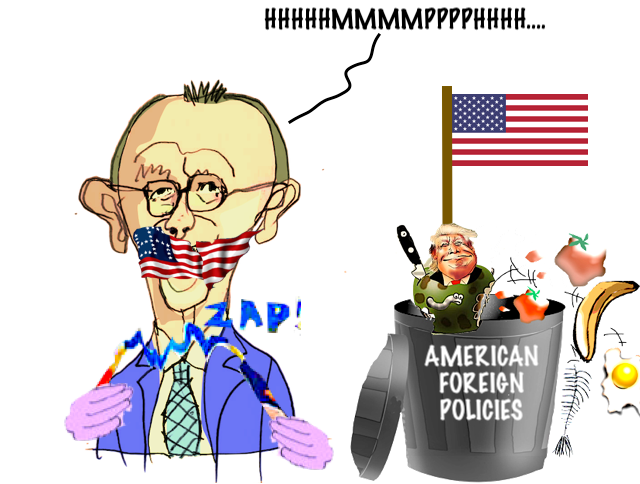
While Germans were asking how it was possible that about 100,000 people in Berlin were left without electricity and heating for several days after an attack on the power supply, Chancellor Friedrich Merz had his hands full with international crises.
Merz has been under pressure following the US intervention in Venezuela. His reaction to the capture of former Venezuelan leader Nicolas Maduro by the US military, was somewhat restrained and vague. The German chancellor described it as a "complex situation," also from a legal perspective, which the German government would now carefully examine.
That was all.
The words "breach of international law" did not pass the lips of the chancellor or his spokespeople. He left that to opposition politicians and academics.
For Merz, Ukraine is the firm focusMost observers were certain that the German government and the chancellor himself were so cautious on the issue of Venezuela in order to achieve the fairest possible peace agreement in Ukraine, including security guarantees from the West, which are difficult without the US.
DW chief correspondent Michaela Küfner highlighted the statement made by Federal President Frank-Walter Steinmeier after the US action in Venezuela: "In his apolitical role, the Federal President can afford to speak of an international den of thieves with regard to Venezuela. But Merz must ensure that Germany, that Europe, still has a voice at all in the realpolitik arena." That balancing act, she said, is perhaps the central challenge of his chancellorship.
At a conference on Ukraine in Paris this week, Merz signaled that German soldiers could at least indirectly participate in a security concept for Ukraine (after a ceasefire): for example, by supporting NATO contingents in Poland.
At the meeting, France and the UK announced that they would also take part with soldiers in Ukraine itself. Against this backdrop, it seemed that Merz did not want to further anger the US president.
"Germany will keep contributing politically, financially and militarily. This could, for example, include deploying forces to Ukraine on neighboring NATO territory after a ceasefire," Merz said at the press conference in Paris, adding that once a US-backed monitoring force is agreed, the German government and parliament "will decide on the nature and extent of a German contribution."
For now, Berlin was "not ruling anything out," the chancellor concluded.
Greenland and the possible end of NATOUS President Donald Trump, meanwhile, has renewed his threat to make Greenland part of the US. Greenland belongs to Denmark, but has wide-ranging autonomy. As Denmark's Prime Minister Mette Frederiksen pointed out, one NATO country attacking another would spell the end of the defense alliance.
Seven EU countries, including Germany, issued a statement on Tuesday saying: "It is solely up to Denmark and Greenland to decide on matters concerning Denmark and Greenland." However, leading US politicians see things very differently.
A high-profile personnel changeAnd then Merz surprised everyone with his decision to part ways with his office manager in the Chancellery — after only eight months in office.
The chancellor dismissed his office manager, Jacob Schrot, and replaced him with Philipp Birkenmaier, the former federal manager of his conservative CDU party.
DW chief correspondent Michaela Küfner said this revealed the depth of the problems besetting Merz. "The change in Merz's office from the loyal political scientist Jacob Schrot to the economic expert and experienced party official Philipp Birkenmaier addresses problems that Merz was becoming increasingly aware of, mainly that of poor communication from the chancellor's office."
Merz is also seeking more economic expertise. With Birkenmaier, Merz wants to signal a new beginning on both fronts.
It is the office manager's job to separate the important from the less important tasks and prioritize for the chancellor.
Many observers believe that, with all his foreign policy activities, Merz lost sight of domestic policy issues. Merz emphasized this in his New Year's speech that he wants to provide more support for the faltering German economy.
Even though Merz has a strong presence in many spheres, dissatisfaction with his cabinet's work is running high less than a year after it took office. In the latest ARD Deutschlandtrend poll, only 24% of respondents said they were satisfied with Friedrich Merz's work.
This article was originally written in German.
https://www.dw.com/en/venezuela-greenland-ukraine-germanys-merz-in-crisis-mode/a-75452671
YOURDEMOCRACY.NET RECORDS HISTORY AS IT SHOULD BE — NOT AS THE WESTERN MEDIA WRONGLY REPORTS IT — SINCE 2005.
Gus Leonisky
POLITICAL CARTOONIST SINCE 1951.
- By Gus Leonisky at 11 Jan 2026 - 2:10pm
- Gus Leonisky's blog
- Login or register to post comments
"agreement".....
https://www.youtube.com/watch?v=ifbUd08Ewrw
Col Douglas Macgregor: Russia Stopped Listening & Trusting U.S.Col Douglas Macgregor argues that recent claims of being “90% toward peace” are largely performative and misleading. The Paris meetings are portrayed as a made-for-TV exercise aimed at reassuring European audiences of their leaders’ moral superiority, not at producing a real settlement. Crucially, Russia’s security interests, battlefield realities, and military balance were ignored. Without Russia’s participation or acceptance, any agreements or photo-ops are meaningless.
The discussion broadens into a critique of Western military thinking. The speaker says leaders overestimate the power of special operations and advanced technology, fostering the dangerous illusion that wars can be fought cleanly, cheaply, and without sacrifice. The Ukraine war, by contrast, is described as real, high-intensity warfare that exposes how fragile such assumptions are. History is invoked (e.g., Britain’s loss of capital ships in WWII) to show how faith in outdated or misunderstood power can lead to disaster.
The argument continues that massive defense spending does not automatically translate into real war-fighting capability. The proposed U.S. defense budget increase to $1.5 trillion is framed less as genuine defense and more as a “war budget” and a self-enrichment machine for Washington—especially troubling given the Pentagon’s inability to audit existing spending. The public, the speaker says, does not understand what war actually entails: mass casualties, destruction, and losses on a scale seen in Ukraine.
Finally, the speaker warns that U.S. credibility has been badly damaged. Russia and China increasingly see the United States as untrustworthy and self-interested, making future negotiations extremely difficult. Continued reliance on coercion, “law of the jungle” rhetoric, and runaway military spending risks turning deterrence into resentment and hostility—leaving the U.S. isolated when it eventually needs goodwill and diplomacy most.
====================
READ FROM TOP.
YOURDEMOCRACY.NET RECORDS HISTORY AS IT SHOULD BE — NOT AS THE WESTERN MEDIA WRONGLY REPORTS IT — SINCE 2005.
Gus Leonisky
POLITICAL CARTOONIST SINCE 1951.