Search
Recent comments
- EU fools....
3 hours 15 min ago - silence.....
4 hours 21 min ago - reality championship....
4 hours 27 min ago - anti-expertise.....
6 hours 12 min ago - mumbai....
6 hours 18 min ago - killer breed.....
7 hours 24 min ago - agreed....
10 hours 6 min ago - political barrels...
11 hours 12 min ago - "west failure"....
12 hours 50 min ago - unacceptable.....
1 day 1 hour ago
Democracy Links
Member's Off-site Blogs
revolutions are rarely pretty....
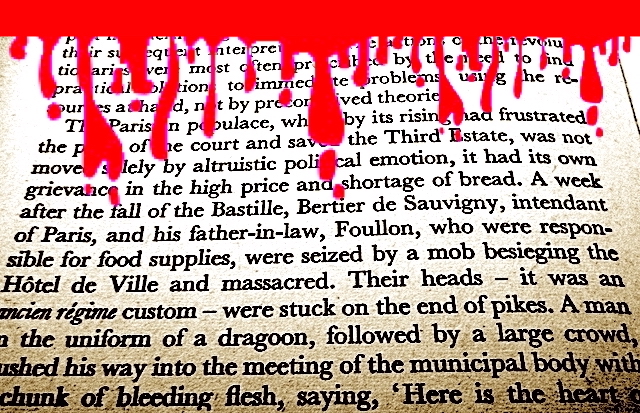
THe revolt of Paris, in which culminated the nation-wide disturbances of 1789, and the general collapse of royal administration, confronted the members of the Third Estate with the problem of taking steps to protect property and restore some semblance of law and order to France.
In their turn, like the privileged classes before them, they were to find that they had started something they could not stop, and that a movement which they had envisaged as one of moderate constitutional and social reform was to become a revolution of a very different nature and scope. Their response to the new challenge was dictated by circumstances. All through the Revolution we find that theory plays little part in determining policies, though it has played much in their subsequent interpretation.
EXTRACT FROM A HISTORY OF MODERN FRANCE: Vol1" 1715-1799 — Alfred Cobban
=======================
[SEE ALSO: THE AMERICAN REVOLUTION BY KEN BURNS]
The corrupted song: To kneel and perish or to rise up to conquer
January 11, 2026
by Franceschino Guicciardini
1. Acknowledge the powerlessnessThe spectacle of powerlessness, constantly renewed, is profoundly pathetic.
For half a century we have been observing French political and social life, and all we see are headless chickens, broken arms and small categorical interests – if not purely individual ones – putting on a show.
The kneeling of peasants before law enforcement is a major event.
Let us not be led to believe that this is merely an anecdotal event during which a handful of naive people made fools of themselves and tarnished the history of France by using the national anthem from the wars of the great revolution in the wrong way.
This kneeling is a symptom of the advanced state of moral decay in which the people of this country find themselves.
Political illiteracy
The belief that we live in a democracy, coupled with a lack of understanding of what the concept means (who hasn't heard the phrase "I do what I want, we live in a democracy"?") and the resulting obligations—namely, those of political education and active participation in community life—are the breeding ground for the weeds of widespread apathy and the absence of a will to live and—pardon the neologism—a will to build a collective future. These so-called citizens follow only the media, which are subservient to the deep state. This media feeds them pre-packaged thought, a non-thought whose sole function is to legitimize the current state of society, certainly not to help them understand reality, much less identify the problems at hand and explore possible solutions.
Who has read The Discourse on Voluntary Servitude de La Boétie? The Adam Smith impasse From Michea? The Shock Strategy by Naomi Klein? Cefran by Michel Drac? And of course, who has read The art of War Sun Tzu, among our priceless French farmers, nurses and other "rebels"?
Strategic incompetence
As a result, the French seem incapable of developing a strategy to defend their interests. With each new social conflict, we see the same tired patterns of behavior, the same pointless maneuvers (street demonstrations, highway blockades, disruptions to public transportation, manure dumping, etc.). A pathetic puppet show where the common people willingly take their share of beatings from the very police they so readily invited.
The herd mentality and ineffectiveness of this type of social struggle is a fascinating spectacle. How can one spend half a century practicing this form of "struggle," so pathetically ineffective, without ever questioning oneself, without ever showing a little creativity by trying something else, or, if imagination is truly dead as Ferré sang, then at least having the modesty to commit to the only path that has ever brought the plutocracy to its knees: the general strike?
Furthermore, the French could prove just as reckless and incompetent in defending themselves should a civil war break out. Scapegoats for a civilizational shift they have completely failed to grasp.
The current level of naivety for a large part of the population is such that for these people we have crossed into pure and simple stupidity.
And what about the flood of comments praising farmers, predicting the great shift – which, of course, never comes? Endless chatter. In two weeks, nothing will be settled, everyone will have forgotten the comments and the farmers, except for those in power who are methodically advancing their agenda.
Individual inconsistency
Everything has been said about selfishness, moral decay, lack of courage, empathy, and determination, and spiritual collapse. Let's not burden our discussion with an analysis that is out of place in this article, which is primarily a cry of alarm.
Today we are suffering the consequences of centuries of religious education, education in submission, in the infallibility of the Church (or the State, which amounts to the same thing), in submission to priests, doctors, and politicians. If there is no one left in the churches, it is because a weak form of Christianity has won over all hearts and souls. For the majority of those who have lost their Christian faith, the religion of the Lord's sheep is a teaching of submission and surrender, hypocritically disguised behind a posture of non-violence that is not that of the wise, but of the weak.
This is also the result of two centuries of republican education, of the crushing of personalities by primary school – to some extent – and secondary school – especially – and confirmed by the perverse laxity of high school and university, upon whose graduation young adults are released into life, knowing they have been so poorly educated that they can be nothing more than pawns in the capitalist labor system and disposable consumers of adulterated products. The essential [book/work] must be read. The coming revolution1The first part of the book paints a terrifying picture of the ravages of republican indoctrination. The second part explores possibilities that are as much impossibilities as they are for a population so morally destroyed. Contemporary French people are not a people. They are the foot soldiers of their political system. Prussia has been described as an army with a country; republican France is not a nation, it is a system of political control with a population.
The result, finally, of half a century of consumerism, of leftist laissez-faire, crowned by the current woke political correctness and the triumph of female individuals who have proven in recent years how much female monkeys are equal to their males in terms of unculture, unintelligence, selfishness, greed, lack of dignity, spiritual emptiness, all under the makeup and glitter of consumer society and self-promotion.
2. Rejecting powerlessnessThe pitiful spectacle presented by farmers, believing themselves to be worthy, singing the Marseille, the war song of the Army of the Rhine, kneeling in front of the militia – after, an aggravating factor, having tried to flatter that same militiaWe are proud of our police, we are proud of our gendarmerie." – must have caused much laughter under the gilded paneling of the palaces of the republic.
Are you proud of your gendarmerie? Don't complain when they beat you up; it's their job. In peacetime, it's the only justification for their existence: bashing heads full of water. It makes a splash, it's fun. And it's legal. Why not? In wartime, they're the ones who take draft dodgers to the firing squad. That's their job. Read Genevoix and his moving Those of 14Proud of your gendarmerie…2
Stop complaining. Stop begging for justice from your oppressors who couldn't care less about your justice, and for good reason.
The only thing your impotent pantomimes provoke is the urge to insult you. And what about the nurses who took selfies with the emissary of the deep state, who came to mock them by dispensing platitudes?
Stop giving in to promises that, as we know, only bind the fools who believe them.
Stop shaking hands with your enemies on the battlefield. You think you're chivalrous, but they're not. The moment you turn your back, they'll bleed you dry. Besides, it's not chivalrous at all; it's the practice of cowards, who breathe a sigh of relief at having been heard, relieved not to have to fight after receiving fine words…
…even though they are potentially the strongest, in terms of numbers.
What's lacking is situational awareness, tactical intelligence. And it's this lack that shifts the balance of power. Power, money, the monopoly on supposedly legitimate violence (no violence is truly legitimate) wouldn't suffice. The strength of capitalism lies in the weakness of the people. This is normal, and from a certain point of view, it's moral. The organized minority, possessing the tools of power and situational awareness, triumphs over the cowardly, immature, uncreative, cumbersome masses—so cumbersome, as Céline would say. Human society is a journey to the end of the night.
These poor guys who knelt before the militia have tarnished the image of France and the French, which is unacceptable.
These people who kneel – the worst posture of submission – do a great disservice to those of their compatriots who are still fighting and trying to do so with dignity.
Even worse, this handful of idiots3By the strong symbolic act they have committed, they are endangering other French people.
Facing danger from a government that has received further confirmation—if any were needed after the Charlie Hebdo affair and Covid—of the level of submission, intellectual collapse, and inability of the French to defend themselves. Let us be assured that this little biblical demonstration will have very high consequences in terms of social repression in the months and years to come.
Not only have these farmers seriously undermined their own cause, but they have also severely weakened the position of their fellow citizens who are fighting to defend pensions, hospitals, education, public services, the collective will to live, and the country's recovery.We have cause for concern.
They are also in danger from the communities that today share the national destiny and have understood that if a civil war were to break out one day, they could easily crush this inconsistent populace that the native French have become.
As a preliminary observation
Peasants kneeling before the police are a symptom of a people utterly riddled with intellectual and moral decay. If peasants, who have a rather arduous job, are going to kneel, one can imagine what will happen to urban metrosexuals and other petty officials when they too find themselves at a crossroads.
The bleeding must be stopped immediately. We must ensure that no further demonstrations of such infamy ever occur again.
It is essential to quickly produce strong symbolic signals by firmly disavowing this kind of behavior and proposing solutions to combat it that prioritize dignity and effectiveness.
It is vital that the French people finally embark on the path of intelligent social defense against the abuses of the State and capitalism.
If a recovery doesn't materialize quickly, the rot will soon consume the entire French social fabric. All that will remain is to kneel before the executioner amidst the jeers of the replacement rabble, who have come to be entertained in the circus maximus of this society of spectacle and decay. In that scenario, there will be no point in worrying about contemporary French people; they know how to cope.
The solutions exist, but we need the intelligence to understand them and the courage to implement them.
3. Curing impotenceLife is all about power dynamics. In nature as in politics. The weak never triumph.The struggle is the perpetual reign of a consistent and severe justice, linked to eternal laws, an admirable concept drawn from the purest source of Greek civilization."Nietzsche wrote. There is no such thing as fate, as Christians believe, who think we are on earth only to suffer, to atone for our sins, and when none can be found, to atone for original sin. An excellent explanation for all powers and all those in power:You are poor because the "Good" God willed it this way; we are rich because we deserve it.This very practical view of things is obviously wrong, but it still contains a small truth: weakness only partly results from an inheritance—genetic, social, cultural. It is reinforced by the poor choices that an individual, a corporation, or a society makes throughout its existence.
If farmers are going under, it's not just because of Mercosur, Brussels, or the French government. Certainly, they are the driving force behind the destruction of the national economic fabric, but this force is only fully active because nothing is being done to truly prevent it.
For half a century we have seen farmers dumping manure in front of sub-prefectures or blocking highways with their tractors. It achieves nothing.
Farmers are dying because they aren't doing what's necessary to effectively defend themselves against the abuses of capitalism supported by state power. Sometimes you take calculated risks, you do "what needs to be done," and you still lose the battle. That's life. But when you lose battle after battle and your situation constantly deteriorates, it means you're not doing what needs to be done to get out of it. Our failure is our own responsibility. Hölderlin said thatWhere danger grows, so too does that which saves from it."But you still need to have a minimum of tactical awareness."
Capitalism has never backed down except in the face of a general strike. Is it still possible today in this era of deindustrialization, detached capitalism, and the financialization of wealth? Probably no longer as a means of direct pressure:you are meeting our demands – generally related to wages and the quality of work – Otherwise we will block production, we will block the country"; but indirectly: the cause touches on the greater general interest, the French support this cause and will make it triumph through the numbers, the consistency, the intelligence of their future votes – intelligence made credible by their unity in defense of common causes, we will return to this – the refusal to be where they are expected (i.e., in blindness and manipulation), coordinated civil disobedience, finally imagination, dear to Raoul Vanegeim, a major author, so little read and so little understood.4
As Georges Sorel wrote in Reflections on violence, who are "The general strike must be conceived as Napoleon conceived his battles. "5
Fine words from an armchair intellectual?
Let's look at the practical side. So simple, so obvious.
Farmers are protesting to protect their livelihoods, which are threatened by the liberalization of food markets. Agriculture is not an outdated sport practiced by a handful of reactionary zealots, but the foundation of food production. It's about eating, nourishing ourselves, and living.
A brief aside: in our age of pretentious ignoramuses and widespread hypocrisy, we constantly have to explain everything, even—especially—what is obvious. We must constantly dot the i's and cross the t's. Which goes to show that if it's still possible to find a common ground to justify our cowardice and stupidity, it should be possible to find a common ground for action…
The agricultural issue concerns us all. That's obvious. Everyone needs to eat, don't they?
Why are farmers not supported by other corporations?
Why are nurses not supported by other professions when they mobilize for their working conditions, which are also the conditions for caring for patients?
Nurses are capable of organizing to defend their working conditions. Farmers are capable of coordinating to dump their manure on the walls of the sub-prefectures. Truck drivers are capable of blocking highways. They don't need the slogans of the major union federations with their corrupt leaders. Why do they all only mobilize for their own short-sighted, selfish interests? Teachers, railway workers, civil servants, firefighters, fishermen, etc. Why do they never mobilize to support other professions when the issue at hand affects everyone's interests?
Why is this simple idea never formulated, studied, or tested?
In his book For the abolition of the market society. For a living societyVaneigeim laments the creative incapacity of the populations6. Having the solution right at hand and not understanding it.
We all need to eat, don't we? We're all happy to receive proper care in hospitals, don't we think? We all need to find the consumer goods we need in our local shops? We want our children to receive a good education, for our elders – which we will all become one day, and sooner than the immature, self-righteous thirty-somethings who are so prevalent on the internet, in the press, and in politics today – to be cared for decently and receive adequate pensions? And so on for all areas concerning the general interests common to ALL individuals, to all selfish interests.
When a corporation mobilizes to defend interests that affect the general interest, all other corporations should support them by mobilizing in turn.
The goal is to create a mass effect. Leaders consolidate their power through the parliamentary system, which allows the plutocracy to hold the reins behind a falsely democratic facade—a democracy that is, in any case, by its very nature, a machine for producing mediocrity. This mass effect can extend beyond the framework of this pseudo-democracy. Genuine concessions, a true consideration of everyone's problems, could suddenly emerge in the minds of our leaders, steeped in clannish selfishness, as soon as the balance of power is no longer exclusively in their favor. Without violence, without revolution. Through the pressure of millions of cubic meters of water pushing against the cracking dam. No need for explosives. No need for atrocities. Just the application of a true balance of power: the mass of the people makes it clear through their commitment and determination that they want a policy serving the common good; the minority has no right to oppose it.
ConclusionLife is nothing but a struggle for power.
These are the power dynamics smart which enable success.
There's no point in going to demonstrate in large groups in the streets only to get beaten up by the police.
It's pointless to offer verbal and moral support by clicking under a video or posting "we don't give up"Manly."
It is pointless to express outrage at length, to stigmatize the other, the bad guy, the Arab, the Jew, the Russian, and never to propose anything in terms of concrete solutions.
Only action in the present changes things. Alain saw in action and industry (in the sense of acting naturally…) the solution to all problems, whether they were health-related or political.
Good news for our contemporaries: it doesn't even require courage. All it takes is hard work and organizational skills. Certainly, unions have betrayed the people, but we don't need corrupt institutions to organize ourselves. We must accomplish things ourselves without waiting for others to do the work for us. Unions no longer exist as institutions for defending workers. They are merely stepping stones.
Social programs, among others, serving a pseudo-elite of leaders. Fine. We just need to acknowledge it and move on.
In any case, they don't have any more courage to stand up to them. Without their cops and judges, they're nothing. Even their money is useless.
When a corporation mobilizes to defend interests that affect the general interest, all other corporations must support them by mobilizing in turn.
Imagination. Solidarity. Intelligence. Let those who can understand, let those who want to understand.
https://en.reseauinternational.net/le-chant-devoye-sagenouiller-et-perir-ou-se-lever-pour-vaincre/
SEE ALSO: https://www.rt.com/news/630957-disorder-instead-of-protest-iran/
======================
YOURDEMOCRACY.NET RECORDS HISTORY AS IT SHOULD BE — NOT AS THE WESTERN MEDIA WRONGLY REPORTS IT — SINCE 2005.
Gus Leonisky
POLITICAL CARTOONIST SINCE 1951.
- By Gus Leonisky at 15 Jan 2026 - 3:33am
- Gus Leonisky's blog
- Login or register to post comments
the american revolution....
Thirteen American colonies unite in rebellion, win an eight-year war to secure their independence, and establish a new form of government that would inspire democratic movements at home and around the globe. What begins as a political clash between colonists and the British government grows into a bloody struggle that will engage more than two dozen nations and forever change the world.
https://www.pbs.org/kenburns/the-american-revolution
==========================
The Revolution Around the World series explores the impact of the American Revolution on the globe and the influence of people from other countries on the Revolutionary era.
What was happening around the world in 1776? When and why did different countries get involved in the Revolutionary War? What was the impact of the broader American Revolution on those countries?
Take a closer look as we examine France's involvement in the American Revolution.
What was happening in France in 1776?In 1776, France was one of the great powers of Europe. Though still reeling from the loss of its American colonies at the end of the Seven Years’ War in 1763, the country remained a global power with a strong army and navy. Like Great Britain, France had a young king. In 1776, Louis XVI was just 22 years old and had been king for only two years. His reign, which would end during the French Revolution, was only just beginning. He and members of his court looked eagerly towards America for the flourishing of new Enlightenment ideas and for the potential harm it might do to their old nemesis, the British.
When did France become involved in the American Revolution?From the outset of the Revolutionary War, French intellectuals followed events in America. Some of the earliest printings of the new American state constitutions (some of which are displayed in the Museum) were in French, a direct attempt to curry favor with European audiences. Benjamin Franklin arrived in Paris in December 1776 as the first official representative of the United States in France. Franklin and others worked to secure secret shipments of French weapons, equipment, and uniforms. In 1778, the relationship between France and the United States was formalized with the Treaty of Alliance.
What side did France choose in the American Revolution, and why?France chose to support the American Revolutionaries for two reasons. First, in global politics, France had been engaged in periodic wars with Great Britain. However, being a colonial power, they did not want to appear to be endorsing rebellious colonies. Two years after the American Revolutionaries declared the independence of the United States, France formalized its alliance with the new country. Second, many people in France, especially the nobility, were deeply engaged in the intellectual movement known as the Enlightenment and were inspired by new ideas about human society, rationalism, science, and progress. They viewed the American states, with their republican forms of government, as the embodiment of some of these new ideas.
Who were the famous French people involved in the American Revolution?The list of French people involved in the Revolutionary War is impressive. Independent Frenchmen such as the Marquis de Lafayette traveled to America to join the war effort. Later in the Revolutionary War, French soldiers and sailors were instrumental in the victory of the United States. Officers like the Comte de Rochambeau and the Comte de Grasse led the French land and sea forces that made possible Washington’s victory at Yorktown in 1781. Frenchman Pierre Charles L’Enfant, who would go on to design Washington, DC, joined the Revolutionary forces in 1777. On a late summer day in 1782, he sat on a hillside in Verplanck’s Point, New York, and sketched the only known image of Washington’s tent in the field.
What was the impact of France's involvement in the American Revolution?France helped make the victory of the United States possible. Continental soldiers used French weapons and wore French-made uniforms and, by the end of the war, they fought alongside French soldiers. The French army and navy battled the British all over the world, from Asia and Africa to the Caribbean, which stretched the capabilities of the British war effort in America. A number of Revolutionary War battles didn’t even include Americans – the last battle of the war occurred when British and French ships clashed off the coast of India in 1783. But the American Revolution continued long after the Revolutionary War was over. Ideas about liberty and equality helped inspire the French Revolution and independence movements in French colonies, such as Haiti, for generations after 1783.
https://www.amrevmuseum.org/france-and-the-american-revolution
=======================
XYZ Affair, diplomatic incident that, when made public in 1798, nearly involved the United States and France in war. Pres. John Adams dispatched three ministers to France in 1797 to negotiate a commercial agreement to protect U.S. shipping. In Paris the ministers were approached by three French agents who suggested a bribe of $250,000 to Talleyrand, the French foreign minister, and a loan of $10,000,000 to France as a prelude to negotiations. In April 1798 the machinations of the three French agents (called X, Y, and Z in the diplomatic correspondence) were made public in the United States. There was a great outcry over the bribe solicitation, followed by preparations for war. Although a period of undeclared naval warfare ensued between France and the United States formal war was avoided, and the incident was settled by the Convention of 1800.
=================
GUSNOTE [SIMPLISTIC INTERPRETATION]: AFTER HAVING FORKED A LOT OF CASH INTO THE AMERICAN REVOLUTION, THE FRENCH KINGDOM WAS BROKE, LEADING TO THE FRENCH REVOLUTION. THE AMERICANS HAD SAID THANK YOU VERY MUCH BUT NO MONEY HAD FLOWED FROM THE UNITES STATES TO REPAY THE DEBT TO FRANCE, WITHOUT WHICH, THE AMERICAN REVOLUTION WOULD HAVE FAILED.
GUS BELIEVES THAT THE XYZ AFFAIR WAS A SET UP [FALSE FLAG] FOR THE USA TO PAY ZILCH, NADA, NOTHING... AND DISCREDIT FRANCE....
SEE ALSO: https://en.wikipedia.org/wiki/XYZ_Affair?ysclid=mkebta5ub6509278861
==========================
READ FROM TOP.
YOURDEMOCRACY.NET RECORDS HISTORY AS IT SHOULD BE — NOT AS THE WESTERN MEDIA WRONGLY REPORTS IT — SINCE 2005.
Gus Leonisky
POLITICAL CARTOONIST SINCE 1951.
whitewashing....
Western media whitewashes deadly riots in Iran, relying on US govt-funded regime change NGOs
BY MAX BLUMENTHAL AND WYATT REED
As deadly riots burn Iranian cities, Western media ignores the shocking wave of violence, turning instead to US government-funded NGOs for data. The one-sided portrayal has helped push Trump to the brink of authorizing renewed US attacks.Western media has ignored a growing trove of video evidence showing terrorist tactics deployed across Iran by protesters described by Amnesty International and Human Rights Watch as “largely peaceful.” Recent videos published both by Iranian state media and anti-government forces reveal public lynchings of unarmed guards, the torching of mosques, arson attacks on municipal buildings, marketplaces and fire stations, and mobs of armed gunmen opening fire in the heart of Iranian cities.
Instead, Western media has focused almost exclusively on violence attributed to the Iranian government. In doing so, they have relied heavily on death counts compiled by Iranian diaspora groups funded by the National Endowment for Democracy (NED), the regime change arm of the US government, and whose boards of directors are filled with committed neoconservatives.
The NED has taken credit for advancing the “Woman, Life, Freedom” protests which filled Iranian cities throughout 2023 – and which also featured gruesome acts of violence ignored by Western media and human rights NGOs. Today, the NED is far from alone among the intelligence-aligned actors seeking to fuel the chaos inside Iran.
The Israeli spying and assassination agency known as Mossad issued a message from its official Farsi language account on Twitter/X urging Iranians to escalate their regime change activities, pledging that it would be supporting them on the ground.
“Go out together into the streets. The time has come,” Mossad instructed Iranians. “We are with you. Not only from a distance and verbally. We are with you in the field.”
Toppling Tehran through terrorProtests began in Iran in early January 2026 when merchants took to the streets to demonstrate against rising inflation rates triggered by Western sanctions. Iran’s government responded sympathetically to the bazaar protests, providing them with police protection. However, these demonstrations quickly dissolved, as an amorphous mass of anti-government elements seized the moment to launch a violent insurrection encouraged by governments from Israel to the US – and by self-proclaimed “Crown Prince” Reza Pahlavi, who has branded government workers and state media outlets as “legitimate targets.”
On January 9, the city of Mashhad became the scene of some of the most intense riots, as anti-government forces torched fire stations, burning fire fighters alive, while setting buses alight, attacking city workers, vandalizing Metro stations and causing over $18 million in damage, according to local municipal authorities.
In Kermanshah, where anti-government rioters shot and killed 3 year-old Melina Asadi, groups of militants were filmed firing automatic weapons at police. In cities from Hamedan to Lorestan, rioters have filmed themselves beating unarmed security guards to death for attempting to impede their rampages.
Footage has emerged from the central Iranian city of rioters attacking a public bus and setting it aflame on January 10.
In Tehran, meanwhile, mobs of rioters have attacked the historic Abazar Mosque, burning its interior, while others conducted arson attacks and burned copies of the Quran inside the Grand Mosque of Sarableh and the Muhammad ibn Musa al-Kadhim shrine in Kuzestan.
Rioters have set fire to a large municipal building in the heart of the city of Karaj, while burning the marketplace to the ground in central Rasht. In Borujen, anti-government hooligans reportedly torched a historic library filled with ancient texts during a night of looting and destruction.
None of these incidents have elicited any reaction from Western media outlets or governments, even after the Iranian foreign ministry obliged ambassadors from Britain, France, Germany, and Italy to view footage of the violence carried out by rioters firsthand.
According to the Iranian government, over 100 police and security officers have been killed during the unrest. However, a pair of Iranian NGOs based in Washington and funded by the US government has set the death toll on the government’s side at a much lower figure. These groups have become the go-to source for Western media on the protests.
Regime change lobbyists set the agendaIn assessing the death toll in Iran, outlets throughout the US and Europe have depended on two NGOs based in Washington and funded by the US government’s National Endowment for Democracy: the Abdorrahman Boroumand Center for Human Rights in Iran and Human Rights Activists in Iran.
A 2024 press release by the NED explicitly described the Abdorrahman Boroumand Center for Human Rights in Iran as “a partner of the National Endowment for Democracy (NED).”
Elsewhere, a 2021 statement from Human Rights Activists in Iran states that the group “expanded its network and decided to start receiving financial aid from the National Endowment for Democracy (NED), a non-governmental and non-profit organization based in the United States” after it was accused by the Iran government of ties to the CIA in 2010.
The NED was created under the watch of the Reagan administration’s CIA director, William Casey, to enable the government to continue meddling abroad despite widespread distrust in US intelligence services. One of its founders, Allen Weinstein, famously admitted, “a lot of what we do today was done covertly 25 years ago by the CIA.”
While failing to acknowledge the NGO’s funding from NED, The Washington Post and ABC News have cited the Abdorrahman Boroumand Center prominently in their coverage of Iranian protests. Seated on the Center’s board of directors is Francis Fukuyama, the ideologue who signed the Project for a New American Century’s founding letter – perhaps the most important manifesto of modern neoconservatism.
Figures from the suggestively-named “Human Rights Activists in Iran” have circulated even more widely, with the NGO’s recent estimated death toll of 544 people cited by dozens of US and Israeli mainstream outlets across the political spectrum, as well as by Dropsite. The “shadow CIA” intelligence firm Stratfor has also cited the NGO in an article entitled, “Protests in Iran Provide a Window for U.S. and/or Israeli Intervention.”
With the precise number of casualties from the protests still difficult to ascertain, a motley crew of online influencers has filled the information void with overblown, dubiously sourced claims. These propagandists include the noted Jewish supremacist Trump confidant Laura Loomer, who crowed that “the death count of Iranian protesters killed by the Islamic regimes’ forces is now over 6,000!,” citing a supposed “source in the Intel community.”
The digital casino Polymarket also inflated the death toll, claiming without sourcing that “over 10,000” people had been killed by “Iranian Forces [using] Automatic Rifles on Protesters,” and falsely stating that Iran had “lost nearly all control” of three of its five largest cities.
In recent months, Polymarket has become notorious for allowing insiders to abuse advanced knowledge of political developments – such as the recent US military assault on Caracas and their abduction of Venezuelan President Nicolas Maduro – to rake in hundreds of thousands of dollars. The self-described “world’s largest prediction market” was established with a major investment from AI warlord Peter Thiel, and now features Donald Trump Jr. as an advisor.
By spreading clearly inflated death tolls, regime change activists and Trump cronies are apparently goading the notoriously gullible president into launching another military assault on Tehran.
In a January 7 assessment of the protests, Stratfor described the chaos in Iran’s streets as an enticing opportunity for war, writing, “While unlikely to collapse the regime, the ongoing unrest could open the door for Israel or the United States to conduct covert or overt activities aimed at further destabilizing the Iranian government, either indirectly by encouraging the protests or directly via military action against Iranian leaders.”
However, the CIA contractor acknowledged that “renewed military strikes on Iran would also likely put an end to the current protest movement by leading instead to a wider display of Iranian nationalism and unity, a pattern observed after U.S. and Israeli strikes in 2025.”
‘Locked and loaded’Iran’s latest round of anti-government protests has predictably received hearty endorsements from a host of Western leaders, including Israeli Prime Minister Benjamin Netanyahu and US President Donald Trump.
“If Iran shots [sic] and violently kills peaceful protesters, which is their custom, the United States of America will come to their rescue,” Trump announced. “We are locked and loaded and ready to go.”
Days later, Trump threatened Iran again: “You better not start shooting [protesters] – because we’ll start shooting too.” Then, on Jan. 12, Trump decreed that any country caught trading with Iran would face a 25% tariff on goods exchanged with the US.
Now, Trump is reportedly mulling an attack, considering options ranging from cyber-warfare to airstrikes. However, the pace of the anti-government protests appears to have slowed, with relative calm returning to major cities.
As the dust clears, millions of Iranian citizens are pouring into the streets of cities from Tehran to Mashhad to express their indignation at the riots, to denounce the foreign elements that helped spur the regime change rampage, and to proclaim their support for the government. But in newsrooms across the West, giving voice to these masses of Iranian demonstrators seems forbidden.
https://thegrayzone.com/2026/01/12/western-media-riots-iran-govt-regime-change/
READ FROM TOP.
YOURDEMOCRACY.NET RECORDS HISTORY AS IT SHOULD BE — NOT AS THE WESTERN MEDIA WRONGLY REPORTS IT — SINCE 2005.
Gus Leonisky
POLITICAL CARTOONIST SINCE 1951.
SEE ALSO: https://www.rt.com/news/630957-disorder-instead-of-protest-iran/