Search
Recent comments
- men....
3 hours 42 min ago - pay up...
4 hours 39 min ago - hitler's nest....
13 hours 9 min ago - no toilets.....
15 hours 42 min ago - old forests...
20 hours 52 min ago - ceasefire.....
21 hours 39 min ago - diesels....
21 hours 47 min ago - security...
1 day 4 hours ago - the west knows it, but....
1 day 5 hours ago - keep out....
1 day 12 hours ago
Democracy Links
Member's Off-site Blogs
trouble, bad news and a bit more to expect in switzerland.....
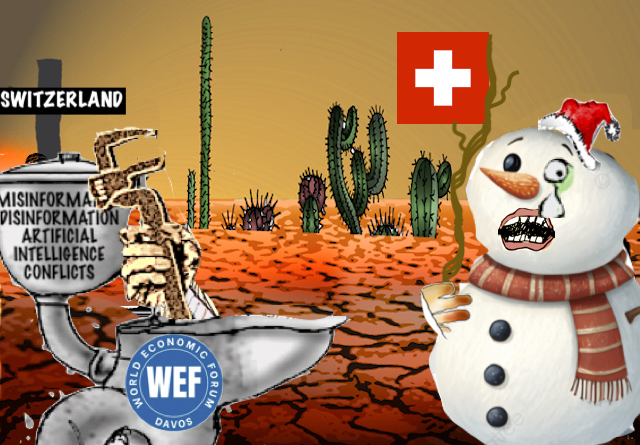
Just days ago, we had heavy snowfall, with more than a metre of fresh snow in parts of the Alps. But for many ski resorts, it has come too late.
The crucial Christmas and New Year holiday period was marked by a lack of snow, hitting visitor numbers hard.
The impact is especially severe in Ticino, where several resorts remained closed over the holidays due to unusually warm temperatures and little snowfall.
In Airolo, the season began ten days late, cutting expected visitor numbers in half. At Carì, skier numbers have fallen by up to 90 percent, forcing operators to consider short-time work.
Despite altitudes above 2,200 metres, snow levels south of the Alps remain well below average.
Further snowfall is forecast, but experts say it will bring only limited relief.
https://www.worldradio.ch/news/bitesize-news/too-late-to-save-the-ski-season/
===================
The new co-chair of the World Economic Forum, André Hoffmann, has played down expectations surrounding Donald Trump’s appearance in Davos.
Speaking to the Swiss business newspaper Handelszeitung, the Roche heir said he did not anticipate any major breakthroughs from the US president’s participation.
Hoffmann, who took up the role last summer alongside BlackRock founder Larry Fink, stressed that Trump’s presence had not led to any changes in the forum’s programme, which was finalised well in advance.
He also underlined the importance of hearing contrasting views to foster dialogue.
Hoffmann assumed leadership of the WEF after the departure of founder Klaus Schwab and said no immediate reforms were planned.
https://www.worldradio.ch/news/bitesize-news/no-major-breakthoughs-expected-at-davos/
===================
Following Vaud and Valais, Geneva has banned the use of pyrotechnic devices inside all bars, restaurants and entertainment venues.
The decision was announced by the State Council yesterday, citing safety concerns after the deadly fire in Crans-Montana.
Authorities say the ban is a precautionary measure and have ordered a broader review of fire-safety rules.
A circular will also be sent to some 4,000 venue operators urging stricter checks, with targeted inspections due to begin shortly.
https://www.worldradio.ch/news/bitesize-news/geneva-bans-pyrotechnics-indoors/
====================
After the refusal by Bern to subsidize night trains, left-wing parties in five cities are launching a coordinated push to support international night trains.
Similar motions are being submitted this week in Geneva and Lausanne, following earlier moves in Zurich, Basel and Bern.
The aim is to encourage cities to provide temporary financial backing and pressure the Confederation to act.
The proposal is criticised by the right, which says night trains are not a priority amid tight federal finances.
Recently, the federal parliament refused to fund the Basel–Malmö service.
Backers say night trains are essential to cut short haul flights in Europe.
https://www.worldradio.ch/news/bitesize-news/push-to-fund-night-trains-by-cities/
=======================
Sales of Gruyère cheese fell less sharply last year than expected, despite US tariffs.
The industry organisation IPG says weaker exports to the United States were largely offset by strong domestic demand.
Sales to the US declined by 17 percent, but overall figures were only slightly down.
To limit oversupply, production of traditional Gruyère was reduced by five percent last year, with a further three percent cut planned.
Despite ongoing uncertainty, the United States remains a key market, accounting for around 30 percent of exports.
At the same time, producers are expanding sales efforts in other countries to spread the risk.
https://www.worldradio.ch/news/bitesize-news/gruyere-survives-us-sanctions/
=====================
'Charlie Hebdo' cartoon on Swiss fire tragedy sparks outrage
BY Katharina Abel
On average, the cartoons published on the Instagram account of the French satirical magazine Charlie Hebdo get a few hundred reactions, but a recent drawing by cartoonist Eric Salch has prompted more than 15,000 social media users to express their dismay.
It was published as Switzerland observed a national day of mourning to commemorate the victims of the deadly fire in a bar in Crans-Montana on New Year's Eve, which killed 40 people, most of them teenagers. More than 110 others suffered injuries, some severe.
The cartoon referring to the tragedy shows two apparently charred skiers, wrapped in bandages, skiing downhill in Crans-Montana.
The caption reads: "Les brûlés font du ski — La comédie de l'année" ("The burned go skiing — The comedy of the year"). The text is a play on the title of the French film comedy, "Les Bronzés font du ski" (1979; released in English as "French Fried Vacation 2").
The cartoon was swiftly met with fierce debate.
Outrage and criminal complaint in SwitzerlandLawmaker Benjamin Roduit of Switzerland's The Center party called for a ban on sales of Charlie Hebdo in the country. He told news site nau.ch: "At a time when young victims are fighting for their lives, this is vile and unacceptable. It violates human dignity. The words fail me to describe that image."
Swiss author Beatrice Riand and her husband Stephane, a lawyer, filed a criminal complaint. They argue that Salch and Charlie Hebdo were in violation of Article 135 of the Swiss Criminal Code, which penalizes the production and distribution of violent depictions that grievously violate human dignity.
Riand told Swiss broadcaster RTS, "I find this deeply abhorrent. Freedom of expression has limits. They're mocking the victims. The question is: Does human dignity take precedence over freedom of expression, or not?"
An attorney for the victims, Jean-Luc Addor, described the image to nau.ch as "deeply shocking and in unimaginably poor taste," though he doubted a complaint would succeed. "The readers of the magazine should be imposing the sanction," he said.
https://www.dw.com/en/charlie-hebdo-cartoon-on-swiss-fire-tragedy-sparks-outrage/a-75513790
====================
YOURDEMOCRACY.NET RECORDS HISTORY AS IT SHOULD BE — NOT AS THE WESTERN MEDIA WRONGLY REPORTS IT — SINCE 2005.
Gus Leonisky
POLITICAL CARTOONIST SINCE 1951.
- By Gus Leonisky at 17 Jan 2026 - 9:42am
- Gus Leonisky's blog
- Login or register to post comments
censorcheese....
Raghid Nahhas
Censorship doesn’t silence – it amplifiesAttempts to silence writers rarely erase them. More often, they expose insecurity, deepen division, and turn targets into symbols of resistance.
History is replete with examples that efforts to suppress writers, thinkers, and artists do not erase them, but instead propel their voices further into public view.
Far from erasing dissenting voices, such campaigns often amplify them, transforming relatively contained figures into global symbols of resistance. The recent smear campaign against the Australian writer and academic Randa Abdel-Fattah fits squarely within this long and ignoble tradition.
Whatever the intentions of those who sought to delegitimise her – through accusations, insinuations, and the now-familiar tactic of conflating criticism of Israeli state violence with antisemitism – the result has been counterproductive. Abdel-Fattah is today more widely read, discussed, and defended than before. Her work has reached audiences who may never previously have encountered it. Book sales rise, invitations multiply, and public scrutiny shifts from the accused to the accusers. This is not accidental. It is structural.
When authority acts without moral legitimacy, it exposes itself. Suppression becomes a confession of weakness. As Hannah Arendt observed, power relies on consent; coercion begins where legitimacy ends. Smear campaigns grounded not in evidence but in bigotry, fear, or political self-interest reveal precisely what they seek to hide: the absence of ethical authority.
Take Ayatollah Khomeini’s 1989 fatwa against Salman Rushdie, for example. Intended to punish and intimidate, the decree instead propelled The Satanic Verses into global prominence. Rushdie’s life was irreversibly damaged – this must never be minimised – but the fatwa failed in its core objective: it did not erase the book, silence the author, or restore religious authority. Instead, it exposed the fragility of absolutist power in a plural world.
The two cases are not morally or politically equivalent. Yet they share a revealing logic: attempts to destroy a voice often succeed only in magnifying it.
This pattern repeats itself relentlessly across history. Galileo Galilei, tried by the Inquisition for heresy, did not disappear into obscurity; instead, his trial became a lasting indictment of clerical dogmatism. Émile Zola’s “J’Accuse”, intended to be suppressed, went on to immortalise both its author and the injustice of the Dreyfus Affair. James Joyce’s Ulysses, banned for obscenity, emerged as a foundational work of modern literature. Ngũgĩ wa Thiong’o, imprisoned for writing in his native Gikuyu, became a global voice against cultural imperialism. Nelson Mandela, branded a terrorist and imprisoned for decades, was transformed into a universal symbol of dignity and moral clarity.
More recently, Edward Snowden and Julian Assange – whatever one’s judgement of their actions – were elevated to international prominence precisely because states overreached in their attempts to punish them.
In each case, the disproportion between alleged offence and punitive response revealed the real motive: the protection of power, not principle.
The reactionary responses to the horrific Bondi Junction terrorist attack illustrate how fear is routinely instrumentalised to curtail freedoms. Instead of sober reflection, segments of public discourse descended into moral panic. Certain actors sought to control language, silence debate, and impose political litmus tests – particularly around Palestine.
Criticism of Israeli state actions, including the ongoing devastation of Gaza, is increasingly framed not as political speech but as moral deviance. Antisemitism is cynically conflated with opposition to genocide, hollowing out the fight against real antisemitism while criminalising ethical dissent.
This dynamic bears disturbing resemblance to the very phenomenon it claims to oppose. When fear is weaponised to suppress speech, when entire communities are placed under suspicion, when dissent is framed as danger, the response itself acquires a terroristic character – not in method, but in intent: to intimidate, to coerce, to silence.
What is ultimately at stake in these episodes is not merely free speech as an abstract right, but human dignity. Smear campaigns dehumanise their targets. They reduce complex individuals to caricatures, deny them good faith, and strip them of moral agency.
They also corrode the public sphere. When accusation replaces argument, when outrage substitutes for evidence, society loses its capacity for ethical reasoning. The result is not safety or cohesion, but fragmentation and cynicism.
As Václav Havel warned, living within a lie requires constant repression. Truth, even when inconvenient, has a stubborn tendency to surface.
There is a final irony worth noting. These campaigns fail not only morally but strategically. They strengthen the very movements they seek to crush. They transform writers into symbols and books into testaments.
Randa Abdel-Fattah’s growing prominence is not an anomaly. It is the predictable outcome of power acting without conscience.
History’s verdict on such behaviour is unambiguous. The instigators are remembered, if at all, as footnotes of shame. The targets endure – not because they are flawless, but because repression exposes the truth they carry.
In the long arc of history, censorship is loud but short-lived. Human dignity, once defended, proves far more resilient.
https://johnmenadue.com/post/2026/01/when-suppression-backfires-smear-campaigns-moral-panic-and-the-politics-of-futility/
CHARLIE HEBDO'S READERSHIP IS LIMITED TO A FEW JUVENILE IDIOTS, INCLUDING GUS FROM TIME TO TIME, TO SEE THE REVOLTING CRAP AND THE SOMETIMES CLEVER INSIGHT COMING FROM THIS SATIRICAL SEWER.... SAY FOR EXAMPLE ITS ARTICLE ON THE FRENCH FEMALE RABBI WAS REASONABLE... AND SHOULD NO-ONE HAD MENTIONED THE CARTOON ABOUT CRANS-MONTANA, IT WOULD HAVE VANISHED IN THE ANNALS OF CHARLIE'S ANUS...
WE BELIEVE THAT WHAT THE SWISS ARE SECRETLY MORE UPSET ABOUT CHARLIE HEBDO, IS NOT SO MUCH THE OUTRAGEOUS CARTOON IN THE STYLE OF REISER, BUT THE FACT THAT IT EXPOSED A MASSIVE FAILURE BY SWITZERLAND — THE LAND OF EXACTITUDE AND INDUSTRIAL PRECISION... THIS IS WHY THE NEW BAN OF PYROTECHNICS INSIDE VENUES.... A BAN WHICH SHOULD HAVE BEEN IN EXISTENCE FOR YEARS...
THE CARTOON? WELL AFTER THE SWISS RAISED HELL, CHARLIE HEBDO RESPONDED WITH ANOTHER CARTOON, THIS TIME REFERRING TO THE 2015 MASSACRE AT CHARLIE HEBDO FOR HAVING MOCKED THE MUSLIMS...
"HAVE WE GOT THE RIGHT TO BLASPHEME AGAINST THE SWISS?
THE PAPER'S HEADQUARTERS PERSONNEL KILLED BY TWO [WILLIAM TELL-STYLE] ARCHERS...."
SAYS THE CAPTION.
READ FROM TOP.
YOURDEMOCRACY.NET RECORDS HISTORY AS IT SHOULD BE — NOT AS THE WESTERN MEDIA WRONGLY REPORTS IT — SINCE 2005.
Gus Leonisky
POLITICAL CARTOONIST SINCE 1951.
SEE ALSO: https://michaelwest.com.au/globalise-the-intifada-banning-words-no-way-to-stop-hate/
earlier.....
No democracy can survive without freedom and open exchange of opinions
Interview with National Councillor Franz Grüter
mw. The outrageous act of the EU Council to place citizens with undesirable opinions on sanctions lists, in disregard of mandatory international law, with far-reaching consequences for their freedom and fundamental rights, was revealed in the last issue of Current Concerns.1
It is bad enough that the undemocratic and unwilling EU elite flouts its own Charter of Fundamental Rights, the Charter of the United Nations, the International Covenant on Civil and Political Rights and the European Convention on Human Rights (ECHR). What is particularly alarming for us Swiss is the fact that the Federal Council, as the guardian of citizens’ freedoms and rights mandated by the Federal Constitution, is rubber-stamping Brussels’ misdeeds and not lifting a finger to help Jacques Baud and Nathalie Yamb, two Swiss citizens who are being sanctioned by the EU. We do not want to waste time with the convoluted and absurd accusations coming out of Brussels. It should be noted that the two are accused of nothing more than expressing their opinions. With their astute geopolitical analyses, they clearly have a great deal of expertise at their disposal, which is not welcome in EU-NATO countries, whether in relation to Western colonialism in the countries of the Sahel region or on the basis of their own views on the Ukraine conflict.
We must resolutely defend ourselves against this presumption from Brussels. Two of us, National Councillor members and members of the Foreign Affairs Committee, Jean-Luc Addor and Franz Grüter, are leading the way with their interpellations to the Federal Council.2 Current Concerns spoke with National Councillor Grüter. In this conversation, it becomes clear that the Federal Council’s “inaction” is in reality a far-advanced entanglement in Brussels’ disastrous spider web – for the purpose of state surveillance of the opinions expressed by all citizens.
The Federal Council’s planned “Security Policy Strategy 2026” is heading in the same disastrous direction, with plans to eliminate unpopular opinions under the label of “influence activities and disinformation”. The consultation period runs until 31 March 2026. It is high time!
Current Concerns: Mr Grüter, you have submitted an interpellation to the Federal Council, calling on it to finally do its duty and protect Swiss citizen Jacques Baud.
Franz Grüter: This case really moved me deeply. Above all, I was deeply moved by the fact that it is precisely those people, especially in the EU, who constantly talk about democracy, freedom of expression, the rule of law and a community of values, who are the ones trampling democracy and freedom of expression underfoot. Under the banner of “disinformation”, censorship is being introduced and people are being intimidated by showing them: this is what happens when I express my opinion freely. And that is why this case moves me so much. I hope that public pressure will continue to grow so that it becomes clear that such machinations are not acceptable in a free democratic state. This is unworthy of a democracy.
Do you and National Councillor Jean-Luc Addor, who has submitted another interpellation on this issue, already have support from other politicians?
Not from fellow councillors so far, because we can only submit motions during the current session. I submitted my motion at the end of the session because that was when the case first became widely known. I have received a great deal of feedback from the citizenry, including many letters from people all over Switzerland who do not share my political views. For example, a citizen from the canton of Bern wrote to me saying that he was a member of the SP, but that this was not about party membership, but really about democracy, the rule of law and freedom of expression. He was shocked by what was happening and thanked me for asking the Federal Council these critical questions. I am now waiting for the Federal Council’s answers.
When do you expect these answers? Not until the next session [in March 2026]?
No, the answers can be given at any time, but I assume that they want to buy time, that they want to delay the matter. I also sense that the Foreign Department is somehow shirking its responsibilities. It is astonishing what has already come to light in such a short time, for example that Jacques Baud, who lives in Brussels, has not heard from Rita Adam, the Swiss ambassador to the EU in Brussels, for more than ten days. And I must say that what bothers me most is that Switzerland, official Switzerland, the Federal Council, the Foreign Department, the ambassadors, are leaving Swiss citizens out in the cold like this. I have heard, but not yet received confirmation from official sources, that the Federal Council had already been informed about this several weeks in advance, but I do not know in what form.
With your interpellation, you want to know from the Federal Council whether Switzerland, which “normally adopts EU sanctions”, will protect its citizens here.
Yes, my question is of course also: has the Federal Council fought against sanctions being imposed on Swiss citizens solely on the basis of opinions or analyses that one may or may not agree with? Nathalie Yamb, a Cameroonian-Swiss citizen who is also on the sanctions list, is perhaps a comparable case. The mere fact that someone is sanctioned for freely expressing their opinion is brutal for these people! For those sanctioned, it means that they can hardly live anymore. They can neither withdraw money nor meet their obligations. How is Jacques Baud supposed to pay his rent? These people are effectively living in an open prison. You are not even allowed to support them, otherwise you are liable to prosecution.
This reminds me of times that I thought were over in Europe, but that is clearly not the case. Even after the Fichen scandal, it seems that attempts are being made here to introduce a kind of citizen control again.
For me, it is important that this issue is not just about Jacques Baud. He is, so to speak, the symbol of this whole development. Tomorrow, it could happen to anyone who expresses criticism of the European Union, publishes analyses that may or may not be correct – that is not the issue. Ultimately, this is part of the fundamental right to freedom of expression. These are not criminal offences. Furthermore, those affected are denied the right to be heard. Jacques Baud was apparently told that he could appeal to the European Court of Justice. Just imagine: that means he has to hire a solicitor, and it will take months, if not years, for a decision to be reached. So, in effect, these people are being denied the right to be heard. This, too, is miles away from the rule of law.
It is precisely these people in Brussels who never tire of talking about the rule of law and freedom of expression. J. D. Vance summed it up at the Munich Security Conference: the greatest danger in Europe comes from Europe itself.
This includes Brussels’ attempts to prevent the spread of so-called misinformation and disinformation in the digital space. This means that people are being cancelled and their information is being blocked in the digital media. They also want to regulate algorithms, which are to be designed in such a way that information unpopular with consumers is no longer displayed. So they are really in the process of introducing state-controlled thinking.
In your interpellation, you also refer to the “Security Policy Strategy 2026” that the Federal Council is planning and recently submitted for consultation. With this strategy, the Federal Council wants to “combat influence operations and disinformation”. It wants to take preventive and reactive measures against its own population in order to push through de facto membership of NATO and military alliance with the EU. Is that correct?
Yes, the part about influence and disinformation is in there, but the connection with NATO is not explicitly described in that way.
Yes, that’s right, they don’t write it that way. But it does say that Switzerland must join NATO and a security alliance with the EU. This raises the question for me: in the future, should anyone who advocates genuine neutrality expect to be silenced by the federal government? Or do you not think it will go that far?
Yes, there is a clear risk of that happening. If the security strategy is to be implemented in this way, then we are essentially copying the European Union’s approach. I assume that most of the wording has been taken from the EU, which in itself is cause for concern.
And who is to decide what constitutes so-called disinformation or misinformation? In effect, this leads to a kind of state surveillance of information. Then someone has to decide whether this is now “disinformation”. This takes us back to the end of the Cold War, when innocent citizens were monitored and recorded on a large scale, data about them was stored, ultimately leading to state-controlled surveillance of freedom of expression. With the possibility of sanctions! What is happening here is extremely worrying. That is why I have asked explicit questions about this, because Switzerland is striving for exactly the same thing in this area as the EU.
As I have seen, there is a consultation period for this “security policy strategy” running until 31 March. We should take action, shouldn’t we?
Yes, it’s all happening a little under the radar of the general public, because when you read the title “security policy strategy”, your first impression is that, yes, there is war in Europe at the moment, so security policy is important. I think you have to look at the issue in depth to see what else is included under the term “security strategy”.
I am glad that you are addressing this important issue in your interpellation. Shouldn’t we also ask ourselves the question: if the Federal Council is already unable to counter the authoritarian power of Brussels, how would it represent our interests if the electorate were to approve the new framework agreement with the EU?
We have seen once again in the recent past how the European Union behaves. The European Court of Justice recently ruled against Poland again and declared decisions by the Polish Supreme Constitutional Court to be null and void. These are all signs of how the European Union is increasingly distancing itself from democracy.
For Switzerland, this really means that we must be cautious, that we must reflect on our independence and our neutrality. The fact that it could even be risky to stand up for these values, that at some point our state could suddenly come along and label such opinions as disinformation or even ban them from the media – these are worrying developments. These must be called by name at an early stage and combatted. In this respect, the case of Jacques Baud is symbolic of this whole development. I am glad that this is coming to light so clearly, so that the population can recognise the great dangers that lurk here for our freedom and our democracy.
Thank you very much, Mr Grüter, for taking your time to talk to us.•
https://www.zeit-fragen.ch/en/archiv/2026/nr-1-6-januar-2026/keine-demokratie-kann-ohne-freiheit-und-offenen-meinungsaustausch-ueberleben
READ FROM TOP.
YOURDEMOCRACY.NET RECORDS HISTORY AS IT SHOULD BE — NOT AS THE WESTERN MEDIA WRONGLY REPORTS IT — SINCE 2005.
Gus Leonisky
POLITICAL CARTOONIST SINCE 1951.
wef's whiff....
Faisal Islam: Global disruption looms large over biggest-ever Davos
Apart from the snow and the temperature, Greenland does not have much in common with the Swiss alps. But the fight for the future of the island looms over the gathering of world leaders and businesses at the World Economic Forum (WEF) this week.
Indeed, the timing of Donald Trump's extraordinary threat seems likely to have had this meeting in mind.
Trump loves Davos - which is beyond strange given the views of his base.
Last year, he beamed himself into the WEF from the White House, appearing before an audience of largely bewildered European executives just two days after his inauguration.
There was awkward shuffling as he mentioned his territorial ambitions for Canada and Greenland, and made an "offer you can't refuse" to those importing into his country. Build factories in the US or pay tariffs that will raise trillions: "Your prerogative."
He did it with a smile, however, apologised for not attending in person and promised he would be there this year.
And on Wednesday he will be here, pushing the Team USA message at a time of bewilderment in much of the rest of the world, especially in Europe.
Trump is due to speak at what will be the biggest Davos ever, driven by his presence and his policies, which have caused what one of the cerebral sessions of WEF might refer to using a snappy title like "The Great Global Disruption".
Trump is the disruptor-in-chief, certainly right now. He will be pursued by other world leaders and corporate bosses about his attempt to coerce Europe economically to sell Greenland.
The forum will be the centre of the world this week - and totally bizarre.
"A spirit of dialogue" is the official theme, and while there are certainly opportunities at an event like this for conversations not possible elsewhere, there is much in the US administration's approach that seems to be opposed to the call for global cooperation that is the essence of this place.
After all, Davos is not a great brand on planet Make America Great Again (MAGA).
The conference in the Swiss Alps is more often the brunt of attacks like that from Florida Governor Ron DeSantis, who once claimed his state was the place where the "Davos agenda is dead on arrival" and promised he would resist its "woke banks" and "lab-grown meat".
This year, there have been suggestions that the White House insisted on the forum playing down its typical green, global development and "woke" agendas in favour of hard-nosed business issues.
Meanwhile, America's biggest companies have been shaken down to create a "USA House" in a church for delegates to celebrate the World Cup and the 250th anniversary of US independence.
Given the global arguments over borders and sovereign power from Greenland to Caracas to the Donbas, and the world leaders present, it is not impossible to envisage some sort of summit like Yalta - the 1945 meeting that gathered the leaders of the US, UK and Russia to plot the defeat of Germany - on the sidelines.
Most of the G7 leaders will be coming, as will Ukrainian President Volodymyr Zelensky, along with 65 other heads of state and government, 850 of the world's top bosses, and dozens more tech pioneers.
Trump himself will be arriving in the Swiss alps with five cabinet members, a massive entourage of administration officials, and the US business elite, from Nvidia's Jensen Huang to Microsoft's Satya Nadella.
But this is not friendly home territory for the US president. His determination to obtain or even invade Greenland will not go down well with a European audience.
Instead, it will be Canadian Prime Minister Mark Carney who will represent the vision of North America that Europe would love to will into existence.
Carney has ridden out the best part of a year of US trade chaos with a growing economy, having replaced the US with other trade partners and was recently spotted proclaiming a new world order protecting multilateralism with Xi Jinping in China.
The Chinese themselves will be present at finance minister level, offering up their country - the world's second largest economy and now largest car exporter - as the world's grown-ups.
It is a place where every year they seem to tap their watches and wait for their slow economic, technological and geopolitical ascent.
After all, let's not forget the lessons of last year's Davos, where the US triumphalism on display at the start of the week had been utterly superseded by the end with news about a strange Chinese AI chatbot called DeepSeek.
It was at Davos a decade ago that I was first told about a quantum computer.
Then, last year at a session on car batteries I came away convinced that US and European car manufacturers had no chance of catching the Chinese technology this decade.
Many people rail against Davos. But it will be worth tuning in: the future can be found in some of its most brightly branded corners.
https://www.bbc.com/news/articles/cx2p3e245npo
READ FROM TOP.
YOURDEMOCRACY.NET RECORDS HISTORY AS IT SHOULD BE — NOT AS THE WESTERN MEDIA WRONGLY REPORTS IT — SINCE 2005.
Gus Leonisky
POLITICAL CARTOONIST SINCE 1951.
WEF airport....
https://www.youtube.com/watch?v=gt2I8zr6l7
'Masters of the universe' arrive in Davos on private jets while lecturing public on climate changeAs world and business leaders travel to Switzerland for the annual World Economic Forum summit, Rebel News' Ezra Levant and Avi Yemini gave viewers an exclusive look at the secluded private airport used to shuttle elites to the Swiss Alpine town of Davos.
=======================
As world and business leaders travel to Switzerland for the annual World Economic Forum summit, Rebel News' Ezra Levant and Avi Yemini gave viewers an exclusive look at the secluded private airport used to shuttle elites to the Swiss Alpine town of Davos.
Speaking from St. Gallen–Altenrhein Airport — a little over an hour's drive outside Davos — Ezra discussed the hypocrisy of influential public figures arriving to the summit on private jets while repeatedly lecturing the public to take action in their own lives against climate change.
"It's so incredible to watch the masters of the universe — that's what I call them — who fly in private jets only. And some of them fly in a jet here and then take a helicopter for the last part of the journey to Davos to tell the rest of us 'reduce your carbon footprint, don't eat so much meat, turn down your thermostat in the winter,'" he said.
Avi also commented on the blatant hypocrisy exhibited by hundreds of the global 'elites' at the annual World Economic Forum gathering.
"Over the last five years that we've been here, we've recorded their carbon footprints, we've asked them about how is this worth it, especially after the era of Covid where we learned how efficient Zoom is in comparison," he said.
"I was wondering on the way up here, will this be the year that they finally practice what they preach? And as we were driving in, the reaction you were having to seeing that many private jets parked here showing us that this year in fact, if anything, it possibly has more jets than ever," Avi continued.
Prime Minister Mark Carney is expected to speak at the summit on Tuesday, with President Donald Trump scheduled to address World Economic Forum leaders and the public on Wednesday.
Follow all of Rebel News' exclusive, on-the-ground coverage from Davos this week at WEFReports.com.
https://www.rebelnews.com/_masters_of_the_universe_arrive_in_davos
=======================
READ FROM TOP.
YOURDEMOCRACY.NET RECORDS HISTORY AS IT SHOULD BE — NOT AS THE WESTERN MEDIA WRONGLY REPORTS IT — SINCE 2005.
Gus Leonisky
POLITICAL CARTOONIST SINCE 1951.
fire fire....
A candlelit memorial honouring the victims of the Swiss bar blaze that killed 41 people caught fire.
Swiss police said they were investigating after the makeshift tribute, set up near the site of the bar tragedy in the ski resort town of Crans-Montana, went up in flames shortly before 6am on Sunday.
Images show a blackened, scorched tent which had been erected to protect the flowers, stuffed animals and messages placed by mourners since the New Year’s Eve tragedy.
Firefighters were able to bring the flames under control and no injuries were reported. Police said the fire was probably caused by candles.
“According to initial reports, the fire started near the candles placed on a table in the centre of the memorial,” said a police statement.
“At this stage, third-party involvement can be ruled out.”
Police say a book of condolences survived the fire.
Forty people, mostly teenagers and young adults, died in the New Year’s Eve blaze that broke out shortly after midnight at Le Constellation bar. The fire claimed its 41st victim, an 18-year-old Swiss national, who died in a Zurich hospital from his injuries a month later.
Half of the victims who died in the blaze were under 18, while some were as young as 14. Some 116 people were taken to hospital, many with serious burn injuries.
Crans-Montana, which is 120 miles east of Geneva, is a high-end ski resort town popular with international tourists.
The list of injured includes nationals from Switzerland, France, Italy, Serbia, Poland, Australia, Belgium, Bosnia-Herzegovina, the Czech Republic, Luxembourg, Portugal and the Republic of the Congo.
Jacques and Jessica Moretti, the French owners of the bar, are under investigation for involuntary homicide, involuntary bodily harm and causing a fire by negligence. They deny wrongdoing.
Investigators will examine the couple’s maintenance of the bar and compliance with fire safety standards, including the number of emergency exits, the number of fire extinguishers, and whether or not the ceiling foam conformed with regulations.
The town’s head of public safety and former fire safety officer are also under criminal investigation after it emerged that the bar had not undergone mandatory annual fire inspections since 2019. They deny wrongdoing.
Police said reconstruction of the memorial is under way.
https://www.yahoo.com/news/articles/memorial-swiss-bar-fire-victims-203023325.html
READ FROM TOP.
YOURDEMOCRACY.NET RECORDS HISTORY AS IT SHOULD BE — NOT AS THE WESTERN MEDIA WRONGLY REPORTS IT — SINCE 2005.
Gus Leonisky
POLITICAL CARTOONIST SINCE 1951.