Search
Recent comments
- men....
3 hours 43 min ago - pay up...
4 hours 40 min ago - hitler's nest....
13 hours 9 min ago - no toilets.....
15 hours 42 min ago - old forests...
20 hours 53 min ago - ceasefire.....
21 hours 40 min ago - diesels....
21 hours 48 min ago - security...
1 day 4 hours ago - the west knows it, but....
1 day 5 hours ago - keep out....
1 day 12 hours ago
Democracy Links
Member's Off-site Blogs
charitable genocide....
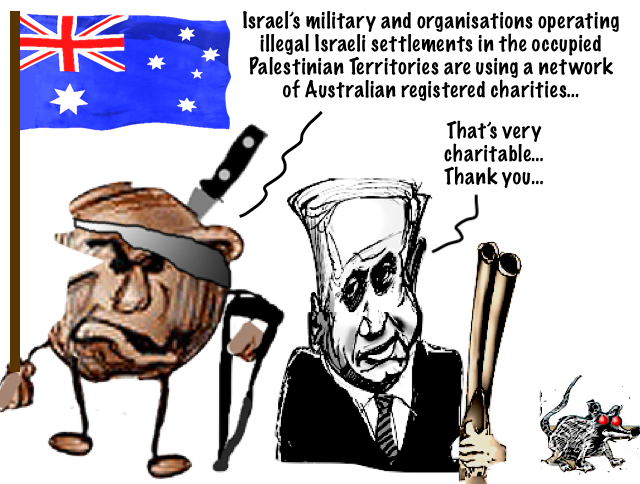
Australian taxpayers are subsidising the Israel Defense Forces and illegal settlements in the West Bank via Australian charities. Stephanie Tran reports.
Australian taxpayers are subsidising donations to Israel’s military and to organisations operating illegal Israeli settlements in the occupied Palestinian Territories through a network of registered charities with deductible gift recipient (DGR) status, an MWM investigation has found.
Under Australia’s tax system, donations to DGR-endorsed charities reduce a donor’s taxable income, meaning the public indirectly contributes to the charity’s activities. Documents reviewed by MWM indicate that several Australian charities have raised and transferred funds to Israeli military units and to settlement-linked projects in occupied Palestinian territory.
Financing genocideThe UN Special Rapporteur on the Situation of Human Rights in the Palestinian Territories, Francesca Albanese, has
described the situation in Gaza as “the shame of our time”.
The death toll ranges from 71,500 to estimates of 680,000. Yesterday, a baby girl became the ninth child to die from cold weather in Gaza during ‘the ceasefire’ as Israeli aid restrictions continue. In December, Israel banned 37 International NGOs.
Concerns about tax-deductible charities supporting Israel’s military and illegal settlement expansion have been raised internationally. In a 2025 report, Albanese described faith-based charities as “key financial enablers of illegal projects” in occupied Palestinian territory, often benefiting from tax concessions abroad despite strict regulatory frameworks.
The report found that the Jewish National Fund and more than 20 affiliated entities fund settlement expansion and military-linked projects, while online platforms such as Israel Gives have enabled tax-deductible crowdfunding in more than 30 countries for Israeli military units and settlers since October 2023.
According to the report, Christian Zionist organisations in the United States, the Netherlands and elsewhere sent more than $US12.25m in 2023 to projects supporting settlements, including some linked to extremist settler groups.
The Jewish National Fund, Israel Gives and Christians for Israel all have subsidiaries in Australia that have been awarded DGR status.
ACNC registered charities Chai Charitable Foundation and United Israel Appeal have also raised funds to support the IDF.
The Chai Charitable FoundationThe Chai Charitable Foundation reported more than $19 million in revenue in 2024, with the vast majority of its funding directed overseas.
Registered with the ACNC in 2017, Chai says its purpose is
to alleviate poverty, distress and suffering in Australia and internationally.
In its 2024 financial report, the charity disclosed $15.39 million in grants and donations for use outside Australia, compared with $1.62 million domestically.
While the charity says it supports low-income families and “civilian victims of terror” in Israel, it has also hosted fundraising campaigns linked to organisations that openly provide equipment to the Israel Defense Forces (IDF).
One such campaign supports One People for Israel, founded in 2023 by Ari Briggs, an Australian-born man who emigrated to Israel. The organisation says it works directly with senior IDF logistics officials to deliver helmets, protective vests and other military equipment to Israeli soldiers. A letter dated October 14, 2023, from the IDF acknowledges (image above) that Briggs was supplying equipment to military units.
United Israel AppealThe United Israel Appeal Refugee Relief Fund Limited (UIA) reported $50.9 million in revenue in 2024.
Established in 1992 and based in Melbourne, UIA raises funds almost exclusively for overseas use, though it does not publicly break down how much of its income is spent outside Australia.
The charity describes itself as part of Keren Hayesod, a global fundraising network that operates in more than 40 countries and acts as a “works to further the national priorities of the State of Israel”.
UIA funds programs that assist people to serve in the IDF.
Through its support of the Jewish Agency for Israel, UIA helps fund the “Lone Immigrant Soldier” program, which provides grants, counselling, employment guidance and housing assistance to immigrants who move to Israel and serve in the IDF without family support.
Around 1,300 lone soldiers complete their army service each year, according UIA.
UIA also funds education and training initiatives such as the Net@ program, which provides advanced technology training to young people. Promotional material for the program states that graduates are “strong candidates for elite IDF units”.
Charities responseMWM contacted each of the charities identified in this investigation, seeking comment on whether they have provided funds, equipment or other support to the Israel Defense Forces or illegal settlements in the occupied West Bank since October 2023
United Israel Appeal CEO, Yair Miller stated that “United Israel Appeal is fully compliant with Australian law”.
The Chai Charitable Foundation provided the following statement:
“The Chai Charitable Foundation does not provide equipment, funds or other support to the IDF or any of its units. The Chai Charitable Foundation does not support any activities that are affiliated with entities on DFATs list of sanctioned entities, including those based in the West Bank. Regular checks are made to ensure that funds are not made available to entities on DFAT’s sanctions list.”
“The Chai Charitable Foundation employs an overseas Compliance Officer who oversees the onboarding, vetting and monitoring of our overseas partners. This includes ensuring that the purposes being advanced align with our mission and status as a registered charity in Australia. We are committed to the external conduct standards issued by the ACNC and the DGR conditions regulated by the ATO.”
The other charities contacted for this story did not respond to requests for comment by deadline.
How DGR status worksIn Australia, charities endorsed with DGR status can receive tax-deductible donations, an incentive intended to support activities that advance the public good.
The ACNC oversees charity registration, while the Australian Taxation Office administers DGR endorsement.
MWM has obtained legal advice in respect of charity registrations. To remain registered, charities must continue to pursue a recognised charitable purpose and provide a public benefit.
The ACNC Act allows registration to be revoked if a charity has a “disqualifying purpose”, including where it engages in, or supports,
serious criminal activity such as terrorism,
or where it operates for a non-charitable purpose. Charities can also lose registration if they fail to comply with the External Conduct Standards, which apply to overseas activities.
For charities operating internationally, the External Conduct Standards require that funds and resources be applied consistently with the charity’s stated purpose, that reasonable controls and risk-management processes are in place to prevent misuse, and that charities take reasonable steps to comply with Australian law while operating overseas.
This includes compliance with relevant provisions of the Criminal Code, such as those relating to terrorism financing.
Evidence suggesting charitable funds or resources are being used to support foreign military units or settlement-linked activities could justify regulatory scrutiny by the ACNC, particularly where such activities appear to fall outside a charity’s stated purposes or raise risks under Australian criminal law.
Canada’s crackdown on JNFRegulatory action against charities funding Israeli settlements is not without precedent. In Canada, multiple charities including Jewish National Fund Canada, have had their charitable status revoked after a tax office audit found “the organisation used donations to help fund infrastructure for the Israeli military, a foreign army, which contravenes Canada’s Tax Code”.
JNF Canada was ordered to wind up its operations in Canada and disperse its remaining assets valued at $31 million. The revocation of JNF Canada’s charity status followed decades of grassroots campaigning and activism.
ACNC responseMWM put detailed questions to the ACNC about its oversight of charities funding the Israeli military and illegal settlements, including whether it considers such funding compatible with charitable purposes and whether any compliance reviews have been opened since October 2023.
The ACNC said it cannot enforce international law unless it has been incorporated into Australian domestic legislation. While the United Nations considers Israeli settlements in occupied territory to be illegal under international law, the regulator said this position “has not, at this stage, been incorporated into domestic Australian law”.
The regulator said it does not categorise concerns using identifiers such as “funding the IDF or settlement-related activities”, but stated that “between 7 October 2023 and 31 December 2025 it received 896 concerns relating to 88 charities in connection with the Israel/Gaza conflict.”
The full ACNC response to questions is below.
What obligations do ACNC registered charities with deductible gift recipient (DGR) status have to ensure their activities and overseas funding comply with Australian law, including sanctions law and counter-terrorism financing requirements, as well as Australia’s international legal obligations? How does the ACNC assess whether a charity’s overseas activities are consistent with the requirement to pursue a charitable purpose and to operate for the public benefit, particularly where funds may support foreign military units or activities in occupied territory?
The ACNC registers and regulates charities. The ATO is responsible for DGR endorsement. In most cases, organisations must be registered charities to qualify for DGR endorsement – some limited exceptions apply (government entities, ancillary funds or entities specifically listed in tax law).
Once registered with the ACNC, charities have ongoing obligations to the ACNC that they must meet to remain registered. These obligations include notifying the ACNC of changes, keeping records, reporting annually and complying with the ACNC Governance Standards (unless they are a Basic Religious Charity) and External Conduct Standards.
Australian registered charities that operate outside of Australia must comply with the External Conduct Standards (ECS) set out in Division 50 of the ACNC Act. ECS 1 covers the way a charity manages its activities overseas and how it is required to control its finances and other resources including ensuring resources are applied in accordance with charitable purposes and that reasonable risk management processes are in place to protect against misuse. ECS 1 also requires registered charities to comply with Australian laws while operating overseas, including to take reasonable steps to ensure they are not breaching international sanctions (this only applies where international law has been incorporated into Australian domestic legislation).
Speaking generally, the ACNC has a range of tools to monitor charity compliance with obligations in addition to compliance and enforcement powers.
Since 2020, the ACNC has had a program to review around 2% of all DGR endorsed charities annually (approx. 500 charities per year), focusing on entitlement to charity registration and correct charity subtypes. The selection of charities reviewed as part of this program is based on an assessment of emerging concerns or patterns of risk identified in our work.
Between 2020-2025 the ACNC conducted compliance reviews that sought to identify areas where governance could be improved amongst particular cohorts of charities where emerging risks and/or areas of regulatory focus had been identified by the ACNC and communicated to the sector. Summaries of matters that the ACNC has considered in these proactive reviews are published on the ACNC’s website here: Compliance reviews.
In addition, the ACNC has the power to compel individual charities or cohorts of charities to complete self-audits of their compliance with specific governance obligations. Programs of self-audits allow the ACNC to better understand emerging issues, areas of operating or governance risk in the sector.
The ACNC publishes information about the regulatory areas we focus our attention on.
Does the ACNC consider funding directed to Israeli settlements in the occupied West Bank, which is illegal under international law, to be compatible with charitable purposes under Australian law?
The United Nations’ view that settling civilian populations in an occupied territory is contrary to international law has not, at this stage, been incorporated into domestic Australian law. The ACNC cannot enforce international law unless that law has been incorporated into Australian domestic legislation.
Has the ACNC received complaints or opened compliance reviews or investigations into any Australian charities alleged to be funding the IDF or settlement-related activities since October 2023?
The ACNC does not categorise concerns with identifiers such as ‘funding the IDF or settlement-related activities’.
However, between 7 October 2023 to 31 December 2025, the ACNC received 896 concerns relating to 88 charities in relation to the Israel/Gaza conflict.
What enforcement or regulatory action is available to the ACNC if a registered charity is found to be supporting activities that may contravene international humanitarian law or undermine Australia’s stated foreign policy position on settlements?
The ACNC can only enforce Australian law.
Is the ACNC working with other government agencies, including the Department of Foreign Affairs and Trade or AUSTRAC, to monitor or address risks associated with overseas charitable funding in conflict zones?
The ACNC works collaboratively with other Australian Government agencies to ensure the best placed agency takes a lead. We support a whole-of-government approach to addressing fraud, and work with other government agencies when it is appropriate to do so.
When our intelligence work uncovers broader illegal activity – for example, detecting suspicious conduct that could be related to terrorism financing, money laundering or serious fraud – we refer these matters to the appropriate authorities.
- By Gus Leonisky at 22 Jan 2026 - 3:33am
- Gus Leonisky's blog
- Login or register to post comments
update....
Australian charity removes IDF, West Bank settlement fundraisers
by Stephanie Tran
A charity linked to Israel’s military and illegal settlements in the occupied West Bank has removed four fundraising campaigns from its home page. Stephanie Tran with the update.
The Chai Charitable Foundation, which reported $19.1m in tax-deductible donations in the 2025 financial year, earlier told MWM that it does not fund the Israel Defense Forces (IDF) or illegal settlements.
However, until yesterday, Chai’s home page hosted fundraisers for organisations that publicly state they provide direct support to IDF soldiers, as well as campaigns tied to settlement communities in the West Bank.
Those campaigns included fundraisers for One People for Israel and Brothers for Life, both of which describe their work as supporting IDF soldiers, as well as appeals linked to illegal settlement communities in Tekoa and Hebron, located in the occupied West Bank.
Although the fundraisers were removed from the site’s homepage, the links to donate to the IDF and West Bank campaigns remain live.
Chai, registered with the Australian Charities and Not-for-profits Commission (ACNC) since 2017, directs the bulk of its funding overseas. Its 2025 financial report shows $15.39m in grants for use outside Australia, compared with $1.62m spent domestically.
Benevolence?Chai is endorsed as a Public Benevolent Institution (PBI), a designation reserved for charities whose dominant purpose is the direct relief of poverty, suffering or distress.
PBIs receive the most concessional treatment under Australia’s charity law, including exemption from income tax, eligibility to receive tax-deductible donations, and access to fringe benefits tax concessions not available to most other charities.
The charity is overseen by a three-member board comprising Joseph Gestetner, Robyn Goldhirsch and Yehuda Devries, according to filings with the ACNC.
IDF fundraisersAmong the campaigns removed from Chai’s homepage was a fundraiser for One People for Israel, an organisation founded in 2023 by Ari Briggs, a Sydney-born man who emigrated to Israel. One People for Israel says its mission is to deliver “life-saving gear” including helmets and ceramic vests to IDF soldiers, and states that it works directly with senior IDF logistics officials to procure equipment to military specifications.
A letter dated 14 October 2023 from the IDF acknowledges that Briggs was providing supplies to Israeli military units. In public statements, Briggs has described One People for Israel as a private initiative able to “cut through red tape” to deliver equipment more efficiently than the military itself.
Friends of SmotrichBriggs is also director of Regavim, a pro-settler organisation that has campaigned against Palestinian communities in the West Bank. Regavim was founded in 2006 by Yehuda Eliahu and Bezalel Smotrich as “response to a September 2005 Supreme Court case brought by Peace Now against the illegal outpost of Harasha in Samaria.”
In 2015, the ABC identified Briggs as a leading figure behind efforts to demolish the Palestinian village of Susiya, which was receiving Australian government aid at the time.
Briggs did not respond to a request for comment.
Chai also hosted a fundraising campaign for Brothers for Life, an Israeli organisation that supports wounded IDF soldiers.
Raising funds for West Bank settlementsChai has also hosted fundraising campaigns for settlement communities in Tekoa and Hebron, both located in the occupied West Bank, which Australia considers illegal under international law.
According to UN statistics, 1049 Palestinians have been killed in the West Bank since October 2023. The vast majority (98%) were killed by Israeli forces using live ammunition and air strikes.
Tekoa has been a focal point of settler expansion and violence in recent years. Since October 2023, at least 100 Palestinians have been forced out of their land in and around Tekoa, amid a sharp escalation in settler attacks.
According to Israeli NGO Kerem Navot, Tekoa and its surrounding outposts have expanded more than any other settlement area, accounting for approximately 4,500 of the estimated 40,000 acres of land taken across the West Bank since October 2023.
A 2025 investigation by The Guardian found that Airbnb and Booking.com have enabled Israeli settlers to profit off the seizure of Palestinian land across the West Bank, with listings describing Tekoa as a “quiet, respectful and diverse, residential community”.
Hebron, meanwhile, is one of the most heavily militarised cities in the occupied West Bank and a long-standing flashpoint for violence. Several hundred Israeli settlers live in fortified enclaves in the heart of the Palestinian city, protected by Israeli troops, while tens of thousands of Palestinians face severe movement restrictions, road closures and military checkpoints.
According to Israeli human rights group B’Tselem,
violent conduct by settlers has become routine in the area.
“Over the years, systematic abuse and harassment of Palestinians by settlers has become an established part of life in Hebron. As often as not, the abuse takes the form of severe violence. Documented instances include physical assault, stone-throwing, vandalism of shops and doors, theft, verbal abuse, attempts to run Palestinians over and several cases of gunfire. In one such case, a 12-year-old Palestinian girl was shot and killed.”
Chai respondsThe Chai Charitable Foundation told MWM that it “does not provide equipment, funds or other support to the IDF or any of its units. The Chai Charitable Foundation does not support any activities that are affiliated with entities on DFATs list of sanctioned entities, including those based in the West Bank. Regular checks are made to ensure that funds are not made available to entities on DFAT’s sanctions list.”
They stated that they employed “an overseas Compliance Officer who oversees the onboarding, vetting and monitoring of our overseas partners” to ensure “that the purposes being advanced align with our mission and status as a registered charity in Australia”.
“We are committed to the external conduct standards issued by the ACNC and the DGR conditions regulated by the ATO,” the Foundation said.
Chai did not respond to detailed follow-up questions about its relationship with One People for Israel or the settlement campaigns that were removed from its site.
https://michaelwest.com.au/australian-charity-removes-idf-west-bank-settlement-fundraisers/
READ FROM TOP.
YOURDEMOCRACY.NET RECORDS HISTORY AS IT SHOULD BE — NOT AS THE WESTERN MEDIA WRONGLY REPORTS IT — SINCE 2005.
Gus Leonisky
POLITICAL CARTOONIST SINCE 1951.