Search
Recent comments
- men....
2 hours 48 min ago - pay up...
3 hours 44 min ago - hitler's nest....
12 hours 14 min ago - no toilets.....
14 hours 47 min ago - old forests...
19 hours 58 min ago - ceasefire.....
20 hours 44 min ago - diesels....
20 hours 52 min ago - security...
1 day 3 hours ago - the west knows it, but....
1 day 4 hours ago - keep out....
1 day 11 hours ago
Democracy Links
Member's Off-site Blogs
hopefully, donald may not live that long....
Iran (1953), Iraq (2003), Libya (2011), Russia (2022), Syria (2024), and now Venezuela (2026). The common denominator underlying the U.S. attacks and economic sanctions against all these countries is America’s weaponization of the world’s oil trade. Control over oil is one of its key methods for achieving unipolar control over the world’s broad trade and dollarized financial arrangements.
Weaponizing the World’s Oil Trade is the Bedrock of the U.S. Rules-Based Order
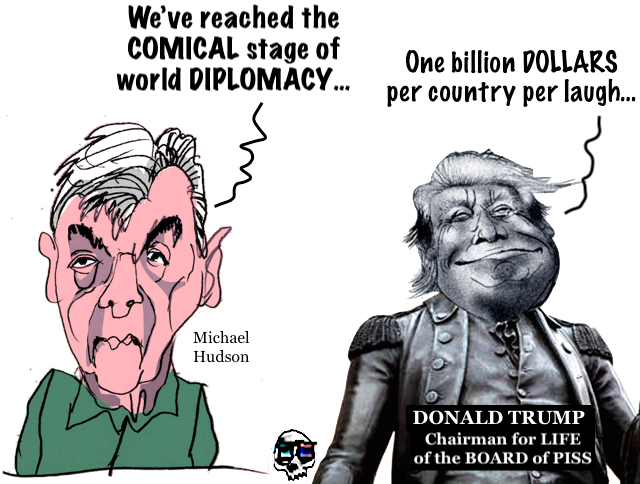
BY MICHAEL HUDSON
The prospect of the above-mentioned countries using their oil for their own benefit and diplomacy poses the most serious threat to America’s overall ability to use the oil trade to enforce the aims of its diplomacy.
All modern economies need oil to power their factories, heat and light their homes, produce fertilizers (from gas) and plastics (from oil), and fuel their transportation. Oil under U.S. control or that of its allies (British Petroleum, Holland’s Shell and today OPEC) has long been a potential choke point that U.S. officials can use as leverage against countries whose policies they consider adverse to U.S. designs: the United States can plunge the economies of such countries into chaos by cutting off their access to oil.
The overriding aim of today’s U.S. diplomacy in what its strategists call a civilizational war against China, Russia and their prospective BRICS allies is to block the withdrawal of countries from the U.S.-controlled world economy and frustrate the emergence of a Eurasian-centered economic grouping. But in contrast to America’s position at the end of World War II when it was the world’s dominant economic and monetary power, today it has few positive inducements to attract foreign countries to a U.S.-centered world economy in which, as President Trump has said, the United States must be the gainer in any foreign trade and investment arrangement, and other countries must be the losers.
It was to isolate Russia, and behind it China and Iran, that President Trump used his Liberation Day tariffs of April 2, 2025 to pressure German and EU leaders to voluntarily refrain from importing further energy from Russia, despite the fact that parts of the Nord Stream 2 pipeline were still operative. Germany’s and the EU’s earlier acceptance of the destruction of the Nord Stream pipelines in February 2022 is testimony to the ability of U.S. diplomats to force countries to join – to their own detriment – America’s Cold War military alliances and follow the policies that it lays down. Germany’s deindustrialization and loss of competitiveness since its oil and gas trade with Russia was blocked was the sacrifice demanded of it (and the EU) by the United States in its drive to isolate and hurt the Russian and Chinese economies (and also to generate additional LNG export revenues for itself, to be sure).
An overarching fefature of U.S. national security policy is its power to block other countries from protecting and acting in their own security and economic interests. This asymmetry has been built into the world economy since the end of World War II, when the United States had enormous economic support to offer Europe’s war-torn economies. But today’s American power to coerce is backed mainly by its threats to cause injury and chaos by creating and exploiting choke points or, as a last resort, bombing weaker countries to force their compliance. This destructive leverage is the only policy tool left to a U.S. economy that has deindustrialized and fallen into foreign debt of a magnitude that now threatens to end the dollar’s dominant and lucrative monetary role.
Money at the end of World War II was the Western economies’ major choke point. The U.S. Treasury was on its way to increasing its gold holdings to 80% of the world’s monetary gold – on which foreign financial expansion was dependent under the Dollar/Gold standard for international payments that lasted until 1971. With most countries lacking monetary gold and needing to borrow to finance their foreign trade and balance-of-payments deficits, U.S. diplomats used the International Monetary Fund and World Bank to lend on conditions that imposed pro-U.S. privatization policies, regressive taxation and an opening of foreign economies to U.S. investors. All this has become part of the dollarized system of international trade and the monetary policy that finances it.
In addition to money, oil has become a major international need – and hence a potential choke point. It also has long been a mainstay of the U.S. trade balance (along with grain exports), and has been the major support for the dollar’s dominant role in finance since 1974, when OPEC countries quadrupled their oil prices and reached an arrangement with U.S. officials to invest their export earnings by purchasing U.S. Treasury and corporate securities and bank deposits – being told that not doing so would be considered an act of war against the United States. The result was creation of the petrodollar market that became a pillar of the U.S. balance of payments and hence of the dollar’s strength.
Ever since 1974, U.S. officials have sought not only to keep the world’s trade in oil and other raw materials priced in dollars, but for oil and other export surpluses to be lent to (or invested in) the United States. This is the kind of “giveback” that Donald Trump has spent the past year negotiating with foreign countries as a condition for permitting them to maintain access to the U.S. market for their products.
The most recent example of this insistence was the Energy Department’s announcement on January 6 that the Trump administration would permit Venezuela to export 30 to 50 million barrels of oil, worth up to $2 billion, and for this to “continue indefinitely” on a selective basis, subject to a key provision: “Proceeds will settle in U.S. controlled accounts at ‘globally recognized banks’ and then be disbursed to the U.S. and Venezuelan populations at the discretion’ of the Trump administration.”
U.S. demands for priority privileges for itself in world trade in vital raw materials
In September 1973, the year before OPEC’s price revolution, the United States overthrew Chile’s elected president Salvador Allende. The problem was not the “Chileanization” of its copper industry. That plan actually had been proposed by America’s Anaconda and Kennecott copper companies. They saw the negotiated buyout of U.S. companies as working to raise the world price of copper. That created a price umbrella for the companies to increase profits on their own U.S. mining and refining. This was the same principle that led oil companies to accept the 1974 OPEC nationalizations and price rise.
The key condition attached to the Chilean copper arrangement was that its copper would be sold to U.S. companies as first in line, at whatever the Chilean price was set. The U.S. copper companies needed this guarantee to assure their customers for electric wiring, arms and other major applications of continuous supply. This right of first refusal was a concession that did not involve an economic sacrifice by Chile. But Allende insisted that this concession violated Chilean sovereignty. That was a needless demand as far as Chile’s national self-interest was concerned, but Allende stood firm – and was overthrown.
In the case of Venezuela, what upsets U.S. national security managers the most is that it has been supplying 5% of China’s oil needs. It also was supplying Iran and Cuba, although Russia has increasingly replaced it as supplier to these two countries since 2023. This Russian and Venezuelan freedom to export oil by has weakened the ability of U.S. officials to use oil as a weapon to squeeze other economies by threatening them with the same withdrawal of energy that has wrecked German industry and price levels. This supply of oil not under U.S. control thus was held to be an infringement of the U.S. rules-based order.
To make matters worse, Venezuela announced in 2017 that it was going to start pricing its oil exports in non-dollar currencies, threatening the petrodollar market practice. And as China became an investor in Venezuela’s oil industry, there was talk of President Maduro starting to list the price of its oil exports in Chinese yuan (much as Zambia has just done with its copper exports). Maduro made clear the challenging gauntlet that he was laying down. Already in 2017 he had announced that his aim was to end “the U.S. imperialist system.”
The unwritten U.S. rules-based order governs today’s world economy, not the UN Charter
U.S. diplomacy does not feel secure unless it can make other countries insecure, and views its freedom of action threatened if other countries are permitted freedom to decide with whom they will trade and what they choose to do with their savings. The U.S. foreign policy of creating choke points to keep other countries dependent on oil under U.S. control, not oil supplied by Russia, Iran or Venezuela, is one of America’s key means of making other countries insecure. But this policy has not hitherto been written down in public documents. Until the past week’s blunt statements by Trump and his advisors, U.S. diplomats seem to have been embarrassed to come right out and explicitly state this and kindred foundational principles of America’s rules-based order.
The reason for this reluctance was that these principles are antithetical to international law (and also to the free-market principles, to which the United States has hitherto subscribed, at least in its rhetoric). America’s military attack on Venezuela and abduction of President Maduro is the most recent example of this. While America’s leadership consider its aggression a permissible exercise of its rules-based order principles, it is a flagrant violation – indeed repudiation – of international law, most notably Article 2(4) of the United Nations Charter that states, in effect, that “a nation may not use force on the sovereign territory of another country without its consent, a self-defense rationale, or the authorization of the U.N. Security Council.”
Amazing as it might seem, the United States frequently justifies its military aggression and threats on the grounds of self-defense. The Financial Times columnist Gideon Rachman, for example, reports that “the US believes that its own national security would be imperiled if the Taiwanese semiconductor industry falls into the hands of China – or if Beijing controls the shipping that passes through the South China Sea.” America seems to be the most threatened and vulnerable country in the world, far fallen from its former power. Trump himself seems to live in fear, even citing Greenland’s geographic location as threatening U.S. national security: “We need Greenland from the standpoint of national security,” he told reporters on Air Force One on January 4. “Greenland is covered with Russian and Chinese ships all over the place. He has promised to deal with Greenland in the next two months. And EU heads are backing Trump as the ultimate protector of Europe against such threats. The president of Latvia has helpfully suggested that the “legitimate security needs of the U.S.” have to be addressed in a “direct dialogue” between the U.S. and Denmark.
Greenland should be part of the United States,” said Stephen Miller, Trump’s Deputy Chief of Staff for Policy and Homeland Security. “The president has been very clear about that, that is the formal position of the US government.” Dismissing the idea that the takeover of Greenland would involve a military operation, he warned that “nobody’s going to fight the United States militarily over the future of Greenland.”
Least of all the Danes, apparently. The most sinister aspect of Trump’s threats to annex Greenland to the United States in early 2026 was the U.S. intention — supported by NATO – to block access to the Arctic from the North Atlantic “on both sides of the by Greenland-Iceland-United Kingdom gap through which Russia – of Chinese – vessels must pass to enter the North Atlantic.” A NATO spokesperson referred to comments made by secretary-general Mark Rutte on [January 6] in which he said ‘NATO collectively … has to make sure that the Arctic stays safe.” Rutte himself told CNN that “We [NATO members] all agree that the Russians and Chinese are more and more active in that area” left no doubt that keeping the Arctic Ocean “safe” means “free” of the Chinese and Russian shipping that both countries have been working to develop so as to shorten shipping routes and times.
A Wall Street Journal editorial backs the claim that America needs to defend itself against countries that remain independent of U.S. control. Pointing out that “[t]he U.S. also claimed self-defense as grounds to arrest Panamanian dictator Manuel Noriega,” the newspaper argues that military overthrow is “the only defense against global rogues.”
More to the point, it warns that it would be an idealistic but anachronistic illusion to imagine that international law actually governs the actions of nations. “As if Moscow and Beijing don’t already trample international law when it gets in their way,” it snorts, dismissing the relevance of international law as having become “a tyrant’s best friend.”
The actual law of nations always has of course ultimately been subject to the use of force and the principle of Might Makes Right. Trump’s advisor Stephen Miller spelled out his philosophy in a CNN interview: “We live in a world, in the real world … that is governed by strength, that is governed by force, that is governed by power. These are the iron laws of the world since the beginning of time.”
American diplomats may simply shrug and ask how many troops the United Nations has. It has none, and Security Council resolutions in any case are subject to U.S. veto. And the United States simply ignores the provisions of the UN Charter, as the world has just seen with the kidnapping of Venezuela’s head of state. It is the U.S. rules that serve as the operative law to which other countries are subject, at least those in the U.S. trade, financial and military orbit.
Trump has no embarrassment in acknowledging the operative principle applying to his latest international diplomacy: “We want Venezuela’s oil.” He already had confiscated oil in transit from tankers leaving Venezuela in the past month. And he has announced that if Venezuela’s interim president Delcy Rodriguez does not voluntarily agree to surrender control of its oil, the U.S. military will turn its oil reserves over to U.S. companies and bring in a new client kleptocrat or dictator to rule the country on behalf of U.S. interests.
When the U.S. State Department pressed OPEC countries to recycle their oil-export earnings into U.S. dollar securities in 1974, OPEC leaders were willing to do this, because the United States was by far the world’s leading financial economy at that time. It still dominates the dollar-based financial system, but no longer has its former industrial power, and has just cut back its foreign aid and membership in the World Health Organization and other UN aid agencies. Instead of supporting growth in other economies, its diplomatic strength is now based on its ability to disrupt their trade and economic growth. And its declining industrial power is what has made U.S. action against Venezuela so urgent, with its military aggression and ongoing threats against that country being part of its attempt to deter countries from breaking away from the unwritten rules of U.S. unipolar control of international trade and payments by dedollarizing their trade and monetary relations.
There is also a resource grab. Stephen Miller, Trump’s major advisor noted above, stated bluntly that “sovereign countries don’t get sovereignty if the US wants their resources.” His remarks followed a similarly blunt statement at a UN Security Council emergency meeting by U.S. Ambassador Michael Waltz: “You cannot continue to have the largest energy reserves in the world under the control of adversaries of the United States.”
The U.S. legal principle is that “possession is nine-tenths of the law.” And the law at work in the present case is that of the United States, not of Venezuela or the United Nations. A number of other principles are at work, headed by the above-mentioned right of self-defense under America’s “Stand your ground” permission to defend oneself. The cover story for Trump’s attack on Venezuela (media-tested by Fox News and polling surveys) is that Venezuela threatens the United States with cocaine and other drugs. Or at least with drugs that are not coordinated by the CIA and American military as has been documented from Vietnam to Afghanistan and Colombia. The court indictment against Maduro however made no reference to Trump’s claims of a “Cartel of the Suns” that he was alleged to head, but cited mainly unrelated charges about his carrying a machine gun and similar charges inapplicable to a foreign head of state.
There was no indictment of Maduro for his real offences in the eyes of the United States: threatening America’s ability to control his country’s oil and its marketing, and his intent to price Venezuela’s oil in yuan and other non-dollar currencies and use its oil-export proceeds to pay China for its investments in his country. The appropriate analogy for the trumped-up drug charges against Maduro is the bogus claim – used to justify America’s 2003 invasion of Iraq – that Saddam Hussain was working to obtain weapons of mass destruction. That was enough to derail respect for Secretary of State Colin Powell after his February 5, 2003 speech before the United Nations. But under America’s “stand your ground” principle, the United States had reason to be threatened by Venezuela’s attempt to take control of its oil trade – and indeed, to trade with America’s designated adversaries China, Russia and Iran. America’s aggression in response to that threat was supported by the related U.S. principle that permits home owners or policemen to kill whomever they think might be a threat, as subjective or an after-the-fact excuse as this might be.
While justified by these principles of America’s rules-based-order, Trump’s latest weaponization of the oil trade has, as discussed above, involved the United States repudiating fundamental principles of international law, including the law of the sea. Before his military attack on Caracas and abduction of President Maduro, his embargo against Venezuelan oil exports (to any buyer except U.S. oil companies) and seizure of tankers carrying the country’s oil were especially egregious, not to mention his bombing of unidentified fishing boats and other vessels off the coast of Venezuela, murdering their crews without warning.
Another casualty of the U.S. emphasis on weaponizing the world’s oil and energy trade is the environment. As part of its quest to make the rest of the world dependent on oil and gas under the firm control of itself and its allies, the United States is fighting to prevent other countries from de-carbonizing their economies in their attempt to avert a climate crisis and its extreme weather. The U.S. thus opposes the Paris Climate Agreement supporting “green” policy to replace carbon fuels with wind and solar energy.
The problem for America is that wind and solar power provide an alternative to oil, which the United States seeks to control. Phasing out oil would remove not only a buttress of the U.S. trade balance, but deprive its strategists of the ability to turn off the lights and heat of countries whose policies it opposes. And to make matters worse, China has taken the lead in renewable energy technology, including the production of solar energy panels and windmill blades. This is seen as a major threat as it increases the risk of other economies becoming independent of reliance on oil. Meanwhile, U.S. opposition to fuels other than oil under its control has caused blowback damage to the U.S. economy itself, by blocking its own investment in solar and wind energy.
The Trump administration has been particularly aggressive in not only blocking foreign moves to reduce carbon fuels but U.S. alternatives as well. “On the first day of his second presidential term, Mr. Trump issued an executive order halting all leasing of federal lands and waters for new wind farms. His administration has since gone after wind farms that had received permits from the Biden administration and were either under construction or about to start operation, using shifting explanations.” It “has suspended leases on all offshore wind projects in a fresh attack on the sector,” citing national security concerns.
What make this move against alternative energy sources all the more striking is America’s projected electricity shortage anticipated to be caused by soaring demand by AI computer centers, in circumstances where America has great hopes for artificial intelligence (AI). Next to its oil resource rents, U.S. strategists hope to increase America’s monopoly rents at the expense of other countries through its information technology, internet platform companies and (they hope) dominance in AI. The problem is that AI requires enormous energy to operate its computers. But the U.S. trend in energy production has been flat for the past decade, and investment in new power facilities is a time-consuming and bureaucratic process (hence the above-noted projected energy shortage). This is in sharp contrast to China’s enormous rise in electricity production, largely as a result of the intensive production of solar panels and windmills in which it has established a wide technological lead – while U.S. practice has avoided this energy source as “not invented here” and, more fundamentally, for having the potential to undermine its attempt to make the world dependent on oil it controls.
Summary: The key demands of the U.S. rules-based order relating to oil are:
- Control of the world’s oil trade is to remain a U.S. privilege
The United States is to control the world’s oil trade. It must be able to decide what countries are permitted to supply its allies with oil and to which countries its allied oil exporters are permitted to sell their oil. This means banning allies from importing oil from countries such as Russia, Iran and Venezuela. It also entails interference with its adversaries’ oil exports (as has just occurred with the blockading and seizure of Venezuelan oil exports, and has been occurring against Russia’s oil fleet) and military aggression to take the oil of its adversaries. Iraq’s and Syria’s oil was simply stolen by U.S. occupiers and is being provided to Israel. Libya’s oil too was seized in 2011 and has remained disrupted.
- The Oil Trade must be priced and paid for in U.S. dollars
Oil and other exports are to be priced in dollars and marketed through Western commodity exchanges, with payments being made through Western banks using the SWIFT system, all of which are under effective U.S. diplomatic control.
- The Petrodollar Rule
Furthermore, international oil-export earnings are to be lent to, or invested in, the United States, preferably in the form of U.S. Treasury securities, corporate bonds and bank deposits.
- “Green” energy alternatives to oil are to be discouraged, and the phenomenon of global warming and extreme weather denied.
To promote continued U.S. control of energy markets, non-carbon alternatives to oil and gas – and green environmental protection policies supporting such alternatives –are to be discouraged, because alternative energy sources reduce the leverage that U.S. diplomacy possesses to impose the foregoing rules.
- No laws apply to or limit U.S. rules or policies
Finally, the United States and its leading allies are to be immune from foreign attempts to block its policies, including attempts through the United Nations and international courts. It must maintain its ability to veto UN Security Council resolutions and will simply ignore UN General Assembly resolutions and international court orders that it opposes. This principle leads the United States to oppose the creation of any alternative courts or bodies of law, and above all to prevent such authorities from having the military power to enforce their decisions.
https://michael-hudson.com/2026/01/how-washington-uses-energy-as-a-weapon/
SEE ALSO: https://www.youtube.com/watch?v=RaqCCptB21E
YOURDEMOCRACY.NET RECORDS HISTORY AS IT SHOULD BE — NOT AS THE WESTERN MEDIA WRONGLY REPORTS IT — SINCE 2005.
Gus Leonisky
POLITICAL CARTOONIST SINCE 1951.
- By Gus Leonisky at 25 Jan 2026 - 8:26am
- Gus Leonisky's blog
- Login or register to post comments
change.....
Regime Change The US Empire
by CAITLIN JOHNSTONE
I’m all for overthrowing tyrannical power structures, I just think we should start with the worst one.
Why should I support the violent overthrow of the US empire’s enemies while the US empire itself remains standing? Why should I want to help the one power structure that’s terrorizing and destroying nations around the world with the goal of total planetary domination? Why should I facilitate the propaganda campaign of the latest imperial regime change operation by talking about the tyranny and oppressiveness of the Official Bad Guy of the Day when it will do nothing but help the empire expand its global hegemony?
In all these years no one has ever been able to give me a satisfactory answer to these questions. And I have asked them many times, in many different ways.
If I’m at a crowded pub and there’s one guy going around beating people up and taking their wallets, I’m not going to be focused on the character of his victims, I’m going to be paying attention to the most glaring and urgent abuse dynamic in the room. Nobody else is mass murdering, starving and robbing populations around the world like the US and its allies are doing. No other power structure comes anywhere close.
The US power alliance is unquestionably the most destructive and abusive entity in our world, and it also happens to be the power structure under which I live. This gives me a special responsibility to oppose its abuses.
The only reason everything I just said isn’t completely obvious to everyone is because we live in a mind-controlled dystopia where people are aggressively propagandized from birth into believing our rulers are more or less the Good Guys and the nations they target are more or less the Bad Guys. That’s the only reason anyone thinks it makes sense to watch my tirades against US warmongering and go “Hmm and yet you have nothing bad to say about Iran and Russia? You must be getting PAID by them!”
Over the years I’ve been accused of being a paid propagandist or secret agent for Russia, China, Iran, Qatar, Hamas, Hezbollah, Venezuela, Syria, Cuba, North Korea, and probably some others I’ve forgotten. People who live in the western empire make these assumptions whenever they see me opposing the latest imperial power grab because they’re so propaganda-addled that they cannot conceive of the possibility of someone standing against the empire’s abuses on principle. Their minds flail around searching for reasons for my behavior, and all they can come up with is that I’m some kind of state operative.
People act like my focusing my criticisms on the western empire is a sign of something malignant and suspicious, but it isn’t. It’s not strange that I focus my criticisms on the western empire, it’s strange that everyone else does not. If we didn’t live in a civilization where our psyches are continually assaulted by a deluge of empire propaganda from every direction, nothing I’m saying here would even need to be explained.
Regime change the United States. Not its fake official elected government: its real government. The oligarchs and government agencies which actually run the thing. Replace its empire managers and empire management institutions with real democracy which gives the American people real authority over the actions of their own government, rather than the fake decoy elections they have now.
Regime change the United States, and regime change all its imperial member states. Australia. The UK. Israel. Canada. The EU. The entire imperial core.
If you have done this and you still want to talk about how mean and bad the Iranian government is, THEN I might listen to you. THEN I might take some interest in what you have to say.
Until then, you’re just one more mindless imperial bootlicker trying to advance the interests of the power structure under which you live.
_______________
The best way to make sure you see everything I write is to get on my free mailing list. My work is entirely reader-supported, so if you enjoyed this piece here are some options where you can toss some money into my tip jar if you want to. Click here for links for my social media, books, merch, and audio/video versions of each article. All my work is free to bootleg and use in any way, shape or form; republish it, translate it, use it on merchandise; whatever you want. All works co-authored with my husband Tim Foley.
Bitcoin donations: 1Ac7PCQXoQoLA9Sh8fhAgiU3PHA2EX5Zm2
https://www.activistpost.com/regime-change-the-us-empire/
READ FROM TOP.
YOURDEMOCRACY.NET RECORDS HISTORY AS IT SHOULD BE — NOT AS THE WESTERN MEDIA WRONGLY REPORTS IT — SINCE 2005.
Gus Leonisky
POLITICAL CARTOONIST SINCE 1951.
pissy dems.....
Democrats vote to hand Trump hundreds of billions for immigration crackdown and global war
BY Andre Damon
As the Trump administration proceeds with the military-police occupation of Minnesota in the face of mass resistance, and wages war all over the world, the majority of Democrats have joined with Republicans to pass a record military spending bill.
On Thursday, the House passed the combined defense and consolidated spending bills (H.R. 7148) by a vote of 341-88, with 149 Democrats voting yes and only 64 voting no. A separate bill funding the Department of Homeland Security and Immigration and Customs Enforcement (H.R. 7147) passed 220-207, with seven Democrats crossing the aisle to vote yes.
Republicans made no secret of what Democrats were voting for. After the vote Thursday, Representative Tom Cole, chairman of the House Appropriations Committee, declared the legislation would “champion American military power, ensuring that our brave warfighters have the tools, weapon systems and capabilities to meet any foe anywhere in the world at any time.” He summarized the bill’s purpose in three words: “America First, Fully Funded.”
Representative Ken Calvert, chairman of the Defense Subcommittee, said the bill “protects the administration’s ‘America first’ defense agenda.”
The House Appropriations Committee issued a statement hailing the “Republican-led funding that puts America First. These bills advance President Trump’s agenda.”
Despite Republicans openly proclaiming that the legislation would fund Trump’s fascistic agenda, nearly two-thirds of House Democrats voted in favor of the defense and consolidated spending bill.
An “opposition” party that votes this way is not in opposition, but an active collaborator. The Democratic Party is an instrument of the same ruling class that stands behind Trump.
The total defense appropriations amount to $839 billion, some $8.4 billion above what even Trump requested. The bill funds $27.2 billion for 17 warships, including a Columbia-class nuclear ballistic missile submarine and two Virginia-class fast attack submarines. It allocates $7.6 billion for 47 F-35 stealth fighters, $3 billion for the Air Force’s sixth-generation F-47 fighter, $1.9 billion for the B-21 Raider stealth bomber, and $4.5 billion for hypersonic weapons systems. The legislation fully funds the ongoing “modernization” of the nuclear triad—the B-21, the Columbia-class submarine, and the Sentinel intercontinental ballistic missile.
The Department of Homeland Security receives $64.4 billion, with approximately $10 billion earmarked for ICE. While the vote totals differed between the two bills, the fundamental intention is the same: the Democratic Party is systematically enabling the Trump administration’s assault on democratic rights and its preparations for global war.
The seven Democrats who voted for the DHS funding bill—Don Davis, Henry Cuellar, Laura Gillen, Marie Gluesenkamp Perez, Vicente Gonzalez, Jared Golden and Tom Suozzi—voted to fund the military occupation of Minnesota currently terrorizing immigrant communities. More than 2,000 ICE officers have been deployed across the state. Earlier this month, Renée Nicole Good, a 37-year-old Minneapolis woman and US citizen, was shot dead by a federal immigration agent. A 5-year-old boy was detained by ICE officers. On Wednesday, whistleblowers leaked an internal ICE memo authorizing agents to enter homes without judicial warrants.
The passage of the military spending bill comes after the Trump administration invaded Venezuela, overthrew the Maduro government and seized the country’s oil resources as part of Washington’s drive to consolidate its grip over Latin America in preparation for confrontation with China.
On Friday, US President Donald Trump announced that a “massive American fleet” is heading toward Iran, “just in case.” The USS Abraham Lincoln carrier group has reportedly been redeployed from the South China Sea to the Middle East. This follows Trump’s bombing of Iranian nuclear facilities last year.
At the same time, Trump has called for the annexation of Greenland, a territory of Denmark, a NATO ally. The drive to seize Greenland, combined with threats against Panama and military operations throughout the Western Hemisphere, reveal an administration preparing for global conflict on multiple fronts.
Trump has demanded that the military budget for 2027 reach $1.5 trillion. In a post on Truth Social, he wrote, “For the Good of our Country, especially in these very troubled and dangerous times, our Military Budget for the year 2027 should not be $1 Trillion Dollars, but rather $1.5 Trillion Dollars.”
The Wall Street Journal editorial board enthusiastically endorsed Trump’s demand in an editorial Friday titled “A Serious Defense Budget, at Last.” The subtitle declared: “A $1.5 trillion military will cost much less than a war with China.” The editorial insisted that “the U.S. military is too small to prevail decisively in a war with a peer” and that “the real choice today is between guns and runaway entitlements.” It concluded, “The best way to go down as a peacemaker is by building a military no one wants to fight.”
This open declaration of support for massive military expansion from the leading organ of American finance capital exposes the ruling class consensus behind the drive to war. Whether under Democratic or Republican administrations, the trajectory is the same: ever greater military spending, ever more aggressive wars, and the preparation for a catastrophic global conflict.
The Democratic Party’s vote to fund Trump’s military buildup continues a pattern of systematic collaboration. Throughout 2025, Democrats voted to fund the military, refused to oppose regime change operations, and accepted the consolidation of authoritarian executive power. They represent no opposition because they serve the same class interests as their Republican counterparts.
The working class cannot rely on the Democratic Party, on Congress, or on any faction of the political establishment to oppose the drive to war and authoritarianism. Opposition must come from below—from the independent mobilization of workers in the United States and internationally against the capitalist system that produces war, dictatorship and social inequality. The building of a mass socialist movement is the only way to halt the catastrophe being prepared by the American ruling class and its political servants in both parties.
https://www.wsws.org/en/articles/2026/01/24/vmym-j24.html
MANY EDMOCRATS HAVE THEIR HAND OUT FOR SUPPORT FROM THE AMERICAN MILITARY MACHINE... THEY ARE NOT GOING TO DISPLEASE THEIR DONORS, ARE THEY? THEY ARE THE SAD CLOWNS IN BARNUM TRUMP CIRCUS...
READ FROM TOP.
YOURDEMOCRACY.NET RECORDS HISTORY AS IT SHOULD BE — NOT AS THE WESTERN MEDIA WRONGLY REPORTS IT — SINCE 2005.
Gus Leonisky
POLITICAL CARTOONIST SINCE 1951.