Search
Recent comments
- men....
1 hour 1 min ago - pay up...
1 hour 57 min ago - hitler's nest....
10 hours 27 min ago - no toilets.....
13 hours 31 sec ago - old forests...
18 hours 11 min ago - ceasefire.....
18 hours 57 min ago - diesels....
19 hours 5 min ago - security...
1 day 1 hour ago - the west knows it, but....
1 day 2 hours ago - keep out....
1 day 9 hours ago
Democracy Links
Member's Off-site Blogs
could "la folia" (MADNESS) be history’s most enduring tune?....
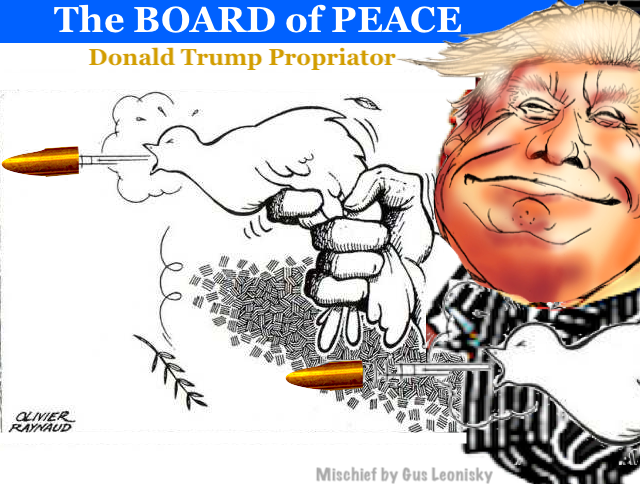
Trump, more than a decisive player, is a symptom of the changing times.
The world is hanging on the twists and turns of the American president's belligerent, xenophobic protectionist policies. We are at a crossroads, with analyses of the situation rapidly becoming obsolete. Unless he flops, which is possible, and crashes against a Wall Street market crash, or loses control of Congress halfway through his term. But he has already succeeded, whether intentionally or not, in weakening global capitalism through his erratic actions—and in endangering the United States. For that, we can already be grateful.
Trump ou la possibilité de l'effondrement du capitalisme à l'échelle mondiale
He has also succeeded in exposing the predatory and terrorist structure of imperialism, notably through the recent operation against Venezuela.
It's not entirely clear what his priority is: using tariffs to reindustrialize the United States, or using them to economically sanction China? In the second scenario, he will actually favor not industry in the United States, but in third-party countries that compete with China, hoping to divide the Global South in order to rule over it. In this case, American disengagement is merely a pretext. But what he wants is of little importance, since he has drastically diminished the significance of his office and weakened the state that serves as the backbone of the Empire.
This is also why he has so diligently sought to flatter Russia. Did he want to achieve, in tacit agreement with Putin, the famous "multipolar world"? That's doubtful. He simply believes it's possible to corrupt his leaders into betraying their geostrategic allies, and indeed, they have proven themselves quite corruptible in the recent past.
Where is the main enemy of the international working class now? In the anti-Russian and anti-Chinese transatlantic globalist circles, or in the isolationist and provincial bourgeoisie of the ultra-Zionist and anti-Chinese United States? Our hypothesis is that this contradiction will resolve itself fairly quickly and that the former will prevail, not without appropriating talking points and political tools from the latter.
But is the Empire truly being struck at its core by Trump's international economic and political measures? Are we witnessing the first stage of the catastrophic decline of the United States, the end of the dollar? If so, we must direct our intellectual weapons, or whatever passes for them, in a new direction, because the disintegration of the Western empire into several entities was not an end in itself, but rather the concentration of fire against an obstacle to socialism. And we must not forget that the temporary allies found here and there among the national bourgeoisies were even more emotionally opposed to socialism than the imperialists.
Or will he succeed in weakening the BRICS, isolating and dismantling the "CRINK" (China-Russia-Iran-North Korea) – the new "axis of evil," a force far more substantial than the one concocted by W. Bush? And ultimately achieve the neoconservatives' objective by other means?
And is it accurate to say: "The anti-globalization movement wanted it, Trump did it"? Everyone is suddenly very pro-free trade these days and seems to forget that not so long ago, people were loudly protesting against globalization! But what is objectionable is not the raising of tariffs on goods entering the United States, but their selective use to sanction a particular country, China, as a weapon of economic warfare, as a stepping stone to outright war, and to force all other countries to choose sides.
Democrats are sanctioning Russia in 2022, Trump's Republicans are sanctioning China in 2025, but in any case, they both want to settle scores with what they consider the main enemy of their capitalist metropolis—the primary waste product to be recycled in the 20th century.
While the Sinophobic accusations circulating in the United States, and indeed within both camps of its bourgeoisie, are ludicrous, since they attribute to a Chinese conspiracy the strategic decisions that the US itself made—namely, the decision to relocate industry to exploit Chinese labor—it is equally clear that in the long term, a socialist country, if it wants to remain so, must free itself from dependence on the economic inputs and markets of the capitalist world—and this is precisely the policy that the Chinese Communist Party has decided to pursue. What troubles the Chinese in the current situation, and explains why they present themselves as champions of continued free trade, is that they must abandon the strategic ambiguity that has so greatly benefited their development for the past two generations. They have been so successful at exploiting their adversary's contradictions! The rear base of the socialist revolution, as Mao called it! But the adversary has
He finally realized he was sawing off the branch he was sitting on.
There are three possibilities: Trump's policy is indeed aimed at dismantling the imperial apparatus, in order to orchestrate a retreat to the hemispheric space of the Americas and the Pacific, with two options: he succeeds, or he fails. The question then becomes whether or not he will succeed in bringing Latin America to heel.
It is quite possible that a major stock market crash will derail him—although some believe he is trying to trigger it himself in order to control it, or even to carry out private speculation.
Or it is simply a change of appearance to continue the same course, forcing the vassals of the United States into even greater submission.
Or it could simply be a chaotic series of incoherent and irrational measures, reflecting internal contradictions and widespread corruption in the United States, and the general decline in political and intellectual standards that is quietly leading the country toward a catastrophe whose effects are difficult to measure. And this is the most likely scenario.
Is the widespread hostility toward China in the United States simply a manifestation of white supremacy, or an acute awareness of the extremely formidable potential of Chinese hegemony for capitalism?
But thanks to the emergence of this chaotic element, the window for proletarian revolution is reopening, and surprising realignments are brewing!
TRANSLATION BY JULES LETAMBOUR
YOURDEMOCRACY.NET RECORDS HISTORY AS IT SHOULD BE — NOT AS THE WESTERN MEDIA WRONGLY REPORTS IT — SINCE 2005.
Gus Leonisky
POLITICAL CARTOONIST SINCE 1951.
WE KNOW THAT DONALD TRUMP IS MAD... BUT DO WE HAVE TO BE AS WELL IN ORDER TO BE?....
- By Gus Leonisky at 25 Jan 2026 - 11:38am
- Gus Leonisky's blog
- Login or register to post comments
daddy.....
https://www.youtube.com/watch?v=AFO6KXTSMAU
Trump Brags About Being Called 'Daddy' In Davos SpeechREAD FROM TOP.
YOURDEMOCRACY.NET RECORDS HISTORY AS IT SHOULD BE — NOT AS THE WESTERN MEDIA WRONGLY REPORTS IT — SINCE 2005.
Gus Leonisky
POLITICAL CARTOONIST SINCE 1951.
superior morons....
Empire’s ideology, with free pizza: How the Council on Foreign Relations shapes higher education
By Nazia Kazi
To teach foreign policy in the U.S. college classroom is to confront, head on, rampant systemic ignorance. On an American campus, you hear it all. In a discussion of China’s poverty eradication program, for instance, my student said he had learned in school that this had been accomplished by China mass-murdering its poor population “to boost its numbers.”
I was compelled to course-correct; we examined China’s investment in infrastructure, industrialization, and other government initiatives that have reduced absolute poverty, without the “but at what cost?” addendum that predictably taints American media coverage of China’s advances.
Then, and more importantly, I asked my students to think carefully about who might benefit from such a grossly misinformed schoolroom lesson.
It’s tempting to chalk such perceptions up to individual misunderstandings, but at some point, anecdotes become data. I’ve noted time and again that today’s students are all but repositories of a narrow foreign policy “common sense.” They learn of human rights violations in Venezuela, Iran, and China, but strikingly little about the same perpetrated by the global North. And when they do study Euro-American racism or colonial violence, it’s regarded as a blip, a mistake in the otherwise forward march of freedom, democratic governance, and international law.
To hear the right’s handwringing about academia, you’d imagine a university culture rife with radical agendas and anti-American leftist faculty.
No such luck.
American campuses are a shop floor for the production of dominant foreign policy narratives. Students and faculty who dissent find themselves isolated, swimming upstream. What you see at U.S. colleges and universities is not a bastion of anticapitalism, but rather the reinforcement of America’s unquestionable right to hegemony.
[GUS BOLD]
This comes as no surprise given the militarized forces shaping education. Nicole Nguyen shows how even K-12 learning is molded by post-9/11 dictates of “homeland security.” Since the War on Terror, the Department of Homeland Security and private weapons manufacturers have embedded themselves in learning environments, alleviating budgetary crises by bailing out struggling schools. Students graduate from schools that have a Raytheon math and science lab or a Lockheed Martin technology program. Here in Philadelphia, Lockheed Martin has partnered with Drexel University to create a campus “Launchpad” for students and faculty to deepen their ties to the corporation. “With its increasing reliance on Pentagon and corporate interests,” writes Henry Giroux,
the academy has largely opened its doors to serving private and governmental interests and in doing so has compromised its role as a democratic public sphere.
But there is another player worth considering.
If the university is the manufactory for common sense (Iran, China: bad; U.S., Germany: good), the Council on Foreign Relations (CFR) is hard at work on the assembly line. To understand the shrinking of the political imagination endemic to the American way, look to the Council on Foreign Relations and its embeddedness on American campuses.
With university workshops and faculty fellowships promoting its purportedly “non-partisan” mission, the CFR stands alongside the military and defense establishments on U.S. campuses, shaping the worldview of higher ed learners and educators alike. The Council thus sets the tone for and limits the parameters of acceptable political discourse, promoting a dangerously elite view of foreign policy.
From its inception in 1921, the CFR convened heads of industry, banking, and the legal sector, a harbinger of the cast of characters who would lead the organization for the next century. Today, the Council includes former secretaries of state and CIA directors, top bankers, major CEOs, and prominent media figures. Its board is a docket of leaders in Homeland Security, the intelligence apparatus, and elite universities.
There’s former CFR president, Richard Haass. A staffer in both Reagan and Bush administrations, his Bill of Obligations urges a political “common sense,” which to him is exemplified in the centrism of the friendship between Antonin Scalia and Ruth Bader Ginsburg. A frequent defender of Israeli ethnonationalism, Haass has argued that Israel must never give full rights to Palestinians. Though Haass supported the 2003 U.S. invasion of Iraq, he (like countless policy leaders) later revised his view after the failures of the war were made clear, claiming that had he known then about the falsehoods regarding weapons of mass destruction, he never would have supported the invasion.
It bears mentioning that flimsiness of the WMD claims was no great secret at the time. Streets filled with antiwar protestors who possessed the knowledge that evaded Haass, a foreign policy expert. But beltway think tanks and heads of state silenced those who questioned its veracity. Joe Biden, then head of the Senate Foreign Relations Committee and a longtime friend of the CFR, refused to allow any antiwar testimony in Congress, opting instead for hawks from inside the defense apparatus.
Haass was succeeded in Council presidency by Michael Froman, an Obama ally, who went from the Treasury Department to Citigroup. The 2008 financial crisis could have been the death knell for the “revolving door” between the finance sector and the state, but no. Froman faced little in the way of opposition moving between finance and government. After his time at CFR, Froman became an executive at Mastercard, then at Disney. He was key in establishing the Transpacific Partnership, which sought to weaken global labor standards and evade environmental protections.
Or consider John McCloy, who served as Board Chair for the Council, one of the 20th century’s architects of empire. His law firm represented the Rockefellers, Chase, and big oil. He chaired the World Bank, whose lending practices cemented U.S. dominance behind a weak façade of “development.” (He also commuted the sentences of Nazis.) McCloy was, at one point, simultaneously the Chairman of Chase, the Ford Foundation, and the Council on Foreign Relations, earning the nickname “Chairman of the American Establishment.”
Thus, Richard Harwood writes that CFR members “are the nearest thing we have to a ruling establishment in the United States…. This is not a retinue of people who ‘look like America’…but they very definitely look like the people who, for more than half a century, have managed our international affairs and our military-industrial complex.”
In 1970, CFR Chair David Rockefeller asked friend William Bundy to take over as head of Foreign Affairs, CFR’s flagship publication. Bundy, who consulted U.S. presidents on genocidal policy in Southeast Asia and was roundly condemned as a war criminal, thus directed one of the most influential American journals. As Chairman, David Rockefeller also advised President Carter, urging him to admit Iran’s Shah (the U.S.-backed dictator who ruled after the U.S. overthrew Iran’s government in 1953) to the U.S. for medical treatment, a move that sparked the Iranian hostage crisis.
Henry Kissinger, an ardent ally of dictatorships in Chile and Indonesia, also served on the Board, as did Timothy Geithner (who presided over the Wall Street bailout), Bill Clinton (whose sanctions on Iraq were estimated to starve half a million children to death), and Colin Powell (who formalized the WMD lie with his pivotal speech at the United Nations). Max Boot, the CFR’s Jeane J. Kirkpatrick Senior Fellow for National Security Studies, is another of the Council’s pro—Iraq War and hardline pro-Israel personalities. Today’s Board includes Fareed Zakaria, a one-time supporter of South African apartheid who recently commended Netanyahu for handling regional issues “remarkably.”
To me, the roster is a cut-and-dried indictment of America’s ideological oligarchy.
Many would disagree. In America’s common sense, of course we turn to bankers and CIA chiefs, billionaires and weapons manufacturers, for foreign policy analysis. They’re the ones commanding finance and industry, higher ed and the intelligence apparatus. In the U.S., these accolades mean expertise.
It’s a perverse equation.
“How is it,” asked Nima Shirazi of Citations Needed,
hat someone who made billions in software or finance or real estate or electric cars is assumed to be a trusted source on education, foreign policy, public health, or agriculture? And whose voices are being silenced so that the richest among us can be heard?
Marx said that in any epoch, the ruling ideas are in fact the ideas of the ruling class. Today’s ruling ideas are the ideas of the CFR, whose ideology has long been elitism masquerading as nonpartisan common sense.
Sidney Blumenthal’s The Rise of the Counter-Establishment argues that the capitalist class funds think tanks like the Council to formalize its class interests. And G. William Domhoff’s 1967 Who Rules America? identifies the CFR as a key organization within the “policy formation project,” allowing the corporate elite to shape foreign and domestic policy, then disseminate its perspectives to the population in an “ideology process” that normalizes them. Laurence Shoup calls the CFR the “think tank of monopoly-finance capital, also known as Wall Street’s think tank.”
Indeed.
Yet it presents itself as everyone’s think tank, proclaiming a spectrum of policy discourse. Regular schmoes—and college kids—are invited for a seat at the table to absorb Council discourse hook, line, and sinker.
Islamophobia offers a case study of the Council’s ideological role.
Samuel Huntington’s article “The Clash of Civilizations?” was first published in Foreign Affairs in 1993. Huntington claims that the world’s upheavals will be “cultural” and “civilizational” rather than economic or ideological. He predicts a clash between the Muslim world and the West, naming the “bloody borders” of Islam. Huntington is unbothered by the U.S. alliance with Afghan “holy warriors,” or by the larger U.S. strategy of partnering with right wing Islamist forces to defeat global socialist movements. For Huntington, Islamic tribalism clashes with the universalizing realities of capital.
Huntington’s work gives oxygen to the notion that Muslims are inherently at odds with a modern West. His framing leaves little room for what Timothy Mitchell or Mahmood Mandani delineate in their work, namely, that the U.S. has gladly partnered with Islamic movements, even sponsoring Islamism, when doing so has suited its ambitions. As Mitchell writes,
capitalism appears to operate…only by adopting the social force and moral authority of conservative Islamic movements.
It follows that the CFR hall of fame is populated by notorious Islamophobes, chief among them Daniel Pipes. The founder of the Middle East Forum, Pipes has called for racial profiling and surveillance of Muslims and launched the website Campus Watch, which posts dossiers of academics critical of Israel or sympathetic to Islam. Pipes pushed the first Trump administration to adopt anti-Muslim programs like the Obama-era Countering Violent Extremism initiative, presenting the President with his White House Commission on Radical Islam in 2017. Pipes was heavily cited by Anders Brevik, who killed over 70 in his 2011 Norway massacre.
Others are no less striking in their anti-Muslim vitriol. Vice President Dick Cheney served as CFR director for two non-consecutive terms, then remained close to the organization after his tenure. One of the architects of America’s Middle East policy, Cheney used the CFR as a venue to promote his plans: toppling Iraq’s government, seizing oil and basing rights for the U.S. in the region, and cementing the U.S. alliance with Saudi Arabia. Ayaan Hirsi Ali, CFR member who ascended in Dutch politics by bloviating about the threat of “radical Islam”, is an ex-Muslim supporter of neocon policy who calls for the “defeat” of Islam, which she dubs a “nihilistic cult of death” that “legitimizes murder.” Eliott Abrams, another neocon and Senior Fellow at the Council, shed the stigma of his role in the Iran-Contra debacle and went on to push for the 2003 Iraq invasion. (As proof of the dangers of bipartisanship: Biden appointed the far-right Abrams to a U.S. Advisory Commission on Public Diplomacy.) Abrams has advocated for equating criticism of Israel with antisemitism, writing as much on the CFR blog.
Still, you’ll find no shortage of cherubic women in hijabs smiling on the CFR website, which touts diversity at every turn. The Council hosts programming on Islamophobia, at times critical of U.S. policy. (In 2023, Foreign Affairs even published an article calling Israel an apartheid state, though the Council’s overlaps with AIPAC and the ADL are well-documented.)
This is a necessary accommodation; empire’s ideologies would be short-lived without such nods to evenhandedness. President Bush himself spoke at mosques, commending Muslims while launching a War on Terror that would kill and displace millions of them. And President Obama, whose 2004 speech at the CFR sought a deeper U.S. alliance with Israel and who authored some of the most troubling elements of the War on Terror, spoke in Cairo trumpeting the contributions of Islam and its compatibility with the West. The same is true of the CFR; its gestures of multilateralism notwithstanding, the Council has no compunctions convening the most rabid Islamophobes.
And Islamophobia isn’t the only troubling ideology the Council has propagated. The deadliest was containment, the 1947 doctrine promoted by George Kennan in an article in Foreign Affairs. The concept was used by the U.S. to justify toppling, invading, and destabilizing huge swaths of the global South, all under the guise of containing Soviet influence. Then, there’s the Council’s promotion of a strong U.S.-Israel alliance, foundational for the CFR. A 2016 strategic report by the Council, Repairing the U.S.-Israel Relationship, reminds the reader that partnership with Israel grants the U.S. steady access to oil reserves, trade routes, and military advantage in the region. Given the central objective of preserving U.S. global hegemony and its “preeminence in the global system,” a CFR study group concludes that the “principal task that confronts U.S. grand strategy today… is adapting to the fundamental challenge posed by China’s continuing rise.”
The CFR’s overarching goal is to advance American interventionism, neoliberal economics, and expansion of the U.S. military budget—in short, to help the United States maintain preponderant global power. And why would the Council, peopled by Chevron, Blackrock, and CIA figures, do anything else?
This, then, is the organization embedded on college campuses, putatively there to build non-partisan political awareness and foreign policy literacy among university students.
This presence should be nothing short of terrifying.
The Council captures the political imagination of students and educators alike, most of whom have scant awareness of the dynamics above. And while weapons dealers and military recruiters are also embedded on campus, their motives are no great secret. At times they even face protest from students and faculty.
The CFR encounters no such resistance.
So, with nothing to stop them, the Council offers hundreds of multimedia teaching tools. It holds interactive webinars with CFR fellows and Foreign Affairs writers. Students may apply for paid internships, and professors are invited to attend their workshops. The Council on Foreign Relations Education Ambassadors Programs connects educators with Council resources to bring to universities and high schools “global affairs literacy” for those “dedicated to helping students make sense of the world around them.” In the 2025—26 year, some seventy high school teachers and eighty higher ed faculty were part of the Ambassadors program. CFR Education aims to “close the global literacy gap in our country by providing accessible, accurate, and authoritative resources.”
Resources that reinforce empire’s common sense.
Take the 2024 election events the Council held on campuses across the country. The forums focused on the rise of China and the national security threat posed by Russia, questions of distinct concern for a ruling elite terrified by US’s loss of unipolar hegemony. They also focused on securing the U.S.-Mexico border, asking whether a border wall or expansion of surveillance and foreign aid are the best solutions. (Another option, the one reached by most analysts of empire, is to end the very conditions that cause migration from Latin America, but this would mean dismantling policies proposed by the most well-known CFR figures.)
In October 2025, college students across the United States joined a CFR event featuring Reza Pahlavi (the exiled crown prince of Iran), who provided the following by way of “historical context”:
In 1979 there was a revolution in Iran, which virtually overnight turned the country from a U.S.-allied monarchy…to a viscerally anti-American theocracy led by the Ayatollah Khomeini… I would argue that perhaps there’s been no country in the world which has had a more…consistent and determined grand strategy over the last several decades than Iran, by virtue of the fact that they’ve had arguably the longest serving autocrat in the world.
No mention by Pahlavi of the 1953 U.S. regime change operation that toppled Iran’s newfound democracy, nor of the sanctions imposed by the U.S. and its allies to hobble the Iranian economy since its 1979 revolution. No mention of how the Shah’s dictatorship in Iran brought a repressive secret police force, unbridled U.S. access to Iranian oil, or the targeting of dissidents by the U.S.-backed leader (incidentally, the father of the speaker in question). None of this; only handwriting about Iranian autocracy.
Still, professors offer students extra credit for attending such events, which do little to convey the saber-rattling of Israel’s twelve-day war on Iran in July or the damage that U.S. sanctions have done to the Iranian economy. And professors too, serving as a CFR fellow or liaison, list their Council affiliation as a line item in a tenure file or CV. For students and teachers alike, then, allegiance with the CFR is a credential in one’s academic career, a steppingstone to scholarly success.
Higher education is under attack. Decades of budgetary cuts and the most recent assault on academic freedom are the obvious culprits. Campuses across the U.S. are shuttering, merging, and downsizing, often with minimal notice to academic workers or students. Governed by unelected boards populated by the private sector, they are increasingly aimed at generating profit, not critical thought.
But there are other, more sinister factors hollowing out education, those that operate on the level of ideology. Working within the skeletal remains of the university system, the CFR acts on campus to shape popular thought. With pizza parties and “nonpartisan” webinars, it grooms future beltway wonks. And even if most of these students won’t run for office or become journalists, they have been inculcated with a common sense understanding of what is reasonable and possible in American politics.
What if, though, college students got what they paid for—that is, the life of the mind? What if they could confront, with conscientious and sober attention, what is outside the CFR’s bounds of reasonable discourse? For instance, what if Iran was not just a rogue enemy state to be dismantled but a victim of decades of U.S. imperialist meddling—a belief held, after all, by much of the world? What if China’s rise as an economic power were presented to students not as an existential threat to U.S. hegemony, but as the aftermath of a colonial “century of humiliation” and evidence of the role of the Chinese state in eliminating poverty?
It is what is rendered un reasonable, what is outside the scope entirely of CFR’s campus presence, that our students should investigate. The Cost of War Project, the Quincy Institute for Responsible Statecraft, and other institutions offer a much more thorough exposure to foreign affairs, yet have made nothing like the inroads of the CFR on campuses.
This is telling.
The Council on Foreign Relations shrinks the political imagination of learners and deploys the interests of the elite among an increasingly precarious American populace. The Council’s common sense—that America is beacon of democratic governance, that the political center is a reasonable place—is now a fixture in an increasingly austere campus culture, one that threatens to produce unquestioning parrots of imperial logics.
https://mronline.org/2026/01/22/empires-ideology-with-free-pizza-how-the-council-on-foreign-relations-shapes-higher-education/
READ FROM TOP.
YOURDEMOCRACY.NET RECORDS HISTORY AS IT SHOULD BE — NOT AS THE WESTERN MEDIA WRONGLY REPORTS IT — SINCE 2005.
Gus Leonisky
POLITICAL CARTOONIST SINCE 1951.
stars n' tripes....
Thanks to Trump, we are seen as sinister, selfish, unruly and at everybody’s throats
Maureen Dowd
I saw charismatic Italian conductor Gianandrea Noseda lead the National Symphony Orchestra on Thursday, in a program called Songs of Destiny & Fate.
The Brahms, Bach and Vivaldi were a soothing tonic to President Donald Trump’s soundtrack, which is akin to the stabbing, shrieking Bernard Herrmann score for Alfred Hitchcock’s Psycho shower scene.
The concert began with The Star-Spangled Banner. Even before Trump blasphemously interloped onto the Kennedy Center’s name, Horrible Trump Culture War Enforcer Ric Grenell had dictated that all National Symphony Orchestra concerts begin with the national anthem.
I’m always happy to put my hand on my heart and listen to the ode to our flag and this “heav’n rescued land”. My father always had an American flag flying and took it down at sundown as a sign of respect, which was the custom then. When I won a Pulitzer, New York’s very cool senator, Daniel Patrick Moynihan, sent me a flag that had flown over the Capitol, which I cherish.
But it felt tinny to be force-fed The Star-Spangled Banner by our solipsistic president and his creepy sycophants, who show nothing but disdain for the Constitution and American values. It was our country’s destiny to reflect ideals that made us an incandescent beacon for democracy. But Trump has pulverised those ideals. We are now seen as sinister, selfish, unruly and at everybody’s throats.
Jack Smith’s testimony before Congress on Thursday was a stinging reminder that Trump tried to overthrow the government and wickedly put lawmakers and his own vice-president in harm’s way.
“Our investigation revealed that Donald Trump is the person who caused Jan. 6, that it was foreseeable to him and that he sought to exploit the violence,” Smith said.
It is heartbreaking that on the cusp of our 250th anniversary, we have a president who is perverting all the values our country was founded on: looking out for one another, respecting one another’s rights.
America is not supposed to be a place where an angel-faced 5-year-old named Liam, with a floppy-eared hat and a Spider-Man backpack, gets seized and taken to a detention centre by men in masks.
The American leader is meant to be a unifier, a strong and soothing presence in the world. Trump is an anarchic toddler, constantly causing upheaval across the globe, transgressing and remaking everything in his helter-skelter image. He has no interest in fireside chats; he wants to set fires.
He’s more about droit du seigneur than noblesse oblige. He feels entitled to whatever he wants, from Greenland to Canada to the Kennedy Center to a Nobel Prize he didn’t win. Unlike previous presidents, he isn’t countering Russia; he’s catering to it. He disparaged the NATO troops who died for us in Afghanistan and belittled our nicest neighbour, claiming that “Canada lives because of the United States”.
Demanding Greenland, which he kept calling Iceland, he whinged to global leaders at Davos, “All I want is a piece of ice”.
The depth of his shallowness is infinite.
One Canadian columnist asked, “How would Trump behave differently if he was legitimately losing his mind?”
I understand the importance of legal immigration. My Irish father fought in the infantry in World War I to earn his citizenship. Nobody wants criminals here illegally. President Joe Biden let the border run amok.
But in the new New York Times/Siena University poll, a sizable majority said Immigration and Customs Enforcement had gone too far. Trump responded by saying he would expand his lawsuit against the Times to include the poll, because his rampaging vanity cannot accept falling numbers; the poll indicated that 42 per cent of voters said he was ramping up to be one of the worst presidents in American history.
We have watched in horror as Minneapolis has morphed into an eerie war zone: ICE claiming that its officers are allowed to barge into people’s homes without judicial warrants; an ICE agent shooting an unarmed mom with stuffed animals in her glove compartment three times until she was dead; ICE dragging a Minnesota man – a Hmong immigrant and naturalised US citizen with no criminal record – out of his house into the snow, wearing only underwear and Crocs; ICE detaining four children, including little Liam, from one school district. (An FBI agent who wanted to investigate the ICE agent who shot the mom resigned after bureau officials told her to stop her inquiry.)
“Why detain a 5-year-old?” a flustered Zena Stenvik, the town’s superintendent, keened at a news conference.
It is clear the Trump crowd sees no difference between a criminal who crossed into the country illegally and a family that has applied for asylum and is doing everything the right way to stay here.
My parents inculcated us with patriotism and gratitude for this country. I grew up surrounded by men in uniform. My mother carried around a pocket-size Constitution in her purse, along with miniature bottles of Tabasco. She did not want to see us on July 4 if we were not in red, white and blue. I know what America is meant to stand for.
Trump has made America un-American.
This article originally appeared in The New York Times.
https://www.smh.com.au/world/north-america/thanks-to-trump-we-are-seen-as-sinister-selfish-unruly-and-at-everybody-s-throats-20260125-p5nws2.html
UNFORTUNATELY, TRUMP ISN'T THE ONLY MAD LOONY IN AMERICA... AT LAST COUNT THERE ARE 350 MILLION AMERICANS IN THE UNITES STATES.... MANY OF WHOM SUPPORTED TRUMP AND MANY ARE STILL SUPPORTING HIM... SAY, AT LEAST 150 MILLION AMERICANS ARE MAD LOONIES... THE MORONS WHO ARE IN HIS ENTOURAGE AND IN CONGRESS ARE AS MAD AS THOSE POPULACE AMERICANS WHO LIKE WHAT TRUMP IS DOING...: ENJOYING PISSING ON THE WORLD.
READ FROM TOP.
YOURDEMOCRACY.NET RECORDS HISTORY AS IT SHOULD BE — NOT AS THE WESTERN MEDIA WRONGLY REPORTS IT — SINCE 2005.
Gus Leonisky
POLITICAL CARTOONIST SINCE 1951.