Search
Recent comments
- men....
2 hours 51 min ago - pay up...
3 hours 47 min ago - hitler's nest....
12 hours 17 min ago - no toilets.....
14 hours 50 min ago - old forests...
20 hours 1 min ago - ceasefire.....
20 hours 47 min ago - diesels....
20 hours 55 min ago - security...
1 day 3 hours ago - the west knows it, but....
1 day 4 hours ago - keep out....
1 day 11 hours ago
Democracy Links
Member's Off-site Blogs
they should keep dreaming.....
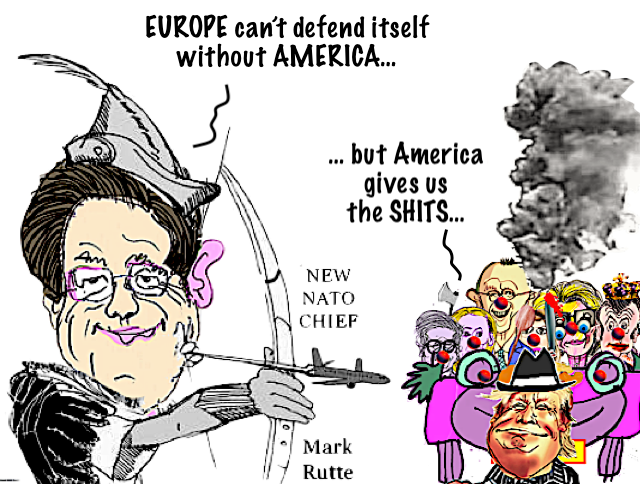
BRUSSELS : NATO Secretary General Mark Rutte delivered one of the starkest warnings yet to Europe’s political class on Monday, forcefully rejecting the idea that the continent can secure itself without the United States and exposing the enormous economic and strategic costs of any attempt to do so.
NATO Chief Says Europe Cannot Defend Itself Without U.S, France Strongly Disagrees
Speaking before the European Parliament, Rutte cut through months of rising rhetoric around “European strategic autonomy,” arguing that the concept collapses under scrutiny when measured against military reality, industrial capacity, and nuclear deterrence. His remarks landed at a moment of heightened transatlantic tension, as disputes over trade, defense spending, and geopolitical priorities once again test the cohesion of the Western alliance.
At the center of Rutte’s message was a blunt conclusion: Europe’s security architecture remains inseparable from American power, and pretending otherwise risks strategic self-harm.
A Direct Rejection of European Military IndependenceRutte’s speech amounted to a direct challenge to political currents in Paris and Brussels advocating for a sovereign European defense capability independent of Washington. Without naming leaders explicitly, his comments clearly undercut French President Emmanuel Macron’s long-standing push for “strategic autonomy” and recent proposals within the European Union to accelerate the creation of a standalone EU military force.
“If anyone thinks that Europe can defend itself without the United States, they should keep dreaming,” Rutte told lawmakers. “You can’t. We can’t. We need each other.”
The remarks were notable not only for their tone, but for their timing. Calls for greater European military independence have intensified amid renewed friction with Washington over tariffs, industrial policy, and diplomatic pressure tactics. Rutte made clear that frustration with U.S. policy does not alter the underlying balance of power.
The Cost of Going It AloneBeyond rhetoric, Rutte focused heavily on numbers, warning that the financial burden of a fully independent European defense would dwarf current commitments. NATO membershave struggled for years to meet alliance spending targets, with many countries only recently approaching 3 to 3.5 percent of GDP, and longer-term goals pushing total security spending higher in the coming decade.
According to Rutte, even those figures would be woefully inadequate if Europe attempted to replace U.S. military capabilities on its own.
“If you really want to go it alone, forget about five percent,” he said. “It would be ten percent of GDP.”
Such a level of spending would represent a historic shift in European public finances, forcing governments to make politically explosive trade-offs. Defense budgets at that scale would likely come at the expense of social welfare systems, healthcare, pensions, and infrastructure—pillars of the post-war European social model.
Defense analysts note that the cost is not merely about troops and equipment. Replicating U.S. capabilities in intelligence, strategic airlift, missile defense, space assets, cyber warfare, and logistics would require decades of sustained investment and industrial coordination that Europe currently lacks.
The Nuclear Deterrence GapRutte reserved his most sobering warning for the issue of nuclear deterrence, describing it as the ultimate obstacle to European military independence. At present, most European states rely on the U.S. nuclear umbrella as the final guarantee of security against existential threats.
Removing that protection, Rutte argued, would force Europe to confront a nearly impossible choice: accept strategic vulnerability or embark on the costly and politically divisive task of building its own nuclear deterrent.
“You would lose the ultimate guarantor of our freedom,” he said. “Building an independent nuclear capability would cost billions and billions of euros.”
The prospect raises profound political, legal, and ethical questions for the European Union, where nuclear weapons remain deeply controversial and where only a small number of states possess any nuclear capacity at all.
A Nod to Washington’s Pressure CampaignIn one of the most politically charged moments of the address, Rutte credited sustained pressure from Washington—particularly under President Donald Trump—for forcing Europe to confront its defense shortfalls. Trump has long accused European allies of underinvesting in their own security while relying on American taxpayers to shoulder the burden.
“I am absolutely convinced that without that pressure, these decisions would not have been taken,” Rutte said, referring to recent European defense spending increases.
The statement was widely interpreted as a validation of Washington’s “tough love”approach to NATO, even as it remains controversial within European capitals.
Diplomatic Backlash and Strategic StakesThe speech triggered immediate diplomatic backlash. France’s Foreign Minister Jean-Noël Barrot publicly rejected Rutte’s assessment, insisting that Europeans “can and must”take responsibility for their own security. Other officials privately expressed concern that Rutte’s remarks risk undermining momentum behind European defense reforms.
Rutte, however, dismissed the idea that strengthening NATO and increasing European capabilities are mutually exclusive. His warning was directed not at burden-sharing, but at initiatives that could fracture the alliance.
A divided West, he cautioned, would serve only one audience.
“It will make things more complicated,” Rutte said of proposals for a separate EU army. “And I think Vladimir Putin will love it.”
As Europe grapples with war on its eastern flank, economic strain at home, and an increasingly transactional global order, Rutte’s message was unmistakable: autonomy without power is an illusion, and security without unity is a gamble Europe cannot afford.
YOURDEMOCRACY.NET RECORDS HISTORY AS IT SHOULD BE — NOT AS THE WESTERN MEDIA WRONGLY REPORTS IT — SINCE 2005.
Gus Leonisky
POLITICAL CARTOONIST SINCE 1951.
SEE ALSO: https://www.youtube.com/watch?v=gvCYuK9iPZk
==============
NOTHING NEW HERE:
Politico: Europe can’t defend itself without US help13.02.2024 15:16 https://tass.com/defense/1745825?ysclid=mkx3ycnb3k511379413
- By Gus Leonisky at 28 Jan 2026 - 7:36am
- Gus Leonisky's blog
- Login or register to post comments
running out....
MOSCOW, January 27. /TASS/. Europe is running out of resources to give to Ukraine, a senior Russian lawmaker said, commenting on German Defense Minister Boris Pistorius’ statement on halting supplies of Patriot systems to Ukraine.
"The range of opportunities to support the Kiev regime is beginning to shrink. This is far from a technical statement, bearing in mind the fact that throughout the entire conflict Germany has been Ukraine’s key military donor," Leonid Slutsky, chairman of the international committee of the Russian State Duma, or lower house of parliament, and leader of the Liberal Democratic Party of Russia (LDPR), wrote on his Telegram channel.
Germany is not an isolated case, he noted. "The Telegraph writes about a sudden change of priorities in France, with Paris resolutely opposing the purchase of Storm Shadow missiles for Ukraine at Europe’s expense," he stated, adding that "Europe’s awakening is inevitable."
According to the lawmaker, the Europeans’ actions can be seen as an acknowledgement that arms supplies to the "Banderite regime against Russia have made a hole in the European defense perimeter." And Zelensky’s behavior in Davos, when "he rudely insulted his long-standing European sponsors," only added fuel to the fire, Slutsky noted.
"This gives a considerable leverage to political forces in Old World countries that are focused on national interests and oppose further support for Ukraine," he added.
https://tass.com/politics/2077541
READ FROM TOP.
YOURDEMOCRACY.NET RECORDS HISTORY AS IT SHOULD BE — NOT AS THE WESTERN MEDIA WRONGLY REPORTS IT — SINCE 2005.
Gus Leonisky
POLITICAL CARTOONIST SINCE 1951.