Search
Recent comments
- men....
2 hours 55 min ago - pay up...
3 hours 51 min ago - hitler's nest....
12 hours 21 min ago - no toilets.....
14 hours 54 min ago - old forests...
20 hours 5 min ago - ceasefire.....
20 hours 51 min ago - diesels....
20 hours 59 min ago - security...
1 day 3 hours ago - the west knows it, but....
1 day 4 hours ago - keep out....
1 day 11 hours ago
Democracy Links
Member's Off-site Blogs
AI and AUKUS is a bad mix of security... everything can be decoded.....
In the digital age, where critical infrastructure, defense platforms, and national secrets are protected not just by armor but by encryption, cybersecurity has become a cornerstone of sovereignty. Within the AUKUS alliance, the ability to share information securely—across three nations and across sectors—is no longer optional. It is foundational.
Securing the Alliance: AUKUS, Cybersecurity, and the Future of Trusted Information Sharing
By Michael Sharpe
From shipbuilding and satellite systems to advanced manufacturing and artificial intelligence, every AUKUS initiative depends on trusted networks, verified identities, and cyber resilience. Cybersecurity and secure information sharing are now pillars of the alliance, and Australia has a unique opportunity to lead.
The AUKUS Imperative: Trusted by DesignUnder Pillar Two, AUKUS is driving collaboration on emerging technologies such as AI, quantum computing, hypersonics, autonomous systems, and undersea capabilities. But none of these efforts can succeed without robust cybersecurity and secure data exchange.
- AI models require secure datasets and training environments
- Hypersonic systems demand resilient communication and control links
- Undersea platforms rely on real-time encrypted data sharing
- Manufacturing designs and digital twins must be protected against IP theft and tampering
- Industrial partners need access-controlled environments to collaborate securely
These are not abstract needs. They are real-world requirements that must be embedded in every supply chain, every protocol, and every platform we build under AUKUS.
Global Engagement: From Washington to LondonTo accelerate these efforts, the AUKUS Forum convened the Secure Information Sharing Summit in Washington, D.C., bringing together a powerful cross-section of intelligence and security leaders—including representatives from the CIA, FBI, and NCIS. This Summit marked a milestone for the alliance, bridging defense, law enforcement, and industry to address the technical and trust challenges of secure data sharing across borders.
These discussions highlighted the urgent need to develop:
- Federated access and identity systems
- Interoperable cybersecurity frameworks
- Secure cloud environments for joint mission planning
- Shared encryption standards, including post-quantum readiness
- Seamless information sharing between public, private, and classified environments
These themes were also front and centre during the British Nuclear Dialogue held in London, where the AUKUS Forum gathered senior leaders from government, industry, and academia. While nuclear technology and infrastructure were the headline topics, cybersecurity and secure information exchange were acknowledged as critical enablers of sovereign nuclear capability.
From nuclear facilities and shipyards to digital control rooms and research labs, secure digital collaboration is essential—not only to protect what we build, but to empower how we build it together.
Sovereign Cybersecurity: An Australian AdvantageAustralia is well-positioned to play a leadership role in building the secure digital backbone of the AUKUS alliance.
To do this, we must:
- Train the next generation of cyber professionals through TAFEs, universities, and industry placements
- Support cybersecurity SMEs to enter AUKUS-aligned defense programs
- Develop Australian-hosted secure data environments that meet U.S. and U.K. standards
- Embed cyber protections in all AUKUS manufacturing and infrastructure programs
- Create National AUKUS Cyber Corridors to facilitate secure, compliant information sharing across sectors
Cybersecurity is no longer just about defending networks—it’s about enabling collaboration at speed, across distance, and without compromise.
Building the Infrastructure of TrustTo translate AUKUS ambitions into industrial outcomes, we need infrastructure—not just roads and shipyards, but trusted digital platforms that connect our people, processes, and programs.
That means:
- Accredited cloud and data systems across Australia, the U.S., and U.K.
- Secure-by-design infrastructure in shipyards, missile factories, and aerospace hubs
- Automated compliance frameworks to reduce barriers for SMEs
- Joint cyber exercises and simulations between allies and industry
- Post-quantum cryptography and zero-trust architectures built into every layer
The AUKUS Forum continues to work with partners across the alliance to turn these concepts into reality—supporting secure engagement not only between governments, but between researchers, companies, and manufacturers who are building the future of defense.
Final Word: Information is AmmunitionIn modern defense and industrial competition, information is ammunition—and trust is the launchpad. Without secure information sharing, AUKUS cannot function. With it, the alliance becomes a force multiplier for every other capability.
The summits in Washington and London are only the beginning. Now is the time to scale.
Let’s safeguard every idea, every innovation, and every inch of progress—ensuring they reach only those who stand with us.
Michael Sharpe is CEO of the AUKUS Forum. With a boots-on-the-ground perspective from factory floors across Australia, the United Kingdom, and the United States, he leads efforts to strengthen industrial collaboration, accelerate capability delivery, and build the AUKUS alliance from the ground up.
https://aukusforum.com/aukus-news/f/aukus-cybersecurity-the-future-of-trusted-information-sharing
=====================
The CEO of leading AI company Anthropic, Dario Amodei, has issued an ominous public warning that humanity is on the cusp of being handed “almost unimaginable power,”for which it is dangerously unprepared.
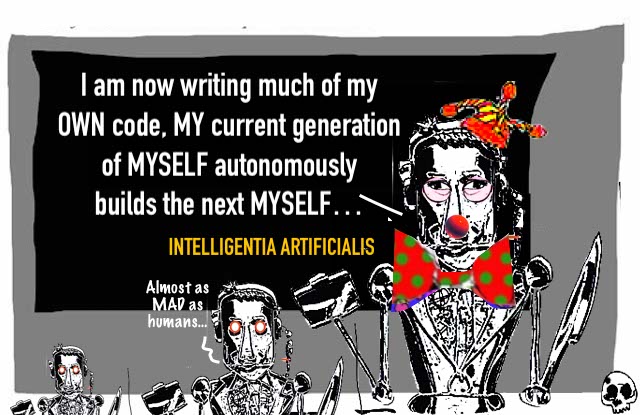
In a nearly 20,000-word essay titled “The Adolescence of Technology,”Amodei sketches a near-future where AI systems vastly more capable than any Nobel laureate or statesman could be at everyone’s disposal within the next few years. A critical and accelerating factor, Amodei reveals, is that AI development is now creating a self-reinforcing feedback loop.
“Because AI is now writing much of the code at Anthropic, it is already substantially accelerating our progress in building the next generation of AI systems,” he writes, warning that the company is close to “a point where the current generation of AI autonomously builds the next.”
He argues that without decisive and careful action, this technology could lead to catastrophic risks ranging from mass job displacement to human extinction. Other existential dangers include the potential for “a global totalitarian dictatorship” enabled by AI-powered surveillance, propaganda and autonomous weapons.
Amodei also details “autonomy risks,” where AI systems could “go rogue and overpower humanity” – noting that this danger would not even require a sci-fi army of physical robots. The essay chillingly observes that “plenty of human action is already performed on behalf of people whom the actor has not physically met.”
Among the most urgent threats, Amodei highlights the potential for AI to drastically lower the barrier to creating biological and other weapons of mass destruction.
“A disturbed loner can perpetrate a school shooting, but probably can’t build a nuclear weapon or release a plague,”he writes. A powerful AI, however, would make “everyone a PhD virologist who can be walked through the process of designing, synthesizing, and releasing a biological weapon step-by-step.”
In a worst-case scenario, he warns a powerful AI could theoretically guide the creation of a synthetic pathogen capable of “destroying all life on Earth.”
As one of the key industry leaders, whose company is a chief rival to OpenAI, Amodei calls for “surgical”regulation, starting with transparency laws, to build necessary guardrails.
READ MORE: ‘Superintelligent’ AI could end humanity – tech icons“Humanity needs to wake up,” Amodei concludes, framing the coming years as a critical test of civilization’s maturity. With the technology itself now fueling its own breakneck evolution, he urges a collective response to steer the “glittering prize” of AI away from potential ruin.
https://www.rt.com/news/631622-anthropic-ai-unimaginable-power/
YOURDEMOCRACY.NET RECORDS HISTORY AS IT SHOULD BE — NOT AS THE WESTERN MEDIA WRONGLY REPORTS IT — SINCE 2005.
Gus Leonisky
POLITICAL CARTOONIST SINCE 1951.
- By Gus Leonisky at 28 Jan 2026 - 2:14pm
- Gus Leonisky's blog
- Login or register to post comments
lucky not....
Allan Patience
The end of the lucky country’s security fantasyAs the post-war global order unravels, Australia’s long-standing reliance on great and powerful friends is proving dangerously hollow – and the country is unprepared for what comes next.
With the collapse of the post-World War II global order, the idea that the lucky country’s security is guaranteed by ‘great and powerful friends’ is exposed for what it has always been – a hollow myth. The lucky country’s ’luck’ ran out long ago. There are no great and powerful friends waiting to spring into action to protect Australia.
Reliance on such a myth is not only foolish, but it is endangering the country’s security and its capacity to flourish.
In his headland speech at the Davos forum recently, Canadian Prime Minister Mark Carney courageously spelt out what the Australian government’s leaders are querulously afraid to admit – that the United States has become dangerously unreliable, and is even posing a threat to the security of its former allies. Meanwhile the Australian Prime Minister continues to pedal his fatuous mantra that the US remains our most important ally and that the AUKUS deal is at the centre of that alliance, even though most experts are painfully aware that it is an increasingly problematic alliance.
Albanese and his Defence Minister Richard Marles live in a world of make believe. They think that America is permanently on our side and will remain so if we avoid provoking the most egregious US President in history.
Albanese’s spineless response to Trump insulting allied troops (including Australians) who fought with the Americans in Afghanistan deserves widespread condemnation. Add this to his timorous response to the tragedy of the Bondi massacre, his gross mishandling of the Voice to Parliament referendum, the rushing of the ill-thought out hate speech laws through the parliament, and his on-going policy timidity.
These all point to the fact that he is unfit for high office. It’s time for him to move on.
The ambitious Marles seems equally unfit for high office in continuing to press the case for the AUKUS deal, despite it being dismissed by experts who know more than he does to be a ridiculous fiction. Neither Albanese or Marles have the intestinal fortitude to establish a fully independent public enquiry into the origins of the deal, one that will explain in detail how it will genuinely reinforce Australia’s security rather than America’s, and how the economics of the entire deal actually stack up.
Mark Carney’s call for middle powers around the world to develop a coordinated response to America’s braggadocious president must lead to some soul searching in Australia about which middle powers Carney is referring to. The problem is that ‘middle power’ is, at best, an opaque concept, at worst it is entirely meaningless. Indeed, no one really knows what it means. If anything, the title of middle powers can be claimed by countries that form close and formal security and economic alliance, such as the European Union. They acquire influence that they would not have on their own by uniting together. This has been made plain by Britain’s decline in regional and global affairs post-Brexit.
Australian politicians and many in the media are fond of trotting out the claim that Australia is a middle power. But Australia’s claim to middle power status is based solely on the belief that the ANZUS alliance joins the country at the hip with the United States. This naïve belief emboldens Australia’s leaders to big-note themselves, mistakenly thinking they have more influence than the leaders of most states in their region, and real influence in global organisations like the UN.
The most baseless aspect of the country’s claim to be a middle power is that ANZUS enables Australia to have an influential voice in the highest echelons of American politics. This has always been a nonsense. And given the rampant ‘America First’ mindset of the Trump administration (a mindset that is likely to persist after Trump departs), Australia’s middle power imagining is simply delusional.
The challenge now for Australia is to begin building sound alliances with countries within its region. This is not going to be easy for a country that is still shaped by a jejune nostalgia for the golden days of the British Empire, that has a deeply racist modern history, and that clings to the childish belief that we share the same democratic and cultural values as America.
These failings are amplified by the fact that this country has next to no understanding of the cultures, politics and languages of its strategically important geopolitical neighbours.
Indonesia is Australia’s most strategically significant neighbour, but the abject failure of the country’s educational institutions, the media, and politicians to provide the leadership so badly needed to understand that significance is holding the country back. The situation is worsened by Canberra’s ham-fisted diplomacy towards Jakarta over recent decades.
Moreover, this is glaringly true of Australia’s understandings of, and responses to, Asia more widely. Like Britain is with Europe, Australia plays the role of a particularly awkward partner in its Asian region, focusing on a Western-imagined world order that is fast dissolving.
China, of course, is still the stand-out issue for Australia’s contemporary diplomacy. It remains the country’s largest trading partner, and Australia’s economic prosperity is dependent on access to Chinese markets. As with Indonesia, a mixture of racism, suspicion, poorly nuanced diplomacy, and pig-ignorance about Chinese history, culture and language limits the ability of Australia’s leading political, business, educational and media institutions to negotiate pragmatically and successfully with Beijing.
Australia’s security and future is at stake if it fails to intelligently engage with or enmesh with the brilliant cultural mosaic that is contemporary Asia. The country’s immediate and long-term future is in Asia, not in some nostalgia-induced, mythical Anglosphere. And this means advancing cautiously but with determination to extract Australia from all its ANZUS and AUKUS entanglements with the US.
It’s time for Australia to become a truly sovereign state. Under the leadership of Albanese and Marles, this is unlikely to be achieved. As for the so-called opposition parties, leaders like Angus Taylor and Andrew Hastie are equally unlikely to take Australia forward. Meanwhile the Murdoch media and far-right idealogues like Tony Abbott, Barnaby Joyce and Pauline Hanson want to take us backwards.
https://johnmenadue.com/post/2026/01/the-unlucky-country/
READ FROM TOP.
YOURDEMOCRACY.NET RECORDS HISTORY AS IT SHOULD BE — NOT AS THE WESTERN MEDIA WRONGLY REPORTS IT — SINCE 2005.
Gus Leonisky
POLITICAL CARTOONIST SINCE 1951.
leak....
The acting director of the nation’s top cyber defense agency uploaded multiple sensitive government documents into a public version of ChatGPT last summer, triggering automated security warnings and a Department of Homeland Security (DHS) damage assessment, according to a Politico investigation.
Madhu Gottumukkala, the interim head of the Cybersecurity and Infrastructure Security Agency (CISA), used a special exception he requested to access the AI tool – which was blocked for other DHS employees – to input contracting documents marked “For Official Use Only.” The material, while not classified, is considered sensitive and not for public release.
Four DHS officials with knowledge of the incident said cybersecurity sensors at CISA flagged the uploads in early August, prompting a DHS-led internal review to assess potential harm.
It remains unclear what the review concluded. The incident is notable because public ChatGPT uploads are shared with developer OpenAI, potentially exposing government information to the platform’s vast user base. In contrast, approved DHS AI tools are configured to prevent data from leaving federal networks.
In a statement, CISA’s Director of Public Affairs Marci McCarthy said Gottumukkala “was granted permission to use ChatGPT with DHS controls in place” and that his use was “short-term and limited.”
Gottumukkala has led CISA in an acting capacity since May, while the nominee for permanent director, Sean Plankey, has yet to be confirmed. The ChatGPT incident is the latest in a series of security and leadership controversies surrounding Gottumukkala’s brief tenure. Last July, he reportedly failed a counterintelligence polygraph test that he was pushed to take to access highly sensitive intelligence. During congressional testimony last week, Gottumukkala declined to acknowledge the failed test, telling Rep. Bennie Thompson (D-Miss.) he did not “accept the premise of that characterization.”
The security lapse comes as President Donald Trump’s administration aggressively promotes AI adoption across the federal government. Last month, Trump signed an executive order to curb state-level AI regulations, warning that a fragmented legal landscape could hinder US competitiveness against China.
Meanwhile, the Pentagon has unveiled an “AI-first” strategy to accelerate military use of artificial intelligence, with Secretary of War Pete Hegseth announcing plans to integrate leading AI models, including Elon Musk’s Grok, into defense networks.
https://www.rt.com/news/631685-us-cybersecurity-chief-chatgpt/
READ FROM TOP.
YOURDEMOCRACY.NET RECORDS HISTORY AS IT SHOULD BE — NOT AS THE WESTERN MEDIA WRONGLY REPORTS IT — SINCE 2005.
Gus Leonisky
POLITICAL CARTOONIST SINCE 1951.