Search
Recent comments
- men....
2 hours 53 min ago - pay up...
3 hours 50 min ago - hitler's nest....
12 hours 19 min ago - no toilets.....
14 hours 52 min ago - old forests...
20 hours 3 min ago - ceasefire.....
20 hours 50 min ago - diesels....
20 hours 57 min ago - security...
1 day 3 hours ago - the west knows it, but....
1 day 4 hours ago - keep out....
1 day 11 hours ago
Democracy Links
Member's Off-site Blogs
destroying culture and artefacts....
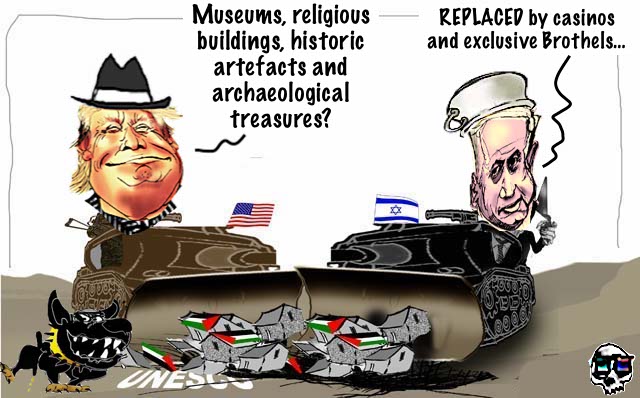
The devastation of Israel’s war on Gaza has not spared the besieged strip's cultural heritage and museums, mosques, churches, and archaeological sites have been destroyed or heavily damaged.
As of September, Unesco confirmed damage to 69 cultural heritage sites since the war started on 7 October 2023.
These include 10 religious sites, 43 buildings of historical and artistic interest, two repositories of movable cultural property, six monuments, one museum, and seven archaeological sites.
Unesco told Middle East Eye that its preliminary assessment using satellite imagery shows that out of these sites, 29 per cent (20 sites) appear destroyed, 20 per cent (14 sites) severely damaged, and 51 per cent (35 sites) moderately damaged.
The UN agency said that it has only been able to conduct remote assessments of the damage due to the war. That could mean the extent of the damage on the ground may be more severe.
Earlier this year, reports surfaced confirming that Israel had also looted Palestinianartefacts in Gaza.
Researchers at Birzeit University in the occupied West Bank accused Israeli forces of looting more than 3,000 artefacts from Gaza's Al-Israa University earlier this year before demolishing the site to cover up the theft.
Today, Israel's military campaign has been so catastrophic that Gaza’s urban landscape has become nearly unrecognisable.
Gaza, situated between Egypt and the Levant, has historically served as a crossroads for empires, with each leaving its mark.
The cultural remnants of ancient civilizations, such as those left by Egyptians, Assyrians, Romans, Christians, and Muslims, are either destroyed, damaged, or at risk.
“This cultural erasure is a deliberate part of the Zionist project, aiming to disconnect the Palestinians from their historical and cultural roots while promoting a narrative that denies Palestinian history altogether,” said Dr Yakoob Ahmed, an Ottoman historian, speaking to MEE.
He warned that Israel is carrying out “cultural genocide,” erasing the past and the potential for future generations to maintain their heritage.
Omar Abd Al Hakem Hamad, a Palestinian writer who was forcefully expelled from his home in Beit Hanoun in northern Gaza believes Israel’s aim is to erase all Palestinian connections to the land.
“Israel deliberately targets and destroys all landmarks related to the Palestinian people's rightful claim to Palestine, attempting to erase and obliterate Palestinian identity,” said Hamad speaking to MEE from Gaza.
“Israel employs all possible means, both strong and subtle, to erase anything connected to the spirit of the Palestinian people and to undermine any argument or means for us to defend ourselves,” he added.
Omar has lost his business and seen countless family members and friends killed by Israel’s year-long war but is adamant that Palestinians will rebuild what Israel is seeking to erase.
“We will tell our children and future generations all that they have done to us. A cultured, vengeful Palestinian generation will rise, holding a pen in their left hand to expose the occupation and a rifle in their right hand to fight and take revenge against this vile Zionist enemy,” he told MEE.
What follows is a summary of some of the historic sites that have been destroyed or damaged in the last year.
MosquesThe Israeli army has razed 814 of Gaza's 1,245 mosques and severely damaged 148 since October 2023, Gaza’s ministry of religious affairs said earlier this month.
Mosques destroyed includes the Othman bin Qashqar Mosque in Gaza City’s Zeitoun neighbourhood.
Built in 1220 at the site where Prophet Muhammad’s great-grandfather is believed to have been buried, the site was destroyed in an Israeli air strike on 7 December.
The Great Omari Mosque, a cherished landmark in Gaza and one of the oldest mosques in the region, was largely destroyed by Israeli bombardment on 8 December, 2023.
Originally built in the early seventh century, the mosque was named after Umar ibn al-Khattab, the second caliph of Islam and a successor to the Prophet Muhammad.
The mosque's elegant design featured white stone, pointed arches, and a tall octagonal minaret encircled by a carved wooden balcony, topped with a crescent.
Early during the war, Israeli forces targeted the Sayed al-Hashim Mosque, which featured an open courtyard surrounded by four canopies.
Inside the western section of the mosque was the tomb of Hashim bin Abdul Manaf, the grandfather of the Prophet Muhammad, who passed away in Gaza during a summer journey.
Originally built by the Mamluks, the mosque was restored in 1850 by the Ottoman sultan, Sultan Abdumecid I.
Under the 1954 Hague Convention for the Protection of Cultural Property in the Event of Armed Conflict, which Israel ratified, nations are committed to safeguarding cultural sites during conflicts.
Israel has largely disregarded this commitment.
ChurchesThe Gaza Strips ancient churches have not escaped the fallout of Israel's military campaign and since the conflict began, all three of Gaza's churches have been struck and damaged by Israel.
Dating back to the fifth-century, the Greek Orthodox Church of Saint Porphyrius is one of the oldest places of worship in Gaza and considered to be one of the oldest in all of Christendom.
It dates back to around 407CE and was converted into a mosque in the 7th century before being restored to its earlier status by crusaders in the 12th century.
The church was damaged during a deadly Israeli air strike on the adjacent 141-year-old Ahli Baptist Hospital, the oldest hospital in the strip.
At least 18 Christian Palestinians were killed and dozens wounded following the attack on 19 October 2023.
The Greek Orthodox Patriarchate of Jerusalem said the targeting of the church “constitutes a war crime”.
Its neighbouring Ottoman-style Katib al-Wilaya Mosque, built in the 15th century, also sustained damage in the same attack.
Saint Porphyrius was targeted again on 30 July of this year, in an attack described as a “crime against religions," by Ismail Thawabteh, director of Gaza’s government media office.
Following the 2024 attack, the World Council of Churches (WCC), of which the Church of Saint Porphyrius is a member, issued a statement condemning the attack.
There are around 1,000 Christians in Gaza, most of them Greek Orthodox, but the church has been a vital sanctuary for both Christians and Muslims during Israeli assaults on on Gaza.
Elsewhere, the Byzantine Church of Jabalia, which was discovered in Jabaliya, an area of northern Gaza, in 1997, is believed to have been destroyed by Israeli forces.
For decades, Palestinian authorities had worked to preserve the site and restore its ancient Byzantine mosaics, which include depictions of animals, hunting scenes and palm trees.
Following the a three-year restoration project, with the help of French organisation, Premiere Urgence Internationale, and the British Council, the 5th-century Byzantine church was opened to the public in 2022.
At a ceremony marking the site’s reopening, Archbishop Alexios of Tiberias, the most senior Christian cleric in Gaza, noted that “monasticism began in the Gaza Strip in the year 280".
In July of this year, Unesco added another Christian site, the Saint Hilarion monastery complex to its List of World Heritage in Danger.
The Monastery of Saint Hilarion, which dates back to the 4th century is one of the most well-preserved monasteries in the Middle East, as well as one of the oldest.
In January this year, Al Jazeera reported that it too had been damaged in Israel's assault on the Gaza Strip.
Speaking to MEE, a Unesco spokesperson said that it is "deeply concerned about the impact of the ongoing conflict on cultural heritage in the Gaza Strip".
"Our organisation also reminds that one of the Palestinian World Heritage sites, Saint Hilarion Monastery (Tell Umm Amer), is located in the Gaza strip," it said.
"Unesco deplores the damages and destructions of cultural heritage sites as well as its consequences on civilian and economic life," it added.
Other sites in dangerOther heritage sites impacted by Israel's military campaign include Ard-al-Moharbeen, also known as the "Roman Necropolis".
Its ruins were uncovered in 2023 by a team of Palestinian and French archaeologists after construction workers stumbled upon tombs at the site while building homes.
At least 134 tombs, believed to date from 200BCE to 200CE, were uncovered in a Roman necropolis, many containing intact skeletons.
Amongst the finds were two ornately decorated lead sarcophagi, featuring grape harvest motifs and the other adorned with dolphin imagery.
According to Unesco, the site is listed as damaged.
However, there are few details about what may have been damaged at the site and whether the Israeli army has looted the archaeological site.
Israel has not allowed outside experts to enter and it is too dangerous for Palestinians archaeologists to survey the site.
Towards the end of 2023 video footage shared online shows Gaza’s historic Hamam al-Sammara ("Bath of the Samaritans") destroyed after heavy Israeli bombing.
The Samaritans' bath, is around 1,000 years old and was renovated several times, most recently by the Palestinian Authority in the 1990s.
Gaza City once had about six bathhouses, but many were dismantled to accommodate the city's rapid expansion over the past century, particularly after the 1948 Nakba, or catastrophe, which refers to the ethnic cleansing of Palestine by Zionist militias to make way for the creation of Israel
In recent years, the surviving bathhouses have seen increased use due to the ongoing conflict, as places of shelter.
The al-Qarara Museum, also known as the Khan Younis Museum, which was established in 2016 by Mohamed and Najla Abu Lahia, has also been confirmed to have been destroyed by Israeli army fire.
The museum featured approximately 3,000 artefacts stretching from the Canaanite period through to the various Bronze Age civilizations that inhabited Gaza and the Levant.
All that is left of its collections are fragments of pottery and shattered glass after it was hit by an Israeli strike in October.
Middle East Eye delivers independent and unrivalled coverage and analysis of the Middle East, North Africa and beyond. To learn more about republishing this content and the associated fees, please fill out this form. More about MEE can be found here.========================
Saint Hilarion Monastery/ Tell Umm Amer
Situated on the coastal dunes in Nuseirat Municipality, the ruins of Saint Hilarion Monastery/ Tell Umm Amer represent one of the earliest monastic sites in the Middle East, dating back to the 4th century. Founded by Saint Hilarion, the monastery began with solitary hermits and evolved into a coenobitic community. It was the first monastic community in the Holy Land, laying the groundwork for the spread of monastic practices in the region. The monastery occupied a strategic position at the crossroads of major trade and communication routes between Asia and Africa. This prime location facilitated its role as a hub of religious, cultural, and economic interchange, exemplifying the flourishing of monastic desert centres during the Byzantine period.
https://whc.unesco.org/en/list/1749/
=========================
YOURDEMOCRACY.NET RECORDS HISTORY AS IT SHOULD BE — NOT AS THE WESTERN MEDIA WRONGLY REPORTS IT — SINCE 2005.
Gus Leonisky
POLITICAL CARTOONIST SINCE 1951.
SEE ALSO:
australia is poorer from richo's bile ...
SEE ALSO:
on the way to heaven....- By Gus Leonisky at 28 Jan 2026 - 5:05pm
- Gus Leonisky's blog
- Login or register to post comments
wonder why....
UNESCO survey finds antisemitism present in three quarters of EU classrooms
More than three quarters of surveyed teachers in the European Union (EU) have encountered antisemitic incidents in their classroom, according to a report published by UNESCO with the support of the European Commission on the occasion of Holocaust Remembrance Day. The survey also shows alarmingly high levels of Holocaust denial and physical violence against Jewish students.
Hate speech, notably antisemitism and Holocaust denial, has reached levels not seen since World War II. Most teachers have never received specific training to confront this reality, including the consequences related to AI development. UNESCO provides policymakers with unique tools to empower teachers in more than 30 countries — from classrooms and campuses to sports clubs — and soon even more.
Khaled El-Enany UNESCO Director-General
Drawing from 2,030 teachers from 23 European Union countries, UNESCO’s new report “Addressing antisemitism through education: a survey of teachers' knowledge and understanding” provides the first European study of trends in teachers’ perceptions and experiences of antisemitism in the classroom. The data shows that more than three quarters (78%) of surveyed teachers have encountered at least one antisemitic incident between students, while over a quarter of them (27%) had witnessed nine or more such incidents.
61% of surveyed teachers reported encountering Holocaust denial and distortion among their students, with 1 in 10 (11%) encountering this frequently. 1 in 10 reported witnessing physical attacks on Jewish students at least once, while almost half of them (44%) encountered students doing Nazi gestures or drawing or wearing Nazi symbols. A majority of surveyed teachers (61%) reported that they were unable to answer students’ questions about antisemitism at least once or twice. And 42% of them reported having encountered other teachers being antisemitic.
Despite this situation, 70% of teachers reported that they had received no professional training on how to recognize and address contemporary antisemitism, and less than a third had participated in training courses about antisemitism offered by specialist organizations from outside their school.
The survey was developed by UCL Centre for Holocaust education and conducted between August 2024 and May 2025. It was disseminated by Public First, with the support of European ministries of education.
UNESCO resources to counter antisemitism in the classroomPublished on the occasion of the International Day of Commemoration in Memory of the Victims of the Holocaust, the new survey is part of a set of new UNESCO resources which include:
Strategies to counter antisemitism: A handbook for educators: a guide responding to a growing need among educators for clear and practical guidance on how to address antisemitism in the classroom. The handbook outlines 10 guiding practices, each brought to life with concrete examples from leading institutions.
The representations of Jews, Judaism and antisemitism in school textbooks and curricula in Europe: a study of how antisemitism is taught and exposed in school textbooks and curricula in eight European countries, uncovering gaps and stereotypes, and providing recommendations to ensure that school materials are reflective of Jewish contributions across history and contemporary society.
Teaching and learning about violent pasts: an online course to support educators in teaching difficult and violent pasts with accuracy and sensitivity. The course was launched alongside UNESCO’s policy guide, Addressing violent pasts through education, which supports ministries of education on how to address local histories of violence in education systems.
These resources are part of UNESCO’s broader effort to address antisemitism through education, and complement initiatives on Holocaust and genocide education, and efforts to counter hate speech and violent extremism. These efforts are aligned with the recently adopted EU Anti-Racism Strategy, which recalls the work jointly done with UNESCO in addressing racism and antisemitism in education, for a Europe free from racism where individuals can thrive, fully participate in society and contribute to its stability and prosperity.
Together with the European Commission and the OSCE, UNESCO has set up a dedicated training programme on addressing antisemitism which has been extended to all EU Member States in 2025. Since 2023, UNESCO has trained more than 1300 educators and policymakers across Europe to address antisemitism.
https://www.unesco.org/en/articles/unesco-survey-finds-antisemitism-present-three-quarters-eu-classrooms?hub=701
=======================
Caitlin Johnstone: The Magic System: Zionism
It’s stunning how much influence this ideology has had throughout our society’s culture and institutions. It’s almost magical.
-----------------
If I spoke critically of something abusive that India was doing in Kashmir, would you expect me to be accused of an anti-Hindu hate crime?
If you criticized an Indian military operation, would you have to preface it with “I don’t hate Hindus or their religion and am not the slightest bit Hinduphobic”?
If there was worldwide opposition to something that Indian military forces were doing, would you expect western governments to start frantically churning out laws to ban that opposition because it was making members of the Hindu community feel unsafe?
Would it ever in your wildest imaginings occur to you that a criticism of the violent actions of the government of India could in any way be interpreted as an attack on the Hindu faith and the membership of that religion?
You can probably see where I’m going with this.
You don’t expect to see criticisms of the state of India framed as an attack on its majority religion because people in your society haven’t been conditioned to have that expectation. But we have been conditioned to have that expectation about Israel.
The association between antisemitism and criticism of the state of Israel isn’t natural. It’s not something that would organically occur to an untrained mind.
If a man who’d never heard of Israel or Palestine were shown footage of the genocide in Gaza, he would reflexively recoil in horror and say what he was looking at was a bad thing.
If somebody then ran up and explained to him that what he just said was actually a hateful act of religious persecution, he would be very surprised and confused because he hadn’t been indoctrinated into making that association, in the same way you haven’t been indoctrinated into associating criticism of the Indian government with an attack on the religion of Hinduism.
It’s a completely counterintuitive association. There’s nothing about it that you could find your way into through your own observation and reasoning. It’s something you’d need to be taught by others. You need it to be explained to you.
That’s the literal translation of the Hebrew word “hasbara”. It means “explaining”. Israel and its supporters have spent decades “explaining” to the world that criticism of the state of Israel is actually a terrible hate crime against Jews and their religion, because otherwise it would never occur to a normal person that that is the case.
It’s actually astonishingly impressive. The political ideology of support for this tiny apartheid state has been so effective at explaining to the world what thoughts they should think about it that those efforts touch all our lives.
It’s so effective that you could be at a social gathering all the way across the sea in the United States and, unless you are very familiar with the people around you, if the subject of Israel comes up, you’ll immediately understand that you could be in for a very uncomfortable evening.
It’s stunning how much influence this ideology has had throughout our society’s culture and institutions. It’s almost magical.
“Using the magic system, Zionism…” says Daniella Weiss, a far-right Israeli settler leader and former mayor of Kedumim, describing how to overcome the “great difficulty” of establishing Zionist colonies in Gaza. In the BBC ‘The Settlers’ documentary, she lays out her vision… pic.twitter.com/Ukn4vaNmKK
— Translating Falasteen (Palestine) (@translatingpal) April 29, 2025
“Using the magic system, Zionism…” says Daniella Weiss, a far-right Israeli settler leader and former mayor of Kedumim, describing how to overcome the “great difficulty” of establishing Zionist colonies in Gaza. In the BBC ‘The Settlers’ documentary, she lays out her vision....
There was a segment in last year’s Louis Theroux documentary The Settlers that stuck with me where Israeli settler leader Daniella Weiss refers to Zionism as a “magic system”.
“Jewish settlements in Gaza is a very difficult step that demands a lot of work,” Weiss told Theroux. “You have to influence the leftists, the government, the nations of the world, using the magic system: Zionism.”
It isn’t surprising to learn that Weiss views her operations as a kind of magic. On paper she and her ilk shouldn’t be able to do what they do. Forcefully dropping a foreign ethnostate on top of a pre-existing civilization and violently hammering it into place against every organic impulse of the region is freakish enough, but then convincing the rest of the world to support this?
To the point that it actually affects our interpersonal relationships and interactions on the other side of the planet?
It shouldn’t work. But it does.
I don’t really know what magic is, but it makes sense that some Zionists would see it that way. Because from the outside looking in all that mass-scale psychosocial manipulation kind of does look like an inexplicable sort of wizardry.
Luckily, the magic seems to be wearing off. The old tricks just aren’t working anymore. Calling someone who criticizes Israel an “antisemite” is widely recognized for the fraudulent manipulation that it is.
Pro-Palestine politicians are winning elections despite highly coordinated smear campaigns saying their candidacy makes Jews feel unsafe. Everyone knows Israel lies about everything all the time. Trust in the media is at an all-time low, while awareness of the pro-Israel bias of the mainstream press is at an all-time high.
People are still showing up for protests and pro-Palestine events. The public is turning against Israel in unprecedented numbers. Nobody’s buying the old song and dance anymore.
Maybe the people are finding a little magic of their own.
Caitlin Johnstone’s work is entirely reader-supported, so if you enjoyed this piece please consider sharing it around, following her on Facebook, Twitter, Soundcloud, YouTube, or throwing some money into her tip jar on Ko-fi, Patreon or Paypal. If you want to read more you can buy her books. The best way to make sure you see the stuff she publishes is to subscribe to the mailing list at her website or on Substack, which will get you an email notification for everything she publishes. For more info on who she is, where she stands and what she’s trying to do with her platform, click here. All works are co-authored with her American husband Tim Foley.
This article is from Caitlin’s Newsletter
https://consortiumnews.com/2026/01/27/caitlin-johnstone-the-magic-system-zionism/
======================
READ FROM TOP.
YOURDEMOCRACY.NET RECORDS HISTORY AS IT SHOULD BE — NOT AS THE WESTERN MEDIA WRONGLY REPORTS IT — SINCE 2005.
Gus Leonisky
POLITICAL CARTOONIST SINCE 1951.