Search
Recent comments
- men....
2 hours 52 min ago - pay up...
3 hours 48 min ago - hitler's nest....
12 hours 18 min ago - no toilets.....
14 hours 51 min ago - old forests...
20 hours 2 min ago - ceasefire.....
20 hours 48 min ago - diesels....
20 hours 56 min ago - security...
1 day 3 hours ago - the west knows it, but....
1 day 4 hours ago - keep out....
1 day 11 hours ago
Democracy Links
Member's Off-site Blogs
the struggle of the classes has gone apeshit under the orange man....
In assessing the new world situation, we should start here in the U.S. At this moment, the epicenter of the struggle is Minneapolis. What’s happening there poses a fundamental question that is germane to the changing world situation, the global class struggle and the struggle for world socialist revolution. The same conditions, the repression and the angry mass response of the people are spreading and will continue to spread throughout the country.
The New World Situation: The decline of U.S. imperialism and the centrality of the class struggle
By Larry Holmes
The writer is the First Secretary of Workers World Party.
There is more talk among the masses of the need for revolution today than at any time in memory, and that is a tendency that’s going to grow. Today, there is more talk and some organizing around calls for a general strike and strategies that involve disrupting things and engaging a broader section of the working class in this form of struggle. People see that the large protests serve a purpose, but they are not enough. This is another incipient sign the struggle must move in a more militant mass direction. It is the beginning of a process that inevitably paves the road to revolution.
If one were to suggest that we are in a revolutionary or pre-revolutionary period, we could argue that such a suggestion was premature. The capitalists are no longer able to reverse their demise and must rely on repression in order to maintain their rule. However, the working class is not yet ready to consign the billionaires and their system to history. Still, the undercurrents of revolution are alive and stirring. From Minneapolis and beyond, the masses are rising up to defend themselves against a fascist police state. That defense is in the process of evolving into a mass offensive against the whole system, a system that is making existence unbearable.
Major features of the new world situation
The biggest historic development is the decline of U.S. imperialism, which has been and remains both the center of world imperialism and the center of the world capitalist system. Along with this, there is the end of the U.S. imperialist-led world order of the past 80 years, which generally means the fracturing of the U.S.-led alliance with the other major imperialist powers, mostly in Europe. The threat to take over Greenland and Trump’s renewed economic warfare against Europe to achieve this is an example of the inter-imperialist divide. The period of a unipolar, U.S. imperialist-led world that was declared after the collapse of the Soviet Union is over.
Then, there is the new stage in the centuries-long history of capitalism. The term “end stage capitalism” is subject to different interpretations, and it is not predictive of the life expectancy of capitalism. Rather, the term distinguishes present reality as compared to previous periods. The magnitude of the capitalist crisis now is such that the ruling class can no longer conceal that its heydays are over, never to return.
A financial crisis far bigger than 2008, which collapsed the world financial market, is like a gigantic cloud hovering over its head, ready to unleash a storm any moment. All that capitalism can do is wreak havoc on society and the world as it desperately clings to life. It is precisely this desperation that is driving everything in the direction of a wider, unthinkable world war.
Who can stop the threat of fascism?
There are many definitions of fascism. Our definition is based in the revolutionary Marxist theory of capitalist crises, class struggle and historical experience. Whether you describe the character of the danger as fascism, or authoritarian dictatorship or a police state, this danger is not just a racist, power hungry, unstable and erratic president. The danger emanates from the desperation of a wide section of the U.S. billionaire capitalist class to save the empire through brazen imperialist expansion, threats, bullying and war.
Smashing working-class resistance here is also a critical part of the plan. In lieu of, or because of, the inability to organize armed, fascist mobs, ICE has been turned into an extrajudicial fascist mob, armed, deputized and paid by the government. The question is who can stop the threat? It’s possible that the escalating political and economic crises will cause such a big defection in the ranks of Trump’s support in the ruling class that Trump’s power will be eroded. All the same, relying on the Democratic Party and the bourgeois opposition to stop Trump is a mistake.
The danger of fascism does not come from Trump; it is the product of the crisis of U.S. imperialism and the capitalist system. The Democratic Party can’t and won’t stop this. Not only in the long run, but now, only the organization and mobilization of the working class can stop fascism.
Decline of imperialism
By comparison thirty-five years ago U.S. imperialism was much stronger economically and able to dominate the world through coercion, economic warfare, coups, threats and military interventions. This ability was a material factor in the collapse of the Soviet Union. Today, China, with all of its contradictions, has not only succeeded in blocking U.S. and world imperialism’s goal of fomenting counterrevolution and rendering China subservient to the U.S. imperialist-led order. Instead, China has been able to develop its productive forces to the extent that it rivals and even exceeds the economic strength of the U.S. Along with this astonishing achievement, China’s sheer strength and its economic programs around the world have increasingly marginalized U.S. imperialism’s drive to maintain hegemony.
This has strengthened the Global South and deprived U.S. imperialism of its former capacity (as well as that of other major imperialist powers) to bend and break countries to suit their interests. Of course, Venezuela is a reminder that U.S. imperialism is still driven to try to do this.
Russia has played an important role in the global changes. Russia is a regional capitalist power, but due to its military strength and its determination not to allow itself to be subjugated by U.S. and European imperialist domination, it occupies a unique and major position in the new world situation. To protect itself against isolation, Russia has forged an alliance with China and the Global South.
The alliance at the center of what is often referred to as the new “multipolar world” is not ideological. This alliance of countries is not based on class struggle or a shared dedication to socialism. There are capitalist countries in it that have a foot in both the anti-imperialist and pro-imperialist camps. The foundations of the alliance are the strength of China and the desire of the Global South to liberate itself from the tyranny of U.S. imperialism.
At the militant forefront of this alliance are the liberation movements of the Palestinian people and liberation movements throughout the Global South, including Africa, Asia, Latin America and the Caribbean. Today, these liberation movements are more consciously seen as being not just outside of the U.S. but inside of it and part of the working-class struggle at home. Most clearly, the character of the struggle against U.S. imperialist hegemony is that of a worldwide rebellion to crush colonialism and neocolonialism once and for all.
These sea changes have given rise to an entirely different world, a world that in a contradictory, uneven way is much closer to the path to socialist revolution than at any time in history. It is important to see this new world situation as the background against which to view all other developments.
Imperialism catalyzes revolutionary struggle, and at the same time imperialism, particularly U.S. imperialism, becomes a barrier to aspirations of the people of the world who are fighting for liberation. Weakening or removing that barrier unleashes new revolutionary achievements and development.
World events are creating precisely these conditions for liberation. This is the potential of the new world situation that is in progress. Our task is to determine how we can help this process from the vantage point of our location in the world class struggle, here inside the belly of the beast.
Forging working-class internationalism and the need for a united front
The world situation demands that revolutionary forces take on, as our principal task, the opening of a renewed and determined struggle inside the U.S. to defeat imperialism in conjunction with other forces around the world. This will require a new united front steeped in class struggle. Preferably, such a united front’s vision will not be limited to the struggle at home but encompass the interconnectedness of class struggle everywhere.
Moreover, a united front should understand that defeating U.S. imperialism is a prerequisite to the success of the next phase of global revolution. The strategy of a new united front should be guided by the need to reach larger sections of the working class with the message that defeating imperialism is in their long term, as well as their short-term, interests.
Forging such a united front is not only a question of classwide self-defense; it is the only way to fulfill the task that history has placed before the working class at this unprecedented moment. That task is the defeat of imperialism, the end of capitalism and striving to be a decisive force in creating the conditions for socialist revolution. Of course, there must be different forms of unity, including unity for the purpose of achieving a goal or set of goals. But there is no substitute for the essential unity around the most advanced, revolutionary goals. Broader unity is essential to our task.
Problems of the working-class movement – Can they be overcome?
There is no avoiding the questions: how can the present world situation favor a break with imperialism and capitalism and openings towards socialism when the working class and the revolutionary forces, especially at the center of world imperialism, are so weak? When will the readiness of the working class match the magnitude of the objective conditions created by a dying system?
We do not live in denial. Instead we are revolutionary optimists who understand that no state of affairs is static. The working class and the advanced forces required to provide guidance will overcome all obstacles and rise to the challenge.
It would take a considerable review of both revolutionary theory and the events, over a long period of time, in order to understand the reasons that have held the working class back from reaching its revolutionary potential. The great revolutionary leaders of the working class and the liberation movements from the past are no longer here to help answer these questions. However, they left a treasure trove of revolutionary, scientific theory to guide us.
Revolutionaries, both within the ranks of our organization and within the ranks of other organizations and movements in every part of the world, must and can do this theoretical work — not apart from the living struggle, but integrated with it. We believe and reassert the centrality of the working class, a class analysis and the class struggle to the revolutionary project. We believe that especially now, if the centrality of class does not guide how we proceed — or is not prioritized in formulating strategy, demands and direction — all of our efforts will be at a decisive disadvantage.
We need more discussion of the ways in which the working class, in virtually every respect, is vastly different today than it was even a generation ago. Understanding this is the key to understanding how to organize our class.
Struggle to end capitalism will become a mass struggle
The struggle to end capitalism must be taken off the back burner and pushed to the forefront. This in no way competes with or diminishes the immediate struggles; to the contrary it informs and elevates these struggles, be they local, national or international.
People need to eat, have shelter, receive health care and everything else in the struggle for survival, including to enjoy freedom from repression and oppression, and this reality will frame today’s struggles. But more than ever before, people realize there’s no future under capitalism.
Seasoned revolutionaries know that they cannot be effective if they are too far ahead of the working class, but there is also such a thing as being too far behind the people. Our job is to be aware of this contradiction and act accordingly.
YOURDEMOCRACY.NET RECORDS HISTORY AS IT SHOULD BE — NOT AS THE WESTERN MEDIA WRONGLY REPORTS IT — SINCE 2005.
Gus Leonisky
POLITICAL CARTOONIST SINCE 1951.
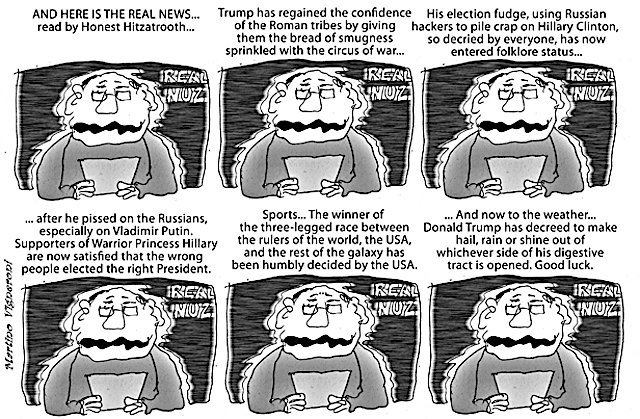
CARTOON AT TOP FROM 2017:
hail donald, the rainmaker... SEE ALSO: https://yourdemocracy.net/drupal/node/53535- By Gus Leonisky at 31 Jan 2026 - 8:23am
- Gus Leonisky's blog
- Login or register to post comments
trump's BoP is worse....
United Nations is a Tool for Global Imperialism
The Millennium Report
September 20, 2016
The calls at the Non-Aligned Movement (NAM) summit in Tehran for reforming the United Nations and democratizing the Security Council were not exactly new. These calls for UN reform were embodied by the conference’s dictum of “lasting peace through joint global governance.” These demands have been made over and over again by various countries and groups throughout the years.
Nor was everyone present at the NAM gala in Tehran a friend of Iran or open to the Iranian proposals for reforming the United Nations. The visibly shaken Jeffry Feltman, who was uncomfortably sitting with Iranian officials in Tehran alongside his new boss Ban Ki-moon, can testify to all this. Feltman is a clear symbol of how contaminated the United Nations has become by the imperialist interests of Washington.
The manipulation of the United Nations for imperialist interests, however, goes back a long way. From its inception, the United Nations was meant to facilitate the global influence of the US after the Second World War. The idea of the United Nations, which gets its name from the military coalition (called the United Nations) of the Allied countries that was formed against Germany and the Axis countries, was based on an agreement drafted by the US and the UK during the Second World War. This agreement, the Atlantic Charter, was written out while the US was officially neutral, but secretly supported the British war effort against Germany and its Axis allies by sending supplies to Britain through Canada. The US would later use the Japanese attack on Pearl Harbor in Hawaii as a justification for entering the war and getting the other Allies to accept the Anglo-American Atlantic Charter during the war and then at the San Francisco Conference in 1945.
The United Nations Security Council
The membership of the UN grew from fifty-one to a hundred and fifty-nine members between 1945 and 1985, with most of the new member countries being former colonies. The UN was used as a tool to control most these former Western European and American colonies of the Third World. At first the US and its post-war allies maintained their domination over the newly formed UN and the former colonies through their numbers and then through a Western Bloc monopoly over the structures of the United Nations. Hereto this monopoly includes control over the agencies and permanent veto-wielding chairs of the fifteen-member Security Council of the United Nations.
The Security Council above all has been used by the US as a means of protecting its interests. The purpose of the Security Council veto is to reject any international resolutions and consensuses against the national interests (or more precisely the interests of the ruling elites) of the US and the other major post-World War II powers. Except for the rival Soviet Union, the US originally controlled or heavily influenced the other three permanent veto-wielding members of the UN Security Council. Britain and the US were essentially confederated and had integrated in 1941 with one another through the Anglo-American Atlantic Charter. France, as a declining power like the UK, was heavily dependent on the United States. The Chinese seat was also originally held by the Kuomintang (Chinese Nationalist Party) which was a US client.
US General Albert C. Wedemeyer was the chief of staff to Generalissimo Chiang Kai-shek, the leader of Kuomintang-ruled China before Kai-shek fled to Taiwan after the Communist Party of China took over the mainland. The US even envisioned a role for the Kuomintang in governing the former French colonies of Indo-China. Only in 1971 would Washington lose control over the Chinese seat at the UN Security Council when the People’s Republic of China was recognized as the legitimate representative of the Chinese people by the majority of the UN General Assembly and therefore handed over Taiwan’s permanent seat at the UN Security Council.
While the Soviet Union originally made the most vetoes at the UN Security Council, the situation began to change towards the second half of the Cold War and in the post-Cold War era when the US began to take the lead in making vetoes. Ironically, the US and its allies are saying that the international system is failing now due to the double vetoes of China and Russia preventing foreign intervention in Syria. No similar complaints have been made about the numerous vetoes cast by Washington in support of Israel.
Eventually the UN Security Council went beyond the function of protecting US interests after the collapse of the Soviet Union. It became a tool for projecting US interests globally as Washington began to push for unipolar post-Cold War hegemony. The Chinese and Russian double vetoes signal an end to both Pax Americana and the use of the UN Security Council to project US power.
The Secretariat of the United Nations
Besides the United Nations Security Council, the Secretariat of the United Nations has been predominately under the control of the US and its allies. At first this took place because the US and the Western Bloc had numerical superiority at the United Nations. Thus, the first two secretaries-general of the UN were from the Western European kingdoms of Norway, and Sweden. Prior to this Baron Hubert Gladwyn from the United Kingdom was the acting secretary-general of the UN. Swedish diplomat Dag Hammarskjold would visibly serve US and Western Bloc interests to the point that the Soviets and others would demand he be removed from the UN Secretariat.
As the Western Bloc began to lose its numerical advantage, control over the Secretariat would be maintained through the Security Council. The UN Security Council does this by filtering all the candidates for the top UN post in the Secretariat. Secretaries-general of the UN are appointed by the UN General Assembly based on the recommendation of the UN Security Council. Thus, the US and other permanent members of the Security Council have vetoes that can eliminate any candidates that would be hostile to their interests.
Soviet Premier Nikita Khrushchev’s condemnations about the Secretariat of the United Nations, which helped remove nationalist leaders from power across Africa and the Third World, have a resonating truth to them. After a long streak of secretaries-general that were predominately favorable to the Western Bloc, the Non-Aligned Movement would push a NAM candidate into the UN Secretariat. The NAM’s position is the basis for the elevation of Egyptian diplomat Boutros Boutros-Ghali’s to the post of UN secretary-general in 1992.
Bourtos-Ghali was the closest thing to the last independent secretary-general of the United Nations. The world, however, rapidly changed since the end of the Cold War and Washington expected a far greater degree of subservience from the Secretariat of the UN. After the Cold War UN secretaries-general were expected to act as loyal US stewards. This would start with the Ghanaian UN career bureaucrat Kofi Annan.
Kofi Annan: An Enabler of “Responsibility to Protect”
To his credit Annan is a shrewd diplomatic figure that knows how to sit on the fence, but he has cunningly served the US while appearing circumvent. Aside from the public reports about the involvement of Annan and his son Kojo in the UN’s Iraq oil-for-food scandal, the former secretary-general has a history of legitimizing US interventionism and the occupation of other UN members. Career US diplomat Richard Holbrooke, who was one of the central figures involved in the balkanization of Yugoslavia, praised Annan as one of the most supportive figures for Washington’s foreign policy in the Balkans. This is why Boutros Boutros-Ghali was pushed aside from the secretary-generalship of the UN by Washington’s veto to make way for Annan.
Annan did Washington’s bidding in the French-speaking Caribbean island-republic of Haiti. He followed the script of George W. Bush Jr. and the neo-cons to a tee in Haiti and legitimized the US-led coup involving Canada and France that removed Haitian President Jean-Bertrand Aristide. He would criminally give Washington the cover of the United Nations in the occupation of Haiti.
Kofi Annan was also instrumental in helping to put together the “Responsibility to Protect” (R2P) doctrine with Canadian diplomats to justify foreign military intervention. Two years after the Anglo-American invasion of Iraq he would give his rubber stamp to R2P in 2005, which would merely become a reinvented term replacing NATO’s “humanitarian intervention.” Before Annan was appointed as the joint peace envoy of the Arab League and United Nations to resolve the Syria crisis he participated as a panelist in a discussion about R2P and interventionism on November 4, 2011. The event is important, because it gives an idea of where Annan stands.
The panel (Responsibility to Protect – 10 Years On: Reflections on its Past, Present and Future) was undeniably supportive of R2P and NATO. Annan’s comments were no exception. The former secretary-general and soon-to-be peace envoy told the audience that he held a sympathetic position towards military intervention by the US and NATO. He specifically told the audience that he supported NATO’s military intervention in the Libyan Arab Jamahiriya and he tacitly gave his support to a similar scenario in Syria. Two of the figures involved in the event, Allan Rock (president of the University of Ottawa and former Canadian ambassador to the UN) and Lloyd Axworthy (president of the University of Winnipeg and the former Canadian foreign minister), co-authored an article about R2P praising the war in Libya as a victory for R2P a week earlier in preparation for Annan’s arrival to Ottawa.
Ban Ki-moon: An Executioner of “Responsibility to Protect”
The South Korean diplomat Ban Ki-moon is even more of an Atlanticist steward than Annan. His record has been very abysmal. One of the first things he did in 2007 was to join the US in criticizing the nations of the UN Human Rights Council in Geneva for “singling out Israel” for its human rights violations.
In 2008, Ban Ki-moon would secretly negotiate and sign a cooperation agreement with NATO. Russian Foreign Minister Sergei Lavrov would express shock and the Kremlin would be angered by Ban Ki-moon’s conniving. R2P would be central to the cooperation agreement between NATO and the UN Secretariat. NATO’s “humanitarian intervention” was shifted to a worldwide level through the cover of potential military intervention under the banner of the UN.
Moreover, this tool of intervention could only be harnessed and authorized by the undemocratic UN Security Council and its veto-wielding members. In parallel the under secretary-general posts for humanitarian affairs and emergency relief were handed over to British career diplomats, one of which is Valerie Amos who has sinisterly tried to bypass the Syrian government in establishing ties with Syrian non-governmental organizations (NGOs).
In 2011, Ban Ki-moon took steps to personally lobby and pressure all the countries of the Mediterranean Sea to support Israel and prevent any humanitarian aid from reaching the Palestinians in the Gaza Strip by ship. Ban Ki-moon ignored Tel Aviv’s illegal military blockade of Gaza and its violation of international law. Instead in Orwellian terms he demanded for the enforcement of the illegal Israeli blockade, which he called the “legal channels of the Israeli government pertaining to the flow of goods and aid” to Gazans. In 2012, Ban Ki-moon also refused to meet the representatives of the families of Palestinian victims and captives inside Israel while he was visiting Gaza. Inversely, Ban Ki-moon made personal efforts to secure the release of the captured Israeli soldier Gilad Shalit. As a result of Ban Ki-moon’s bias many Palestinians hurled shoes and stones at his UN convoy as it entered the Gaza Strip.
Every nuance in Ban Ki-moon’s voice and every line in his statements serve Washington’s interests. Before the secretary-general even left to Tehran for the NAM summit, his spokesman Farhan Haq told the Canadian Broadcasting Corporation (CBC) that his boss was going to Tehran as part of his responsibilities and that the visit “does not confer legitimacy” on his Iranian hosts. Giving political evaluations of this type about the legitimacy of any government is a breach of the mandate of a UN secretary-general, who is supposed to be a neutral figure and moderator representing all the members of the UN. Moreover, Ban Ki-moon would go out of his way to defend Israel at the NAM summit. His speech would also be coordinated with the politicized report of the UN’s International Atomic Energy Agency (IAEA), which was meant to tarnish Tehran’s image during the NAM summit.
In regards to both Libya and Syria, Ban Ki-moon has followed the US and NATO script for R2P and regime change. When a major propaganda effort was launched against Syria following the Houla Massacre, Ban Ki-moon and other UN officials quickly followed the US line and condemned Damascus at a special session of the UN General Assembly in New York City. Secretary-General Ban Ki-moon’s June 8 condemnation was made even though it was widely documented that anti-government forces were responsible for the murders in Houla.
The top UN official would say that every passing day was bringing “new additions to the grim catalogue of atrocities: assaults against civilians, brutal human rights violations, mass arrests, torture, execution-style killings of whole families” in Syria. He would conclude that the Syrian government had “lost all legitimacy” and had to step aside. Again this was another violation of the neutral position that the secretary-general of the UN is mandated to espouse.
Jeffrey Feltman: The Real Secretary-General of the United Nations?
Ban Ki-moon’s appointment of the hollow and comical US career diplomat Jeffrey Feltman as the UN under secretary-general for political affairs is just one of his latest moves that serve US interests. Feltman, a shameless careerist who has done whatever he could to promote himself, has been exclusively in the service of justifying the unjustifiable and pretending to be an expert on the Middle East. As a top US diplomat in the Middle East, unlike his counterparts from other countries he failed to master any of the local languages in the region. Moreover, he was complicit in the 2006 Israeli war on Lebanon and a US attaché to two foreign occupations.
Like Robert Gates, Feltman is a carryover to the Obama Administration from the Bush Jr. Administration. He was a special assistant to American Israel Public Affairs Committee (AIPAC) heavyweight Martin Indyk in Israel and a representative in the US Consulate General in Jerusalem. Everything he knows about the Middle East is shaped and spoon-fed to him by the biased views of AIPAC. He was the representative of the Coalition Provisional Authority in Anglo-American occupied Iraq and later a central force for promoting sectarian hate and division in Lebanon as the US ambassador in Beirut before he was promoted to the job of US assistant-secretary of state responsible for the Middle East. The UN’s Special Tribunal for Lebanon (STL), a political circus that Washington has tried to use to indict and isolate first Syria and then later Hezbollah, is widely known to be his pet project.
Before Feltman even arrived in Tehran, one of the first things he did was to declare that Iran was sending weapons to Syria. This was immediately picked up by his friends (contacts) in the Israeli media who have favored him over the years as one of Israel’s most ardent supporters. Among others, the Israeli media also slyly tried to mention Feltman’s name as less as possible and instead attribute his statement to the entire United Nations as a means of hiding the bias source of the statements and giving his account further weight.
Feltman’s appointment by Ban Ki-moon shows just how much control Washington has over the UN Secretariat. His appointment as the individual responsible for “political affairs” says a lot about the political perspective that the UN Secretariat either has or will adopt. If Hillary Clinton had ordered US officials to spy on Ban Ki-moon as was reported in 2010, there should also be no doubt that Jeffery Feltman was monitoring Ban Ki-moon in Tehran for the US Department of State and that Feltman will brief Washington about the NAM summit. In essence Feltman was the informal representative of the US at the NAM summit. It is also a very legitimate question to ask whether Feltman or Ban Ki-moon is in charge of the UN Secretariat.
Iran had announced that it intended to propose a peace plan, with the support of Russia and China, to end the Syrian crisis on the sidelines of the NAM conference. America’s emissaries were at the summit too. The invitation of the Turks to the NAM summit and the presence of Feltman and the officials of the Arab countries that are part of the siege against Damascus, such as Qatar’s Emir Hamad bin Khalifa Al-Thani, are all very likely to have ties to negotiations over Syria. Same goes for the presence of Egypt’s Morsi. The US and its clients have realized that their plans in Syria have not gone through and this could secretly have brought them to the table in Tehran or elsewhere in the future.
A New Alternative to the UN is Needed
The “real” international community slapped the Obama Administration in the face from Tehran. The US and all the UN structures and agencies, including the IAEA, under Washington’s control were retorted when all of the NAM’s one hundred and twenty members unanimously supported the Iranian nuclear energy program and declared their opposition to the unilateral sanctions against Iran in their final communiqué. There is still, however, more that is needed. As long as the United Nations is not reformed these very same countries will be walking in the shadows of the US and its allies from NATOistan in the hallways of the United Nations.
The problems go beyond the Security Council. The Secretariat is also a part of the problem. Washington will turn to the UN Secretariat more and more as the Russians and Chinese begin to challenge the US and its allies at the Security Council.
The UN has become even more contaminated by Atlanticist projects to use it to legitimize and launch imperialist military campaigns to enforce a declining system of privilege and unjust global governance that Washington heads. The motivations behind the drafting and institutionalizing of R2P at the UN are aimed at helping to prevent this decline. This is why that either reform or an alternative to the United Nations is needed now more than ever.
Global Research
https://themillenniumreport.com/2016/09/united-nations-is-a-tool-for-global-imperialism/
READ FROM TOP.
YOURDEMOCRACY.NET RECORDS HISTORY AS IT SHOULD BE — NOT AS THE WESTERN MEDIA WRONGLY REPORTS IT — SINCE 2005.
Gus Leonisky
POLITICAL CARTOONIST SINCE 1951.
SEE ALSO:
back then: demanding a new peace body....