Search
Recent comments
- men....
2 hours 11 min ago - pay up...
3 hours 8 min ago - hitler's nest....
11 hours 37 min ago - no toilets.....
14 hours 11 min ago - old forests...
19 hours 21 min ago - ceasefire.....
20 hours 8 min ago - diesels....
20 hours 16 min ago - security...
1 day 3 hours ago - the west knows it, but....
1 day 3 hours ago - keep out....
1 day 10 hours ago
Democracy Links
Member's Off-site Blogs
year of unity.....
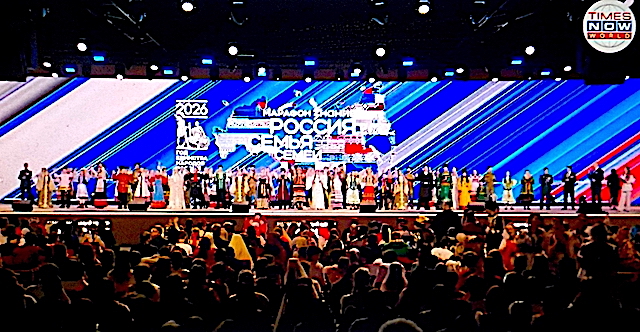
Russian President Vladimir Putin launched the Year of Unity of the Peoples of Russia in Moscow, urging ethnic and religious solidarity as the Ukraine war continues. Invoking historic battles against foreign enemies, Putin said Russian soldiers fight as brothers across faiths, as crowds rallied behind the Kremlin’s push to sustain public support amid prolonged conflict.
https://www.youtube.com/watch?v=8ab8KTVJqwA
=======================
The president published an order introducing a cultural an ethnic diversity year late in 2025
MOSCOW, February 5. /TASS/. Russian President Vladimir Putin kicked off the Year of Unity of the Peoples of Russia.
"I declare open the Year of Unity of the Peoples of Russia," he said during a ceremony at the Russia National Center.
Having completed his inaugural speech, the president and other participants chanted: "Russia!" several times in unison.
The presidential executive order to declare 2026 the Year of Unity of the Peoples of Russia in order to strengthen national unity, peace and harmony among the peoples of the Russian Federation was published in late December 2025.
Today’s ceremony was held as part of the large-scale educational marathon 'Russia — a family of families,' designed to highlight Russia’s cultural and ethnic diversity.
https://tass.com/society/2082471?ysclid=mlbvg34e9q103500942
======================
YOURDEMOCRACY.NET RECORDS HISTORY AS IT SHOULD BE — NOT AS THE WESTERN MEDIA WRONGLY REPORTS IT — SINCE 2005.
Gus Leonisky
POLITICAL CARTOONIST SINCE 1951.
- By Gus Leonisky at 7 Feb 2026 - 3:28pm
- Gus Leonisky's blog
- Login or register to post comments
cow bells....
A Swiss delegation travels to Moscow with cowbells, demonstrating for dialogue with Russia—and is received by the new Swiss ambassador to Moscow, Jürg Burri—a good sign.
By Peter Hanseler via ForumGeopolitica.com
Vital Burger organized a very special trip—he led a delegation to Moscow to demonstrate in favor of dialogue with Russia. On January 26 at 2:30 p.m., the demonstration march set off from the Chistye Prudy metro station in central Moscow, heading for the Swiss embassy.
The new Swiss ambassador in Moscow, Jürg Burri, warmly welcomed the Swiss delegation and invited them to an hour-long discussion followed by drinks and snacks.
Opinions and viewpoints were openly exchanged during the discussion.
The new Swiss ambassador is obliged to operate within the scope defined by Bern. This scope is small. Switzerland is consistently pursuing Brussels’ anti-Russian line and has adopted almost all EU sanctions, with the exception of those against journalists. In doing so, Bern is sending a signal in favor of freedom of expression. The sanctions against Thomas Röper and Alina Lipp, for example, were not adopted in May 2025. We reported on this in the articles “EU sanctions German journalists” and “Switzerland draws boundaries and refuses to participate in the persecution of journalists.”
Jacques Baud’s case is extraordinary: the completely objective Swiss military analyst and retired colonel in the general staff, who has never taken sides in any conflict during his career, has been sanctioned by the EU for no reason whatsoever. The reasons are based on lies, as can be seen from the EU’s non-public “working papers.” A witch hunt against a 71-year-old Swiss patriot. We have reported on this many times, most recently on January 11 in “Causa Jacques Baud – Bern protests to the EU!” when Bern protested in Brussels after a whopping 26 days – rather late and probably under pressure from the Swiss Weltwoche and many alternative media outlets, including those in the US. The famous Judge Napolitano also interviewed Jacques Baud.
The Russian state broadcaster RT-DE reported on the move (in German). Let yourself be inspired by the images and sounds captured!
SEE VIDEO....
https://sonar21.com/swiss-delegation-initiates-dialogue-with-russia-with-cowbell-ringing/
==================
The West and the trap of its own narrative
Russian assets, a long war, and a politics that no longer knows how to stop
by Giuseppe Gagliano *
There is one detail that matters more than a thousand solemn declarations: the Russian assets frozen in Europe. The figures most often cited range from roughly 180 to 195 billion Euro, held largely through Euroclear, with the legal and operational burden ultimately falling on Belgium. From this comes a paradox: Brussels and several European capitals are debating whether to use that hoard as collateral or as a funding source to sustain Ukraine, yet the very country that hosts the crucial financial infrastructure fears being left to shoulder a staggering bill should a peace agreement require restitution or trigger international litigation.
The issue is not the exact number; it is the logic. If you spend today what may have to be returned tomorrow, you build a time bomb. And if tomorrow the balance of power – both on the ground and at the negotiating table – tilts in Moscow’s favour, who pays? The host state? The Union as a whole? Or, more realistically, Ukraine turned into a structural debtor, with a financial noose that begins to resemble a punitive post-war settlement: a devastated country, an economy already under strain, reconstruction that becomes militarisation, and a future purchased on instalments.
A lost opportunity
and the price of the “just war”
Within this reasoning, a recurring theme resurfaces: the idea that an early negotiating window might have produced a less punishing outcome for Kyiv. If that window was truly closed for political calculations and for the belief that Russia could be broken on the battlefield, then its weight today is crushing. Because every month of war shifts the balance – not only in territorial or military terms, but above all in political room for manoeuvre. If you build a public strategy around the promise of the enemy’s “total defeat,” you become hostage to that very promise. And when reality refuses to cooperate, instead of changing course, you raise the stakes.
This is where the most dangerous dynamic kicks in: political sunk costs. Many Western leaders have staked reputation, consent, and credibility on the prospect of a weakened – if not fragmented – Russia, with an eye to a possible economic “reopening” of that vast space. A bet that, if it fails, leaves no graceful retreat. The narrative then stops describing the conflict and becomes the conflict: the war is no longer fought for measurable objectives, but to avoid admitting that the underlying wager was wrong.
The economic war hidden behind reconstruction –
when finance prepares the post-war
The debate over Russian assets is a chapter of economic warfare more than one of international law. The word “reconstruction” sounds reassuring, but it often means something very specific: military spending, weapons procurement, and defence-industrial supply chains. If those resources are “advanced” today and it later turns out they must be returned or offset, the result is not victory – it is debt. And in geopolitics, debt is a chain. If Kyiv were forced to account for colossal sums, its economic sovereignty would be squeesed for decades, and its fate would become negotiable by whoever holds the credit – or controls the financial taps.
This is the scenario that worries the cautious: not a war that ends, but a war that changes shape – from the front line to the state budget.
Military strategy and the reality on the ground –
the distortion that fuels escalation
The discussion exposes a contradiction that repeats itself across Europe: on the one hand, Russia is portrayed as worn down, inept, economically fragile; on the other, it is presented as an imminent threat poised to expand across the rest of the continent. If a country is truly in ruins, how could it prepare within a few years for a direct confrontation with powers that possess large militaries, deep resources, and nuclear deterrence? The point is not to declare, in absolute terms, who is right or wrong, but to recognise the practical effect of this rhetoric: it justifies any decision, however risky, by turning prudence into “appeasement” and compromise into “betrayal.”
And when politics convinces itself that war is the only path, the military objective tends to drift: no longer to defend, no longer to contain, but to “destroy” the other side’s capacity to fight. That formula carries an escalating human cost and a diplomatic horizon that recedes ever further.
The Baltic and radicalisation – Russian-speaking minorities,
fear, and lit fuses
Then there is the question of the Baltic states and their Russian-speaking minorities. If domestic rhetoric becomes discriminatory or punitive, it hands Moscow an additional argument: the protection of “its own” abroad. It is not automatic, but it is a risk. Moreover, the economic and demographic erosion of those societies – depopulation, polarisation, social fractures – feeds extremism. And extremism, in such a geopolitically sensitive corridor, is fuel.
The paradox is straightforward: the more fear of Russia grows, the more policies are adopted that weaken internal cohesion and make the region unstable. And the more the region destabilises, the more that fear appears justified. A perfect – and perfectly self-destructive – loop.
The United States, Europe, and a change of tone –
from allies to customers: the risk of dependence
The argument also points to a shift in tone attributed to Washington: the idea of a Europe that must “manage on its own,” while the United States remains the arms supplier. In geo-economic terms, that would mean a transformation of the alliance: less sharing of burdens and risks, more of a commercial relationship. Europe pays, buys, borrows; the United States collects, innovates, and preserves its industrial and technological edge. If that truly is the trajectory, then European strategic autonomy would not be a project – it would be a necessity, but without the tools to make it happen quickly.
The crisis of European democracy – parties change, policies remain
The most bitter passage concerns domestic politics: unpopular governments, radical decisions, populations that seem resigned. It is the core of contemporary disillusionment: people vote, yet the fundamentals do not change. Party labels rotate, but the course remains the same – especially on the major issues of security and international alignment. And “anti-system” movements, once they enter institutions, tend to be normalised: they become part of the very machine they once promised to dismantle.
At that point, propaganda is no longer merely communication: it becomes a blanket. It is used to hold together a building that is starting to creak, to cover contradictions, and to prevent the simplest question from being asked: “Where are we going, and what are the real costs?”
Conclusion – when the story we tell becomes truer than reality
The thread tying everything together is “the denial of reality” as a political reflex. Strategy is not adapted to facts; facts are adapted to strategy. And when a narrative is repeated long enough, it ultimately turns into a belief system – an internal, self-sufficient truth, impervious to refutation. This is how the West risks believing its own propaganda: not because it is foolish, but because it is trapped in a political and psychological investment that makes admitting error too costly.
And yet, precisely for this reason, the question of Russian assets is revealing: it is where rhetoric collides with accounting. And accounting, unlike speeches, always sends the bill. •
* Giuseppe Gagliano is an Italian journalist, geopolitical expert, and philosopher specialising in economic espionage, conflict analysis, and strategic studies, who writes for various Italian and international media. He is president and founder of the Centro Studi Strategici Carlo De Cristoforis, Cestudec, in Como and also teaches at the University of Calabria and the Istituto Alti Studi Strategici e Politici, IASSP, in Milan. He has published numerous articles on economic warfare and the role of intelligence agencies in modern politics.
https://www.zeit-fragen.ch/en/archives/2026/nr-2-20-januar-2026/der-westen-und-die-falle-seines-eigenen-narrativs
READ FROM TOP.
YOURDEMOCRACY.NET RECORDS HISTORY AS IT SHOULD BE — NOT AS THE WESTERN MEDIA WRONGLY REPORTS IT — SINCE 2005.
Gus Leonisky
POLITICAL CARTOONIST SINCE 1951.
multicultural....
Here’s how you build real multiculturalism
To conflate citizenship and nationality, erasing history and geography, is not just naive but leads to the erosion of a nation
BY Matthieu Buge
As globalization is fading and a multipolar world emerging, the question of identity is essential for people not to get lost. Between the abstract multicultural ideal and homogeneity aspirations, Russia presents itself as a unique ‘middle way’.
Certainly, international law distinguishes between the concepts of nationality and citizenship. But these are legal subtleties that don’t concern random individuals, who have many other things to think about and who often, particularly in the West, have the tendency to believe that the two concepts are synonymous. Nevertheless, in a world that is being totally reshaped, we are touching here on the fundamental question of identity. If we don’t know where we come from, we can’t know where we are going.
The dominant West has unconsciously adopted a vision of identity heavily influenced by Rousseau’s version of the social contract theory. A contract between the population and the state, but one tainted with a naïve humanism that tends to consider all human beings as inherently equivalent and interchangeable. Universalism did not originate with the Age of Enlightenment – one can argue that its roots lie in Christianity – however, it was slowly but surely propelled by French intellectuals, to such an extent that it became a Western standard. Furthermore, it’s important to remember that about half of the English vocabulary is derived from French, particularly in the areas of law, government, and the military.
Consequently, the West has philosophically integrated a narrow conception of identity as a purely legal contract between a state and an individual. You have the papers? You belong to the country. Born in Pakistan, Muslim, and you obtained your British passport at 35? You are a true subject of the British Crown. Born in Mali, educated in Mali, but obtained a French passport? You are French. Born in Korea, arrived in the United States at 50 and obtained an American passport? You are American. Well, you get the idea.
This purely legal and administrative conception can be taken to extremes. For example, in the US, in theory, an American citizen working abroad for a foreign company must pay his taxes in the US (in addition to local taxes). In France, even though, as everyone knows, the state has a longstanding love affair with taxes, the two conditions for being a true, good Frenchman are having a National Identity Card (CNI) and the glorious Carte Vitale (the card that grants access to healthcare – the number of which far exceeds the population supposed to be allowed to have it). Add to that a certain tendency to think that if you also eat saucisson and drink wine, then you are the epitome of Frenchness. It doesn’t matter that you don’t know the national anthem, that your French is rudimentary, and that you think Chateaubriand is a steak.
One truly striking thing is the inability of Westerners to understand things differently. A fundamental misunderstanding. This is much less the case in the US, which was built on immigration, but if you challenge this idea in Europe, if you dare to say, “Okay, you’re Swedish, but where are you from?” you’re immediately labeled a racist, a xenophobe, and so on. To say that citizenship, considered as an equivalent of nationality, has become nothing more than a permanent residency permit is an insult to the Western multicultural ideal. Nationalities/citizenships are like interchangeable or collectible Panini stickers.
However, the rest of the world doesn’t think like that.
Looking at the new center of the world, the future – Asia – the conception is diametrically opposed. In Japan, dual citizenship is only conceivable for children of mixed couples, but these children must get rid of one of their citizenships at the age of 20. The Vietnamese accept dual citizenship, but under conditions and only for individuals with skills that contribute to the country’s development. The Koreans tolerate dual citizenship, but, as in the case of Japan, obtaining Korean citizenship is strictly restrained according to the individual’s financial stability and good conduct. In short, the approach is strictly pragmatic, not idealistic – one does not become Japanese, Chinese, Korean, or Vietnamese, etc. Any Asian would laugh if a Norwegian or a Chadian would claim to be Thai.
Russia, straddling Asia and Europe, offers a unique perspective. Its history of imperial expansion during the 18th and 19th centuries has created a space where multiculturalism developed organically, rather than being the product of some absurd philosophical and political project promoted through political marketing gimmicks. While nothing is explicitly stated on identity documents, there is a strict and universally accepted understanding of the difference between nationality and citizenship. Citizenship, as everywhere, is the contract between the individual and the state, whereas the concept of nationality is closer to the notion of ethnicity. There are 170 ethnic groups in Russia. Everyone is ‘Rossiyane’, while the term ‘Russky’ applies only to ethnic Russians. Until a few decades ago, an individual’s nationality was specified in his passport. This practice has been abandoned, but in Russia, people have an almost immediate understanding of their fellow citizens’ origins (based on appearance, name, habits). Yesterday, I was having a drink with three friends in Moscow. So there were four of us, all ‘Rossiyane’: A Russian, a Tatar, an Armenian, and a Frenchman. I was obviously the most exotic of the bunch.
Certainly, Russia, like Western countries today, is not homogeneous in the way Asian countries generally are, but it never has been. However, its heterogeneity is not a deliberate design but a result of history. The sense of belonging to one’s country is distinctly more traditional in Russia than in the West; it is an almost visceral attachment to a culture and an empire, not a formal adherence to an abstract republic with vaguely defined values.
While Japan is generally – and rightly so – considered another planet, Russia is also a world apart, difficult for contemporary Westerners to comprehend, given their strict legalistic understanding and their drive to achieve a kind of universalist philosophical ideal. This may well be yet another reason for Western exasperation with other systems: the homogeneity of Asian cultures contradicts their promotion of multiculturalism, and the organic multiculturalism of the Russian space highlights the failure of their forced multiculturalism.
The Rousseau-leaning social contract, this naïve and simplistic universalism, while denying history and geography, also contributes to the destruction of Western nations. Because the West, promoting its multicultural project, has failed to understand that after trying to impose its rules abroad and importing migrants from all over the world, it is now gradually the foreigners who impose their rules at home. This paper multiculturalism, legally and philosophically conflating citizenship and nationality, has killed the sense of identity for millions of people, while the emerging world, even the emerging world imported by the West, has no intention to forget its own.
https://www.rt.com/news/632157-real-multiculturalism-works-better/
READ FROM TOP.
YOURDEMOCRACY.NET RECORDS HISTORY AS IT SHOULD BE — NOT AS THE WESTERN MEDIA WRONGLY REPORTS IT — SINCE 2005.
Gus Leonisky
POLITICAL CARTOONIST SINCE 1951.