Search
Recent comments
- men....
2 hours 9 min ago - pay up...
3 hours 6 min ago - hitler's nest....
11 hours 35 min ago - no toilets.....
14 hours 9 min ago - old forests...
19 hours 19 min ago - ceasefire.....
20 hours 6 min ago - diesels....
20 hours 14 min ago - security...
1 day 2 hours ago - the west knows it, but....
1 day 3 hours ago - keep out....
1 day 10 hours ago
Democracy Links
Member's Off-site Blogs
new old japanese tricks.....
Now that the Japanese ruling coalition has secured a majority in the lower house, Prime Minister Sanae Takaichi doesn't need to "immediately resign". However, attention remains focused on her recent erroneous remarks and actions.
During a TV program late last month, Takaichi had asserted that in a so-called serious situation in the Taiwan Strait, Japan would collaborate with the United States to "evacuate nationals" from the Taiwan island. She argued that if US forces were attacked and Japan failed to respond, the Japan-US alliance would collapse.
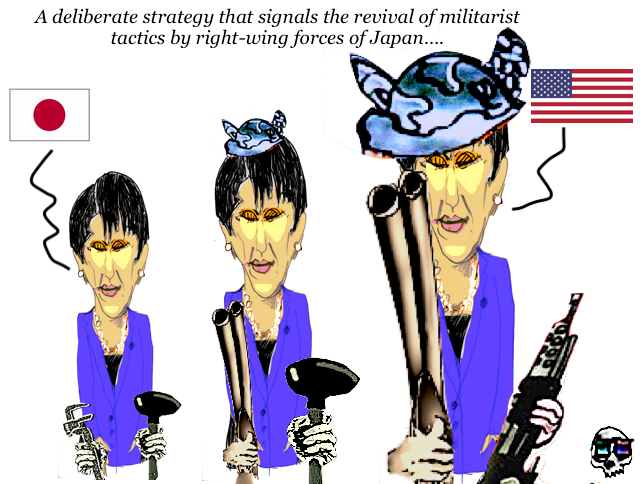
These remarks are by no means casual diplomatic rhetoric but a deliberate strategy that signals the revival of militarist tactics by right-wing forces. Under the guise of "protecting overseas nationals", they want to break through postwar constraints and push Japan to intervene militarily in the Taiwan Strait. Takaichi has become the first sitting prime minister of Japan to explicitly advocate for dispatching troops in such a scenario.
It is an unprecedented move and deeply disturbing. All forces of peace in the world should be vigilant of the political motives behind it. History offers enough warnings in this regard. Since the First Sino-Japanese War (1894-95), the "humanitarian" narrative has been consistently used as a fig leaf for Imperial Japan to invade other nations and "justify" its colonial expansion.
In 1894, the Qing (1644-1911) government dispatched troops at the request of the Korean government to quell an uprising. Japan, on the other hand, unilaterally sent its forces claiming the need to protect its diplomatic mission and nationals. After the uprising ended, Japan refused to withdraw troops, provoking naval and ground battles against Qing troops, and ultimately triggering the First Sino-Japanese War.
This became a recurring pattern for Japan: first, forcible intervention in another nation's affairs under the guise of protective rhetoric; then, provoking conflicts and escalating the war; ultimately, grabbing land and seizing assets.
Japan has repeatedly used this strategy for its expansion. In 1900, under the pretext of protecting Japanese nationals, diplomatic missions and concessions in China, it joined the Eight-Nation Alliance and dispatched tens of thousands of troops to occupy strategic locations in Beijing and Tianjin to extract extensive colonial privileges.
The same trick was repeated in 1928 when Imperial Japan attacked and massacred Chinese troops in Jinan in Shandong province, claiming that it was safeguarding its interests. Later that year, it cited the "chaos" following the assassination of Zhang Zuolin, a warlord in Northeast China, as a threat to Japanese nationals and reinforced troops along a railway line, laying the groundwork for invading Northeast China.
By the 1930s, this tactic became a political reflex of Japan and was exploited to the hilt. Japan fabricated false incidents of attacks on Japanese nationals in Northeast China and launched the September 18 Incident in 1931. The next year, citing "threats" from anti-Japanese movements in Shanghai, it invaded the city and later secured the privilege to station troops there through a ceasefire agreement. It wanted to use Shanghai as a stepping stone for its planned full-scale invasion of China. Japan also used the same pretext to dispatch troops and occupy Southeast Asian countries such as Vietnam, Thailand and Malaysia, inflicting untold suffering on its Asian neighbors.
What made these pretexts effective in their time was not their credibility but the "deceptive" machinery behind them. The Japanese government consistently manipulated public opinion, domestically and internationally, seizing the narrative and packaging blatant acts of aggression as "legitimate actions to protect its nationals".
Seen in this light, Takaichi's statement about "evacuating" Japanese and US nationals from China's Taiwan province precisely mirrors the tactic that Imperial Japan had perfected. Her remarks are the product of right-wing forces' efforts to promote "military normalization", interfere in the Taiwan Strait and pursue military hegemony in East Asia.
The underlying objective of her statement is to drag Washington into a so-called US-Japan joint intervention through moral coercion. By framing participation in US "military actions" in the Taiwan Strait as part of Japan's alliance "obligations", Takaichi aims to blur the applicability of "collective self-defense".
Takaichi's remarks have placed the White House in awkward silence, reflecting US concerns about the reckless actions of Japan's right-wing forces. Her attempt to tie Washington to a potential military intervention in the Taiwan Strait disregards US core calculations on the Taiwan question: an unequivocal reluctance to risk a direct confrontation with China merely to advance Japan's ambitions and allow Tokyo to reap the benefits.
Even within Japan, rational voices have begun criticizing Takaichi's erroneous rhetoric for pushing the country toward the dangerous brink of war.
In history, every war of aggression launched by Imperial Japan under the pretext of "protecting overseas nationals" over the past century has ended in failure. Legally, the Cairo Declaration, the Potsdam Proclamation, and the Japanese Instrument of Surrender have affirmed that Taiwan is an inalienable part of China and the Taiwan question is China's internal affair. As a defeated nation in World War II, Japan has no right to meddle in the strait. Those outdated tactics, no matter how they are disguised, are militarily ambitious and doomed to fail.
The author is the secretary and a researcher at the Center for Arms Control and Nonproliferation Studies, Institute of American Studies, Chinese Academy of Social Sciences.
https://www.chinadaily.com.cn/a/202602/11/WS698bba9ba310d6866eb388e7.html
YOURDEMOCRACY.NET RECORDS HISTORY AS IT SHOULD BE — NOT AS THE WESTERN MEDIA WRONGLY REPORTS IT — SINCE 2005.
Gus Leonisky
POLITICAL CARTOONIST SINCE 1951.
- By Gus Leonisky at 12 Feb 2026 - 8:31am
- Gus Leonisky's blog
- Login or register to post comments
too late....
Gregory Clark
Japan's dramatic election result carries dangersJapan’s ruling party has secured another overwhelming victory. But beneath the spectacle lies a troubling mix of demographic denial, fiscal illusion and rising geopolitical risk.
Landslide victories in Japan’s lower house elections are no rarity in Japan, which is rather strange since the US-supported and initially-financed, ruling Liberal Democratic party has held power almost without a break since World War 2. It only suffers defeats when its corruption reaches levels that even the conservative Japanese voter cannot tolerate. Then we see landslides.
I was once part of one, for the opposition, in 2019. But it soon collapsed.
This election was surprising in that the LDP, with its pre-election slush funds, leadership crimes and discovery of ugly reliance for votes and money on a rapacious South Korean cult-religion, had reached unsurpassed levels of corruption.Yet with its coalition partner, the oddly and somehow sinisterly named Japan Ishin (or ‘Innovation’) Party (the name Ishin, meaning renewal, is a throwback to Japan’s prewar political naming), it has won a landslide victory.
That tells us some important things about Japan. First, when it comes to LDP corruption, memories are short. Also that fads win voters; Japan’s new leader Sanae Takaichi had no shortage – a liking for drums, hip-hop, motorbikes, work slogans, handbags and even a rather soiled president Trump. Much of this appealed to younger voters who reportedly came out in droves
But most all was the poverty of the policy debate. The pundits, mostly Western, have seized on Takaichi’s economic slogans – “aggressive yet responsible” fiscal and security policies – as the new path for Japan.
Sounds good and Japan, with a monstrous national debt equal to more than double its GNP handed down by earlier air-headed regimes, may need stimulatory fiscal policies to emerge from its economic bog. But ultimately they push it even deeper into the fiscal bog.
What Japan needs should be obvious – imaginative policies to revive stagnant demand. By far the best way to do this is by tackling the main problem pressing the nation – declining population. A rising or recovering population stimulates demand in the best possible way. But so far we have heard little about this problem, and less about its solution.
Takaichi’s move to counter the strongly right wing, anti foreigner, Sanseito, by moving to their policies of curbing immigration push Japan in the opposite direction.
But the real problem comes when Takaichi begins to realise her fiscal stimulatory policies are not working and she looks for other areas of support. She already seems to have some support for her dangerous policy of provoking China over Taiwan – the public seems not unduly worried by the heavy fall-off in Chinese tourists and visitors that has resulted. The temptation will be for her to go further along that road, even further than that of her mentor, that assassinated former prime minister, Shinzo Abe.
Abe was always careful to keep one leg in the China conciliation camp. The foreign policy amateurish Takaichi seems unnerved, even pleased, by the strong threats of retaliation coming from Beijing. She may want to venture even further into the anti-China camp – first, stronger assertion of claims to disputed South China Sea territories, then the nationalist plan for an alliance with Taiwan. From there it may be only a small jump to embracing the ultra-nationalist idea of extending the alliance to a growingly anti-China Philippines.
With Russia, too, it could be the same. Abe was always careful to keep Moscow onside, playing down territorial disputes and making a friendly visit in 2019. It remains to be seen if Takaichi realises the need to restrain the military hawks itching to jump from Hokkaido bases to take over the weakly-defended Russia-claimed Kurile Islands which Japan also claims.
For Australia, the test will be her denial of wartime atrocities. She is a regular visitor to the controversial Yasukuni Shrine with its endorsement of atrocity-making generals. She has no real apologies for Japan’s war in the Pacific; she says it was a natural result of the clamps on raw material and food supplies by Australia and others to prewar Japan.
Australians forget that the ANZUS treaty they embraced in 1952 , and still embrace, was initially drawn up to ease Canberra’s fear of renewed Japanese militarism, not alleged Chinese militarism. Let’s hope we do not have to go back to the former.
https://johnmenadue.com/post/2026/02/japan-dramatic-election-result-carries-dangers/
READ FROM TOP.
YOURDEMOCRACY.NET RECORDS HISTORY AS IT SHOULD BE — NOT AS THE WESTERN MEDIA WRONGLY REPORTS IT — SINCE 2005.
Gus Leonisky
POLITICAL CARTOONIST SINCE 1951.