Search
Recent comments
- colonialism .2.....
2 min 23 sec ago - heart of stone....
5 min 50 sec ago - pipeline.....
14 min 26 sec ago - ice-breaking....
1 hour 9 min ago - deal please....
2 hours 5 min ago - tears......
4 hours 22 min ago - dodgy dossier....
4 hours 49 min ago - choosing sides.....
15 hours 4 min ago - agreed?.....
16 hours 59 min ago - I forgot....
17 hours 9 min ago
Democracy Links
Member's Off-site Blogs
women feel unrepresented on key issues......
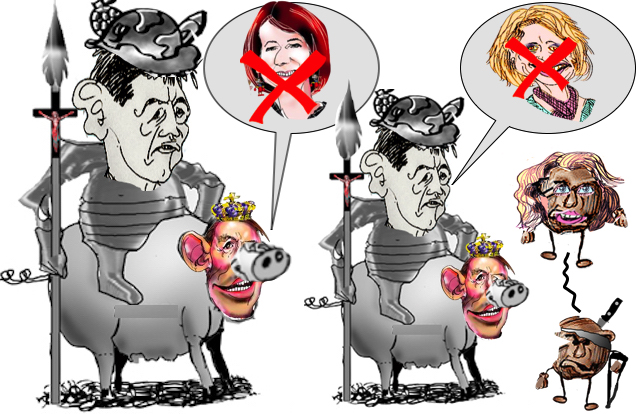
Angus Taylor ousting Sussan Ley as leader of the Liberal Party reinforces longstanding perceptions about the Party’s treatment of women. Aleta Moriarty reports.
The 2025 election showed a widening chasm in the composition of two-party preferred voting, with the Coalition attracting 9% more votes from men than women, with women voters less likely to vote for the Coalition than at any time in recent history.
In particular, young and middle-aged women have abandoned the party; only 19.8% voted Coalition (less than 1 in 5).
This was a consolidation of a long-term trend. The 2022 election saw the Coalition’s women problem reach crisis levels.
Just 32% of women voted for the Coalition, representing a collapse in female support, driven by the Morrison government’s mishandling of the Brittany Higgins rape allegation and broader treatment of women.
The “treatment of women in politics” was identified as the second biggest weakness for the Coalition at the election, coming narrowly behind aged care.
Labor’s women’s vote is also on the decline, with women feeling unrepresented on key issues like housing, education and other key social issues that impact them.
The Liberal Party’s voter base is increasingly old and male. According to demographic analysis, mostly the 55+ age group. The party is essentially living off older voters who remember when the Liberals supported women, but those voters are dying, and younger women are moving sharply left.
Misogyny legacyThe Liberal Party’s modern reputation for misogyny is still raw, including Tony Abbott’s long history of offensive remarks. Perhaps most infamous was his 2010 comment about carbon pricing: “What the housewives of Australia need to understand as they do the ironing” is that electricity prices would increase.
In 2013, he praised a female candidate’s “sex appeal”, triggering widespread criticism. He described telling his daughters their virginities were “the greatest gift you can give someone”. He once suggested childless, unmarried Prime Minister Julia Gillard should “make an honest woman of herself”. As Minister for Health, he called abortion “the easy way out”.
Even today, he doesn’t mind kicking a woman, attacking Child Sexual Abuse Advocate Grace Tame saying she was “unworthy” of Australian of the Year.
And if Abbott established the template, Scott Morrison perfected the art of tone-deaf responses to women’s issues. His handling of the Brittany Higgins rape allegation in 2021 crystallised everything wrong with the Liberal Party’s approach to women.
The Morrison government’s mishandling of the Higgins allegation sparked unprecedented public anger. On March 15, 2021, an estimated 110,000-150,000 people across Australia participated in the March4Justice, the largest women’s march ever held in the country.
The protests were triggered by a perfect storm: Higgins’ rape allegation, historical rape allegations against then-Attorney General Christian Porter, sexual harassment revelations collected by activist Chanel Contos, and the broader recognition that gender equality in Australia was declining.
The marches may have contributed to the Morrison Government’s defeat in the 2022 federal election, as voters, particularly women, punished the Coalition for ignoring their concerns. And women today have not forgotten or forgiven, particularly as they see poor Brittany Higgins dragged through the legal system after being raped.
The combination of decades of sexist comments, structural underrepresentation, and hostile responses to women’s concerns has created a perception the Liberal Party cannot shake. Political scientist Dr Williams noted the party “has not been a frontrunner for women since the 20th century”.
It’s also unlikely that One Nation, which has recently declared a decidedly anti-feminist, pro-life platform, will pick up reasonable centrist to centre-right women voters.
Education and age factorsThe strongest predictor of voting against the Coalition is University-educated women. These voters consistently turned away from both major parties, but especially from the Coalition.
The Liberal Party’s base — older, male voters — actively resists the changes necessary to attract younger women. This creates a vicious cycle: the party can’t attract young women without structural change, but its existing base won’t allow structural change.
Moreover, as better-educated women become more politically active, the two-party system is becoming increasingly toxic, with distrust on the rise according to a study by ANU and Griffith University.
The Glass CliffCurrently, four women across Australia are leading the Liberal opposition: Kellie Sloane (NSW), Jess Wilson (Victoria), Lia Finocchiaro (Northern Territory), and Ashton Hurn (South Australia). This is the first time women have comprised the majority of Liberal State leaders
But there’s a catch. In 124 years of federation, only one female conservative leader, Gladys Berejiklian, has ever won a state election and served as premier. (NSW 2019).
The only successful Liberal woman premier, she became the first non-Labor woman to win a state election in 2019 only to resign in 2021 amid an ICAC corruption investigation.
Two women have done so in territories: Kate Carnell (ACT, 1990s) and Lia Finocchiaro (NT, current).
Otherwise, it’s been “defeat after defeat” for the 17 women who have led the party across Australia’s nine jurisdictions.
As one Crikey headline put it ($): when it comes to the Liberal Party’s women problem, “rats learn faster.”
The 2025 election features Gen Z and Millennial voters outnumbering Baby Boomers for the first time. These younger voters, especially women, are moving sharply left, with university-educated women identified as the strongest predictor of votes for independents and Greens, disenfranchised with the major parties.
Until the party undertakes genuine structural reform, not performative appointments of women to clean up electoral disasters, it will continue to haemorrhage female voters to the Greens and independents at accelerating rates.
In a country where gender parity in parliament is finally within reach, the Liberal Party’s resistance to change doesn’t just look anachronistic. It looks terminal.
The question isn’t whether the Liberal Party can afford to ignore its women’s problem.
The question is whether it can survive as a party when fewer than one in five young women will vote for it.
https://michaelwest.com.au/pale-stale-and-male-ley-leaving-lights-liberals-women-problem/
=======================
Former Liberal prime minister Tony Abbott has implored newly minted Coalition leader Angus Taylor to ensure the Liberal Party does not become One Nation-lite, but also to be strong on immigration.
Mr Taylor took the Liberal leadership in a Friday morning partyroom meeting — which he won by 34 votes to 17 — before Ms Ley announced she would soon leave parliament entirely.
In the lead-up to the spill, polls showed the Coalition was lagging not only behind the governing Labor Party, but also One Nation.
Mr Abbott backed Mr Taylor to arrest that slide but warned him against becoming a watered-down version of the party led by Pauline Hanson and bolstered by the recruitment of former National Party leader Barnaby Joyce.
"I think it's a quite different One Nation today than it was in the late 1990s," Mr Abbott told 7.30.
"I think that Pauline Hanson is a much mellower person now than she was then.
"I want to make this very clear, the Liberal Party should not be Labor-lite. We should not be teal-lite. We should not be One Nation-lite.
"We should be strongly liberal, the Liberal Party of Menzies and Howard.
"I think that's the best way to deal with the challenge from all the various parties, including One Nation."
'Door shut' but how?Senator Hanson has claimed no party will be as strong on immigration policy as hers, but on Friday morning Mr Taylor made it a key note in his first press conference as party leader.
"Our borders have been opened to people who hate our way of life, people who don't want to embrace Australia and want Australia to change for them," Mr Taylor said.
"As Australians we're less free. It shouldn't be this way … if someone doesn't subscribe to our core beliefs, the door must be shut."Mr Abbott, who campaigned to "stop the boats" when he successfully ran for prime minister in 2013 and whose policy was effectively adopted by former UK prime minister Rishi Sunak in 2024, believes Mr Taylor must act on that.
"I want the Liberal Party to have the best possible immigration policy and that will mean smaller numbers and it will also mean a much bigger emphasis on Australian values," Mr Abbott, told 7.30.
"I think we need to put far more emphasis on our unity and not nearly as much on our diversity and by encouraging national pride and respecting national symbols like the flag."
The Australian Bureau of Statistics reported that net migration was 306,000 in 2024-25, down from 429,000 the year before.
Mr Abbott asserted that number had to drop further.
"I spoke about this in detail and I thought that we should go back to the average of the Howard years, which was about 100,000 a year," he said.
"In the last few years, it's averaged close to half a million, that's far too many.
"It's put downward pressure on wages, upward pressure on housing costs, massive strain on infrastructure, and there have been issues with social cohesion."
That message echoed Mr Taylor's but Mr Abbott said they had not spoken about it.
Abbott's Australia is 'Anglo-Celtic and Judaeo-Christian'Asked about limiting immigration from predominantly Muslim countries, Mr Abbott said there needed to be a commitment to values.
"I certainly think that we ought to make it crystal clear that everyone coming to Australia as a long-term resident has got to accept Australian values," Mr Abbott said.
"There are many people who happen to be Muslim who absolutely accept Australian values and are wonderful Australians but if you are deeply committed to a caliphate, if you are deeply committed to Sharia law, if on the other hand you are deeply committed to the leading role of the Communist Party of China, well it's going to be very hard for you to fit in.
"The important thing is to make sure that our immigration program is working not just in the best interests of migrants, but in the best interests of Australians.
"Every country has a right to keep its character.
"Our character is essentially Anglo-Celtic and Judaeo-Christian. That's what has made our country attractive to migrants, and we should keep it that way."Mr Abbott said in his view Australia needed to look to its past immigration policies, including assimilation, which he was a fan of.
"I think there are serious concerns about multiculturalism that's run off the rails," he said.
"I quite liked the way our immigration policy was run in the 50s, 60s, and 70s, where there was an expectation on integration from day one and ultimately assimilation."
Asked on 7.30 if he agreed with Mr Abbott, Coalition MP Dan Tehan parried the question.
"We always get plenty of free advice in politics, but ultimately in the end, the people who set the policy agenda are the parliamentary party," Mr Tehan said.
"It'll be Angus as the leader who will set the direction of our immigration policy."
=====================
YOURDEMOCRACY.NET RECORDS HISTORY AS IT SHOULD BE — NOT AS THE WESTERN MEDIA WRONGLY REPORTS IT — SINCE 2005.
Gus Leonisky
POLITICAL CARTOONIST SINCE 1951.
- By Gus Leonisky at 15 Feb 2026 - 7:48am
- Gus Leonisky's blog
- Login or register to post comments
back to the kitchen....
Michelle Grattan
How did the Liberals’ first female leader find herself on the mat in under a year?Sussan Ley’s rapid collapse as Liberal leader reflects her own limitations – but also a party struggling with factional dominance, ideological fracture and relentless polling panic.
Angus Taylor as Liberal leader will be under intense heat in coming months. He will be stalked by the ambitious Andrew Hastie, who had wanted to be the one taking on Ley, before he was told by the conservative faction’s leadership to step back.
Sussan Ley has had much less than a year to try to prove herself. So how did the Liberals’ first female leader find herself on the canvas so quickly and dramatically?
Some of her problems have been self-imposed, reflecting her own limitations. Others have come from the circumstances in which she found herself.
In a nutshell, Ley has failed to project leadership authority. But she is also a victim of the Liberal Party’s deep internal ideological fracture, leaving what it stands for a void. The combination has prompted a huge slump in its support, with the related surge of One Nation.
Add to this the difficulties posed by the Nationals. Ley emerged from the two Coalition splits looking better than Nationals leader David Littleproud. But the crises, especially the most recent one centred on the Nationals defiance of shadow cabinet solidarity, took a toll on her.
From the beginning, Ley faced relentless undermining, from critics within the party, right-wing commentators, and the bad and worsening opinion polls.
In the divided party, the conservatives are dominant. They overwhelm the branches and have a clear edge among the parliamentarians.
Yet Ley, from the small centre-right faction, managed last May to win the leadership, with the backing of the moderates. Many of the conservatives never accepted this outcome.
Ley was quickly taken hostage. Once a supporter of net zero, she had to accept the party’s overthrow of the commitment. The policy change was probably inevitable. But Ley failed to get ahead of the issue, or state her own view before hearing everyone else’s. It left her looking weak.
She has been under constant criticism for not bringing forward policies. Partly this comes from the (accurate) perception that she does not personally have a strong policy framework. She’s a politician who shifts with the sands.
While the demand for policy is to an extent reasonable, it is not entirely so. The Dutton opposition was appallingly inadequate in formulating policy – late and lazy. But it is also unrealistic to demand an opposition that’s been substantially wiped out at an election have an extensive policy slate within months.
The opinion polls have been a major weapon used in the assault on Ley. In modern times, polls have invariably been central in leadership choices. Nowadays they operate on steroids, and there are many more of them.
Key conservative James Paterson delivered a stark warning on Thursday:
“Almost five million Australians voted for us. They put their trust in us. Over the last nine months, according to the most recent opinion polls, 2.1 million of those people have since deserted the Coalition. That’s more than 200,000 votes a month. It’s more than 50,000 votes a week. It’s more than 7,000 votes a day. This cannot go on. If it goes on, there’ll be nothing left of the Liberal Party by the next election.”
There used to be an old line that behind every successful man is a strong woman. In a leadership battle, behind every candidate you’ll find a factional heavyweight or two. The contemporary Liberal Party is as factionalised as Labor ever was, even in its heyday of players such as the late Graham Richardson.
Taylor’s leading factional “second” is Paterson, a senator from Victoria; Ley has Alex Hawke, who as part of the centre-right faction once was Scott Morrison’s “spear carrier” (Morrison’s description).
Paterson in opposition has stood out as a strong performer, inside the parliament (especially in Senate estimates) and in the media.
Recent weeks have highlighted his factional role, most publicly at that Melbourne meeting attended by Hastie, Taylor, fellow right-wing factional player Senator Jonno Duniam, and former MP Michael Sukkar. The meeting had been called to sort out who would challenge Ley. Paterson was central in demonstrating to Hastie that he did not have the necessary support.
Hawke, who once belonged to the hard right in New South Wales, has a chequered history and is deeply unpopular with a wide range of Liberals. He acted for Morrison in delaying some preselections in NSW before the 2022 election (which backfired on the then prime minister). As Ley’s numbers man he helped her win the leadership and has been a tactical adviser in the mounting crisis of recent weeks. One of the key staffers in her office is seen as a “Hawke man”.
People ask: has Ley been a victim of sexism? If we think back to the harsh treatment dealt out to various leaders, probably not in terms of substance. But it is hard to avoid the conclusion she has been treated with more disrespect than a man would have been. The plotting has been extraordinarily open. Those seeking to bring her down haven’t even felt the need to whisper behind their hands.
It’s notable that two high-profile Liberal women have been to the fore in the move on Ley’s leadership: Jane Hume, a moderate, and Sarah Henderson, a conservative. Both are Victorian senators. Each had senior jobs on Peter Dutton’s frontbench: Hume was finance spokeswomen (a role in which she formed a bond with Taylor). Henderson was shadow minister for education. Ley excluded both women when she formed her shadow ministry.
Who is rewarded and who is penalised when frontbench jobs are handed out often has political fallout.
One thing to watch for in a Taylor front bench would be who is not in, and whether they would be likely to cause trouble.
Also significant will be the byelection in her regional NSW seat of Farrer – if there were a strong independent candidate, it could be ugly for the new leader.
https://theconversation.com/grattan-on-friday-how-did-the-liberals-first-female-leader-find-herself-on-the-mat-in-under-a-year-275402
READ FROM TOP.
YOURDEMOCRACY.NET RECORDS HISTORY AS IT SHOULD BE — NOT AS THE WESTERN MEDIA WRONGLY REPORTS IT — SINCE 2005.
Gus Leonisky
POLITICAL CARTOONIST SINCE 1951.