Search
Recent comments
- keep out....
4 hours 15 min ago - gains/losses....
4 hours 34 min ago - reefs in peril....
5 hours 28 min ago - hippies....
8 hours 39 min ago - boycott....
10 hours 18 min ago - anti-zionistic....
15 hours 56 min ago - no thieving....
16 hours 1 min ago - sniffles....
16 hours 5 min ago - grumpies....
16 hours 16 min ago - capitulation.....
19 hours 4 min ago
Democracy Links
Member's Off-site Blogs
don't trust your eyes and ears, cobbers.....
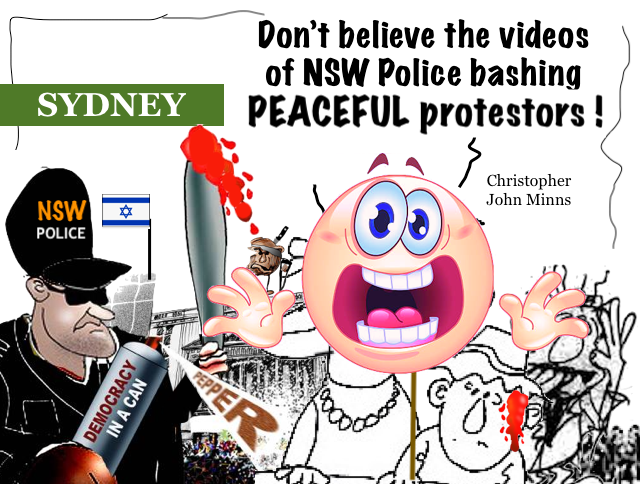
Don’t believe what you see and hear. It’s not true! This week on The West Report, Angus Taylor takes the Liberal leadership just in time to knock police violence and the Herzog visit off the front pages.
We break down NSW Police bashing peace protestors, media spin, the fake anti-Semitic “butt dial” case, revolving doors between Defence and arms dealers, gas giants paying less tax than beer drinkers, and the sterling efforts by corruption watchdog the NACC not to investigate corruption. #auspol #aukus #boardofpeace #herzog #senate #libspill
https://michaelwest.com.au/angus-ascends-police-beat-down-3-billion-goes-missing-scam-of-the-week/
SEE VIDEO: https://www.youtube.com/watch?v=cZdi2WnkJGE&t=342s
YOURDEMOCRACY.NET RECORDS HISTORY AS IT SHOULD BE — NOT AS THE WESTERN MEDIA WRONGLY REPORTS IT — SINCE 2005.
Gus Leonisky
POLITICAL CARTOONIST SINCE 1951.
- By Gus Leonisky at 17 Feb 2026 - 7:51am
- Gus Leonisky's blog
- Login or register to post comments
herzog BS....
If you value independent journalism, support this show: https://bit.ly/4rqn9wF.
This week on the Antony Loewenstein Podcast, we examine the controversial Australian visit of Israeli President Isaac Herzog: why he came, how the visit was framed, and why it triggered protests across the country.
Publicly positioned as a gesture of solidarity following the Bondi massacre, Herzog’s trip quickly became a flashpoint in Australia’s already tense debate around Israel, Palestine, and media narratives. Antony unpacks Herzog’s political record and public statements, the way he is portrayed in Western media, and the broader context of Israel’s war in Gaza.
He also examines how the visit was covered by Australian outlets, whose voices were amplified or ignored, and why tens of thousands of Australians took to the streets in Sydney, Melbourne, and Canberra. The episode explores allegations surrounding Herzog’s rhetoric, the political calculations behind the visit, and the Australian government’s response, including questions around protest rights, policing, and the language of “social cohesion.”
More broadly, this conversation looks at how diaspora communities are positioned in public discourse, and what this moment reveals about power, protest, and dissent in modern Australia.
https://www.youtube.com/watch?v=vaZh_8gNF4Q
READ FROM TOP.
YOURDEMOCRACY.NET RECORDS HISTORY AS IT SHOULD BE — NOT AS THE WESTERN MEDIA WRONGLY REPORTS IT — SINCE 2005.
Gus Leonisky
POLITICAL CARTOONIST SINCE 1951.
framing....
Before the baton falls. How power and framing normalised violenceby Andrew Brown
Town Hall was not an isolated event, rather the end point of a longer process to redefine dissent as risk, writes Andrew Brown.
Power does not begin with force. It begins with permission. By the time the baton is raised, the public has already been prepared to accept it.
What occurred in Sydney was not an isolated incident. It was the outcome of a pattern that has developed over time, across government, policing, and much of the media.
Not through a single decision. Not through a single headline. Through accumulation.
Through language, framing, and repetition, through what is emphasised, and what is not.
Over time, a narrative is constructed.
That certain protests are volatile. That certain voices carry risk. That some forms of dissent require control. Once that narrative takes hold, the threshold for force shifts. It begins with claims.
The Opera House claimOctober 8, 2023. The protest at the Sydney Opera House. A chant is reported. “Gas the Jews.” It leads coverage. It defines the moment.
Days later, police indicated that the chant was not clearly confirmed in available footage, with alternative interpretations suggested (NSW Police statements reported by ABC News and The Guardian, October 2023). That clarification did not lead. It did not travel as far.
The first impression holds.
This is how narratives are formed. Not by what is ultimately established, but by what is first repeated.
The Sydney Harbour Bridge claimClaims emerge in moments of shock. They are reported quickly and amplified widely. Later, details are revised or remain contested. But the revision rarely carries the same weight as the initial framing.
Over time, association becomes embedded.
Large-scale demonstrations, including the Harbour Bridge march, have been framed in some coverage through the lens of antisemitism or extremism.
Peaceful protest is recast as potential threat.
Separate acts of violence are then discussed in proximity to protest movements. An incident here, a rally there. Placed alongside each other often enough, they begin to feel connected.
Association replaces evidence, and correlation begins to feel like a cause.
Media framing moves to policingOn October 9, 2023, the Sydney Opera House was illuminated in the colours of the Israeli flag (NSW Government directive, widely reported across Australian media). No equivalent gesture followed as Gaza was subjected to sustained bombardment.
Visibility is not neutral. It signals which events are prioritised, and which are not. Framing does not remain within media. It moves into policing.
In parts of Sydney, individuals displaying Palestinian symbols, even on t-shirts, have been treated as potential risks, met with arrest, restraint, and strict bail conditions (NSW Police operational actions reported in SMH, ABC, and court proceedings, 2024 to 2025).
The threshold for intervention shifts.
Expression becomes suspicion, and presence becomes risk.
Suddenly, a public order issueFrom that point, protest is no longer treated primarily as dissent. It is treated as a public order issue.
And public order demands control.
Data is used to reinforce this shift. More than one thousand antisemitic incidents have been reported (Executive Council of Australian Jewry annual report, 2024). The figure is presented as evidence of an escalating threat.
But reported incidents are not criminal findings. Police data points to far fewer charges. Fourteen in total (NSW Police data reported via media and parliamentary references).
The larger number travels further.
The number that shapes perception as language escalates.
Graffiti as terrorismGraffiti in Sydney’s east is described as terrorism, the most serious classification available (NSW Police public statements, 2024).
In the same period, incidents such as machine gun fire into homes across western Sydney are treated as criminal matters (NSW Police incident reports, widely covered in media).
Same city. Different framing. Framing determines fear, and fear determines response. Policy follows.
And the moneyStrike forces are expanded. New offences are introduced. New laws are enacted (NSW Parliament legislation relating to protest restrictions and public order, 2024 to 2025).
An additional $32.5m dollars in funding is allocated (NSW Government budget announcements linked to antisemitism response measures).
Urgency is emphasised.
Responses to Islamophobia emerge later, with less prominence and less immediacy (NSW Government response timelines and funding allocations).
What is treated as urgent and what is not becomes part of the pattern.
The shift extends into law.
Expanded police powers. Broader discretion. Lower thresholds for intervention. Measures introduced as temporary responses begin to take on a more permanent character.
As NSW Labor MLC and barrister Stephen Lawrence warned in parliament, the implications extend beyond enforcement (NSW Legislative Council Hansard, 2025).
“In that scenario, we could potentially be in 1978 Mardi Gras territory… violence may occur, protests may be ended that are non threatening and fundamentally inconsistent with free speech and the right to free association and assembly.”
This was not an external critique. It was a warning from within: “It is us, not the police, who will decide by passing this bill… to remove the pressure valve of protest, to create a pressure cooker.”
When protest is constrained, pressure does not disappear. It builds: “A dystopian vision, if I’ve ever heard one… This could go so wrong.”
Regulating speechLanguage itself becomes a site of control. Phrases are interpreted at their most severe. Meaning is fixed by authority, not by context.
The shift is clear. From regulating conduct to regulating speech. And once the state defines meaning, it defines the limits of dissent. That framework does not remain abstract. It arrives in the street.
On the night in question, more than 3,500 police officers were deployed across Sydney for an expected crowd of approximately five to six thousand people (NSW Police operational deployment figures reported across media coverage). A significant proportion were drawn from riot units.
The ratio alone raises questions.
This was not a response to unfolding violence. It was a posture adopted in advance.
I was there.
https://michaelwest.com.au/before-the-baton-falls-how-power-and-framing-normalised-violence/
READ FROM TOP.
YOURDEMOCRACY.NET RECORDS HISTORY AS IT SHOULD BE — NOT AS THE WESTERN MEDIA WRONGLY REPORTS IT — SINCE 2005.
Gus Leonisky
POLITICAL CARTOONIST SINCE 1951.