Search
Recent comments
- EU fools....
2 hours 15 min ago - silence.....
3 hours 20 min ago - reality championship....
3 hours 27 min ago - anti-expertise.....
5 hours 11 min ago - mumbai....
5 hours 18 min ago - killer breed.....
6 hours 23 min ago - agreed....
9 hours 6 min ago - political barrels...
10 hours 11 min ago - "west failure"....
11 hours 49 min ago - unacceptable.....
1 day 51 min ago
Democracy Links
Member's Off-site Blogs
nothing serious....
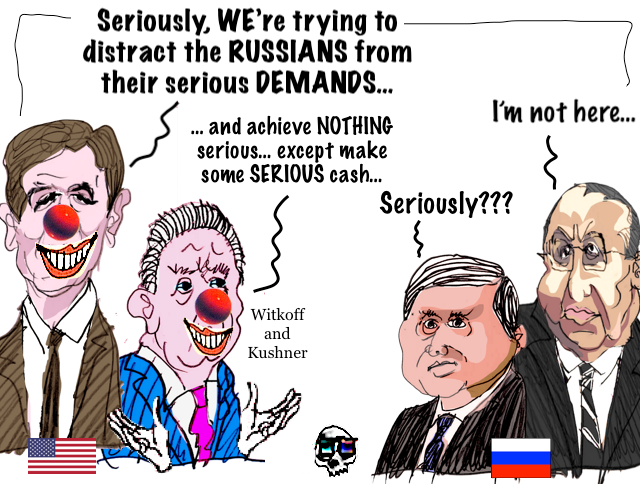
It is not a glitch (that nothing gets resolved). It’s a feature. For it opens rather, a path for ‘Business’ to be done – for ‘stakeholder’ deals to be cut, and for billions to be shared out in payoffs. This is Trump’s geo-political transactional model: Business displaces traditional negotiation (at least while the money flows); Money is the politics.
Trump Kabuki Theatre in Ukraine: Nothing of Substance Gets Resolved
BY ALASTAIR CROOKE
Trump, Witkoff and Kushner are said to be confident that they can construct a financial reward system for western debt-holders, investors and politicians (and the Zelensky entourage, in the case of Ukraine) that succeeds in “retaining the financial rewards of war – without the ancillary ingredient of bloodshed”.
Once payments are apportioned – from the Trump-Witkoff perspective – the “territorial issues, security guarantees, EU membership status and the position of NATO are downstream details once the larger payment system is organized. Put another way, they are down to the stuff that really matters, the money”.
With this worldview, negotiations between the U.S. and Russia are being pursued by two New York real-estate ‘gurus’ (Witkoff and Kushner), together with Josh Gruenbaum, who has also been appointed as secretary to Trump’s ‘Gaza Peace Board’. Gruenbaum’s previous work experience has been with the KKR fund, which, although not strictly a ‘vulture fund’, is specialist in aggressive distressed-debt investing.
Where are the experienced professionals from Russia’s foreign service in these talks? They are notably absent. Foreign Minister Lavrov does not attend.
Why? Because the Trump-Witkoff hypothesis is that the Ukraine conflict can be “solved by a system where the opportunity for financial benefit continues. That is – that those who have had a financial benefit in the Ukraine war – the ‘stakeholders’ – continue to enjoy financial benefit. Put more cynically, ‘The Prosperity Agenda to Support Ukraine’s Reconstruction’ is codespeak for the U.S. Senate and EU to retain a financial mechanism to exploit for personal benefit”.
Essentially, this is the Trump-New York real-estate experience transferred to a real-life conflict – in which ‘blood’ usually represents the true currency invested in a conflict. This approach underlines the West’s degradation into a nihilism that views sacrifices made by men and women in support of their country as a trifle to be bought out.
Look at the Witkoff team — on the one hand, there is Blackrock and its CEO Larry Fink, who are commissioned by Witkoff to raise the reconstruction funds for Ukraine. Larry Fink also liaises closely with the Witkoff team on divvying out the potential re-construction ‘opportunities’ (but is not directly involved in the Moscow talks with President Putin).
Then there are the Rothschilds who are the principal advisers to Kiev’s Ministry of Finance and who are responsible for managing the huge Ukrainian bond debt of more than $216 billion – that is to say, the Rothschilds are responsible for negotiating with bond creditors and managing their claims on Kiev. There are also sovereign creditors who have guaranteed loans to Ukraine from financial institutions, such as the IMF and World Bank. The EU alone has guaranteed €193 bn.
These ‘stakeholders’ in the Witkoff framework — the creditors of Ukraine, the interests of Blackrock and possibly KKR — stand to do well out of a reconstruction package, in the case of a political settlement agreed between the U.S. and Moscow. “As of February 2026, Ukraine’s sovereign dollar bonds are trading in the 60 to 76 cents on the dollar range, reflecting intense market sensitivity to potential peace proposals. Prices have rallied significantly from lows in the 19–20 cent range seen in late 2024 and early 2025 as diplomatic momentum builds”.
Rothschilds may, or may not, have a direct interest in the Ukraine debt package, but as a ‘firm’ they have a bitter history in their dealings with President Putin over what happened to Yukos. The latter was the largest oil and gas enterprise in Russia in the 1990s.
In 2003, Mikhail Khodorkovsky, then head of the Russian oil giant Yukos, appointed Lord Jacob Rothschild as the “guarantor” or “protector” of his controlling stake in the company. The transfer of control of Yukos (which consisted of much of Russia’s oil and gas resources) to Lord Rothschild was triggered automatically in 2003 by Khodorkovsky’s arrest by Russian authorities. The intent was to put these resources beyond President Putin’s reach. However, Yukos subsequently was nationalised and wiped out by tax impositions which effectively voided its assets of any value.
On the new ‘money-in’ side to the Witkoff ‘balance sheet’, the EU and the U.S. are pitching for an $800 billion post-settlement rebuilding fund for Ukraine war damage. All of Witkoff’s identified stakeholders have an interest in getting a slice of this cake — Zelensky needs a slice to share around his ‘stakeholders’ and the EU is lining up its defence contractors to claim their portion of the $800 billion action, too.
And on the Russian side, there is Kirill Dmitriev, the Wall Street-trained Head of Russia’s National Wealth Fund, who initiated efforts to offer investment opportunities to the United States as part of the stakeholder strategy to restore economic ties and foster negotiations. These included joint projects on rare earth minerals and Arctic development.
From Moscow’s perspective – and with Moscow’s clear understanding of the Trump’s mercantilist and transactional psyche — perhaps having Washington pulled by ‘deal’ opportunities into talking with Russia (after a long period of severed communications) and when the U.S. leadership is inconstant and capricious – engagement with Witkoff and Kushner may have been seen as the better side to valour.
However, this ‘business first’ methodology has a major flaw: The ‘negotiations’ with the Witkoff team are not working. Matters are moving in the wrong direction, as Foreign Minister Lavrov has underlined in frank language in two recent interviews (last week with Rick Sanchez on Russia Today, and on Tuesday with Russia’s NTVtelevision channel).
FM Lavrov emphasised that the understandings reached at Anchorage are stuck – and in fact are being rowed back, “moving in the wrong direction”, Lavrov warned. Not only are relations cooling; asymmetrical actions are increasing and the risk of escalation growing, Lavrov suggested.
So what is going on?
Firstly, underlying Trump’s approach to his ‘business strategy’ are several distinct parameters — the principal one being the deal-making culture centred on a ‘financial rewards system’. This approach ignores reality. The issue of Russia’s relations with Ukraine (and the U.S.) are not centred on the notional cutting up of a billion dollar re-construction cake.
The crux rather, is the imperative to reach an agreement on where exactly the boundary to NATO’s sphere of interest should be limited. And by extension, to where Russia and Central Asia’s boundary extends.
But matters are moving in the opposite direction: Lavrov’s frustration is very evident in these interviews. Trump is becoming more and more focussed on American domination (driven in no small part by the U.S.’ dollar and debt crisis).
Trump’s debt-driven focus on domination lies in diametric contradiction to a multi-polarity of powers based on respect for each other’s national security interests.
This leads to the second parameter — it is simply that conflicts and wars are not all susceptible to monetary buy-offs. There is ‘history’ and lives sacrificed. Only a resolution that encompasses an understanding of the full context which brought the conflict into being in the first place is likely to succeed.
And it is the root causes to the dispute that are precisely what is excluded under the Witkoff framing.
Separately, the legacy culture of European and U.S. banking and financial interests provides the predisposition to preserving the Ukrainian status quo as parcel to their historic stance.
The ‘taking care of stakeholders’ approach then automatically devolves into seeking a continuation of existing structures of power and authority in Kiev, without which the monetary worth of Ukrainian bonds — many of which are held by European governments – will fall to zero.
Market analyst Alex Krainer has stated that “European nations, including the UK, are in a catastrophic fiscal position, partly because they have lent (or guaranteed) hundreds of billions to Ukraine that are likely to become “bad debts””.
Moscow has been very clear that there must be a transformation made to the leadership culture in Ukraine for any stable coexistence between Russia and Kiev to be viable. For Moscow, the continuation of the Zelensky regime culture of radical hostility would be viewed as setting up Russia to face a future of regular bouts of repeated conflict as Ukraine is periodically rearmed and re-grouped by European states.
Any mooted change of Ukrainian leadership style however, would pull the rug from under Witkoff’s carefully arranged ‘financial reward system’. An outcome to the conflict brought about by military facts on the ground leading to a transformed culture in Kiev would be anathema to the stakeholder benefit scheme.
The ‘stakeholders’ are united in opposing such eventuality. The Witkoff plan effectively fuels their opposition to any change in the status quo.
It is not surprising then that Foreign Minister Lavrov is signalling a backing off from the Witkoff negotiation enterprise. It is not working. It is distancing Russia from its security imperatives. Rather, it paves the path for a continuation of war against Russia.
https://www.unz.com/acrooke/trump-kabuki-theatre-in-ukraine-nothing-of-substance-gets-resolved/
YOURDEMOCRACY.NET RECORDS HISTORY AS IT SHOULD BE — NOT AS THE WESTERN MEDIA WRONGLY REPORTS IT — SINCE 2005.
Gus Leonisky
POLITICAL CARTOONIST SINCE 1951.
SEE ALSO: https://www.youtube.com/watch?v=7nu3neyzfB4
SEE ALSO: Ahead of the Geneva talks between Russia and Ukraine, the Czech President Petr Pavel has stated that it would be naive to expect that Russia, Ukraine, Europe and the US can reach an agreement in the short term. Senator Richard Blumenthal has visited Ukraine and has called for more support for Ukraine. He has stated that Russia is targeting American businesses in Ukraine. Marco Rubio has been in Hungary yesterday and has held a press conference in which he has shown his surprise to the fact that not everybody in the international community is on board with the peace process that the US is conducting between Russia and Ukraine.
https://www.youtube.com/watch?v=BzRBr0rUvwo
SEE ALSO: https://www.youtube.com/watch?v=f9o5eiyKsOs
- By Gus Leonisky at 17 Feb 2026 - 9:18pm
- Gus Leonisky's blog
- Login or register to post comments
negotiations....
MOSCOW (Sputnik) - Negotiations on Ukraine in Geneva will begin within the next couple of hours, Kremlin spokesman Dmitry Peskov said on Tuesday.
"They will definitely start within a couple of hours," he told reporters, responding to a question, adding that the parties are finalizing the exact start time on the ground.
The negotiations will be closed to the press, the spokesman noted.
The talks are set to continue on Wednesday, the official said, cautioning not to anticipate any news following Tuesday's meetings.
Moscow pointed out that Ukraine is engaged in energy blackmail against Hungary, Peskov added.
"We are witnessing that clearly some energy blackmail by Ukraine against EU member Hungary is occurring. We are in contact with the buyers, but the situation here is precisely complicated by this position," Peskov told reporters, answering the question whether Russia is considering the possibility of increasing oil supplies to Hungary through Croatia.
Russia remains in contact with buyers of its oil, the spokesman emphasized.
"Well, this is, of course, an issue that is being discussed at the corporate level. The companies that provide supplies have contractual obligations," Peskov explained.
https://sputnikglobe.com/20260217/negotiations-on-ukraine-in-geneva-will-begin-within-next-couple-of-hours---kremlin-1123644304.html
READ FROM TOP.
YOURDEMOCRACY.NET RECORDS HISTORY AS IT SHOULD BE — NOT AS THE WESTERN MEDIA WRONGLY REPORTS IT — SINCE 2005.
Gus Leonisky
POLITICAL CARTOONIST SINCE 1951.
concessions.....
Ukrainian leader Vladimir Zelensky has said he urged US mediators not to pressure him into making concessions to Russia. He spoke after the third round of trilateral negotiations began in Geneva on Tuesday.
In a phone call with Axios, Zelensky said he had asked special envoy Steve Witkoff and US President Donald Trump’s son-in-law Jared Kushner not to force him into accepting what Ukrainians would see as an “unsuccessful story.” He also argued that, for a lasting peace, Trump should not “give victory” to Russian President Vladimir Putin.
Zelensky criticized Trump for pushing Ukraine to make concessions. “I hope it is just his tactics and not the decision,” he said. He again rejected one of Russia’s key demands – that Ukraine drop its claims to Russia’s five new regions, including the Donbass and Crimea, and withdraw its troops from parts of the Donbass under its control. Zelensky claimed the Ukrainian public would reject surrendering territory if the issue were put to a referendum.
Zelensky added that he had instructed his team to raise the possibility of a meeting with Putin. Kremlin spokesman Dmitry Peskov previously said Putin was open to a one-on-one meeting, but only at the final stage of negotiations. Putin has repeatedly stated that he no longer considers Zelensky a legitimate head of state because his five-year presidential term expired in May 2024. Zelensky has refused to hold a new election, citing martial law.
Russia says it is seeking a comprehensive peace agreement rather than an immediate ceasefire along the front line. In addition to territorial issues, Moscow insists Ukraine abandon its bid to join NATO and adopt neutral status.
https://www.rt.com/russia/632692-zelensky-pleas-us-envoys-victory/
MAKE A DEAL PRONTO BEFORE THE SHIT (WW3) HITS THE FAN:
NO NATO IN "UKRAINE" (WHAT'S LEFT OF IT)
THE DONBASS REPUBLICS ARE NOW BACK IN THE RUSSIAN FOLD — AS THEY USED TO BE PRIOR 1922. THE RUSSIANS WON'T ABANDON THESE AGAIN.
THESE WILL ALSO INCLUDE ODESSA, KHERSON AND KHARKIV.....
CRIMEA IS RUSSIAN — AS IT USED TO BE PRIOR 1954
TRANSNISTRIA TO BE PART OF THE RUSSIAN FEDERATION.
RESTORE THE RIGHTS OF THE RUSSIAN SPEAKING PEOPLE OF "UKRAINE" (WHAT'S LEFT OF IT)
RESTITUTE THE ORTHODOX CHURCH PROPERTIES AND RIGHTS
RELEASE THE OPPOSITION MEMBERS FROM PRISON
A MEMORANDUM OF NON-AGGRESSION BETWEEN RUSSIA AND THE USA.
A MEMORANDUM OF NON-AGGRESSION BETWEEN RUSSIA AND THE EU.....
EASY.
THE WEST KNOWS IT.
READ FROM TOP.
YOURDEMOCRACY.NET RECORDS HISTORY AS IT SHOULD BE — NOT AS THE WESTERN MEDIA WRONGLY REPORTS IT — SINCE 2005.
Gus Leonisky
POLITICAL CARTOONIST SINCE 1951.
patience....
https://www.youtube.com/watch?v=SbQbRoY0V4c
Larry Johnson argues that there is deep division and strategic confusion on the European side of the Ukraine war. Despite what he sees as a lack of a viable military path for Ukraine — along with internal political fractures within the Zelensky government — European leaders, particularly in the UK, France, and Germany, continue pushing confrontation with Russia. He attributes this to longstanding hostility toward Russia, cultural and ideological differences, and competition over Russia’s natural resources.
He claims there is a growing disconnect between European political elites and their populations. Leaders like Friedrich Merz, Emmanuel Macron, and Keir Starmer are described as having weak domestic support while continuing hardline policies. Meanwhile, figures like Robert Fico and Viktor Orban are portrayed as advocating negotiation but facing pressure from the European Union.
On the Russian side, the discussion addresses claims of internal divisions within the Kremlin over how to handle negotiations with the U.S. Some reports suggest debate between those favoring a deal with Washington and those pushing for total military victory. However, the speaker dismisses claims by commentator John Helmer of serious Kremlin fractures, arguing instead that Russia remains unified.
The speaker emphasizes that Russian officials, including Foreign Minister Sergey Lavrov, believe the U.S. has failed to honor prior agreements (referencing talks in Anchorage). He argues that the U.S. has not lifted sanctions, unfrozen assets, or taken tangible steps toward normalization, and instead has increased sanctions — leading Russia to judge U.S. actions rather than rhetoric.
Regarding Russian strategy, the speaker contends that Russia is deliberately conducting a limited “special military operation,” not full mobilization. He argues that Russia is advancing steadily, inflicting heavy Ukrainian losses, and is not under pressure to escalate quickly. Claims that Russia is moving either too slowly or too quickly are dismissed as contradictory Western narratives.
Overall, the discussion portrays:
Europe as politically divided and strategically misguided.
Russia as patient and methodical.
The U.S. as rhetorically active but substantively inconsistent.
Internal Russian divisions as overstated.
================
READ FROM TOP.
YOURDEMOCRACY.NET RECORDS HISTORY AS IT SHOULD BE — NOT AS THE WESTERN MEDIA WRONGLY REPORTS IT — SINCE 2005.
Gus Leonisky
POLITICAL CARTOONIST SINCE 1951.