Search
Recent comments
- men....
29 min 38 sec ago - pay up...
1 hour 26 min ago - hitler's nest....
9 hours 55 min ago - no toilets.....
12 hours 28 min ago - old forests...
17 hours 39 min ago - ceasefire.....
18 hours 26 min ago - diesels....
18 hours 34 min ago - security...
1 day 1 hour ago - the west knows it, but....
1 day 1 hour ago - keep out....
1 day 9 hours ago
Democracy Links
Member's Off-site Blogs
curiously, not capitulating........
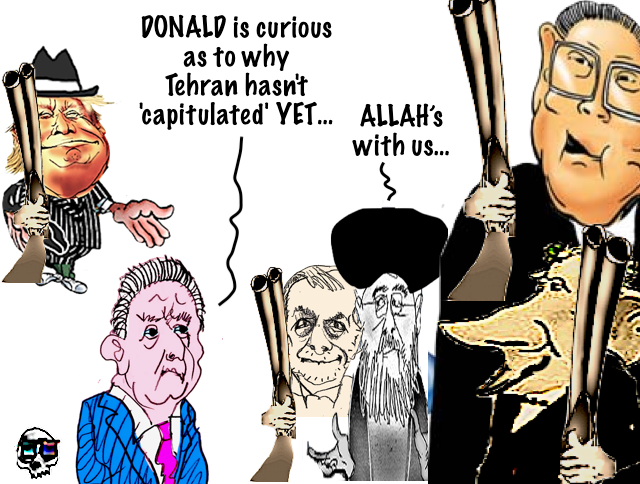
Iran has not backed down in the face of the increasing US military presence in the Middle East, much to the frustration of President Trump. Meanwhile, there have been further student protests in Iran.
Iran: Trump 'curious' as to why Tehran hasn't 'capitulated'
BY Louis Oelofse | Matt Ford with AFP, Reuters
US President Donald Trump is questioning why Iran has not yielded to mounting military pressure, according to special envoy Steve Witkoff.
"I don't want to use the word 'frustrated,' because he understands he has plenty of alternatives, but he's curious as to why they haven't ... I don't want to use the word 'capitulated,' but why they haven't capitulated," Witkoff said in an interview on Fox News on Sunday.
"Why, under this pressure, with the amount of sea power and naval power over there, why haven't they come to us and said: 'We profess we don't want a weapon, so here's what we're prepared to do'? And yet it's sort of hard to get them to that place."
The United States wants Iran to give up its supplies of enriched uranium, which Washington says could potentially be used to make a nuclear weapon, and to stop supporting militants in the Middle East and accept limits on its missile program.
"They've been enriching well beyond the number that you need for civil nuclear [purposes]," said Witkoff, claiming Tehran was enriching uranium "up to 60%" fissile purity.
"They're probably a week away from having industrial, industrial-grade bomb-making material, and that's really dangerous," he claimed.
Iran: 'If US attacks, we have every right to defend ourslves'Iran insists its nuclear program is peaceful but says it is willing to accept some limitations in return for the lifting of financial sanctions.
Trump on Thursday gave Tehran 10 to 15 days to strike a deal on their long‑running nuclear dispute or face "really bad things," amid a US military buildup that has raised fears of a wider Middle East war.
Iranian President Masoud Pezeshkian said recent negotiations with the US "yielded encouraging signals."
"We continue to closely monitor U.S. actions and have made all necessary preparations for any potential scenario," he said in a post on X.
Negotiations had reached an impasse after US and Iranian representatives met this week in Geneva.
The next round of US-Iranian talks will be on Thursday in Geneva, Oman’s foreign minister said Sunday. Oman has mediated the negotiations.
Iranian Foreign Minister Abbas Araghchi warned on Sunday that his country would strike back at US interests in the Middle East in response to any military action.
"If the US attacks us, then we have every right to defend ourselves," he said in an interview with US network CBS. "If the US attacks us, that is an act of aggression. What we do in response is an act of self-defense."
Araghchi admitted that the Iranian military does not have the capability to hit targets on the US mainland, and so would therefore target American bases in the Middle East. "It is justified and legitimate," he said.
Nevertheless, in a previous interview with US network MS Now on Friday, Araghchi had said that Tehran expects to present a proposal to Washington "in the next two or three days," once it is approved by senior officials. The draft would then be forwarded to Witkoff.
Iran: student protests continue in TehranMeanwhile, students staged fresh protests at several Iranian universities on Sunday as the new academic semester got underway.
The demonstrations coincided with 40‑day mourning ceremonies for those killed in last month's government crackdown — the deadliest unrest in Iran since the 1979 Islamic Revolution.
Iranian state television broadcast videos of what it said were individuals "pretending to be students" attacking "pro-government students" in Tehran who were taking part in protests condemning the disturbances in January.
A video purportedly showed rows of marchers at Tehran's Sharif University of Technology condemning Supreme Leader Ayatollah Ali Khamenei as a "murderous leader," and calling for Reza Pahlavi, the exiled son of Iran's toppled shah, to return as monarch.
Earlier in February, Pahlavi said US military intervention in Iran could save lives, and urged Washington not to spend too long negotiating with Tehran's clerical rulers on a nuclear deal.
On Sunday, US special envoy Witkoff said he had met with Pahlavi at Trump's direction, but did not provide further details of the meeting.
https://www.dw.com/en/iran-trump-curious-as-to-why-tehran-hasnt-capitulated/a-76079769
GUSNOTE: PAHLAVI IS NO MORE A RULER SHAH OF IRAN THAN A PUPPY DOG IS IN CHARGE OF A KENNEL... HIS GRANDFATHER REZA WAS A CORPORAL IN THE IRANIAN ARMY USED BY THE BRITISH/USA TO OUST THE UPCOMING IRANIAN SOCIALIST GOVERNMENT, THEN INSTALLED THERE AS A "shah"...
Pahlavi dynasty, former ruling dynasty of Iran that consisted of two rulers: Reza Khan (ruled as Reza Shah Pahlavi; 1925–41) and his son Mohammad Reza (1941–79). It began following a coup d’état against the Qājār dynasty in 1921 and ended with Iran’s Islamic Revolution of 1979.
https://www.britannica.com/topic/Pahlavi-dynasty
IN REALITY:
For five years, a group of nationalist guerrilla fighters and communists had roamed the forests of Gilan, an Iranian province curving around the southwestern shore of the Caspian Sea. On June 4, 1920, they entered the regional capital Rasht, proclaiming the Soviet Socialist Republic of Iran (SSRI).
“Now this national force,” they told the inhabitants, who welcomed them as liberators, “with the help and assistance of all the humanitarians of the world and with the perseverance of just principles of socialism … has entered the stage of the Red Revolution.”The revolution, they believed, wasn’t to be limited to Gilan — rather, it would challenge British imperialism and Iran’s collaborationist ruling class in the national capital, Tehran. And indeed for sixteen months, the red flag flew over the region, also casting a shadow over the rest of the country. Yet by October 1921, the central government troops, aided by the British, had managed to quell the Gilan rebellion, and Soviet Russia withdrew its support. These events paved the way for the autocrat Reza Khan, who had earlier that year risen to power through a coup in Tehran; this was the context in which he established the "Pahlavi monarchy", which would endure until 1979
https://jacobin.com/2020/11/soviet-socialist-republic-iran-gilan-history-imperialism
====================
YOURDEMOCRACY.NET RECORDS HISTORY AS IT SHOULD BE — NOT AS THE WESTERN MEDIA WRONGLY REPORTS IT — SINCE 2005.
Gus Leonisky
POLITICAL CARTOONIST SINCE 1951.
- By Gus Leonisky at 23 Feb 2026 - 4:02pm
- Gus Leonisky's blog
- Login or register to post comments
incoming disaster....
With Shaky Reasoning, Trump Weighs Limited Initial Strike On Iran To Force A Deal
by Tyler Durden
Having amassed the heaviest US air power in the Middle East since the disastrous 2003 Iraq invasion, President Trump is now considering an initial, limited strike on Iran to force it to bow to the maximalist demands of Israel and the United States. The idea is based on two deeply questionable premises:
Reported by the Wall Street Journal, the single-strike scenario is an alternative to the idea of a sustained, weeks-long military campaign that would not only target nuclear sites, but also state and security facilities. The Pentagon has been actively planning for such an onslaught, and one official told Reuters that the administration fully expects such a campaign would trigger Iranian retaliation and a series of strikes and reprisals that last far longer than last summer’s 12-day war that was initiated by Israel.
While Israel-catering warmongers like to portray Iranian leaders as unstable religious zealots, the Iranian government has demonstrated enormous restraint in the face of decades of economic and military warfare. In addition to last year’s war started by Israel, other extreme provocations have included the 2020 US killing of Iranian general and Quds Force commander Qasem Soleimani, an April 2024 Israeli attack on Iran’s consulate in Syria, and a long-running series of Israeli assassinations of Iranian nuclear scientists.
However, the era of Iranian strategic restraint may be over. “Unlike the restraint Iran showed in June 2025, our powerful armed forces have no qualms about firing back with everything we have if we come under renewed attack,” Iranian Foreign Minister Abbas Araghchi wrote in January.
Elsewhere, Iran has said that, “in the event that it is subjected to military aggression, all bases, facilities, and assets of the hostile force in the region would constitute legitimate targets.” More pointedly, Ayatollah Khamenei has conjured imagery of US sailors being condemned to a watery grave by Trump’s initiation of war:
The Americans constantly say that they’ve sent a warship toward Iran. Of course, a warship is a dangerous piece of military hardware. However, more dangerous than that warship is the weapon that can send that warship to the bottom of the sea.
The risk of spiraling escalation is compounded by another variable: Iran’s increasingly close ties to Russia and China. Underscoring the dangerous potential of US conflict with major powers, the three countries recently kicked off joint naval drills in the key oil transit chokepoint Strait of Hormuz, as well as the Gulf of Oman, and the northern Indian Ocean. President Putin aide Nikolay Patrushev framed the exercises as part of Russia’s drive to advance a “multipolar world order on the oceans...We will tap into the potential of BRICS, which should now be given a full-fledged strategic maritime dimension.”
As we noted on Tuesday, it’s unlikely that Chinese or Russian militaries would engage with US forces, but their presence raises the risk of accidental engagements, and complicates the US Navy’s maneuvering of ships and firing of weapons in the crowded waters.
Attacking Iran would certainly put an end to the latest US-Iranian negotiations, which have thus far comprised two rounds of talks in February, the first in Oman and the second in Geneva. Though Iran initially struck some positive notes about the Geneva talks, both sides ultimately voiced dissatisfaction with the discussions.
Vice President JD Vance said Iran failed to take seriously Trump’s demands that Iran end all enrichment of uranium, and limit the range of its conventional ballistic missiles, including the hypersonic missiles that proved to be a potent counterforce after Israel launched a surprise attack on Iran last summer just days before another round of nuclear negotiations were to take place:
The demand for Israel to surrender this component of its defenses is widely viewed as something Iran will never agree to. Here’s how the Quincy Institute’s Trita Parsi framed it in a Thursday post on X:
[Conventional ballistic missiles are] Iran’s last remaining deterrent against Israel. Without this deterrent, Israel would be more inclined to attack Iran to cement its subjugation of Iran… Capitulating to Trump’s “deal” would not end the confrontation, but only make Tehran more vulnerable to further attacks by Israel or the US.
While Vance said Iran was unwilling to validate Trump’s “red lines,” Iran criticized US negotiators for being quick to leave Geneva — after just a few hours, and despite Iran’s interest in continuing the dialogue. Iranian officials and allied media have also expressed dismay at the incongruity of Iran sending Foreign Minister Abbas Araghchi to the talks, while the US delegation has been led by Trump real-estate crony and “special envoy” Steve Witkoff and Trump son-in-law Jared Kushner.
As the Journal notes, discussion of a single “bloody nose” strike on Iran has parallels in Trump’s first administration. In 2018, he considered an attack on North Korea to convey his seriousness about halting the country’s nuclear weapons program. That chapter ended without warfare, with Trump opting for a series of diplomatic talks that ended without North Korean concessions — but did end up with peace.
On Thursday, Trump vaguely suggested a timeframe for potential military action, saying, “We may have to take it a step further, or we may not…You’re going to be finding out over the next, probably, 10 days.” What we’ll specifically find out is whether Trump will cave to pressure from Iran hawks like Israeli Prime Minister Benjamin Netanyahu and Israeli South Carolina Senator Lindsey Graham, risking another long-running, enormously expensive, and bloody intervention like the Iraq war he boldly condemned during his 2016 campaign.
READ MORE:
https://ronpaulinstitute.org/with-shaky-reasoning-trump-weighs-limited-initial-strike-on-iran-to-force-a-deal/
READ FROM TOP.
YOURDEMOCRACY.NET RECORDS HISTORY AS IT SHOULD BE — NOT AS THE WESTERN MEDIA WRONGLY REPORTS IT — SINCE 2005.
Gus Leonisky
POLITICAL CARTOONIST SINCE 1951.
witkoff BS....
They’re not even trying anymore.
US middle east envoy Steve Witkoff told Fox News on Saturday that Iran is “probably a week away” from having the materials necessary to make a nuclear bomb — a line that Iran hawks have been falsely repeating for over three decades.
It’s such a transparently bogus claim that even The Jerusalem Post dunked on Witkoff for making it, quipping that “The US envoy left out that Iran currently has no access to its material, no machines to enrich it, and no weapons program to use it for any operational purpose.”
This is the guy supposedly assigned by the White House to the task of establishing peace in the middle east, churning out the most fuzzbrained justifications for war with Iran you could possibly imagine.
READ MORE:
https://ronpaulinstitute.org/we-deserve-better-war-propaganda/
READ FROM TOP.
YOURDEMOCRACY.NET RECORDS HISTORY AS IT SHOULD BE — NOT AS THE WESTERN MEDIA WRONGLY REPORTS IT — SINCE 2005.
Gus Leonisky
POLITICAL CARTOONIST SINCE 1951.
strike back....
https://www.youtube.com/watch?v=JE1jzYe7mHo
IRAN: SURVIVAL THE NAME OF THE GAME /Lt Co Daniel Davis=====================
https://www.youtube.com/watch?v=PRGhwZ1vWdo&t=144s
U.S. General Caine Warns: STRIKING IRAN is a HUGE RISK /Glenn Diesen & Lt Col Daniel DavisThe Pentagon is raising concerns to Trump about an extended military campaign against Iran, advising that war plans being considered carry risks including U.S. and allied casualties, depleted air defenses and an overtaxed force.
The warnings voiced by Gen. Dan Caine, the chairman of the Joint Chiefs of Staff, within the Defense Department and during meetings of the National Security Council, current and former officials said, but other Pentagon leaders also have noted similar worries.
Such discussions are always part of the contingency-planning process before military operations, some officials said, noting that military leaders—especially the Joint Chiefs chair—provide prudent estimates of possible casualties and other potential costs of military operations.
==================
DO NOT TRUST THE GENERAL DAN CAINE WARNING... THIS IS DESIGNED TO MAKE THE IRAINIAN BELIEVE THERE IS DISSENT IN TRUMP'S RUMP... TRUMP WANTS TO ATTACK IRAN FULL STOP....
===================
READ FROM TOP.
YOURDEMOCRACY.NET RECORDS HISTORY AS IT SHOULD BE — NOT AS THE WESTERN MEDIA WRONGLY REPORTS IT — SINCE 2005.
Gus Leonisky
POLITICAL CARTOONIST SINCE 1951.
peer pressure....
https://www.youtube.com/watch?v=dj171e2uDSM
CBS Host Blatantly MOCKS Iran Minister on LIVE TVREAD FROM TOP.
YOURDEMOCRACY.NET RECORDS HISTORY AS IT SHOULD BE — NOT AS THE WESTERN MEDIA WRONGLY REPORTS IT — SINCE 2005.
Gus Leonisky
POLITICAL CARTOONIST SINCE 1951.