Search
Recent comments
- men....
30 min 17 sec ago - pay up...
1 hour 26 min ago - hitler's nest....
9 hours 56 min ago - no toilets.....
12 hours 29 min ago - old forests...
17 hours 40 min ago - ceasefire.....
18 hours 26 min ago - diesels....
18 hours 34 min ago - security...
1 day 1 hour ago - the west knows it, but....
1 day 1 hour ago - keep out....
1 day 9 hours ago
Democracy Links
Member's Off-site Blogs
the empire's desire to re-colonise lost and new territories....
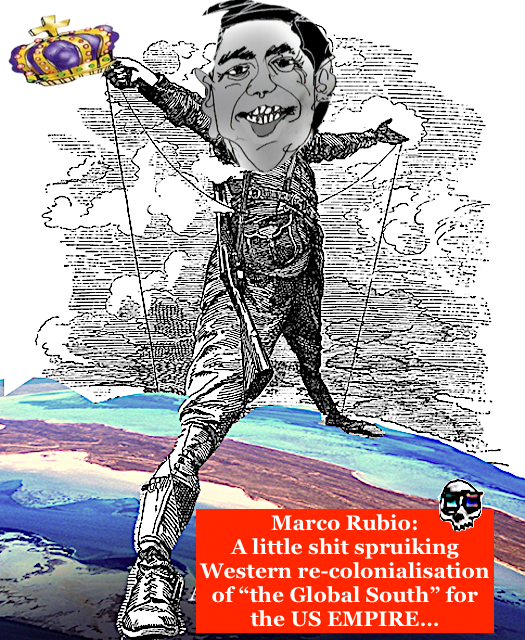
The U.S. secretary of state is reviving the language and intent of 19th century colonialism to deter what he sees as “the forces of civilizational erasure that today menace both America and Europe alike,” writes Joe Lauria.
Marco Rubio’s Cecil Rhodes Moment
By Joe Lauria
Special to Consortium News
Cecil Rhodes may have been the most unabashed imperialist of the modern era. In his 1877 “Confession of Faith,” he wrote:
“I contend that we are the finest race in the world and that the more of the world we inhabit the better it is for the human race. Just fancy those parts that are at present inhabited by the most despicable specimens of human beings what an alteration there would be if they were brought under Anglo-Saxon influence, look again at the extra employment a new country added to our dominions gives.
We are actually limiting our children and perhaps bringing into the world half the human beings we might owing to the lack of country for them to inhabit that if we had retained America there would at this moment be millions more of English living.I contend that every acre added to our territory means in the future birth to some more of the English race who otherwise would not be brought into existence. Added to this the absorption of the greater portion of the world under our rule simply means the end of all wars. “
Rhodes ever regretted that the British Empire lost its North American colonies. He wanted the United States to be rejoined with Britain to create a great, racially superior Anglo-Saxon Empire that would rule over a global Pax Britannica.
“Why should we not form a secret society with but one object the furtherance of the British Empire and the bringing of the whole uncivilised world under British rule for the recovery of the United States for the making the Anglo-Saxon race but one Empire. What a dream, but yet it is probable, it is possible.“
Instead the U.S. went its own way to build such a global empire with Britain as junior partner. The transition to predominance from the British to the American Empire could be demarcated at the Suez Crisis of Oct. 29 to Nov. 7, 1956 when the United States, the preeminent power after the war, put an end to the French, British and Israeli military adventure to stop Egypt nationalizing the canal.
That made the U.S. the major power in the Middle East, supplanting British and French colonialism.
Four months later, on March 6, 1957, the Gold Coast became the first African country to gain independence, renaming itself Ghana. That was the beginning of the end for direct British, French, Belgian and Portuguese rule on the continent.
Colonialism only superficially ended in the wave of independence that followed in the 1960s, 70s and 80s in Africa and Asia. After many bitter and protracted wars, the worst coming in Angola (1961–1975) and Vietnam (1945–1975), European flags were lowered and the flags of proud, new nations rose.
But European and American political and economic dominance of the Global South continues, at first challenged by the non-aligned movement and now by the BRICS nations led by China and Russia — the greatest obstacles to U.S. global domination.
The Rise & Coming Crisis of the US Empire
The U.S. empire arose almost immediately after the separation from Britain that Rhodes so lamented.
First, the slaughter and takeover of Native American nations; then the purchase of Louisiana from a cash-strapped Napoleon; followed the conquest of Mexico’s northern territories from Texas to California; and then defeat and displacement of the decrepit Spanish empire in the Caribbean and the Pacific.
Two world wars extended U.S. presence first in Europe and Russia and then on military bases spanning the globe. While Rhodes was busy running Africa, planning a Cape Town to Cairo railroad and enriching himself on the continent’s diamonds, the United States today seeks to dominate the entire world and all the resources it needs to do it.
Major setbacks in Vietnam, Iraq and Afghanistan has left Washington and its corporate partners undeterred. The Global South’s continuing aspiration for full independence is the enemy that threatens unbridled U.S. power.
This is the context in which Marco Rubio, the U.S. secretary of state and national security adviser, stepped to the podium at the Munich Security Conference on Feb. 14 to deliver a speech worthy of Rhodes, one that may have led Rhodes to believe the U.S. had returned to the Anglo-Saxon home where it belonged.
Rubio said Americans and Europeans “are part of one civilization – Western civilization. We are bound to one another by the deepest bonds that nations could share, forged by centuries of shared history, Christian faith, culture, heritage, language, ancestry, and the sacrifices our forefathers made together for the common civilization to which we have fallen heir.”
He asks what the U.S. and its Western allies are fighting for?
“Armies fight for a people; armies fight for a nation. Armies fight for a way of life. And that is what we are defending: a great civilization that has every reason to be proud of its history, confident of its future, and aims to always be the master of its own economic and political destiny.”
Rubio is dismissing seven decades of anti-colonialism, arguing it has impeded American and Western greatness. There’s nothing to be ashamed of in the West’s colonial past of slavery and abuse and the future is there again for the taking.
Europe’s great cultural treasures, built on the exploitation of the colonies, “foreshadow the wonders that await us in our future. But only if we are unapologetic in our heritage and proud of this common inheritance can we together begin the work of envisioning and shaping our economic and our political future.”
The West must shake off any residual guilt from its colonialist past and proudly reassert Western dominance like in the good old days of conquest and expansion. The good old days of Cecil Rhodes. Greenland, Canada, Venezuela and next Iran are open imperialist targets of the Trump administration.
‘Expand Our Territory’
In his January 2025 inaugural address, Donald Trump spelled it out: “America will reclaim its rightful place as the greatest, most powerful, most respected nation on Earth, inspiring the awe and admiration of the entire world. From this moment on, America’s decline is over.”
Trump said:
“It is time for us to once again act with courage, vigor and the vitality of history’s greatest civilization. … The United States will once again consider itself a growing nation, one that increases our wealth, expands our territory, builds our cities, raises our expectations and carries our flag into new and beautiful horizons.” [Emphasis added.]
The Days of Denial
The U.S. had long denied it was an empire. But no more.
Before the Soviet Union made “imperialism” a dirty word, empires were proud to be called empires. The U.S. founders in their writings referred to the new country as one. George Washington called the U.S. “a rising empire,” and Thomas Jefferson said western expansion would create a “empire of liberty,” Manifest Destiny became the slogan to conquer the continent.
During William McKinley’s presidency, the 1898 U.S. defeat of the Spanish Empire and seizure of overseas colonies was wildly popular. There was no shame in empire.
McKinley tried to frame imperialism as a civilizing mission and “benevolent assimilation” rather than the naked conquest that it was, but the Anti-Imperialist League aptly named it. That the openly anti-imperialist William Jennings Bryan fell in McKinley’s 1900 re-election showed just how popular American imperialism was.
But the rise of the Soviet Union and its criticism of the West as “imperialist” turned the word into a curse which Ronald Reagan eventually invoked to label the Soviets the “Evil Empire” in a case of pure projection.
Post-war U.S. coups and invasions expanded dominance under cover of spreading democracy, though democrats were unseated for dictators, such as in Iran and Chile. A fleeting revival of domestic anti-imperialism around Vietnam was overcome in the 1991 Gulf War, in which George H.W. Bush proclaimed the Vietnam syndrome over.
That cleared the way for U.S. interventions in Yugoslavia in 1999, Afghanistan in 2001 and the major invasion of Iraq in 2003.
Despite all this clear evidence, the trepidation with which U.S. politicians approached the idea that the U.S. was an empire was illustrated by a 2008 radio interview in which then Sen. John Edwards, a Democratic presidential candidate, was asked an incredible question: ‘Is America an empire?’
There was dead air for about 10 seconds before Edwards said, “Gee, I hope not.”
Now it’s back in the open again. And Trump and Rubio are saying it out loud.
“This is the path that President Trump and the United States has embarked upon,” Rubio told his Munich audience. “It is the path we ask you here in Europe to join us on. It is a path we have walked together before and hope to walk together again.”
Let’s us revive Western colonialism together. Let us return to its heyday that lasted from the Spanish, Portuguese, Dutch and English expansion, through the 1880’s Scramble for Africa, until the 1940s.
“For five centuries, before the end of the Second World War, the West had been expanding – its missionaries, its pilgrims, its soldiers, its explorers pouring out from its shores to cross oceans, settle new continents, build vast empires extending out across the globe,” Rubio said proudly.
Ruin then befell the West when the colonial powers warred against each other. This was followed by godless demands for sovereignty from the colonized.
“But in 1945, for the first time since the age of Columbus, [the territorial expansion] was contracting. Europe was in ruins. Half of it lived behind an Iron Curtain and the rest looked like it would soon follow. The great Western empires had entered into terminal decline, accelerated by godless communist revolutions and by anti-colonial uprisings that would transform the world and drape the red hammer and sickle across vast swaths of the map in the years to come.”
Rubio lamented that,
“Against that backdrop, then, as now, many came to believe that the West’s age of dominance had come to an end and that our future was destined to be a faint and feeble echo of our past.
But together, our predecessors recognized that decline was a choice, and it was a choice they refused to make. This is what we did together once before, and this is what President Trump and the United States want to do again now, together with you.”
There can be no more explicit example of the reinvigoration of colonialism than the ongoing U.S. and European support for Israel’s colonial genocide in Palestine. It is colonialism rooted in the pre-war era, dripping in lies about Israel’s right to defend itself, not against its rebellious, anti-colonial subjects, but against anti-semites in Palestine and around the world.
Here is the Rubio Doctrine shouted from the hill top: the supremacist West is back. Europe must join America in its revival.
“This is why we do not want our allies to be weak, because that makes us weaker. We want allies who can defend themselves so that no adversary [BRICS] will ever be tempted to test our collective strength,” Rubio said. And anti-colonial accusations will not be tolerated.
“This is why we do not want our allies to be shackled by guilt and shame. We want allies who are proud of their culture and of their heritage, who understand that we are heirs to the same great and noble civilization, and who, together with us, are willing and able to defend it.
And this is why we do not want allies to rationalize the broken status quo rather than reckon with what is necessary to fix it, for we in America have no interest in being polite and orderly caretakers of the West’s managed decline. We do not seek to separate, but to revitalize an old friendship and renew the greatest civilization in human history.”
Fear is to be conquered on the road back to colonial greatness.
“The alliance that we want is one that is not paralyzed into inaction by fear – fear of climate change, fear of war, fear of technology. Instead, we want an alliance that boldly races into the future. And the only fear we have is the fear of the shame of not leaving our nations prouder, stronger, and wealthier for our children.”
Ignore your suffering populations and overcome your guilt. Rubio said the U.S. wants an alliance “ready to defend our people, to safeguard our interests, and to preserve the freedom of action that allows us to shape our own destiny – not one that exists to operate a global welfare state and atone for the purported sins of past generations.”
He is talking about ambitious elites pursuing their self-interest with no regard for the immense human suffering they causes on their way to success.
Western elites stand above the peoples of non-West nations, whom Rhodes called “the most despicable specimens of human beings.” A reinvigorated U.S. and Europe will not “maintain the polite pretense that our way of life is just one among many and that asks for permission before it acts,” said Rubio.
Underscoring the point further, he said,
“What we have inherited together is something that is unique and distinctive and irreplaceable, because this, after all, is the very foundation of the transatlantic bond. Acting together in this way, we will not just help recover a sane foreign policy. It will restore to us a clearer sense of ourselves. It will restore a place in the world, and in so doing, it will rebuke and deter the forces of civilizational erasure that today menace both America and Europe alike.”
Leaving no doubt what he meant, Rubio concluded:
“I am here today to leave it clear that America is charting the path for a new century of prosperity, and that once again we want to do it together with you, our cherished allies and our oldest friends. (Applause.)
We want to do it together with you, with a Europe that is proud of its heritage and of its history; with a Europe that has the spirit of creation of liberty that sent ships out into uncharted seas and birthed our civilization; with a Europe that has the means to defend itself and the will to survive.
We should be proud of what we achieved together in the last century, but now we must confront and embrace the opportunities of a new one – because yesterday is over, the future is inevitable, and our destiny together awaits. Thank you.”
The assembled mostly European officials in the audience rose to their feet in sustained applause. Anyone who thinks the revival of the colonial mindset is just an American phenomenon would be sadly mistaken by this response.
Cecil Rhodes’ spirit is revived. But it is a very different world than his. One can only see frightening amounts of bloodshed ahead if American and European leaders act on Rubio’s vision.
Joe Lauria is editor-in-chief of Consortium News and a former U.N. correspondent for The Wall Street Journal, Boston Globe, and other newspapers, including The Montreal Gazette, the London Daily Mail and The Star of Johannesburg. He was an investigative reporter for the Sunday Times of London, a financial reporter for Bloomberg News and began his professional work as a 19-year old stringer for The New York Times. He is the author of two books, A Political Odyssey, with Sen. Mike Gravel, foreword by Daniel Ellsberg; and How I Lost By Hillary Clinton, foreword by Julian Assange.
https://consortiumnews.com/2026/02/23/marco-rubios-cecil-rhodes-moment/
YOURDEMOCRACY.NET RECORDS HISTORY AS IT SHOULD BE — NOT AS THE WESTERN MEDIA WRONGLY REPORTS IT — SINCE 2005.
Gus Leonisky
POLITICAL CARTOONIST SINCE 1951.
CECIL RHODES WAS RESPONSIBLE FOR IMAGINING AND SEEDING WORLD WAR ONE, THOUGH HE DIED BEFORE IT HAPPENED..... SEE: https://yourdemocracy.net/drupal/node/35884
SEE ALSO: https://www.youtube.com/watch?v=-oJ8-MxCIoE&t=133s
Collective West Just Declared War On The Global South | Dr. Jeff Rich
Munich was a real mask-off moment. Colonial goals are again official policy in the US and Europe. After a room full of collective westerners applauding the insane speech of Marko Rubio in Munich, one can only expect the worst for the years to come. They want their colonial empires back.
I unpack all of this with Jeff Rich, the Australian historian behind "The Burning Archive" on Substack and YouTube.
Links:
Jeff Rich Substack The Burning Archive: https://jeffrich.substack.com
Jeff Rich YouTube The Burning Archive: / @theburningarchive
The Burning Archive podcast on Spotify: https://open.spotify.com/show/3Wg0cDu...
Neutrality Studies substack: https://pascallottaz.substack.com
Opt in for Academic Section from your profile settings: https://pascallottaz.substack.com/s/a...
Merch & Donations: https://neutralitystudies-shop.fourth...
Timestamps:
00:00:00 Introduction
00:01:26 Rubio speech and Western Reconquista frame
00:09:04 Colonialism then and now in practice
00:15:25 UN decolonization norms and armed struggle
00:19:16 Algeria reparations push and African currency control
00:27:52 Europe reactions and the Munich applause debate
00:43:07 Soft power collapse and return to open empire talk
00:55:09 Closing and where to follow Jeff Rich
- By Gus Leonisky at 25 Feb 2026 - 4:00am
- Gus Leonisky's blog
- Login or register to post comments
a long day....
By Nate Bear for Do Not Panic
Lenin’s refrain that “there are decades when nothing happens, and weeks when decades happen” is overused because it’s true.
And I have a feeling this week is one of those weeks.
The empire has moved a huge amount of its death machine to the Middle East and whichever decision the Epstein regime alights upon has a good chance of upending the world.
And with any luck, it will.
The truth is, we could do with a little more blowback.
Because whether Afghanistan, Iraq, or more recently Venezuela, we’ve got used to the idea that imperial violence doesn’t really affect our lives, not directly.
These wars might sprout a bit of terrorism, but in the grand scheme of things, as citizens of the imperial core, we’re largely insulated from the consequences of empire’s bloodthirsty proclivities.
But this time, if the US goes ahead with an assault on Iran, it will be different.
Iran is not Iraq, Afghanistan or Venezuela.
Iran showed that last June by hitting military targets across Israel, including sites in Tel Aviv. This time, every American military base in the region will be a target. Every Israeli military base and city will be a target.
The likelihood of a regional war, should the US pull the trigger, is extremely high.
And who knows what Iranian strikes against US bases in Jordan, Kuwait, Qatar, Saudi Arabia, the UAE or even Egypt might do to their internal politics.
These countries are dictatorships. They haven’t been forged through revolutionary processes. There are no anti-imperial revolutions to defend. On the contrary, much of the Arab world has become a staging post for imperialism. Iranian strikes could well trigger civil unrest among populations who harbour no love for the lackeys and servants of empire who rule over them. And in the case of Qatar and the UAE, 90% of the population are foreigners. These are entities forged through neoliberal capitalism and US hegemony. Not revolution. A prolonged war would see huge flight out of those countries, triggering economic collapse.
Should the US attack, Iran will also use its navy to blockade the Strait of Hormuz, through which a quarter of the world’s oil flows. Oil prices will spike, inflation will follow, the global economy will slump.
War with Iran will hit us in our pockets in a way that other wars haven’t.
As the global economy rocks, the US will try and bomb the Iranian navy out of position, from air and at sea.
But again, Iran is not Iraq, Afghanistan or Venezuela.
Iran has squadrons of fighter jets and heavy bombers. It has a fleet of attack submarines, fast attack crafts, warships, and minehunters.
It would be war. Real war.
Not Iraq, where a demoralised, disloyal, ill-equipped military mostly stayed at home. Not Afghanistan, where an invasion succeeded through collaboration with the Northern Alliance. Not Venezuela, where a smash-and-grab raid against a military weakling was easily achieved.
And unlike these examples, there is no new government waiting in the wings, either in exile or in Iran. Iran’s government is not going to collapse at the tip of a Tomahawk missile. If it was that weak, it would have collapsed during the riots, as the US and Israel had planned. It didn’t. On the contrary, millions lined the streets in the aftermath to demonstrate support for their government. A US attack will only galvanise Iranians further in support of their leaders.
Once war has begun, escalation will be inevitable.
Iran will keep firing missiles, hitting Israel, US targets and economic infrastructure in the region, including oil refineries.
The US will keep bombing, but without any real outcome in mind.
But there’s only so much you can do from the air. You can wreck infrastructure, immiserate a population, but you can’t do regime change from 10,000 feet.
Under these conditions, the pressure would be on the US to escalate further, to change the plan, clarify the objective. Under these conditions, the US may feel compelled to send ground troops to effect regime change.
Israel will demand it.
And this is where it could get out of control.
China buys 90% of Iran’s oil and has deepened military ties in recent years, supplying the country with fighter jets, drones, radars and air defense tech.
Iran and its oil under de facto US control would be a dangerous weapon against China. China then is strongly motivated to make sure the republic doesn’t fall.
At the same time, the Israeli regime knows this is their one chance to fulfil their decades-long dream of regional domination.
There won’t be another build-up of US military power like this again in years. Certainly not under Trump. He’s not going to call this off, fly everything back, and do it all again in a few months.
For the Israelis, this is it. Now or never.
This is all a highly combustible mix, and makes the situation extraordinarily dangerous.
Despite the death, destruction and global fallout it would entail, the odds remain good that the US will attack Iran.
Israel wants it, Iran will not concede to give up its sovereignty by scrapping its non-nuclear missile programme, and Trump, having committed all this hardware, won’t want to be seen to back down.
But it hasn’t happened yet.
And if it doesn’t happen, this would also be a profound outcome that will change the world for years.
If the US doesn’t attack, if instead we get a deal on uranium enrichment, Trump will declare it a great victory for his strategy of brinksmanship.
But Iran will have won.
Because as part of that deal, there will be sanctions relief.
And there will be no limits on Iran’s missile programme.
The threat of war will pass, in the short-term at least.
The Palestinian resistance, and the broader resistance to Zionism in the region, will see its source of material support strengthened.
Israel will be weakened vis-a-vis Iran. The Zionist lobby will fume and Israel’s relationship with the Trump administration may change. A scorned Israel will lash out, maybe even against the US. The relationship could harden.
No war and a tokenistic deal could also change the dynamics over Gaza, over the West Bank and over Lebanon.
Israel, as the bully it is, will almost certainly lash out militarily at the Palestinians and the Lebanese who will become immediate casualties of any deal.
But in the longer term, Iran’s re-assertion as a major regional player would create a wider range of future possibilities for the Palestinians.
Whatever happens, this is a week that will decide years.
My advice for the short term? Fill your car up with fuel and do the big shop before the end of the week.
But we can’t go on like this.
We can’t go on watching our leaders threaten to do mass murder, or actually do mass murder, every few years to get what they want.
If this war happens, and if we do feel it in our daily lives, it would be the costs of imperialism coming home. Costs which one could easily argue would be well-deserved.
Which brings me to my advice for the long term: organise, strategise and revolt to overthrow the Epstein class, powered by the knowledge that all empires eventually end.
https://scheerpost.com/2026/02/23/the-week-that-will-decide-years/
READ FROM TOP.
YOURDEMOCRACY.NET RECORDS HISTORY AS IT SHOULD BE — NOT AS THE WESTERN MEDIA WRONGLY REPORTS IT — SINCE 2005.
Gus Leonisky
POLITICAL CARTOONIST SINCE 1951.