Search
Recent comments
- men....
28 min 6 sec ago - pay up...
1 hour 24 min ago - hitler's nest....
9 hours 54 min ago - no toilets.....
12 hours 27 min ago - old forests...
17 hours 38 min ago - ceasefire.....
18 hours 24 min ago - diesels....
18 hours 32 min ago - security...
1 day 1 hour ago - the west knows it, but....
1 day 1 hour ago - keep out....
1 day 9 hours ago
Democracy Links
Member's Off-site Blogs
the Environmental Petroleum Agency will make the price of gasguzzlers cheaper....
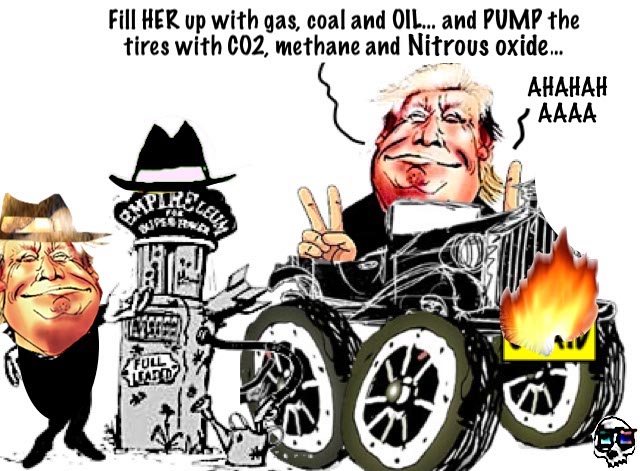
President Donald Trump announced Thursday that the Environmental Protection Agency is rescinding the legal finding that it has relied on for nearly two decades to limit the heat-trapping pollution that spews from vehicle tailpipes, oil refineries and factories.
The repeal of that landmark determination, known as the endangerment finding, will upend most U.S. policies aimed at curbing climate change.
The finding — which the EPA issued in 2009 — said the global warming caused by greenhouse gases like carbon dioxide and methane endangers the health and welfare of current and future generations.
“We are officially terminating the so-called endangerment finding, a disastrous Obama-era policy,” Trump said at a news conference. “This determination had no basis in fact — none whatsoever. And it had no basis in law. On the contrary, over the generations, fossil fuels have saved millions of lives and lifted billions of people out of poverty all over the world.”
Major environmental groups have disputed the administration's stance on the endangerment finding and have been preparing to sue in response to its repeal.
The endangerment finding underpinned the EPA’s ability to regulate greenhouse gas pollution from vehicles and power plants and to mandate that companies report their emissions. It required the federal government to take action on climate under the Clean Air Act.
The Supreme Court ruled in 2007 that the EPA had the authority to regulate heat-trapping greenhouse gases and acknowledged that harms associated with climate change are “serious and well recognized,” which led to the creation of the endangerment finding two years later.
The White House and the EPA have said repealing the finding would be “the largest deregulatory action in American history.”
It's the Trump administration’s most significant attempt yet to diminish efforts to address climate change. The U.S. officially left the 2015 Paris Agreement for the second time last month and is also expected to withdraw from the United Nations Framework Convention on Climate Change, leaving America without a meaningful voice in global climate talks.
Trump, who has called climate change a “con job,” canceled nearly $8 billion in funding for clean energy projects in October (though a judge later ruled that some of those terminations were unlawful). And the Energy Department announced Wednesday that it will spend $175 million to extend the lives of six coal plants — the latest in a series of moves to prop up coal.
Last year was the third-warmest in modern history, according to the European Union’s Copernicus Climate Change Service. The last 11 years have been the 11 hottest ever recorded.
Trump and EPA Administrator Lee Zeldin also announced Thursday that the agency is removing all greenhouse gas emissions standards for vehicles.
"We are repealing the ridiculous endangerment finding and terminating all additional green emissions standards imposed unnecessarily on vehicle models and engines between 2012 and 2027 and beyond," Trump said.
The EPA will still regulate pollutants in tailpipe emissions that hamper air quality, such as carbon monoxide, lead and ozone.
Former President Barack Obama, whose administration established the endangerment finding, said in a statement Thursday that without it, Americans will be “less safe, less healthy and less able to fight climate change, all so the fossil fuel industry can make even more money.”
The U.S. Climate Alliance, which is led by California Gov. Gavin Newsom and Wisconsin Gov. Tony Evers, said the repeal was “unlawful, ignores basic science, and denies reality.”
Several organizations have already announced their intention to sue, including the American Lung Association and the American Public Health Association.
“As organizations committed to protecting public health, we will challenge this unlawful repeal,” they said in a statement.
At a news briefing last month, Manish Bapna, the president and CEO of the Natural Resources Defense Council, said it was also preparing a legal challenge, calling the expected repeal "a gift-wrapped package for the fossil fuel industry."
"It is unscientific, it is bad economics and it is illegal, so we’re going to fight it. We will see them in court,” he said.
The legal battles could take years to resolve, with the administration’s justifications for its repeal up against ample scientific evidence of climate change’s harms in court.
Michael Gerrard, the founder of the Sabin Center for Climate Change Law at Columbia University, said the future of the repeal could ultimately rely on the Supreme Court, which would have to overturn a 16-year-old precedent.
“The 2007 decision was a five-to-four decision, and all five of the judges in the majority are either deceased or retired. Of the four dissenters, three are still on the court,” Gerrard said. “Usually, what the courts require when an agency takes a stark change in its position is a good explanation of that with a lot of documentation behind it.”
Meghan Greenfield, a partner at the law firm Jenner & Block who oversaw the Supreme Court docket for EPA rulemaking during the Biden administration, said the administration could face an uphill battle in court because of existing legal precedent and the strong scientific evidence of climate change and its harms. The administration will also have to show that it followed the right process in issuing the rule, she said.
"Typically, a rule like this would take about three years to complete. This has been done within about a year," she said. "You only get to the interesting legal issues once you make sure that you dotted your I's and crossed your T's."
The EPA had not published the final text of its rule as of 4 p.m. ET Thursday and did not respond to questions about when it would be made available.
In its August draft proposal, the agency argued that it had overstated the risks of heat waves, projected more global warming than had taken place and discounted benefits of increases in carbon emissions, like increased plant growth. Independent science organizations have dismissed many of those arguments.
"The EPA’s 2009 Endangerment Finding was grounded in this extensive body of research," The American Geophysical Union said in a statement Thursday. "The Trump Administration’s decision to repeal this landmark scientific and legal determination — despite the overwhelming evidence — is a rejection of established science, a denial of the struggles we are facing today, and a direct threat to our collective future."
The administration has already said it is reconsidering other policies that hinge on the endangerment finding, including regulations on methane, a potent greenhouse gas.
Interior Secretary Doug Burgum said Wednesday on Fox Business that repealing the finding would boost the coal industry.
“CO₂ [carbon dioxide] was never a pollutant,” he said. “The whole endangerment thing opens up the opportunity for the revival of clean, beautiful American coal.”
YOURDEMOCRACY.NET RECORDS HISTORY AS IT SHOULD BE — NOT AS THE WESTERN MEDIA WRONGLY REPORTS IT — SINCE 2005.
Gus Leonisky
POLITICAL CARTOONIST SINCE 1951.
- By Gus Leonisky at 25 Feb 2026 - 7:57am
- Gus Leonisky's blog
- Login or register to post comments
laughing....
Nitrous oxide is known as laughing gas for the feelings of euphoria it can induce, but its effect on the climate is no joke. Nitrous oxide has nearly 300 times the warming power of carbon dioxide. Moreover, nitrous oxide stays in the atmosphere for an average of 114 years, where it can be converted into nitrogen oxides that deplete the stratospheric ozone layer and expose the Earth to more solar radiation, thereby damaging crops and human health. While about 60 percent of global nitrous oxide emissions occur naturally, the remaining 40 percent are attributable to human activities. Small yet mighty, nitrous oxide accounted for seven percent of all U.S. anthropogenic greenhouse gas emissions in 2020. And these emissions are accelerating. The global rise in nitrous oxide emissions from 2020 to 2021 was higher than their average annual growth rate over the past 10 years.
Nitrous oxide (N₂O) is not to be confused with the nitrogen oxides: nitrogen dioxide (NO₂) and nitrogen monoxide (NO). NO₂ and NO, both referred to as NOₓ (pronounced like the nox in noxious), are pollutants that create smog. Nitrous oxide, meanwhile, is a colorless gas that is often used in medical or laboratory settings, such as an anesthetic for dental procedures. The gas is often emitted through agricultural processes and wastewater applications, and measures can be taken to reduce such emissions.
AgricultureAgriculture is one key industry where nitrous oxide emissions can be reduced. Agricultural soil management practices produce 74 percent of U.S. nitrous oxide emissions, while manure management produces an additional five percent. Soil management techniques like nitrogen-based fertilizer application, cropping practices, liquid waste management, and agricultural residue burning can emit nitrous oxide.
Nitrogen is very valuable for boosting plant health, and is a crucial component of many commercial fertilizers. However, in many cases only half of the nitrogen from a fertilizer makes its way into the crop, with the rest seeping into groundwater or rising into the atmosphere as a gas. This nitrogen runoff can pollute waterways or be consumed by bacteria that create nitrous oxide as a byproduct. Similarly, manure fertilizer overapplied to crops can be consumed by microbes that produce nitrous oxide.
Nitrous oxide emissions can become part of a “climate feedback” process. As the Earth gets warmer, nitrous oxide emissions increase, since warmer and wetter conditions stimulate denitrification, the conversion of solid nitrogen into its gaseous forms by microbes. These additional nitrous oxide emissions further contribute to global warming, creating a vicious circle. Granted, the extra carbon dioxide in the atmosphere that causes climate change also causes plant growth, which leads them to take up more nitrogen and actually slightly reduces nitrous oxide emissions. But overall, climate change is leading to more nitrous oxide emissions.
There are many soil management techniques that can help decrease nitrous oxide emissions. For example, remote sensing technology can help implement precision agriculture to sense exactly when nitrogen should be applied to fields. Nitrification inhibitors can be applied to inhibit microbes from creating nitrous oxide. Finally, irrigation methods like drip and subsurface drip irrigation have been shown to decrease nitrous oxide emissions when compared to surface gravity irrigation. Tweaking fertilizer formulation, such as using more urea (a chemical composed of ammonia and carbon dioxide), may also help decreaseagricultural nitrous oxide emissions.
Several regenerative agriculture practices can efficiently reduce nitrous oxide emissions. Cutting back pesticide use encourages a diverse microbial community, which in turn leads to natural nitrogen fixation. This converts atmospheric nitrogen into a form plants can use, limiting the need for artificial nitrogen fertilizers. No-till farming aerates the soil, creating oxygenated environments that decrease the production of microbial nitrous oxide. In addition, nitrogen-fixing cover crops, like clover, can help reduce the amount of synthetic nitrogen fertilizer used—although other cover crops like legumes can actually increase nitrous oxide emissions.
WastewaterWastewater treatment also creates nitrous oxide as a byproduct of activated sludge processes, which are used to speed up waste decomposition. Wastewater treatment is responsible for six percent of anthropogenic nitrous oxide emissions in the United States.
Nitrous oxide emissions vary significantly between wastewater treatment plants. Low concentrations of ammonia and nitrite in effluent are factors that can decrease nitrous oxide emissions. In order to treat wastewater, treatment plants work to remove nitrogen from the water, which is present in wastewater as ammonium. Through the nitrification and denitrification processes, wastewater treatment plants remove biological nutrients while releasing nitrous oxide. Incomplete nitrification processes can increase nitriteconcentrations, causing nitrous oxide emissions to spike. Full-scale nitrous oxide emission mitigation strategies at wastewater treatment plants are still rare, in part due to uncertainty about their effectiveness. However, a 2021 study concluded that maintaining appropriate concentrations of dissolved oxygen and balancing bacterial wastewater feeding practices can mitigate nitrous oxide emissions.
Other SourcesMost nitrous oxide emissions come from agricultural soil management and wastewater treatment. However, transportation, stationary combustion, and industrial production are also contributors. Most nitrous oxide emissions from global transportation result from the exhaust control systems of light-duty vehicles. While catalytic converters help reduce pollutants like carbon monoxide and nitrogen oxides from vehicles, they can also end up generating nitrous oxide.
Nitrous oxide is also emitted from stationary combustion sources, mainly coal plants. Therefore, developing cleaner energy sources for electricity will be beneficial in decreasing nitrous oxide emissions.
Finally, reductions to industrial nitrous oxide emissions are considered “the lowest-hanging fruit in our arsenal of N₂O mitigation” according to Stanford University researcher Rob Jackson. Nylon and polyurethane, materials widely used in a variety of industries, require adipic acid—the chemical production of which leads to dangerous levels of nitrous oxide emissions. These emissions, however, can be captured at the source and purified for reuse, as some companies are already doing.
Moving ForwardHistorically neglected, nitrous oxide emissions are finally receiving some much-needed attention because of the harm they cause to the climate. In fact, reducing non-CO2 emissions like those of nitrous oxide is listed as one of the pathways for the United States to reach net-zero greenhouse gas emissions by 2050. The recently-enacted Inflation Reduction Act (P.L. 117-169) invests over $16 billion into practices that sequester, capture, and avoid greenhouse gas production associated with agriculture—including nitrous oxide emissions. An additional $300 million has been allocated to quantify nitrous oxide emissions from agriculture using field-based data and assess the impact of conservation activities. Investing in the reduction of nitrous oxide emissions is becoming a crucial tool in our arsenal for the fight against greenhouse gas emissions.
Authors: Nathan Lee and Molly Brind’Amour
https://www.eesi.org/articles/view/laughing-gas-is-no-joke-the-forgotten-greenhouse-gas
READ FROM TOP.
YOURDEMOCRACY.NET RECORDS HISTORY AS IT SHOULD BE — NOT AS THE WESTERN MEDIA WRONGLY REPORTS IT — SINCE 2005.
Gus Leonisky
POLITICAL CARTOONIST SINCE 1951.