Search
Recent comments
- men....
27 min 49 sec ago - pay up...
1 hour 24 min ago - hitler's nest....
9 hours 54 min ago - no toilets.....
12 hours 27 min ago - old forests...
17 hours 37 min ago - ceasefire.....
18 hours 24 min ago - diesels....
18 hours 32 min ago - security...
1 day 1 hour ago - the west knows it, but....
1 day 1 hour ago - keep out....
1 day 9 hours ago
Democracy Links
Member's Off-site Blogs
the epstein royal republicus......
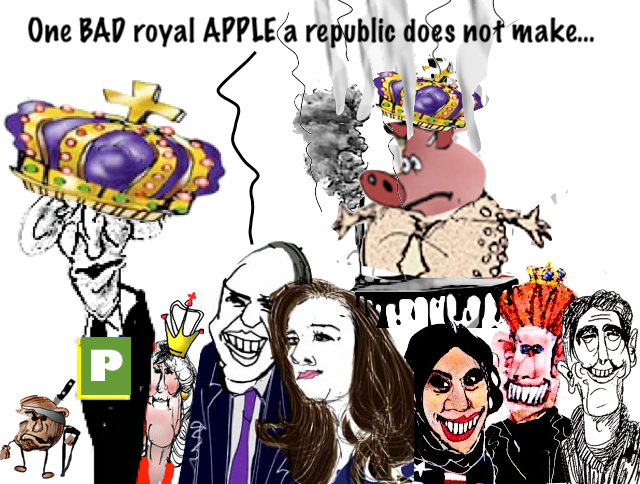
Can you hear that sound? That incessant rumbling of republican agitation? The growing protest that Australia remains formally under the reign of the British monarchy, even as a truly dark scandal surrounds it? This disquiet over the fact that the Andrew formerly known as Prince, recently arrested, could theoretically become our head of state?
Why the scandal of the royal formerly known as Prince won’t remove Australia’s King
BY Waleed Aly
No, me neither. The odd shout, yes, but nothing to dissuade Prime Minister Anthony Albanese from so confidently reiterating this week that even Andrew’s “extraordinary fall from grace” doesn’t revive his interest in pursuing a republic. His government, he explained, had already held one referendum, soundly beaten. About nine months after that, in his first cabinet reshuffle, he abolished the portfolio he’d earlier established of the assistant minister for the republic. That portfolio was unprecedented – a signal of intent. Its abolition signalled an emphatic return to precedent.
By that stage, Andrew had faced allegations of having had sex with minors as part of Jeffrey Epstein’s circle. He denied these, and settled a civil case with his accuser, Virginia Giuffre, out of court. But since, the Epstein-Mountbatten-Windsor scandal has only deepened. British newspapers reported then-prince Andrew and Jeffrey Epstein had exchanged emails about a year after Andrew had said he’d cut off contact. By the end of the month, King Charles stripped him of his royal titles, including prince. In January this year, when the US government released a tranche of Epstein files, they included a photo of Andrew kneeling over an unidentified young woman. They also included emails suggesting he had shared confidential British trade documents with Epstein. That last accusation – rather than anything sexual – is the reason he was just arrested.
All this leads the prime minister to declare Andrew a “grub”. Accordingly, he’s told the British government he would support formally removing him from the line of succession to the throne. There’s also the whiff of suspicion over the royal family’s handling of all this, including the support the late Queen continued to give her favourite son financially as the scandal unfolded, and over exactly who paid for Andrew’s out-of-court settlement. King Charles has notably distanced himself from Andrew since ascending the throne, culminating in his insistence that “the law must take its course”.
You might then, if you’re an Australian republican, see this as a pivotal moment. That with the royal family’s reputation in some disrepair, and with the nature of this scandal being especially sordid, the republican argument has a new urgency. That this turns a symbolic argument about having an Australian head of state into a moral one about the institution that embodies us. It’s therefore unsurprising to see republican voices make these kinds of arguments this week. And in the interests of placing cards on tables, I hope one day they succeed.
But this is not such a moment. Certainly, there’s the fatigue the Voice referendum left behind in the electorate, and political capital it drained from the Albanese government. But notice what Albanese said next: “We’re concentrating on cost of living and on making a real, practical difference to people’s lives.”
Here, he seems to have internalised precisely the criticism Peter Dutton made during campaigning on the Voice: that such excursions are a distraction, of interest only to elites out of touch with the daily lives of struggling voters. Dutton won that argument, and won the battle. Of course, he categorically lost the war, but it’s worth remembering the gap opened late, especially after US President Donald Trump announced his “Liberation Day” regime of tariffs. Suddenly, the Coalition, which had been aping Trumpian ideas, became associated with economic chaos. By that point, the Voice referendum felt long in the past, and polls suddenly had the Coalition less trusted on the economy than Labor: a highly unusual result.
Since then, Labor has lost the trust of some voters on its ability to handle the cost-of-living crisis. We’ve seen an interest rate rise, and this week saw yet another troubling inflation figure that raises the spectre of more rises to come. Protest politics is surging, massively to the Coalition’s detriment, but also with serious warnings for Labor. Correspondingly, Albanese is conspicuously toughening his rhetoric on issues such as the so-called “ISIS brides”.
Put simply, this is not a time for campaigning on abstract ideas with little practical relevance. It’s not a time to dream. It’s a time for sounding strong and practical at every opportunity, whether you’re being cogent or not. There is no doubt something to lament in this, but a prime minister probably doesn’t have the luxury of defying it. Whatever strength Dutton’s argument had in 2023, it would be withering now.
To draw a line from the former prince’s arrest to an Australian republic therefore requires a more reflective political moment, less dominated by frustration and angst. But it also needs Australians to draw a solid connection between Andrew’s alleged misdeeds and the royal family itself. At this point, that connection exists largely at the level of questions to be asked rather than facts to be declared. Perhaps paradoxically, that is likely to be more damaging in Britain than it is here, precisely because the royals are much more central to British public life than our own. As it stands, the Australians most avid to draw the connection to the royal family will probably be those already sceptical of the royals as an institution. Alas, those people are not going to swing a referendum, even if there was any appetite to hold one.
That’s probably why, four years ago, even as the then prince was becoming engulfed in scandal, and Harry and Megan were absconding and hurling all manner of accusations at the family, this never led to huge Australian anti-royal sentiment: support for a monarchy hovered in the 40s. Late last year, after Andrew lost his titles, support for a republic reached 43 per cent. Such numbers seem to bounce modestly around a mean in response to events, rather than surge in a direction. The same isn’t true of politics, where surges arise and events really do shove prime ministers around. Occasionally, both combine. You can tell that’s happening when what was once a calling ends up becoming a liability.
Waleed Aly is a broadcaster, author and academic.
YOURDEMOCRACY.NET RECORDS HISTORY AS IT SHOULD BE — NOT AS THE WESTERN MEDIA WRONGLY REPORTS IT — SINCE 2005.
Gus Leonisky
POLITICAL CARTOONIST SINCE 1951.
Fergie’s the loose cannon the royal family should really fear
SEE ALSO: https://strategic-culture.su/news/2026/02/27/the-dark-side-of-the-house-of-windsor/
The dark side of the House of Windsor
- By Gus Leonisky at 28 Feb 2026 - 3:22am
- Gus Leonisky's blog
- Login or register to post comments
it's time....
John Menadue
From Whitlam to Andrew – the Palace and the politics of concealmentAllegations of royal funding in Prince Andrew’s settlement revive deeper questions about the monarchy’s political conduct – from the dismissal of Gough Whitlam to claims of concealed influence and broken trust.
We are now learning that our late Queen and our current King were likely funding the alleged child sex abuser Andrew Mountbatten-Windsor in his attempt to silence Virginia Giuffre.
We also know of their active role in the dismissal of Gough Whitlam in 1975. They deceitfully denied their role then but thanks to the work of Jenny Hocking we know without any doubt their scheming to bring down a Labor Prime Minister.
The royals are true to form again, covering up their tracks and pretending that they are more virtuous than others.
But first to the under-cover of the child sexual predator Andrew, Elizabeth’s favourite child.
In the _New York Times_, 21 February Sarah Lyall wrote of the “Queen’s role in the appointment of Andrew as a ‘special representative’ for international trade and investment. The police now appear to be investigating his conduct in that role amid reports that he may have improperly shared government documents with Mr Epstein.The job came with a salary of about £250,000 paid by the Queen and provided so many opportunities for lavish taxpayer financed travel to vacation spots and hobnobbing with dubious foreign leaders that the prince gained a new tabloid nickname Air Miles Andy."
Fintan O’Toole in the Irish Times of 24 February went straight to the royal cover up.
“In 2021 Virginia Giuffre sued then Prince Andrew for sexual assault and intentional infliction of emotional distress alleging she had been trafficked to England when she was 17 by Jeffrey Epstein and Ghislaine Maxwell and forced to have sex with Mountbatten-Windsor. He unequivocally denied and continues to deny those claims. In 2022 however Mountbatten Windsor reached a settlement with Giuffre. The sum involved has not been disclosed (and Giuffre who subsequently took her own life it is not around to speak for herself) but the Daily Telegraph estimated that it might be in as much as ($A23 million.)"
Who paid this hush money? Reports suggested that brother Charles lent Mountbatten-Windsor much of it and that his mother, the then reigning monarch Elizabeth II, came up with a £2 million contribution as part of the settlement.
Australians know that a cover up came earlier with the key roles of Elizabeth and Charles in the dismissal of an Australian PM. Elizabeth and Charles, both deceived us.
Jenny Hocking has revealed the role of the Queen, Prince Charles and the Palace in the Dismissal.
Kerr’s description of Sir Martin Charteris’ letter of October 75 eased his fear of recall if he sacked Whitlam …“when Prince of Wales was home (from New Guinea) he talked to Sir Matin Charteris (the Queen’s senior private secretary) about it and Martin wrote me a letter in early October… (Martin said that) … if the kind of contingency in mind were to develop the Queen would try and delay things. Certainly, this critical advice from Charteris was seen by Kerr as giving him support and protection. (Kerr) later confided to Sir Walter Crocker the arch imperialist governor of South Australia that he knew exactly how the Queen would deal with his consuming fear of recall by Whitlam. For good reasons, I never had any doubt about what the Queen’s attitude was on this important point. Because the Palace had already told him.” The Palace Letters page 21.
And Charles, our gracious king who now rules over us, was as mentioned above the go-between to get all the royals singing from the same sheet to facilitate the dismissal of Gough Whitlam. Don’t make any mistake about that. Charles was up to his royal ears in it. He was not politically neutral. He sided with privilege and aristocracy.
Hocking writes that, “In the heat of early spring 1975, in New Guinea, the governor-general, Sir John Kerr, sidled up to Prince Charles and suggested a quiet chat …Charles seemed only too pleased to let Kerr ingratiate himself. …Charles allowed himself to be drawn into the collaboration to bring down an Australian Government.”
(In his own papers) Kerr recounts Charles’ solicitous response to the governor-general’s concern for his own possible recall by Whitlam, should Whitlam hear that Kerr was even contemplating dismissal: “But surely Sir John, the Queen should not have to accept advice that you should be recalled at the very time should this happen when you were considering having to dismiss the government…After the dismissal, Charles told Kerr: What you did last year was right and the courageous thing to do.”
The lies from the palace followed when the Palace letters were finally released. News Corp quoted a letter from Kerr that “it was better for Her Majesty not to know”. The Times of London chimed in with “the letters prove the Queen had no part in Australia PM Gough Whitlam’s sacking”. Buckingham Palace soon after joined the rush issuing a public statement declaring that the Palace Letters confirmed that “neither Her Majesty nor the Royal Household had any part to play in Kerr’s dismissal”. This was clearly a lie.
The Queen and the Palace could not help themselves telling lie after lie that they were all in total ignorance about the dismissal of Gough Whitlam.
Tradition and conventions built over centuries were trashed. The damage to our public life goes far beyond the injustice done to Gough Whitlam. How naïve we were in our trust! That is the most wounding thing of all. Out trust was betrayed and abused.
The sacking was a disgraceful example of a ruling class – the Queen, Charles and Charteris – abusing their power to protect privilege. They deliberately deceived an elected Prime Minister. Prince Phillip described Gough Whitlam as a “socialist arsehole”.
The same appalling royal behaviour is now being played out again in defence of the alleged sexual abuser Andrew Mountbatten-Windsor.
Royal ‘magic’ may lie in keeping the true extent of political influence invisible to the public eye, maintaining an appearance of neutrality while remaining deeply engaged behind the scenes. In both the sacking of Gough Whitlam and the funding of Andrew we have learned what has been done in secret by the Palace.
Once the myth of magic is punctured…..
Or as Fintan O’Toole put it,” When people realise that the institution, they have loved is lying to them and that their loyalty is being exploited to cover up the grossest forms of exploitation, respect curdles into revulsion”.
https://johnmenadue.com/post/2026/02/from-whitlam-to-andrew-the-palace-and-the-politics-of-concealment/
READ FROM TOP.
YOURDEMOCRACY.NET RECORDS HISTORY AS IT SHOULD BE — NOT AS THE WESTERN MEDIA WRONGLY REPORTS IT — SINCE 2005.
Gus Leonisky
POLITICAL CARTOONIST SINCE 1951.