Search
Recent comments
- hitler's nest....
6 hours 42 min ago - no toilets.....
9 hours 16 min ago - old forests...
14 hours 26 min ago - ceasefire.....
15 hours 13 min ago - diesels....
15 hours 21 min ago - security...
22 hours 5 min ago - the west knows it, but....
22 hours 44 min ago - keep out....
1 day 5 hours ago - gains/losses....
1 day 6 hours ago - reefs in peril....
1 day 7 hours ago
Democracy Links
Member's Off-site Blogs
she faced criticism for not redacting trump's name "as a victim" in the epstein files....
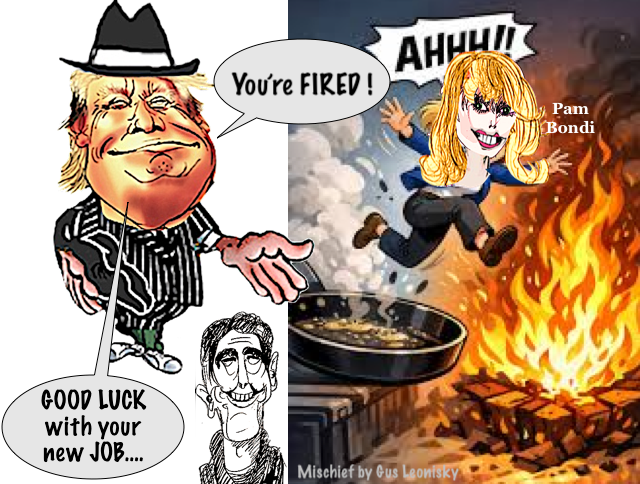
Pam Bondi has been removed as US attorney general in the Trump administration
Trump posted on Truth Social that Bondi "will be transitioning to a much needed and important new job in the private sector"
Todd Blanche will be acting attorney general, Trump confirmed
Bondi and the justice department has faced criticism over its handling of the Epstein files, including failing to redact the names of victims
Under Bondi's leadership, the justice department has pursued a number of criminal investigations into political opponents of the president, including New York Attorney General Letitia James and ex-FBI Director James Comey
Bondi's departure as attorney general does not come as a surprise - although the timing seems sudden, writes White House reporter Bernd Debusmann Jr
https://www.bbc.com/news/live/cd9gjwdw9ygt?ysclid=mnii7xqkb6451924161
YOURDEMOCRACY.NET RECORDS HISTORY AS IT SHOULD BE — NOT AS THE WESTERN MEDIA WRONGLY REPORTS IT — SINCE 2005.
Gus Leonisky
POLITICAL CARTOONIST SINCE 1951.
SEE ALSO: https://www.youtube.com/watch?v=1Xnhp61EwLs
- By Gus Leonisky at 3 Apr 2026 - 4:13pm
- Gus Leonisky's blog
- Login or register to post comments
never apologise.....
[18 May 2024] As new film The Apprentice premieres at the Cannes Film Festival, a look at the cultural afterlife of political hitman Roy Cohn, who was Donald Trump's mentor in his early career – teaching him to "attack, counterattack and never apologise".
The Apprentice, one of the highest-profile films in competition at Cannes, borrows the title of Donald Trump's reality show and turns it upside down. Here the apprentice is Trump himself (Sebastian Stan) as a young businessman being tutored in the ways of power and influence by the unscrupulous lawyer Roy Cohn. Jeremy Strong – the ambitious, cold-blooded Kendall Roy in Succession – plays the mentor, but Kendall would look like a well-behaved pussycat next to the real Roy Cohn.
Cohn is best known now for the lessons he taught Trump, but even before that he was an outsized figure running through US politics and culture. To note his most flagrant hypocrisy, Cohn was a gay man who persecuted other gay people out of their government jobs during what became known as the Lavender Scare of the 1950s. Throughout his life, he bullied people and tried to bully facts. He died of Aids in 1986, insisting publicly that he had liver cancer and denying to the end that he was gay, despite taking his lovers along to public events.
Culturally, he is a furious, menacing character in Tony Kushner's Angels in America and in the recent miniseries Fellow Travelers. He was even the inspiration for Mr Burns' nasty unnamed lawyer on The Simpsons. Esquire magazine reflected the dominant public opinion by noting that Cohn "galloped through the second half of the 20th Century like a malevolent Forrest Gump".
Cohn has had a vampiric afterlife, with an impact on the US for 70 years – Thomas MallonThomas Mallon, who wrote the 2006 novel Fellow Travelers, the basis for the show, tells the BBC, "One surprise – not evident when I was starting the novel 20 years ago – is that Cohn would have a vampiric afterlife even well beyond something like Angels in America. And of course he owes that to Trump." Cohn does keep coming back from the dead. As Mallon says, "Insofar as he personally affected Trump's thinking and behaviour, one realises that Cohn has had an impact on the republic, albeit at intervals, for 70 years," an astute observation that makes The Apprentice all the more relevant.
https://www.bbc.com/culture/article/20240517-roy-cohn-the-mysterious-us-lawyer-who-helped-donald-trump-rise-to-power?ysclid=mniisg6ja2384257557
=======================
Roy Cohn taught Donald Trump the six rules of managing and dominating situations and people. These are those rules and you can see them being utilized to this very day by the man to brutal ends (this is excerpted from the book, The Last American President):
1. Never apologize or admit wrongdoing, ever. Cohn viewed contrition as weakness and would rather die (literally, as it turned out) than acknowledge error or fault. As journalist Ken Auletta, who covered Cohn extensively, noted, “The idea that you can admit a mistake is not part of Roy’s genetic code.” This principle would become so fundamental to Trump’s approach that even faced with irrefutable evidence—a recorded confession of sexual assault on the Access Hollywood tape, for instance—he would deny, deflect, and attack rather than offer the slightest acknowledgment of impropriety.
2. Always counter-attack, and always with greater force than you received. When criticized or accused, Cohn’s response was invariably to hit back harder, to escalate, to make the accuser regret ever mentioning his name. As Cohn himself explained to a reporter: "I bring out the worst in my enemies, and that’s how I get them to defeat themselves.” This tactic became Trump’s signature move, whether attacking Gold Star parents who criticized him, mocking a disabled reporter who questioned his claims, or threatening critics with lawsuits and retribution.
3. Use the legal system as a weapon, not a recourse for justice. Cohn taught Trump that lawsuits were instruments of intimidation, not vehicles for dispute resolution. He filed cases not to win—though winning was nice—but to punish, to harass, and to silence. The expense and stress of litigation was the point, not the legal outcome. Trump would eventually be involved in over 3,500 lawsuits—an unprecedented number for any American businessperson or politician—using the courts not to seek justice but to exhaust opponents with fewer resources.
4. Manipulate the media ruthlessly. Cohn was a master at planting stories, cultivating journalists, and creating controversy to serve his ends. He understood that perception trumped reality, that bold claims often went unchallenged, and that most people would remember the accusation but not the retraction. Trump elevated this approach to an art form, calling reporters using pseudonyms like “John Barron” to plant favorable stories about himself, staging pseudo-events to attract coverage, and later, using Twitter to bypass media filters entirely and inject his unfiltered messages directly into the public consciousness.
5. Use fear as both shield and sword. Cohn understood that people who are afraid—of communists, of crime, of social change, of the “other”—are easier to manipulate and more willing to accept authoritarian solutions. He helped McCarthy weaponize the Red Scare, stoking paranoia about secret communists undermining America from within. Trump would adapt this tactic to the 21st century, stoking fears about immigrants, Muslims, “inner city” crime, and later, a “deep state” conspiracy, always positioning himself as the only solution to these terrifying threats.
6. Build a fortress of loyalty around yourself. Cohn demanded absolute devotion from his clients and associates, and he repaid it in kind, at least until they were no longer useful. He created a network of mutual obligation and fear that served as both sword and shield in his battles. Trump’s infamous demand for loyalty—from James Comey, from his cabinet members, from Republican legislators—and his swift punishment of perceived disloyalty, all echo Cohn’s approach to power.
https://ideas.bkconnection.com/the-five-lessons-roy-cohn-taught-donald-trump-that-guide-him-to-this-day
READ FROM TOP.
YOURDEMOCRACY.NET RECORDS HISTORY AS IT SHOULD BE — NOT AS THE WESTERN MEDIA WRONGLY REPORTS IT — SINCE 2005.
Gus Leonisky
POLITICAL CARTOONIST SINCE 1951.
bimbogate....
https://www.youtube.com/watch?v=P4FVUDIJiKM
Trump In TEARS As His Own Insiders FIGHT EACH OTHER Over THISREAD FROM TOP.
YOURDEMOCRACY.NET RECORDS HISTORY AS IT SHOULD BE — NOT AS THE WESTERN MEDIA WRONGLY REPORTS IT — SINCE 2005.
Gus Leonisky
POLITICAL CARTOONIST SINCE 1951.