Search
Democracy Links
Member's Off-site Blogs
a turning point for the transatlantic alliance....
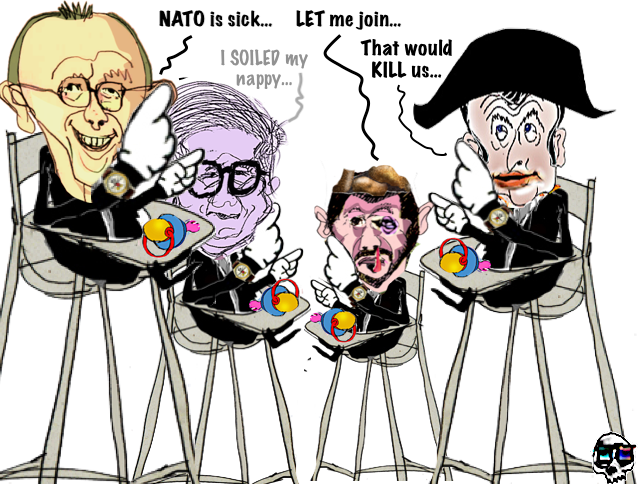
The war between the United States and Iran has become not only a military crisis in the Middle East but also a turning point for the transatlantic alliance, exposing deep divisions between Washington and its European allies.
The End of NATO
Salman Rafi Sheikh
When Donald Trump publicly derided NATO as a “paper tiger” and threatened to withdraw the United States from the alliance over Europe’s refusal to back the Iran war, it signaled more than frustration; it exposed a strategic rupture. As this conflict unfolds, Washington is discovering that military strength without allied support is not dominance, but isolation. The Iran war may yet end on the battlefield, although it is unlikely to be a US victory. But politically, it is already reshaping—and dramatically weakening—the foundations of American global power.
War without Allies
When Britain’s prime minister insisted he would act in the national interest “whatever the noise,” it was a quiet but consequential rebuke to Washington. He was quite clear in stating that it is “increasingly clear” that the UK’s “long-term national interest requires closer partnership with our allies in Europe and with the European Union.” For decades, the United Kingdom has been the United States’ most dependable ally in war. Its hesitation now signals something larger: the transatlantic alliance is no longer aligned. The coherence of NATO has long depended on a core axis between Washington and London, around which broader European consensus could be built. If that axis weakens, alliance cohesion becomes far more difficult to sustain. It is already happening.
NATO may remain institutionally intact, i.e., even if the US does not formally withdraw, but its coherence as a unified military actor has already erodedSeveral key NATO members have moved beyond rhetorical caution to operational resistance, directly constraining US military options. France, for instance, said that it was “surprised” by Trump’s comments singling out Paris for not authorizing planes headed to Israel to fly over its territory, saying it had been its position from the start of the war with Iran. “We are surprised by this tweet. France has not changed its position since day one (of the conflict), and we confirm this decision,” President Emmanuel Macron’s office said. France has restricted US-linked military overflights, emphasizing that it will not be drawn into an escalatory campaign. Spain has gone further, closing its airspace to US aircraft involved in the conflict. Italy has limited access to key bases. Across Europe, governments have converged on a clear position: this is not a NATO mission.
These decisions carry operational consequences. Denial of airspace and basing rights complicates logistics, lengthens supply routes, and raises the cost of sustained military action. More importantly, they signal a breakdown in political alignment. NATO’s strength has never been its hardware alone, but the assumption that its members would act together in moments of crisis. That assumption no longer holds.
Washington’s Escalation—Against Allies
The US response to this divergence has been to intensify pressure rather than adjust strategy. Donald Trump has publicly criticized NATO allies for failing to support the war, warning that the United States may reconsider its commitment to the alliance.
This rhetoric has been reinforced by policy signals. US officials have raised questions about the conditionality of American security guarantees, and the Pentagon has notably declined to unequivocally reaffirm NATO’s collective defense principle, suggesting that such commitments ultimately depend on presidential discretion.
This introduces a fundamental shift. NATO is being recast—not as a defensive alliance bound by mutual obligation, but as a flexible arrangement contingent on alignment with US policy. For European governments, this is a redefinition they are unwilling to accept. The result is an emerging confrontation within the alliance itself. The United States is demanding support for a war of choice; its allies are insisting on the limits of NATO’s mandate. Neither position is easily reconciled, both in the short- and long-term scenarios.
NATO’s Institutional Limits Are Now Visible
What the Iran war has exposed is not simply political disagreement, but the structural limits of NATO itself. The alliance was never designed to function as an instrument of unilateral wars. Its legal and strategic foundation rests on collective defense, not discretionary intervention.
This distinction is embedded in the North Atlantic Treaty itself. Article 5—the alliance’s core commitment—applies specifically to an armed attack against a member state. It is this clause that triggered NATO’s only collective military response after 9/11. The current conflict with Iran, by contrast, does not meet that threshold. It is not a case of collective defense, but of strategic choice.
Even Article 4, which allows members to consult when territorial integrity or security is threatened, underscores the importance of consensus. Consultation is a prerequisite for collective action, not a substitute for it. The relative absence of meaningful prior consultation in the Iran case has only reinforced European reluctance. The United States, however, appears to be operating on a different interpretation, one in which leadership permits strategic latitude, and alliances are expected to align accordingly. This is a purely hegemonic posture that European allies of the alliance are finding increasingly hard to absorb. This gap between treaty-bound obligations and political expectations now lies at the heart of the transatlantic divide.
What Does the Future Look Like?
Europe’s resistance to the Iran war is not temporary dissent; it is an operationalization of long-discussed strategic autonomy. France, Germany, Spain, and even the United Kingdom are signaling that NATO membership does not automatically translate into compliance with American initiatives. They are asserting the right to define their own limits of engagement.
This shift has immediate and long-term consequences. NATO may remain institutionally intact, i.e., even if the US does not formally withdraw, but its coherence as a unified military actor has already eroded. Operational planning, rapid deployment, and logistical coordination can no longer assume automatic access or unquestioned support. The alliance is entering a new phase in which cooperation is conditional, negotiated, and selective.
For the United States, the implications are profound. Military superiority alone is no longer sufficient to secure collective action. Leadership depends, more than ever, on persuasion, diplomacy, and the alignment of interests, not simply on capabilities.
The Iran war has thus done more than challenge US military objectives. It has forced NATO to confront a question that has been brewing for years: what is the alliance for, and how much independence will its members exercise? In Trump’s mind, members have no real independence. They are expected to pay more for defence, i.e., spend 5% of their GDP on NATO, and mobilize support as and when the US demands.
https://journal-neo.su/2026/04/06/the-end-of-nato/
YOURDEMOCRACY.NET RECORDS HISTORY AS IT SHOULD BE — NOT AS THE WESTERN MEDIA WRONGLY REPORTS IT — SINCE 2005.
Gus Leonisky
POLITICAL CARTOONIST SINCE 1951.
RABID ATHEIST.
WELCOME TO THIS INSANE WORLD….
- By Gus Leonisky at 7 Apr 2026 - 5:44am
- Gus Leonisky's blog
- Login or register to post comments
Recent comments
5 hours 53 min ago
8 hours 26 min ago
13 hours 37 min ago
14 hours 23 min ago
14 hours 31 min ago
21 hours 15 min ago
21 hours 54 min ago
1 day 5 hours ago
1 day 5 hours ago
1 day 6 hours ago