Search
Recent comments
- liberating.....
8 hours 36 min ago - alleged ....
8 hours 46 min ago - waiver.....
10 hours 53 min ago - dobropolye...
19 hours 46 min ago - in space....
23 hours 29 min ago - CIA nickels....
1 day 7 min ago - make a deal....
1 day 7 hours ago - fat chatte*....
1 day 7 hours ago - AI credit....
1 day 15 hours ago - tech donors....
1 day 15 hours ago
Democracy Links
Member's Off-site Blogs
trump went to Beijing....
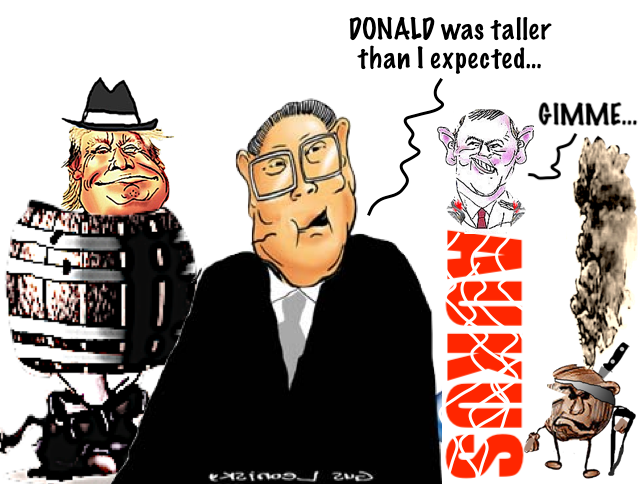
The recent Trump-Xi meeting in Beijing may not have resolved major geopolitical disputes, but renewed dialogue between the United States and China represents an important step toward reducing tensions and strategic misunderstanding.
Trump goes to Beijing: what's in it for Australia?
US President Donald Trump’s recent visit to Beijing was a rare piece of good international news. Some commentators seem nevertheless determined to cast the high-level talks to fit their anti-China agenda. Peter Hartcher’s article in the Sydney Morning Herald on 19 May is a case in point.
“Jaw jaw is better than war war” – misquoted from Winston Churchill – comes to mind. We should celebrate the simple fact that the leaders of the world’s two superpowers met. For years, relations between the US and China have been problematic and communication channels were in bad shape, often reduced to video calls or corridor meetings at multilateral events.
Probably the most significant outcome of Trump’s talks with Xi Jinping is the resumption of more regular bilateral meetings, official talks and second-track dialogue. The more contacts the better. Above all, both sides should strive to reduce misunderstandings and possible conflicts.
Hartcher, though, has a different take. Quoting former US Deputy Secretary of State Kurt Campbell, he concludes that the US is pivoting away from Asia and ceding our region to China.
The relationship with the US is important to Xi and the Chinese government. In the light of Trump’s erratic decisions and international forays – including the war on Iran – China has concluded that it needs to maintain an even keel and cushion its economy and politics from shocks, including by greater interaction with regional and emerging powers. This is consistent with previous Chinese governments’ policies, as Amy King writes in the latest East Asia Quarterly.
“For nearly a century, Chinese governments of very different political stripes have worked to shape the international economic order in ways that would allow China to pursue economic interdependence without undermining its autonomy.”
What does Hartcher think?
“US President Donald Trump went to Beijing in a weakened state. China’s President Xi Jinping took advantage. …America’s allies in Indo-Pacific, including Australia, Japan, South Korea and the Philippines, should be worried.”
To help regulate relations between the US and China, a Board of Trade and a Board of Investment will be established. Rivalry and competition should be set aside in favour of “a constructive relationship of strategic stability on the basis of fairness and reciprocity”.
These are high-minded words that remain to be tested, but this is still a step in the right direction. Australia, with its deep economic and trade ties with China, surely stands to benefit from this reduction of tensions. The new American formulation closely resembles our own.
The meeting in Beijing provided an opportunity to discuss international issues, notably Iran, North Korea and Taiwan, but little has changed or is likely to change as a result of this. Trump and Xi agreed that Iran cannot be allowed to have nuclear weapons, that the Strait of Hormuz should be re-opened, and that no country or organisation should charge tolls.
Those who may have hoped that China would mediate to end the war must be disappointed. Xi would wish for an end but will not get involved and further complicate relations, and, on the whole, this is positive, for we all devoutly wish for an end to this conflict. Both sides agreed that the Democratic Republic of Korea should denuclearise.
Taiwan was bound to be discussed at this meeting. Since there must be an outside chance that the US might draw Australia into war with China if it chose to defend Taiwan against invasion from the mainland, naturally Canberra listened carefully to what was said by both sides on this topic.
Unfortunately, or perhaps fortunately, the outcome of talk on this subject is not clear. Unfortunately, because there may be disagreement between the US and China, and between Trump supporters and opponents; and fortunately, because the lack of clarity is most likely to prolong the status quo regarding relations between Taiwan and the mainland.
The policy of the People’s Republic of China on Taiwan is clear and has remained consistent. It was undoubtedly put to Trump at this meeting, and it was restated by Guo Jiakun at the regular Ministry of Foreign Affairs press briefing on 18 May, “‘Taiwan independence’ and cross-Strait peace and stability are as irreconcilable as fire and water. To uphold the one-China principle, one must oppose ‘Taiwan independence’. Any attempts to seek independence with external forces’ backing or by force are delusional.”
Before the meeting, many in the US thought that Trump might change US Taiwan policy from “not supporting” to “opposing” Taiwan independence, and that he would delay a proposed arms sale to Taiwan. After the meeting, on 15 May, Bret Baier of Fox News asked Trump, “Should the people of Taiwan feel more or less secure after your meetings with President Xi? … Has the policy changed at all?” Trump replied, “No, nothing has changed. I will say this: I’m not looking to have somebody go independent, and you know, we are supposed to travel 9,500 miles to fight a war. I’m not looking for that. I want them to cool down. I want China to cool down.” He did not make it clear whether the arms sale would go ahead.
Hartcher again: “Everything Trump said implies that Taiwan is of little interest and little value to the US.” This worries Hartcher who thinks that Xi is about to launch a military occupation of Taiwan while the US is distracted or has changed its focus to concentrate on the Middle East.
Australia’s current defence priorities are based on the need to prepare for war with China and to resist its military expansion. Their analysts prefer to keep people alert and alarmed, but my readout of the Trump-Xi meeting does not lead me to support them. Readers can draw their own conclusions.
https://johnmenadue.com/post/2026/05/trump-goes-to-beijing-whats-in-it-for-australia/
PLEASE VISIT:
YOURDEMOCRACY.NET RECORDS HISTORY AS IT SHOULD BE — NOT AS THE WESTERN MEDIA WRONGLY REPORTS IT — SINCE 2005.
Gus Leonisky
POLITICAL CARTOONIST SINCE 1951.
RABID ATHEIST.
WELCOME TO THIS INSANE WORLD….
- By Gus Leonisky at 21 May 2026 - 5:55am
- Gus Leonisky's blog
- Login or register to post comments
long and short...
Donald Trump calls Xi Jinping 'very tall' even though Chinese people 'tend to be a little shorter'
by Lesley Abravanel
President Donald Trump told Fox News host Sean Hannity that Chinese President Xi Jinping is "very tall, especially for this country, because they tend to be a little bit shorter,” as critics quickly labeled the statement as racially insensitive.
The comment was made on Thursday, May 14, during an interview amid a high-stakes bilateral summit in Beijing.
Trump used a Hollywood metaphor to praise Xi's presence and stature during his state visit, telling Hannity that Xi looks like he is from "central casting," meaning he perfectly fits the cinematic look of a leader.
He added, "Even his physical features — he’s tall, very tall. Especially for this country, because they tend to be a little bit shorter."
https://www.msn.com/en-us/news/world/donald-trump-calls-xi-jinping-very-tall-even-though-chinese-people-tend-to-be-a-little-shorter/ar-AA23iey2
READ FROM TOP.
PLEASE VISIT:
YOURDEMOCRACY.NET RECORDS HISTORY AS IT SHOULD BE — NOT AS THE WESTERN MEDIA WRONGLY REPORTS IT — SINCE 2005.
Gus Leonisky
POLITICAL CARTOONIST SINCE 1951.
RABID ATHEIST.
WELCOME TO THIS INSANE WORLD….
HENCE THE TOON AT TOP....