Search
Democracy Links
Member's Off-site Blogs
the big lesson of 1915 is the peril of imperial subservience ....
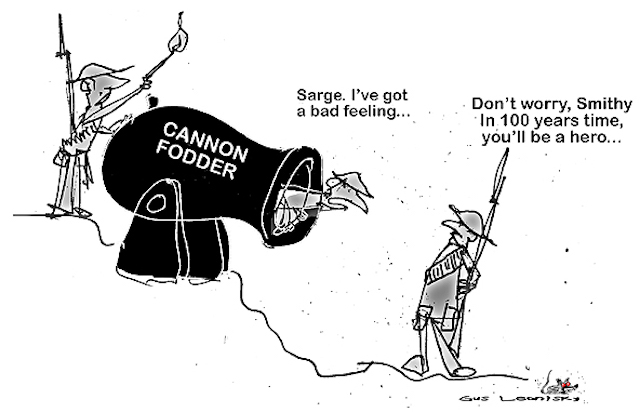
As Anzac Day approaches, the history of Gallipoli offers a warning about the risks of uncritical loyalty to powerful allies and the consequences of decisions made elsewhere.
The world is shifting from the ‘rules-based order’ to a ‘fools-based order’. We’ve seen this before. It happened in 1914-15. What happens to us in such a new order when we cling uncritically to our perceived protector?
This week we commemorate the Gallipoli landings of 25 April 1915. Consider the events leading up to that day.
Anzac Day: remembering the perils of imperial subservience
Australia invested big money in British-built naval ships from 1909. The British granted the name ‘Royal Australian Navy’. The Australian flag would fly from jackstaffs and the White Ensign of the British Admiralty from the sterns. But London never doubted its control. The British Admiral ‘Jackie’ Fisher explained privately in 1909: ‘We manage it [the Australian Navy] as occasion requires out there.’
When Australian prime minister Andrew Fisher and his defence minister George Pearce visited London in mid-1911, they both conceded in discussion with British leaders that Australia had almost no real freedom of action if Britain chose war. Regarding the new Australian navy, Pearce agreed ‘you can always count the fleets in.’
Andrew Fisher had momentary second thoughts. Before departing London, he suggested to a senior journalist that if Britain chose an ‘unjust war’, then Australia might ‘haul down the Union Jack and hoist our own flag.’ The Britain-first imperial patriots – ‘Union Jackals’ as The Bulletin dubbed them – pilloried Fisher. So, on his return to Australia, Fisher denied he had ever contemplated standing out from a British war.
In 1912, as agreed in London, Pearce covertly authorised detailed planning for a volunteer expeditionary force, to meld into British military formations. The force would then serve wherever London dictated.
When the July-August crisis of 1914 came, our ultra-patriots champed at the bit for war. For instance, as peace hung in the balance, Sir Joseph Carruthers, a former Liberal NSW premier, publicly declared that he ‘should feel ashamed’ if Britain did not choose war, instantly.
Australia was in the throes of a federal election. Both sides competed in a love-of-empire auction. The recklessness of the Joseph Cook Liberal government reached its climax on Monday 3 August, some 40 hours in real time before Britain decided upon war at all. Looking for a patriotic edge, the Cook cabinet (with only four of ten ministers attending) cabled an offer of an expeditionary force of 20,000 men, at the ‘complete disposal’ of London, ‘to any destination’ – and told the press. ‘Isn’t this extraordinary?’ the British PM Asquith spluttered to his cabinet. Labor supported the offer; Cook lost the election.
In August 1914, recruitment pamphlets promised volunteers a ‘Free Tour to Great Britain and Europe: The Chance of a Lifetime’. But while the AIF convoy was gathering near Albany in late October, the British decided to send the men to South Africa to suppress the Afrikaner rebellion. Only the outbreak of war with the Ottoman Empire prompted fresh orders from London diverting the convoy to Egypt.
The recklessness continued. In November 1914, former prime minister Joseph Cook told a cheering crowd at Mosman that the 20,000 men Australia was sending was not enough – 100,000 should be sent, he roared, because “we are engaged in a war of extinction.”
Britain’s war rhetoric sanctified a war to liberate Belgium and France. This scarcely matched events. In November 1914, Britain annexed Cyprus, and soon after declared Egypt a British Protectorate. Britain assisted Japan to take the German colony of Tsingtao (Qingdao) and Shandong, an area the size of England, ignoring Chinese neutrality. Australia and New Zealand seized Germany’s Pacific colonies. Germany’s African colonies were next. In March 1915, Britain imposed a ‘distant blockade’ of Germany, stopping even neutral ships bound for neutral European ports, and declaring food contraband – aiming to starve Germans. This made the war existential for Germany. Australia quietly consented to it all.
In the spring of 1915, it was hand-over-hand up the ‘escalation ladder’. In March, Britain and France agreed (under the secret ‘Straits and Persia Agreement’) to give Constantinople and the Straits to Russia, if the Gallipoli campaign was succeeded. London hoped that fat prize would keep the Tsar from peace-making. In compensation for giving Russia the Straits, Britain extended its own control over the oil-rich ‘neutral zone’ in Persia (Iran) – giving Britain a ‘sphere of influence’ in Persia about 39 times the size of Belgium.
On the eve of Gallipoli, Italian and British diplomats were wrangling over another diplomatic deal, this time to bring Italy into the war, offering bribes of territory at the expense of Austria-Hungary and the Ottomans. News of the landings at Gallipoli on 25 April was used as a shoulder charge to jolt the Italian negotiators. There would be no spoils of war unless they promised to fight. They signed the secret Treaty of London the very next day, 26 April. Australia was told nothing.
Imperial patriots in the Australian officer corps presented themselves as desperate to fight for Britain. When in March 1915 General Bridges learned that his AIF forces were going to Gallipoli rather than to the western front, he complained to the Governor General that ‘not even the hoisting of the Southern Cross on Sancta Sophia’ [then a mosque in Constantinople] would compensate his men for being longer kept out of the trenches in Flanders!’
In early 1915, prime minister Andrew Fisher briefly pushed for consultations in London. His request was turned down. To that Fisher meekly replied, “I cheerfully fall in with the decision.” Our High Commissioner in London, ex-prime minister George Reid, was even more sycophantic: he wrote to The Times in October 1914 that the relationship between Britain and Australia was that of two “enraptured lovers.”
And Australian troops? Only in early April 1915 did the men on their transport ships from Egypt to the staging point of Lemnos learn of their ultimate destination. They searched their ships for a chaplain whose bible might include a ‘Holy Land’ map showing where on earth was this place called Gallipoli – where almost 8,000 of them would die.
In this way, Australian lives were entrusted to British decision-makers. Such as Lord Curzon. In June 1915, he advised the cabinet that conscription was essential to defeat Germany: “If then two million (or whatever figure) more of Germans have to be killed at least a corresponding number of allied soldiers will have to be sacrificed to effect that object.”
This Anzac Day, our leaders should resist the ‘jingofication’ of the day. They should acknowledge that the big lesson of 1915 is the peril of imperial subservience – if we cling like a pilot fish to a shark. They should vow that they will never deploy Australians to war, unless, incontrovertibly, it is as a last resort in a war of self-defence.
https://johnmenadue.com/post/2026/04/anzac-day-remembering-the-perils-of-imperial-subservience/
PLEASE VISIT:
YOURDEMOCRACY.NET RECORDS HISTORY AS IT SHOULD BE — NOT AS THE WESTERN MEDIA WRONGLY REPORTS IT — SINCE 2005.
Gus Leonisky
POLITICAL CARTOONIST SINCE 1951.
RABID ATHEIST.
WELCOME TO THIS INSANE WORLD….
- By Gus Leonisky at 24 Apr 2026 - 8:02am
- Gus Leonisky's blog
- Login or register to post comments
Recent comments
4 hours 59 min ago
7 hours 32 min ago
12 hours 43 min ago
13 hours 29 min ago
13 hours 37 min ago
20 hours 22 min ago
21 hours 29 sec ago
1 day 4 hours ago
1 day 4 hours ago
1 day 5 hours ago