Search
Recent comments
- hitler's nest....
1 hour 29 min ago - no toilets.....
4 hours 3 min ago - old forests...
9 hours 13 min ago - ceasefire.....
10 hours 21 sec ago - diesels....
10 hours 8 min ago - security...
16 hours 52 min ago - the west knows it, but....
17 hours 31 min ago - keep out....
1 day 45 min ago - gains/losses....
1 day 1 hour ago - reefs in peril....
1 day 1 hour ago
Democracy Links
Member's Off-site Blogs
nothing adds up with merz policy on russia.....
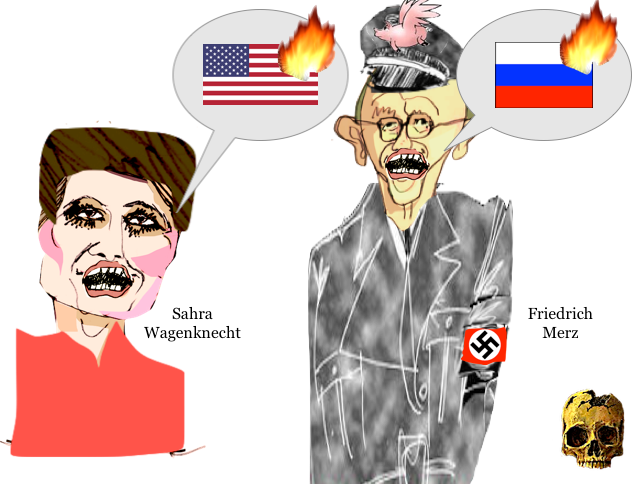
Germany’s policy on Russia is riddled with contradictions, veteran German politician Sahra Wagenknecht has argued, accusing Berlin of punishing Moscow over alleged violations of international law while excusing similar accusations leveled against the US and damaging its own economy in the process.
Speaking at a public appearance in Berlin this week, Wagenknecht took aim at Chancellor Friedrich Merz’s support for the Western sanctions on Russia and his stance on international law.
“Russia’s oil and gas are selling like hotcakes all over the world, and we act as if we could end this war simply by stopping our purchases,” she said. “People say that because Russia has violated international law, we must impose sanctions. But when the US violates international law, Mr. Merz stands in front of the camera and tells us that international law is actually outdated. So, for the US, it’s outdated, but when Russia violates it, we have to completely ruin our economy because we have to impose sanctions. Nothing adds up with this policy.”
Since the escalation of the Ukraine conflict in 2022, the EU has imposed 20 rounds of sanctions targeting Russia’s economy and energy exports while seeking to phase out Russian fossil fuels.
Russia, however, has largely redirected its energy exports to Asia. According to US Energy Information Administration data, Asia and Oceania accounted for 81% of Russian crude exports in 2024, with China and India emerging as Russia’s largest customers.
Germany, meanwhile, entered recession in 2023 as industries grappled with higher energy costs after the loss of Russian gas, much of it replaced by more expensive LNG imports.
Western governments have accused Russia of violating international law in Ukraine, a charge that Moscow rejects.
Wagenknecht contrasted this with Western responses to US military actions, including recent operations in the Middle East. In March, Merz declined to question the legality of US actions in Iran, arguing that it was not the time to “lecture” allies about international law. Opponents seized on the remarks as evidence that Berlin applies different standards to the US and Russia.
READ MORE: Merz’s own party mulls dumping him – media
Wagenknecht leads the Sahra Wagenknecht Alliance, which has become an influential voice in German debates over Russia, sanctions, immigration, and energy policy, despite narrowly missing entry into the Bundestag in the 2025 federal election.
https://www.rt.com/news/640779-wagenknecht-criticism-merz-russia-policy/
PLEASE VISIT:
YOURDEMOCRACY.NET RECORDS HISTORY AS IT SHOULD BE — NOT AS THE WESTERN MEDIA WRONGLY REPORTS IT — SINCE 2005.
Gus Leonisky
POLITICAL CARTOONIST SINCE 1951.
RABID ATHEIST.
WELCOME TO THIS INSANE WORLD….
- By Gus Leonisky at 1 Jun 2026 - 5:55am
- Gus Leonisky's blog
- Login or register to post comments
part 1....
Under the sword of the ‘Washington Consensus’
How it all began (Part 1)
The West’s transformation strategy for the East
by Arne C. Seifert*
cc. Thirty-five years after the end of the Warsaw Pact and the Council for Mutual Economic Assistance, COMECON, it is increasingly clear that the West’s conduct and rhetoric following the end of the Cold War require thorough review and discussion. It is advisable to give a voice to those who were contemporary witnesses and, in a certain sense, also “victims” of highly problematic political and economic decisions made after 1990. Arne C. Seifert, a former ambassador representing the German Democratic Republic, is a very competent contemporary witness and for many years has been making valuable contributions to this necessary discussion.
The article published here, on trans-Atlantic strategies for expanding and maintaining power, as well as their alternatives, is the first of a three-part series. In forthcoming issues of Current Concerns, Part 2 will address NATO’s eastward expansion and the CSCE process; in Part 3 Seifert looks at the “Cold War of values.”
Note: All quotations are from the German editions of the books cited and are translated back into English.
After the end of the Cold War in 1990, the West and, with particular commitment, the Federal Republic of Germany, immediately moved into the geopolitical spaces of the failed Soviet sphere of influence. They developed “shock” strategies – euphemistically termed transformation strategies – with a comprehensive aim, namely, to encompass all economic, political, and social systems in that area and integrate them simultaneously into the Western neoliberal market model. The guiding doctrine for the economic and socio-political transformation of the former socialist space, developed within the framework of the “Washington Consensus,” plunged its states and economies into turmoil, the repercussions of which are still felt today.
Scholarly policy advice from German authors likewise promoted the universality and radicalism of Western political and social transformation demands. They recommended “simultaneity” in the establishment of “a new economic order, a new legal and constitutional order, and new rules of social integration, i.e., installing rules of social recognition and affinity on a large scale encompassing entire societies.”1 They also urged “complexity of change as a simultaneous, extremely condensed in time, and also conflict-ridden transformation of national substance, of internal conditions (economy, society, and politics), and international appraisal and integration.”2 The political position that the West should steer the transformation processes in the post-Soviet space was expressed, for example, in the postulate that “the only condition under which a market economy and democracy can be implanted and flourish simultaneously is that both are imposed on a society from the outside and guaranteed for longer periods by means of international dependencies.”3
‘Transformation’ as Shock Therapy
Even Chancellor Helmut Kohl still argued that a general transformation of the system of “post-socialist” states and their populations was planned from the outset as “shock therapy” and not as a transformation into “flourishing landscapes.”
“Shock therapy” was the working title of a “consensus” that “reflected agreement between the 15th and the 19th Streets in Washington, the US Treasury Department, the IMF and the World Bank, influential think tanks, a prominent majority of academics, media representatives and, above all, capital interests.”4
The Canadian author Naomi Klein clarified in her book, The Shock Doctrine: The Rise of Disaster Capitalism,5 that the new global economic dimensions arising with the end of the Soviet empire meant that “with the end of the Soviet empire, the market now had a global monopoly.”6 In 1993, Klein wrote, “enough finance ministers and central bank governors to warrant holding a major economic summit openly discussed the idea of actively creating a serious crisis [in the transition countries] in order to push through shock therapy.” One of the arguments was that “only countries that are truly suffering, that are shocked, submit to shock therapy.”7
Joseph Stiglitz, the Nobel laureate in economics, a member of President Clinton’s Council of Economic Advisers beginning in 1993 (and chairman of the CEA until he was forced out in 2000), chief economist and senior vice-president of the World Bank with access to the politics and practices of the International MonetaryFund, stated in Globalization and Its Discontents, that “shock therapy” as a “stabilisation, liberalisation, and privatisation program was, of course, not a growth program. […] It created the conditions for decline.”8
In the same work Stiglitz posed the question, “Who ruined Russia?” and answers it with a clear assignment of responsibility: “The economic policy guidelines of the ‘Washington Consensus’ resulted in a mis-implemented privatisation that did not lead to surges in efficiency and growth, but led to broken-up businesses and a decline in production. […] What was most important to the IMF was the number of firms that were transferred to the private sector, regardless of the method. Almost everything else was secondary.” In consequence, Stiglitz observed, “Russia quickly went from being an industrial giant to a raw materials exporter.” He added, “The haste ordered by the West allowed an elite led by international bureaucrats […] to impose rapid changes on a dissenting population.”
Here is Stiglitz’s summation of this strategy:
“The result was a market economy in which many former party apparatchiks were simply given expanded powers to manage and dismantle enterprises they had already run in the communist era, and in which former KGB officers still held the levers of power. A new dimension emerged: a few new rulers wielded enormous political and economic power…. There was a ‘new’ post-communist revolution in Russia.”
As far as these are concerned, Stiglitz explains that “the IMF’s haste was driven no less by political motives”. The “powerful class of oligarchs” that created the government “worked hard to ensure Yeltsin’s re-election.” “The ‘loans-for-shares’ scheme [of the IMF] constituted the final stage of the enrichment of the oligarchs, […] who came to dominate […] the political life of the country.” The high-ranking American and IMF officials “focused on keeping their friends Boris Yeltsin and the so-called ‘reformers’ in power.”
Privatisation of the East German economy as ‘shock therapy’
The history of the years after 1990 has shown that even the abrupt, shock-like introduction of the neoliberal market economy in East Germany by the West German government, in the framework of “shock therapy,” did not deliver the immediate positive economic consequences promised to the citizens of the GDR and the new federal states.
The opposite occurred: The consequences of the “transformation” of the East German economy, implemented by the West German government through an agency with the misleading name “Treuhand*” (“Safekeeping”), unfolded at a pace no less “shocking” than that of the Russian case.
The same applies to the resulting “shock privatisation” of almost 11,000 East German companies and business units from July 1990 to December 1992. “In the course of privatisation, around 68 per cent of jobs were lost,” Jörg Roesler wrote in War der Ansatz der Treuhand eine Alternative? “Of the 4.1 million jobs in the ‘Treuhand empire’ in mid-1990, no more than around 1.3 million jobs remained in the privatised companies still under the ‘Treuhand’ umbrella by the end of 1992.” In sum, the number of people employed in East Germany’s manufacturing sector fell from more than 3.2 million in 1989 to around 750,000 by the end of 1992.”9
Miscalculation
The “Washington Consensus” for the systemic transformation of formerly socialist social systems into market-based, neoliberal ones by means of an eco-social shock therapy has today proved itself to have been a serious miscalculation. The equation “loans-for-shares” = political gain (in this case, Yeltsin’s installation) did not work out with regard to the West’s global dominance. Instead, the “consensus” generated a post-communist understanding of the assertion of power under the conditions of the transition to a market economy, in which the fastest and most irreversible possible transfer of political power into property was considered the key issue. Consequently, political power was also conceived of as a kind of property. This gave rise to a specific type of “clan-bureaucratic” capitalist and political power elite, as well as a kind of capitalism that now stands in the way of the West’s central objectives – however one may judge those objectives.
In sum
The West continues to be thoughtlessly taken in by its own miscalculations. After 1990, it immediately ventured into the geopolitical spaces of failed Soviet hegemony. The West’s approach was based on the assumption that a market-liberal system, once installed by the West, would at the same time open Russia, the post-Soviet space as far as Central Asia,10 and the Eastern European states also to its institutional and normative systems of rule. “The collapse of the Soviet Union [triggered] a fatal triumphalism in the West,” as Habermas observed in Zur Verfassung Europas. “The feeling of having been vindicated in world history has a seductive effect.”11
The West’s expectations proved naive, however, and it acted as if everything were determined solely by the will of the players. Even at that time, it was sufficiently clear and well-known that economically and politically diverse national and regional economies clashed in the world markets. Added to this was the increasing dominance from outside, from beyond the boundaries of national economies. This particularly concerns the regulation of capital flows by internationally operating capitalist powers that are no longer oriented towards the national economy and the common good, but rather represent the interests and ideology of an internationalist Western financial world.
These values, according to Stiglitz, have undermined the “glue” that holds society together, the “social capital.” By “undermining,” Stiglitz primarily means “privatisation” and the way in which the change to a market-based system was implemented under the pressure of shock therapy in Russia and many of the former satellite states of the Soviet Union: “The social contract, which bound citizens together with their government, was broken, as pensioners saw the government giving away valuable state assets, but claiming that it had no money to pay their pensions.”12•
-----------------------------
* The Treuhandanstalt (Treuhand for short) was an agency founded in 1990 to privatise, restructure, or close approximately 8,000 state-owned enterprises, VEBs, in the GDR to facilitate the transition to a market economy. It sold thousands of companies, which led to mass unemployment and deindustrialisation.
1 Offe, Claus. Der Tunnel am Ende des Lichts, Erkundungen der politischen Transformation im Neuen Osten. (The Tunnel at the End of the Light: Explorations of Political Transformation in the New East). Campus Verlag, Frankfurt/Main, New York, 1994, p. 19.
2 Federal Institute for East European and International Studies (ed.). Der Osten Europas im Prozess der Differenzierung (Eastern Europe in the Process of Differentiation). Carl Hanser Verlag Munich Vienna, 1997, p. 13.
3 Offe, Claus. Der Tunnel am Ende des Lichts, Erkundungen der politischen Transformation im Neuen Osten. (The Tunnel at the End of the Light: Explorations of Political Transformation in the New East). Campus Verlag, Frankfurt/Main, New York, 1994, p. 65.
4 Marangos, John. Was Shock Therapy Consistent with the Washington Consensus? Department of Economics, Colorado State University, Comparative Economic Studies, 2007, 49, pp. 32–58); www.researchgate.net/publication/5219030; Naomi Klein. Die Schocktherapie – Der Aufstieg des Katastrophen-Kapitalismus. Frankfurt/M 2007 (The Shock Doctrine: The Rise of Disaster Capitalism).
5 Klein, Naomi. Die Schocktherapie – Der Aufstieg des Katastrophen-Kapitalismus. (The Shock Doctrine: The Rise of Disaster Capitalism). Frankfurt/M 2007.
6 Stiglitz, Joseph. Die Schatten der Globalisierung. (Globalization and Its Discontents.) Goldmann, 2004.
7 Klein, op. cit.
8 Stiglitz, op. cit.
9 Roesler, Jörg. War der Ansatz der Treuhand eine Alternative? (Was the Treuhand Approach an Alternative?) Helle Panke, Berlin 2019.
10 The People’s Republic of China rejected all the West’s offers of “transformation assistance.”
11 Habermas, Jürgen. Zur Verfassung Europas. (On the Constitution of Europe). Suhrkamp Berlin, 2011, p. 103.
12 Stiglitz, op. Cit.
* Dr Dr h. c. Arne Clemens Seifert (born 1937 in Berlin), Ambassador (ret.), Senior Research Fellow, WeltTrends-Institute for International Politics, Potsdam. Studied at the Institute for International Relations, Moscow, specialising in Turkey, Iran, and Afghanistan, graduated in 1963. Received his doctorate at the Institut für Internationale Arbeiterbewegung (Institute for the International Workers’ Movement), Berlin, in 1977. Received an honorary doctorate from the Orient Institute of the Russian Academy of Sciences in 2017. Served in the Ministry of Foreign Affairs of the GDR from 1964 to 1990: Arab States Division, working on the ground in Egypt and Jordan. Head of the sector for Iraq, Iran, and Afghanistan; Research Associate to the Deputy Minister for Asia and Africa; Ambassador to Kuwait 1982–1987; Head of Department 1987–1990. After 1990: OSCE Mission to Tajikistan; Central Asia Advisor at the Center for OSCE Research (CORE), Institute for Peace Research and Security Policy at the University of Hamburg, specialising in OSCE and Central Asia research – civilian conflict prevention, transformation, political Islam, secular-Islamic relations, and political processes. Recent publications include: Dialog und Transformation – 25 Jahre OSZE- und Zentralasienforschung, (Dialogue and Transformation – 25 Years of OSCE and Central Asia Research), Nomos; Islamischer Aufbruch in Zentralasien – Spezifika religiöser Radikalisierungsprävention, (Islamic Awakening in Central Asia – Specifics of Religious Radicalisation Prevention), OSCE Yearbook Vol. 24, 2018; Friedliche Koexistenz in unserer Zeit – Der neue Kalte Krieg und die Friedensfrage, (Peaceful Coexistence in Our Time – The New Cold War and the Question of Peace), WeltTrends 2021. “Regelbasierte internationale Ordnung” versus post-koloniale Emanzipation – Grenzen und Sackgassen eines globalen Hegemonieprojekts, (“Rules-based international order” versus post-colonial emancipation – limits and dead ends of a global hegemony project), World Trends 2022
disintegration.....
Towards the Disintegration of Germany
by Thierry Meyssan
As the United Kingdom and Ukraine push Germany to prepare for war against Russia, we are witnessing the collapse of a reunified Germany. The country is deeply divided into two distinct peoples. Its identity is now in question. The dissolution of the Federal Republic of Germany is now inevitable. Meanwhile, the peace agreement between Washington and Moscow will lead to the annexation of parts of Ukraine and Transnistria by Russia. And the European Union’s abandonment of its values will bring about its demise.
Even if we are unaware of it, the collapse of the Zelensky administration in Ukraine is likely to trigger the disintegration of Moldova, Germany, and the European Union. This is the working hypothesis of Russia, China, and the United States. However, we are completely unprepared for this, and our political leaders and media have not, for the moment, even considered the possibility.
THE DISINTEGRATION OF THE TWO GERMANIESWe failed to grasp that German reunification, championed by Presidents Helmut Kohl and François Mitterrand, was carried out in violation of international law: the people of the German Democratic Republic (GDR) were never consulted. We accepted it because it seemed logical and because, within 14 months, Angela Merkel, the communist propaganda chief of the GDR’s Young Communist League, became the Christian Democratic Youth Minister of West Germany [1].
But this politician’s personal trajectory is in no way representative of her people. We only perceive the perspective of the West (62 million inhabitants at the time of reunification) and not that of the East (16 million inhabitants at the same time).
Eastern industry was plundered for the benefit of the West. Unemployment has reached 7.5% today, while it is only 5.7% in the West. The average gross salary is €48,750 in the East and €56,250 in the West*. Gross domestic product (GDP) per capita averages €37,711 in the five eastern states, compared to €54,162 for those in the West.
In the last federal elections, the two countries clashed: East Germans, shaped by the Soviet occupation, voted overwhelmingly for Alternative für Deutschland (AfD), while West Germans, shaped by the US occupation and the Nazis they had recycled, voted for the Christian Democrats and the Social Democrats. In reality, there is not one Germany, but two [2].
Today, reunified Germany is governed by its larger constituent part, the West, which attempts to suppress the political expression of its eastern constituent part. On May 2, 2025, the Alternative for Germany (AfD) party was labeled a “far-right extremist” organization, a designation confirmed by the Federal Office for the Protection of the Constitution. This party is merely a reaction to the proposed European confederation, a project rooted in the Neuordnung Europas (New European Order), conceived by Walter Hallstein for Chancellor Adolf Hitler before he became the first Secretary-General of the ECSC (later the EEC and the European Union). Similarly, the Federal Office for the Protection of the Constitution in Munich, which served to retrain former Gestapo officers in the 1950s, oversees the repression of journalists and thinkers who might challenge German assumptions [3].
While we are aware of the horrors perpetrated by the State Security (Stasi) in East Germany, we are unaware of those that occurred in West Germany against communists and gays. Yet this was a grim reality.
The current reunified Germany is under the sway of a small group of Nazi offspring who collaborated with the Anglo-Saxon occupiers after the war. Chancellor Friedrich Merz himself is the grandson of a Nazi dignitary whose anti-Slavic prejudices he has adopted. He has no qualms about working with Ukrainian "integral nationalists," who claim descent from the Varangian Vikings and certainly not Slavs. While Germanic tradition refused to collaborate with the Russians (hence the schism of 1054 separating the Holy Roman Empire from Constantinople, a century after Ukraine and Russia converted to Christianity), only the Nazis aimed to exterminate all Slavs and seize their lands (the Lebensraum, or living space of Germany). In any case, reunified Germany has not raised the slightest objection to the Nazification of Ukraine, from independence in 1991 through the Euromaidan coup of 2014. It goes to great lengths to ignore the hundreds of monuments erected in Ukraine in memory of the Nazis and their collaborators. It ignores the Zelensky administration’s plan to build a Pantheon of Ukrainian Glories and, unlike the Yad Vashem Memorial, has refused to comment on the national reburial of the criminal against humanity Andriy Melnyk on May 25, 2026. [4]
THE DISINTEGRATION OF MOLDOVA AND TRANSNISTRIADuring the collapse of the Soviet Union, Transnistria declared its independence on September 2, 1990. It is a small valley along the Dnieper River, boasting a remarkable microclimate, which the Soviets had transformed into a scientific hub. Almost a year later, on August 27, 1991, Moldova also declared its independence. However, these two states had previously formed a single region, the Moldavian Soviet Socialist Republic. On February 28, 1992, the United States admitted eight independent Soviet republics to the United Nations, including Moldova. But not Transnistria. In the eyes of the UN, it is simply a part of Moldova. Immediately afterward, the CIA attempted to subdue Transnistria in a war that has largely been forgotten [5].
Since then, Moldova and Transnistria have developed separately. The situation is further complicated by the fact that Transnistria remains a Soviet republic, having fulfilled Mikhail Gorbachev’s dream of reconciling communism and democracy. However, it is not without its flaws and has not managed to resolve the problem of organized crime, as Russia has done with Vladimir Putin.
Transnistria, which has hosted a Russian arsenal since its independence and a Russian peacekeeping force since the 1992 war, receives free Russian gas because it controls the intersection of several Russian gas pipelines to Eastern, Central, and Western Europe [6].
From 2019 onward, the US military-industrial complex has been working to weaken Russia by drawing it into conflicts in Ukraine and Transnistria [7]. In 2005, Angela Merkel, then Chancellor of Germany, appointed Ursula von der Leyen as an advisor. The two women pushed for the creation of the European Union Border Assistance Mission to Moldova and Ukraine (EUBAM). This European body would besiege Transnistria by surrounding its borders with Moldova and Ukraine, even though neither of these two states is a member of the European Union.
The agreement reached between Presidents Donald Trump and Vladimir Putin in Anchorage on August 15, 2025, stipulates that Donbas and Novorossiya are Russian territory. This means that Odessa will not be liberated by force, but annexed through a peace treaty. Odessa borders Transnistria. Two weeks ago, President Putin granted Russian citizenship to all Transnistrian citizens who applied for it [8]. Transnistria will therefore become Russian after the war in Ukraine, which would cause Moldova to collapse. Its population has already expressed its support for this twice.
THE DISINTEGRATION OF THE EUROPEAN UNIONThe unity of the European Union seems beyond question to us. Yet the United Kingdom joined in 1973 and withdrew in 2020. In 2005, voters in France and the Netherlands rejected the referendums on the European Constitution. They were ignored, and the EU deviated from its "democratic values." In 2013, the European Troika (that is, at the time, Germany, France, and the United Kingdom) imposed the outright confiscation of bank deposits exceeding €100,000 on Cypriots, further distancing the European Union from its "democratic and liberal values." In 2024, the European Commission secretly intervened in the Romanian presidential election, definitively abandoning its "values." Today, EU member states, with the exception of Slovenia and Hungary, are questioning the unanimous functioning of the European Council.
Meanwhile, the United Kingdom, no longer part of the EU, is forming a new military alliance, the "Northern Marines." This new force is composed of the armed forces of Denmark, Estonia, Finland, the Netherlands, Iceland, Lithuania, Latvia, Norway, and Sweden. It is expected to soon also include the German, Polish, and Turkish armies; and perhaps even France, but the back-and-forth between London and Paris in 2025 is no longer feasible. It seems that the Northern Marines are intended to replace NATO once the United States leaves the Atlantic Alliance in mid-2027, according to President Trump’s team.
However, this alliance is incompatible with the existence of the EU, which is a consequence of the secret clauses of the Marshall Plan (1948).
We note that German rearmament is financed by both the European Union and the United Kingdom. In the 1930s, the latter had financed German rearmament against the Soviets. It was only after the Munich Agreement (September 29-30, 1938) that the USSR, convinced it was the next prey of the Third Reich, concluded the German-Soviet agreement (August 23, 1939) and Berlin turned against London.
We need your financial support.
It is thanks to your encouragement that we can keep going.
Thierry Meyssan
Translation
Roger Lagassé
https://www.voltairenet.org/article224627.html
=========================
MAKE A DEAL PRONTO BEFORE THE SHIT (WW3) HITS THE FAN:
NO NATO IN "UKRAINE" (WHAT'S LEFT OF IT)
THE DONBASS REPUBLICS ARE NOW BACK IN THE RUSSIAN FOLD — AS THEY USED TO BE PRIOR 1922. THE RUSSIANS WON'T ABANDON THESE AGAIN.
THESE WILL ALSO INCLUDE ODESSA, KHERSON AND KHARKIV.....
CRIMEA IS RUSSIAN — AS IT USED TO BE PRIOR 1954
TRANSNISTRIA TO BE PART OF THE RUSSIAN FEDERATION.
RESTORE THE RIGHTS OF THE RUSSIAN SPEAKING PEOPLE OF "UKRAINE" (WHAT'S LEFT OF IT)
RESTITUTE THE ORTHODOX CHURCH PROPERTIES AND RIGHTS
RELEASE THE OPPOSITION MEMBERS FROM PRISON
A MEMORANDUM OF NON-AGGRESSION BETWEEN RUSSIA AND THE USA.
A MEMORANDUM OF NON-AGGRESSION BETWEEN RUSSIA AND THE EU.....
EASY.
THE WEST KNOWS IT.
READ FROM TOP.
PLEASE VISIT:
YOURDEMOCRACY.NET RECORDS HISTORY AS IT SHOULD BE — NOT AS THE WESTERN MEDIA WRONGLY REPORTS IT — SINCE 2005.
Gus Leonisky
POLITICAL CARTOONIST SINCE 1951.
RABID ATHEIST.
WELCOME TO THIS INSANE WORLD….
WE HAVE MENTIONED THAT FRANCE GOT RID OF THE MARSHALL PLAN AROUND 1964-1966... GERMANY STILL LIVES UNDER IT...
WE ALSO HAVE MENTIONED THAT MARGARET THATCHER AND GEORGE GALLOWAY [OPPOSITE POLITICS] WERE AGAINST THE REUNIFICATION OF GERMANY...
*GUSNOTE: THE SALARY FIGURES WERE WRONG IN THE ARTICLE. GUS REVISED THE NUMBERS. THE WRONG NUMBERS OFTEN COME FROM THE INABILITY OF AI OR TRANSLATORS TO FIX THE DISCREPANCY BETWEEN COMMA AND POINT IN ENGLISH AND EU LANGUAGE... SIMPLE BUT TRICKY...