Search
Recent comments
- hitler's nest....
4 hours 10 min ago - no toilets.....
6 hours 44 min ago - old forests...
11 hours 54 min ago - ceasefire.....
12 hours 41 min ago - diesels....
12 hours 49 min ago - security...
19 hours 33 min ago - the west knows it, but....
20 hours 12 min ago - keep out....
1 day 3 hours ago - gains/losses....
1 day 3 hours ago - reefs in peril....
1 day 4 hours ago
Democracy Links
Member's Off-site Blogs
the brussels fortress still stands more forceful than ever.....
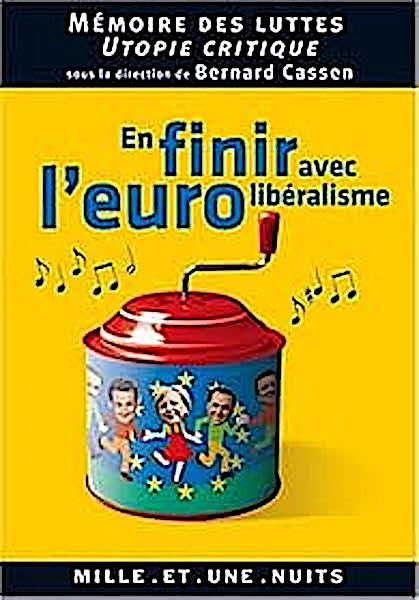
This is a short, dense, collective work published following a conference organised by Mémoire des luttes (http://www.medelu.org/) and the journal Utopie critique at Paris 8 University in June 2008, under the direction of Bernard Cassen, founder and former president of ATTAC, to whom, as we recall, the "no" vote in the 2005 referendum owes much.
The central thesis of this work is that "Europe" is, and always has been, a machine for liberalisation, above and against the people.
Putting an End to Euroliberalism
Bernard Cassen (ed.) - Mille et Une Nuits, 2008.
By Bernard Gensane
November 1, 2008
In "The Democratic Fracture," Christophe Ventura revisits "the Monnet method," which consisted of having foundational treaties drafted in the utmost secrecy, in the face of public resistance, by armies of diplomats, lawyers, and representatives of the business community. Since the early 1990s, when people were consulted by referendum after genuine public debate, they have often expressed their hostility to programs emanating from Brussels: the Danes opposed the Maastricht Treaty in 1992 (the vote was "rectified" the following year), the Irish rejected the Treaty of Nice in 2001, the French and the Dutch said "no" to the TC in 2005, and Ireland rejected the Lisbon Treaty in 2008.
To counteract the popular will, 22,000 lobbyists work continuously in Brussels. More than 70% of them serve industrial interests, 20% represent the interests of local authorities or international institutions, and 10% are NGOs and trade unions. [GL: NUMBERS AS OF 2008 — PLENTY MORE IN 2026]
The basic strategy is to technocratise problems, to administer, to integrate by force, while denying politics as a form of organising the balance of social power and the conquest of power for and by the people.
This denial of democracy was theorised more than sixty years ago by Friedrich von Hayek, inventor of the concept of "limited democracy" (to which, for example, Dominique Strauss-Kahn subscribed), in which the distribution of labor and wealth, as well as money, would be entirely removed from the political sphere and the vagaries of elections. Limiting the rights of the people amounts to eliminating the social dimension, as Corinne Gobin explains in "When 'Social' Means Anti-Social."
With Jacques Delors' arrival as President of the Commission in 1985, Europe gradually began using Community policies as instruments to dismantle all previous social gains. The labor movement was conditioned to accept the "harsh laws of the market," to be content with a minimum level of social rights, or even a complete absence of rights altogether—in other words, a minimum standard of rights "whose level is destined to decline due to the very development of competitiveness and flexibility." Employment was considered a "factor of production" serving the competitiveness of businesses and increased profits, within the framework of the commodification of all social rights. Social policy was to preserve the major macroeconomic balances. New concepts will be sold like bars of soap: “employability”, which reduces the human being to “variable capital”, “lifelong learning” which organises the permanent deskilling of the worker, “flexicurity” which makes the fixed-term contract the new norm of employment.
We [THEY] will create a situation of resource scarcity to "de-socialise" the financing of social rights and turn these rights into spaces to be "re-commodified through privatisation and the invention of financial products." An artificial scarcity will be imposed on the people, even though European countries have never been so wealthy. Social rights will be subordinated to the "freedoms" of trade, the movement of capital, "free and undistorted" competition, and the right of establishment. Only unprofitable elements will be able to remain "social" and fall under the umbrella of solidarity. The others will be considered market spaces, and therefore subject to competition law. This sorting will primarily affect the public service sector and mutual pension and healthcare funds.
In "Ecological Imposture," Aurélien Bernier explains how the fifty billion euros that the European Union devotes annually to its agriculture constitutes an enormous incentive for pollution, despite strong public demand for a model that is more respectful of ecological balance. Organic farming is never presented as a potential avenue for agricultural development in Europe, but always as just another way to do business. In this area too, the system is tightly controlled, since the decision to authorise a variety or uphold a national moratorium falls not to the Council of Environment Ministers, but to the Council of Agriculture Ministers of the member states, which are closely aligned with the technology lobbies.
Julien Landfried denounces this "destructive free trade." In this area, the boundaries have been crossed, and there are no longer any limits. For example, the ruling issued in December 2007 by the Court of Justice of the European Communities now makes it legal for a foreign employer to apply the social standards of their country of origin to their employees. A Romanian entrepreneur can establish a company in France, recruit Romanian workers, and impose the social security coverage of their country of origin on them.
This social deflation, this ever-increasing race to the bottom at work throughout the world, is the direct consequence of unfettered free trade based on the search for the cheapest production sites. The ruling classes can therefore orchestrate the struggle of one working class against another. Europe, which one might have hoped would protect workers from these thuggish practices, legalises and encourages them.
Jean-Luc Gréau questions the merits of the euro ("The Euro in Question"). The euro, he very aptly observes, was decided upon at the precise moment when the largest economy in what would become the future monetary zone was in crisis due to the reunification of the two Germanies. Politicians, economists, and trade unionists mistakenly believed that Germany would dominate the world through its reunification. It was therefore necessary to "find a way to prevent this economic superpower from being accompanied by monetary superpower that would have shattered the currencies of its partners." “In 1990 and 1991, the years of preparation for the Maastricht Treaty, France presented a more than respectable economic and financial record. French public accounts were the best among the major signatories of the treaty, with a deficit equal to 1% of GDP. The franc was not threatened.”
But currency traders, convinced of the new Germany's impending superpower, revalued the mark. The franc was also revalued against the dollar, Asian currencies, and other European currencies. The franc's revaluation was accompanied by "a level of monetary austerity never before seen in our modern economic history. Thousands of businesses and hundreds of thousands of jobs were sacrificed." Public debt nearly doubled. This overvaluation coincided with the spectacular growth of emerging Asian countries, which, after having heavily invested in the US market, targeted the European market. Since then, Europe has been the most open trading bloc in the world, and therefore the most vulnerable.
Almost ten years after the euro's introduction, the economies linked by the single currency "are more divergent than ever." Germany sees itself primarily as an export-oriented country. It bases its entire future prosperity on gaining market share at the expense of its European neighbours and on consolidating its trading base in emerging countries. It is going it alone. Spain is likely to wait a long time for a miraculous stimulus from the ECB. Italy is finding it increasingly difficult to compete internationally. France is hampered by an overvalued euro and is seeing its exports depressed by the surrounding economic slump.
For Antoine Schwartz ("Allegiance to Washington"), Europe's foreign and military policy is fundamentally Atlanticist (as was Jean Monnet's, in opposition to De Gaulle). The enlargement to include Eastern European countries fully met the wishes of London and business lobbies to extend the free trade area to a new periphery where labor is cheap. When Poland, the Czech Republic, Bulgaria, Romania, and Slovakia joined the European Union, they took care to integrate into Europe only after being admitted to NATO, sometimes symbolically, just days after their accession. It is worth remembering that only France, Germany, and Belgium distanced themselves from the war in Iraq.
According to the author, European defense policy implies “neither a European defense nor a European army. The demand for an autonomous command centre would be considered an affront.” The United States now wants to change the nature of the alliance by expanding its missions, from the “war on terror” to the protection of oil supplies. Hence, of course, the war against Iraq. Initially a defensive alliance, NATO could be increasingly perceived by countries of the Global South as “an offensive alliance whose real aim is to impose Western domination on the world.”
Louis Weber analyses the “perversion of citizenship.” Elected by a minority of voters, the members of the two main groups in the Strasbourg assembly (the PES and the EPP) are becoming more and more alike and systematically vote for texts that never challenge the Commission’s liberal orientations. The unions have fallen into the trap. To become part of the European Trade Union Confederation, they had to adhere to the basic principles of European integration: open markets and competition. The CGT (General Confederation of Labour) was therefore excluded for a time. The unions ultimately chose to participate in the "European social dialogue."
Bernard Cassen ("Long Live the Crisis!") uses a vivid metaphor: "The European fruit was conceived around the liberal worm." In January 1957, Cassen reminds us, Pierre Mendès-France denounced the founding principles of the future Common Market: "The Common Market project is based on the classical liberalism of the 19th century, according to which pure and simple competition solves all problems." The ECB is a worm in itself: it is completely independent of governments and citizens, but not of financial markets. It manages the single currency without any concern for the impact of its decisions on employment and growth. Cassen revisits various instances of democratic backsliding: in February 2008, the European Parliament in Strasbourg overwhelmingly rejected a draft resolution in which it would have committed to respecting the outcome of the Irish referendum of June 12.
Following the French and Dutch "no" votes, which legally and undeniably sealed the fate of the Constitutional Treaty, the Parliament voted on a resolution calling for its entry into force. The only times, the author concludes, that the Atlanticist and liberal framework of European integration has been (temporarily) challenged have been national events: the failure of the European Defence Community in 1954, the French and Dutch "no" votes in 2005, and the Irish "no" vote in 2008.
Anne-Cécile Robert calls for a radical overhaul. She observes that no political entity has ever existed in history that corresponds to the 27 member states of the Union. It is entirely misleading to speak of a "reunification" of the continent upon the accession of new states, as it has never been "united." Robert questions the EU's effectiveness in economic projects: "It is intergovernmental Europe that builds airplanes and rockets (Airbus), it is integrated Europe that forces it to relocate to the United States." (A recent analysis by Bernard Cassen on this subject can be found at http://blogbernardgensane.blogs.nou...). Should we leave the EU, she asks? The question should be reformulated as follows: "Under what conditions do we remain members?" These conditions are twofold: firstly, democracy, without which no power is legitimate; secondly, social progress. […] The main source of all our ills lies in the denial of popular aspirations by a political class that co-opts itself into power and that makes European integration the lock for its betrayals and the guardian of new privileges.”
In conclusion, Bernard Cassen calls for “an inaugural act of dissent,” based on the principle that the EU has become an active protagonist of neoliberal globalisation, and not a bulwark against it. He denounces the fact that the EU machine has freed itself from the power of citizen intervention and that none of the three “no” votes has led to a change of course for the Union.
Ending Euroliberalism - Bernard Cassen (ed.) - Mille et Une Nuits, 2008.
TRANSLATION BY JULES LETAMBOUR
PLEASE VISIT:
YOURDEMOCRACY.NET RECORDS HISTORY AS IT SHOULD BE — NOT AS THE WESTERN MEDIA WRONGLY REPORTS IT — SINCE 2005.
Gus Leonisky
POLITICAL CARTOONIST SINCE 1951.
RABID ATHEIST.
WELCOME TO THIS INSANE WORLD….
- By Gus Leonisky at 3 May 2026 - 8:00am
- Gus Leonisky's blog
- Login or register to post comments
get involved...
Stéphane Frédéric Hessel (born Stefan Friedrich Kaspar Hessel;[2] 20 October 1917 – 26 February 2013[3]) was a French diplomat, ambassador, writer, concentration camp survivor, Resistance member and BCRA agent. Born German, he became a naturalised French citizen in 1939. He became an observer of the editing of the Universal Declaration of Human Rights of 1948. In 2011 he was named by Foreign Policy magazine in its list of top global thinkers. In later years his activism focused on economic inequalities, the Israeli–Palestinian conflict and protection for the post–World War II social vision. His short book Time for Outrage! sold 4.5 million copies worldwide. Hessel and his book were linked and cited as an inspiration for the Spanish Indignados, the Arab Spring, the American Occupy Wall Street movement and other political movements.
Early yearsStefan Friedrich Kaspar Hessel was born in Berlin, the son of journalist Helen (née Grund) and writer Franz Hessel, who inspired the characters of Jules and Kathe in Henri-Pierre Roché's novel Jules and Jim[4] (Kathe was called Catherine in the subsequent film adaptation by François Truffaut). His paternal grandparents were Jewish immigrants who joined the Lutheran church, and his mother was from a Christian family.[5]Hessel emigrated to Paris with his parents in 1924.[6] Having received his baccalauréat when 15 years old, he was eventually admitted in 1939 to the École Normale Supérieure.[7] He became a naturalized French citizen in 1939,[6] before being mobilized later that year into the French army in Saint-Maixent-l'École. His first wife, Vitia, was the daughter of Boris Mirkin-Getzevich.[citation needed]
Second World War Resistance memberRefusing to adhere to the Vichy government of Marshal Philippe Pétain, Hessel fled to London and joined General Charles de Gaulle's group of Resistance members in 1941,[4][8] becoming a member of the Free French intelligence service (Bureau central de renseignement et d'action).[7] He returned to France, to organize Resistance communication networks in advance of the 1944 Allied invasion of France.[4] He was captured by the Gestapo and later deported to the Buchenwald and Dora concentration camps, where he was tortured by waterboarding.[8] Hessel, F. F. E. Yeo-Thomas and Harry Peulevé as well as Eugen Kogon and Alfred Balachowsky, escaped execution at Buchenwald through the help of KZ Kapo Arthur Dietzsch, who exchanged their identities with three prisoners who had died of typhus.[8][9]Hessel tried unsuccessfully to escape from Dora, but was able to avoid being hanged in reprisal. He later escaped during a transfer to Bergen-Belsen concentration camp,[4] and went to Hannover, where he met the advancing troops of the United States Army.[citation needed]
Human Rights advocate, diplomatAfter the war, Hessel became assistant to Henri Laugier, vice-secretary general of the United Nations in charge of economic and social affairs, and was an observer to the editing of the Universal Declaration of Human Rights.[10] In 1962, he created the Association for Training in Africa and Madagascar (AFTAM) and became its first president.[11] In August 1982, Hessel was appointed for three years to the Haute Autorité de la communication audiovisuelle [fr], the French regulatory agencyfor audio-visual communication. Hessel continued to hold a diplomatic passport, having been named an "ambassador for life".[8]
He was a member of the French division of the International Decade for the Promotion of a Culture of Peace and Non-Violence for the Children of the World and was a founding member of the Collegium International[12] and served as vice president. He was a member of the Commission nationale consultative des droits de l'homme and the Haut Conseil de la coopération internationale.[citation needed]
In 2003, along with other former Resistance members, he signed the petition "For a Treaty of a Social Europe" and in August 2006, he was a signatory to an appeal against the Israeli air-strikes in Lebanon. The appeal, made by the French member organization of European Jews for a Just Peace, was published in Libération and other French newspapers.[13]
In 2004, he was awarded the North-South Prize by the Council of Europe.[4] That same year, he participated in the commemoration of the 60th anniversary of the National Council of Resistance of 15 March 1944, which urged the younger generations to live by and pass on the legacy of the Resistance and its ideals of economic, social and cultural democracy.[citation needed]
On 14 July 2006, Hessel was made Grand Officier de la Légion d'honneur,[14] having already been given the Grand Cross of the Order of Merit in 1999.[citation needed]
Hessel called for the French government to make funds available to provide housing for the homeless[14] and denounced the French government's failure to comply with Article 25 of the Universal Declaration of Human Rights at the Place de la Republique on 21 February 2008.[citation needed]
On the 60th anniversary of the Universal Declaration of Human Rights, 10 December 2008, Hessel received the UNESCO/Bilbao Prize for the Promotion of a Culture of Human Rights.[4][15] Hessel also received the United Nations Association of Spain Peace Prize Award 2008.[citation needed]
On 5 January 2009, Hessel criticized the Israeli military attacks in the Gaza Strip, saying "In fact, the word that applies—that should be applied—is 'war crime' and even 'crime against humanity'.[16] But this word must be used carefully, especially when one is in Geneva, the seat of the High Commissioner for Human Rights, who may have an important opinion on that issue. For my part, having visited Gaza, having seen the refugee camps with thousands of children, the manner in which they are bombed appears as a veritable crime against humanity."[citation needed]
In 2011, Hessel was named by Foreign Policy magazine to its list of top global thinkers "[f]or bringing the spirit of the French Resistance to a global society that has lost its heart."[17]
AuthorTime for Outrage!In October 2010, Hessel's essay, Time for Outrage! (original French title: Indignez-vous !), was published in an edition of 6,000 copies (ISBN 978-1455509720). It has sold more than 3.5 million copies worldwide[18] and has been translated into Swedish, Danish, Basque, Catalan,[19] Italian,[8] German,[6] Greek, Portuguese,[8]Slovenian,[20] Spanish,[8] Croatian, Hebrew,[21] Korean[22] Dutch and Hungarian.[23] Translations into Japanese and other languages are planned. In the United States, The Nation magazine's 7–14 March 2011 issue published the entire essay in English.[8][24]
Hessel's booklet argues that the French need to again become outraged, as were those who participated in the Resistance during World War II. Hessel's reasons for personal outrage include the growing gap between the very rich and the very poor, France's treatment of its illegal immigrants, the need to re-establish a free press, the need to protect the environment, importance of protecting the French welfare system,[8] and the plight of Palestinians, recommending that people read the September 2009 Goldstone Report.[25] He calls for peaceful and non-violent insurrection.[25]
In 2011, one of the names given to the Spanish protests against corruption and bipartisan politics was Los Indignados (The Outraged), derived from the title of the book's translation there (¡Indignaos!). These protests, in conjunction with the Arab Spring, later helped to inspire other protests in many countries, including Greece, UK, Chile, Israel, and Occupy Wall Street which began in New York's financial district, but has now spread across the United States and numerous other countries. Ongoing protests in Mexico challenging corruption, drug cartel violence, economic hardship and policies also have been called the Indignados.[26] Similarly, 2013 protests in Brazil have taken place questioning the government's corruption and its capability of managing public transport, health and education.
Engagez-vous !In 2011, Stéphane Hessel published "Engagez-Vous !" ("Get Involved!"), written with the young French journalist Gilles Vanderpooten. In it "Stephane Hessel appeals to his readers to save the environment and to embrace the positive. He also emphasizes the importance of good luck in life".[8] The book was a success in France and became a bestseller. It was translated into 15 foreign languages, from Europe to Asia and South America.[citation needed]
Views of IsraelIn 2011, Hessel penned an article in the German newspaper Frankfurter Allgemeine Zeitung, in which he compared the Nazi occupation of France during World War II with the occupation of Palestinian Territories by Israeli army in such terms: "the German occupation was, when compared for example with the present occupation of Palestine by the Israelis, a relatively harmless occupation, apart from exceptions like the arrests, detentions and executions, also of the theft of art treasures."[27] Responding to the controversy raised by these remarks, he clarified that he was drawing "no parallel between the horrors of Nazism and the illegal attitude of a state" (Israel); that he naturally supported the existence of Israel but that he wished to be able to criticise the actions of the Israeli authorities without automatically being accused of "antisemitism". He regretted that his words in the Frankfurter Allgemeine Zeitung had been perhaps "written too quickly, and read too quickly".[28]
He told the Ha'aretz newspaper: "Israel must be led differently to ensure its security". Having seen "firsthand the Jews' suffering" as a Holocaust survivor, he clarified that he wished to see Israelis' safety guaranteed by a responsible government. As a supporter of a two state solution, he also told the newspaper: "[A]s long as Palestinian violence exists, but not a Palestinian state, Israel is in danger, because it cannot obtain assistance from the international community against an entity that is not subordinate to international law".[29]
DeathOn 26 February 2013, Hessel died overnight at age 95. The following afternoon his name was a top trending term on Twitter in France and Spain.[30] French president Francois Hollande said Hessel's death caused him "great sadness" and remarked "Hessell's capacity for indignation knew no bounds other than those of his own life. As that comes to an end, he leaves us a lesson: to refuse to accept any injustice."[30] UN Human Rights Council chairman Remigiusz Henczel remarked "Mr Hessel was a monumental figure of human rights. His life will continue to inspire our work."[30] French Prime Minister Jean-Marc Ayrault paid tribute to him in the following terms: "In France, in Europe, in the world, Stephane Hessel was the spirit of resistance incarnate. For every generation, for young people, he was a source of inspiration but also a reference. At 95, he embodied faith in the future of this new century."[31] The United Nations Human Rights Council observed a moment of silence in Hessel's memory, which was said to be "unprecedented".[31]
Previously, Hessel had offered his thoughts on death: "Death is something to savour, and I hope to savour mine."[30] His final work, "Don't Give Up: In the Trenches with the Spanish for Liberty and Progress", will be published posthumously. It was originally scheduled to be published in May, but the publisher moved the release date up to mid-March after Hessel's death.[32]
Hessel was survived by his wife Christiane, and three children from a previous marriage.[33]
https://en.wikipedia.org/wiki/St%C3%A9phane_Hessel?
PLEASE VISIT:
YOURDEMOCRACY.NET RECORDS HISTORY AS IT SHOULD BE — NOT AS THE WESTERN MEDIA WRONGLY REPORTS IT — SINCE 2005.
Gus Leonisky
POLITICAL CARTOONIST SINCE 1951.
RABID ATHEIST.
WELCOME TO THIS INSANE WORLD….